• Following Us

  • Categories

  • Check out the Archives


  • Awards & Nominations

Star Trek: The Next Generation – Up the Long Ladder (Review)

This January and February, we’ll be finishing up our look at the second season of Star Trek: The Next Generation and moving on to the third year of the show, both recently and lovingly remastered for high definition. Check back daily for the latest review.

It’s been a while since Star Trek: The Next Generation has been openly offensive. So, just in case you’d forgotten that this was the same production staff that gave us “Riker beams down to a planet of beautiful women and screws their heads on straight” or “Troi’s womb is occupied by an alien intelligence, isn’t that cute?”, the writing staff have conspired to remind us that just because prejudice doesn’t exist in the 24th century (tell that to the Ferengi!) doesn’t mean that it can’t exist inside a late twentieth century writing room.

Begosh and begorrah! The space Oirish are coming!

"Wait, we're actually filming this?"

“Wait, we’re actually filming this?”

Continue reading

Star Trek: The Next Generation – Samaritan Snare (Review)

This January and February, we’ll be finishing up our look at the second season of Star Trek: The Next Generation and moving on to the third year of the show, both recently and lovingly remastered for high definition. Check back daily for the latest review.

To describe Samaritan Snare as a step down from Q Who? feels like an understatement. Q Who? was Star Trek: The Next Generation realising that it needed to improve its game if it ever wanted to measure up to its predecessor, interrogating some aspects of the series that had been taken for granted, calling the crew out on their arrogance and offering an opponent that could really push the Enterprise crew for all that they are worth.

It was really the logical culmination of themes running through the second season, themes that seem to faintly echo into Samaritan Snare, another story about the arrogance and ego of the Enterprise crew. Unfortunately, while it does seem to acknowledge many of the same weaknesses and flaws that Q Who? hit upon, it can’t help but seem a little disappointing. Here, the Enterprise are not thrown against an impossible-to-defeat adversary. Instead, their arrogance turns them into interstellar marks.

His heart just isn't in it...

His heart just isn’t in it…

Continue reading

Star Trek: The Next Generation – Pen Pals (Review)

This January and February, we’ll be finishing up our look at the second season of Star Trek: The Next Generation and moving on to the third year of the show, both recently and lovingly remastered for high definition. Check back daily for the latest review.

Pen Pals is a pretty mediocre episode of Star Trek: The Next Generation, one with a lot more potential than the episode actually delivers upon. Centring around Data’s unilateral decision to violate the Prime Directive and the consequences stemming from that decision, there’s a sense that Pen Pals might have been a lot more incisive in earlier version – a lot more willing to ask tough questions about the rules and regulations that our heroes uphold.

Sadly, Pen Pals instead ends with a massive cop out and an unwillingness to really commit to any big idea or to interrogate any of the show’s core concepts.

Everything burns...

Everything burns…

Continue reading

Star Trek: The Next Generation – The Icarus Factor (Review)

This January and February, we’ll be finishing up our look at the second season of Star Trek: The Next Generation and moving on to the third year of the show, both recently and lovingly remastered for high definition. Check back daily for the latest review.

The Icarus Factor is a character-driven story. At least, it wants to be a character-driven story. The problem is that Star Trek: The Next Generation hasn’t reached the point where it can really do character-driven storytelling with a measure of consistence. (The fact that Picard confronting his future failures in Time Squared worked was more down to Patrick Stewart than the episode’s script.)

The Icarus Factor is a story focusing on Riker as a character, and it suffers from the fact that Riker hasn’t really been well-defined to date. We’re repeatedly told that he’s ambitious and career-driven, but most his on-screen characterisation has fluctuated between reckless, jerkish and horny. So The Icarus Factor tries to compensate by giving Riker the most generic back story possible for a lead male character on a television show.

This is the story of Riker’s daddy issues.

Somehow, this image just sums up Riker as a character...

Somehow, this image just sums up Riker as a character…

Continue reading

Star Trek: The Next Generation – Time Squared (Review)

This January and February, we’ll be finishing up our look at the second season of Star Trek: The Next Generation and moving on to the third year of the show, both recently and lovingly remastered for high definition. Check back daily for the latest review.

Time Squared is an intriguing little episode, if not entirely satisfying. Like The Royale before it, it features the Enterprise stumbling across a phenomenon that it can’t explain. Also like The Royale, the episode presents an existential horror to the crew. Time Squared is significantly stronger as a character piece, forcing Picard to confront a potential future version of himself that he can’t reconcile with his own expectations and self-image. Unfortunately, the open-ended mystery of the episode lacks the bizarre charm of the unresolved questions dangling at the end of The Royale.

"I never noticed before, but the Captain has pretty spectacular bone structure..."

“I never noticed before, but the Captain has pretty spectacular bone structure…”

Continue reading

Star Trek: The Next Generation – The Royale (Review)

This January and February, we’ll be finishing up our look at the second season of Star Trek: The Next Generation and moving on to the third year of the show, both recently and lovingly remastered for high definition. Check back daily for the latest review.

“None of it makes any sense, sir,” Riker succinctly states before the credits role on The Royale. The Royale is a decidedly nonsensical episode of Star Trek: The Next Generation, where an away team find themselves trapped inside an atrocious casino melodrama and have to figure out how to return to the ship. The episode is packed with interesting visuals and a bizarre situations, but it never quite comes together in the end.

And, yet, despite the obvious problems, The Royale is intriguing. Visually, it’s one of the most striking and memorable episodes of the show’s first two season. The rotating door to nowhere is a beautifully strange image, and the sight of the Enterprise away team wandering around a twentieth century casino is enough to prevent the episode from ever becoming boring. The Royale isn’t the best constructed episode of the show’s first two years, and it has more than its fair share of problems.

However, it’s also a wonderfully bizarre and adventurous piece of science-fiction, as if Riker has beamed into a cheap imitation of The Twilight Zone. That’s enough to make it well worth a watch.

The whole plot revolves around absurdities...

The whole plot revolves around absurdities…

Continue reading

Star Trek: The Next Generation – The Dauphin (Review)

This January and February, we’ll be finishing up our look at the second season of Star Trek: The Next Generation and moving on to the third year of the show, both recently and lovingly remastered for high definition. Check back daily for the latest review.

The Dauphin ends what looked like the beginning of a winning streak for the second season of Star Trek: The Next Generation. Both A Matter of Honour and The Measure of a Man represented a significant shift in gear for the show – a demonstration of just what The Next Generation was capable of at the top of its game. The Dauphin, in contrast, is a decidedly generic little episode.

It doesn’t help that it’s a character episode devoted to Wesley Crusher as a teenage protagonist on the Enterprise. Wesley was always a character who posed a bit of a problem for the show. There were times when bad writing and Wheaton’s less-than-nuanced performance saw the character threatening to turn The Next Generation into a plucky teenage science-fiction adventure series. Watch the boy genius save the ship while the trained professionals around him are useless!

While A Matter of Honour teased a way of making Wesley work in the context of the show, The Dauphin falls back into familiar traps. It’s a poorly-written teenage romance with some awful dialogue and two rather wooden leads, using familiar Star Trek trappings.

A rocky relationship?

A rocky relationship?

Continue reading

Star Trek: The Next Generation – A Matter of Honour (Review)

This January and February, we’ll be finishing up our look at the second season of Star Trek: The Next Generation and moving on to the third year of the show, both recently and lovingly remastered for high definition. Check back daily for the latest review.

The second season of Star Trek: The Next Generation might be a bit rough around the edges (among other places), but there’s still a sense that the show is trying to improve itself, struggling to find its own voice. Most of the first season seemed content to offer a pale imitation of the classic Star Trek show, ignoring the fact that a lot had changed in the two decades since Kirk and Spock took to the air.

A Matter of Honour is an example of The Next Generation engaging the late eighties instead of trying to evoke the lost spirit of the sixties. Taking the “Klingons as Communists” metaphor as far as it could logically go, and serving as a companion piece to Star Trek VI: The Undiscovered Country, A Matter of Honour is a tale of deep space détente.

Guess who's going to dinner where?

Guess who’s going to dinner where?

Continue reading

Star Trek: The Next Generation (DC Comics, 1988) (Review)

This January and February, we’ll be finishing up our look at the second season of Star Trek: The Next Generation and moving on to the third year of the show, both recently and lovingly remastered for high definition. Check back daily for the latest review.

We’ll be supplementing our coverage of the episodes with some additional materials – mainly novels and comics and films. This is one such entry. This is actually supplementary to the first season of the Next Generation, specifically the episode Encounter at Farpoint.

When Malibu comics launched their Star Trek: Deep Space Nine comic in 1993, the first season of the show had concluded. Due to licensing issues, Marvel Comics published the first Star Trek: Voyager tie-in comic in late 1996, after the show’s second season had concluded. The notoriously dodgy Gold Key Star Trek comics did run alongside the classic television show, but at least waited until 1967 to begin getting the details horribly wrong.

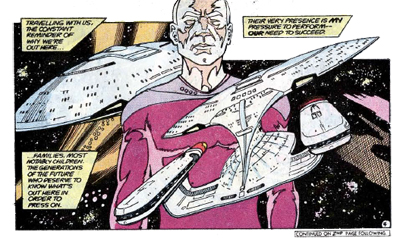
So publishing a tie-in to Star Trek: The Next Generation in early 1988 was an ambitious move by DC comics. By that point, the show’s first season was an ambitious prospect. The six issue miniseries was launched as part of a big publicity push at the start of The Next Generation, with editor Robert Greenberger explaining in the afterword to the first issue that Paramount had approached them “sometime early this year” to write the series.

This means that the comic was being written before Encounter at Farpoint was even finished. In the letters section in the second issue, Greenberger concedes, “As I write this, it’s mid-September and Star Trek: The Next Generation has yet to debut anywhere in America.” It’s no wonder that Michael Carlin’s series wound up so inconsistent and so decidedly strange. While it’s an interesting demonstration of just how firmly Paramount were pushing their new show, it’s hardly a triumph of tie-ins.

These are the voyages...

These are the voyages…

Continue reading

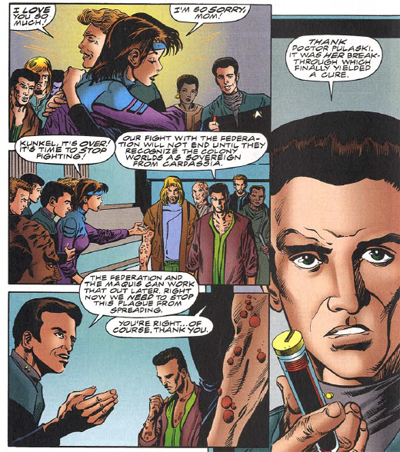
Star Trek: Deep Space Nine (Marvel Comics) #3-4 – The Cancer Within (Review)

This January and February, we’ll be finishing up our look at the second season of Star Trek: The Next Generation and moving on to the third year of the show, both recently and lovingly remastered for high definition. Check back daily for the latest review.

We’ll be supplementing our coverage of the episodes with some additional materials – mainly novels and comics and films. This is one such entry.

Poor Doctor Pulaski. She seems to have just disappeared from the canon. First season casualty Tasha Yar seemed to haunt to the show, returning for Yesterday’s Enterprise while her daughter become a recurring foe from The Mind’s Eye onwards. Even Wesley popped back every once in a while following his departure from the series. Pulaski, on the other hand, remains something of a phantom.

Barring an audible reference to her made in the background during the Star Trek: Voyager finalé Endgame, she disappears from the franchise without so much as a peep at the end of Shades of Grey.  She isn’t even referenced by name in the first episode of the third season to air (Evolution) or the first produced (The Ensigns of Command). While Beverly Crusher’s return is used as a plot point for Wesley, we only get the most fleeting of references to Pulaski in Who Watches the Watchers?

While this can easily be explained by the complex relationship that Diana Muldaur seems to have with Star Trek: The Next Generation. She has suggested the atmosphere on set was decidedly unfriendly, so the fact that Pulaski doesn’t return should not be that much of a surprise. What is interesting is the general apathy that the expanded universe seems to have for Pulaski. While even guest characters seem to get their own back stories and development in novels and comics, Pulaski is treated as a decidedly minor character in the Star Trek canon, reduced to guest spots and small appearances.

I like my family reunions generic and bland...

I like my family reunions generic and bland…

Continue reading