• Following Us

  • Categories

  • Check out the Archives


  • Awards & Nominations

Star Trek: The Next Generation – The High Ground (Review)

This January and February, we’ll be finishing up our look at the second season of Star Trek: The Next Generation and moving on to the third year of the show, both recently and lovingly remastered for high definition. Check back daily for the latest review.

The High Ground is a rather earnest issue-driven episode of Star Trek: The Next Generation, dealing with one of the big issues of the day: international terrorism. However, the moral ambiguity of terrorism was a decidedly more contentious and controversial issue in early 1990 than the plight of Vietnam veterans explored in The Hunted or the Cold War politics of The Defector.

The High Ground is an allegory for the Troubles in Northern Ireland at a point in time where the Troubles were on-going. 1990 saw a number of high-profile terrorist actions conducted by the IRA. They bombed the London Stock Exchange in July. Using an explosive device, they murdered Sergeant Charles Chapman in May. Nobody has ever been prosecuted for his death. In February 1991, the IRA launched a mortar attack on 10 Downing Street. So this was the context in which The High Ground aired.

And, to be fair, there’s something admirable about the show’s willingness to engage with a controversial issue, even if the end result leaves a lot to be desired.

Holding hands around the universe...

Holding hands around the universe…

Continue reading

Star Trek: The Next Generation – The Defector (Review)

This January and February, we’ll be finishing up our look at the second season of Star Trek: The Next Generation and moving on to the third year of the show, both recently and lovingly remastered for high definition. Check back daily for the latest review.

The Defector is the script that earned Ronald D. Moore his place on the writing staff of Star Trek: The Next Generation. The writer had contributed the first script produced by Michael Piller, The Bonding, but it was his second pitch – improvised in the heat of the moment – that cemented Moore’s place with the franchise. He would stay on The Next Generation until it finished, before moving on to Star Trek: Deep Space Nine and eventually Star Trek: Voyager, although he departed Voyager quite quickly.

Although Moore retains the credit on the finished episode, apparently – like so many third season scripts – the final draft of The Defector was a collaborative effort involving the whole writing staff. The episode, the first instalment of The Next Generation to air in the nineties, turned out surprisingly well. Indeed, The Defector is one of the strongest episodes of a very strong season.

A defective defector?

A defective defector?

Continue reading

Star Trek: The Next Generation – The Enemy (Review)

This January and February, we’ll be finishing up our look at the second season of Star Trek: The Next Generation and moving on to the third year of the show, both recently and lovingly remastered for high definition. Check back daily for the latest review.

The Enemy is just a fantastic piece of television. The third season of Star Trek: The Next Generation has maintained an impressive consistency up to this point, despite all the difficulties bubbling away behind the scenes. However, The Enemy is the point where everything seems to have finally settled down and the show is truly comfortable churning out episodes of this sort of quality.

It’s a very typical Star Trek plot, with one of our leads trapped on the planet surface and forced to team up with an enemy soldier in order to survive. It’s a very standard morality tale about how the enemy is not as different as we might like to think; it’s an exploration – in a very Star Trek style – of how two people can overcome their differences in order to survive  a suitably desperate situation.

The Enemy is a demonstration of just how well-oiled The Next Generation had become at this point in time, and how even the most standard of plots could be executed with considerable skill.

The show's quality is climbing...

The show’s quality is climbing…

Continue reading

Star Trek: The Next Generation – The Bonding (Review)

This January and February, we’ll be finishing up our look at the second season of Star Trek: The Next Generation and moving on to the third year of the show, both recently and lovingly remastered for high definition. Check back daily for the latest review.

The Bonding is a pretty pivotal and momentous episode for Star Trek: The Next Generation. On one hand, it’s the first episode overseen by incoming executive producer Michael Piller. Piller would go on to become one of the most influential producers to work on Star Trek. Aside from steering The Next Generation towards success, he also created Star Trek: Deep Space Nine and Star Trek: Voyager, as well as overseeing the production of the first three Next Generation films.

However, The Bonding is also the first script written by Ronald D. Moore. Obviously, the version that made it to screen had been revised and tweaked by Melinda Snodgrass and Michael Piller, but The Bonding still feels like a Moore script. Ronald D. Moore would go on to be one of the more influential writers on The Next Generation and Deep Space Nine. He also worked (very) briefly on Voyager, before departing and heading up his own reboot of Battlestar Galactica.

So The Bonding is the beginning of something new, an original direction for The Next Generation. Featuring a powerful and wonderful opening half, The Bonding suffers a bit from falling into conventional Star Trek tropes towards the end of the episode. However, it’s still a clever and powerful piece of television.

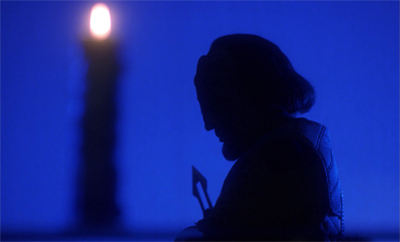
A bit of shadow...

A bit of shadowplay…

Continue reading

Star Trek: The Next Generation – The Survivors (Review)

This January and February, we’ll be finishing up our look at the second season of Star Trek: The Next Generation and moving on to the third year of the show, both recently and lovingly remastered for high definition. Check back daily for the latest review.

Michael Wagner remains something of a forgotten figure among Star Trek fans. While anybody familiar with the behind-the-scenes workings on Star Trek: The Next Generation is aware of the contributions made by the wonderful Michael Piller, and quite a few would be familiar with the work of Maurice Hurley during the first two seasons, Wagner’s four-episode tenure as executive producer and head writer is something of a mystery.

Situated right in the middle of that four-episode run, and the only Star Trek script on which Wagner does not share a credit, The Survivors seems like the most obvious indicator of what Wagner’s version of The Next Generation might have looked like. Of course, it’s impossible to extrapolate from a single episode of television, let alone a single episode of an era that was over before it already began, but it is interesting to look at how Wagner’s work here differs from the style that would be imposed by Piller.

The Survivors is a decidedly high-concept science-fiction mystery, feeling almost like an episode of an anthology featuring the regular cast. Built around a guest star, The Survivors is very much radically opposed to Piller’s vision of character-driven Star Trek.

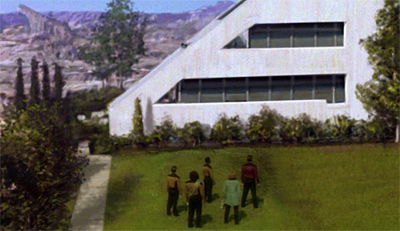
"Nice house. Can't see much about the neighbourhood, though."

“Nice house. Can’t see much about the neighbourhood, though.”

Continue reading

Star Trek: The Next Generation (DC) Annual #3 – The Broken Moon (Review)

This January and February, we’ll be finishing up our look at the second season of Star Trek: The Next Generation and moving on to the third year of the show, both recently and lovingly remastered for high definition. Check back daily for the latest review.

We’ll be supplementing our coverage of the episodes with some additional materials – mainly novels and comics and films. This is one such entry. This is actually supplementary to the first season of the Next Generation, specifically the episode Conspiracy.

If you were to construct a list of the most niggling unresolved plot threads in the history of the Star Trek franchise, “what was up with those things from Conspiracy?” would likely rank up there alongside “so, did Bajor ever join the Federation?” Funnily enough, author S.D. Perry would tie those two dangling plot points up in her Deep Space Nine relaunch book, Unity.

However, several other writers have tried to figure out what exactly was going on with those mind-controlling parasites who appeared at the end of the first season of Star Trek: The Next Generation and were never heard from again. According to Ronald D. Moore on Inside the Writers’ Room on the third Next Generation blu ray box set, various writers for the show tried to revisit the idea, but Roddenberry hated that episode so much nothing was ever developed.

The Broken Moon, the third annual for DC’s Next Generation comic book series, offers its own take on the mind-controlling parasites. While writer Michael Jan Friedman wisely avoids revealing too much about these creatures, the story suffers because it never figures out anything interesting to do with them.

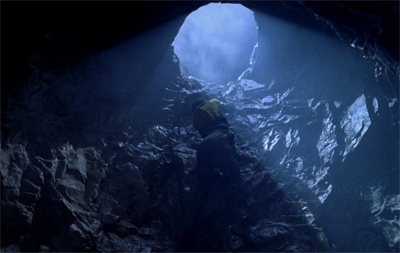
It always bugged me...

It always bugged me…

Continue reading

Star Trek: The Next Generation – Season 2 (Review)

This January and February, we’ll be finishing up our look at the second season of Star Trek: The Next Generation and moving on to the third year of the show, both recently and lovingly remastered for high definition. Check back daily for the latest review.

Although, as Rick Berman argues in the documentary Making It So, the first season of Star Trek: The Next Generation “was at least in syndicated ratings terms, extremely successful”, there was trouble brewing behind the scenes. The show lost two-thirds of its regular female cast members, and the season ended with a whimper rather than a bang as the 1988 Writers’ Strike cutting into the development of the final couple of scripts.

The second season was no less plagued by problems, even as the show proved a ratings and commercial success. The show’s writers’ room was in disarray, with conflicts erupting between Tracy Tormé and Maurice Hurley over scripting for the show – leading to the use of both of Tormé’s WGA-approved pseudonyms on consecutive scripts from the writer. Episodes were coming over budget and behind schedule, necessitating a clip show to round out the season.

tng-qwho17

Even on the set itself, new cast member Diana Muldaur had difficulty fitting in the cast, and did not wish to return after the second season. Katherine Pulaski would disappear from the show (and the franchise) with little fuss – her last appearance being in the rather disappointing Shades of Grey. While The Next Generation was successful by just about any objective external measure, it had yet to really find its own internal balance.

Still, the second season of The Next Generation did show hints of improvement. The show was finding its feet. While the average quality of the episodes was nothing like what it would become in the show’s third season, even the more middling instalments of the show’s second season (like Contagion or Where Silence Has Lease or Peak Performance) were leaps and bounds ahead of where the show had been in the first season. It was getting where it needed to go, but not nearly fast enough.

tng-timesquared19

Continue reading

Star Trek: The Next Generation – Peak Performance (Review)

This January and February, we’ll be finishing up our look at the second season of Star Trek: The Next Generation and moving on to the third year of the show, both recently and lovingly remastered for high definition. Check back daily for the latest review.

Peak Performance is a functional episode of Star Trek: The Next Generation. It doesn’t really stand out all that much, and it feels quite a bit average. Still, that’s not to dismiss Peak Performance. After all, this past season has seen The Next Generation advance considerably. During the first season, an episode like Home Soil or The Big Goodbye was a welcome relief. At this stage in the show, episodes like Peak Performance and Contagion are the average.

Of course, the third season would see the show’s quality improve even more dramatically, but we’re still just a little bit away from that. So we’re left with Peak Performance, a fairly standard piece of Star Trek that feels just a little bit too formulaic and a little bit too cliché. While it’s not among the strongest of the season, there are definitely worse sins.

Game on...

Game on…

Continue reading

Star Trek: The Next Generation – The Emissary (Review)

This January and February, we’ll be finishing up our look at the second season of Star Trek: The Next Generation and moving on to the third year of the show, both recently and lovingly remastered for high definition. Check back daily for the latest review.

The Emissary is one of the stronger episodes from the tail end of Star Trek: The Next Generation‘s second season. An interesting meditation on heritage and race, as well as an insightful character piece for Worf, The Emissary is an interesting exploration of Worf’s relationship to his culture – and how his experience is far from universal. It’s the sort of story that The Next Generation should have been producing on a more consistent basis, but it’s better late than never.

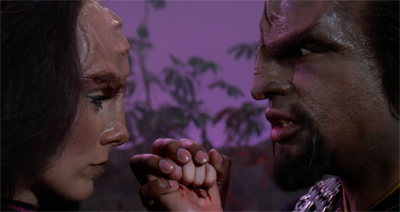
Bonded by blood...

Bonded by blood…

Continue reading

Star Trek: The Next Generation – Manhunt (Review)

This January and February, we’ll be finishing up our look at the second season of Star Trek: The Next Generation and moving on to the third year of the show, both recently and lovingly remastered for high definition. Check back daily for the latest review.

There’s a strange sense of fatigue as we come towards the end of the second season of Star Trek: The Next Generation, as if the effort of producing Q Who? has really just drained the show of any ambition or drive. To be fair, there are probably more banal motivations at play. The 1988 Writers’ Strike had taken the entire industry by surprise and has been credited with dropping television ratings by ten percent. It damaged the tail end of the first season, causing an improvised conclusion to We’ll Always Have Paris and is probably responsible for the mess that was The Neutral Zone.

The damage also bled into the second season. Even closing with a clip show, Shades of Grey, the second season wasn’t able to meet the average quota of twenty-six episodes per season. The season premiere, The Child, had to be hastily repurposed from an aborted script for Star Trek: Phase II. Even with the shortened orders, the second season of The Next Generation frequently saw episodes coming in behind schedule and above budget. This is one of the reasons that Rob Bowman, despite being responsible for two of the season’s strongest episodes (Elementary, Dear Data and Q Who?), did not become a regular director.

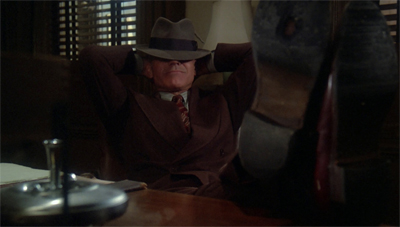
"It's a good time for nap time..."

“It’s a good time for nap time…”

Behind the scenes, the show seemed to be threatening to pull itself apart. Tracy Tormé and Maurice Hurley were frequently at loggerheads with one another over all manner of issues. Tormé was only allowed to register two pseudonyms with the Writers’ Guild of America, he used both on the second season of The Next Generation, protesting over modifications made to his script. It’s no wonder that the writers’ room pretty much exploded at the end of the season, with both Tormé and Hurley departing. When Michael Piller was put in charge on the third season, he had to pretty much start from scratch.

All of which explains why the tail end of the second season seems so lifeless and limp. The Emissary is really the only second season script with any life in it once the show gets past Q Who? Most of the rest of the season seems to trying to limp across the finish line. Still, even with all of that in mind, Manhunt feels a little mean-spirited. It’s an episode designed to mock at Lwaxana Troi, to reduce a middle-aged woman going through a process explicitly compared to menopause to the butt of some particularly harsh joke. It’s hard to find that all that amusing.

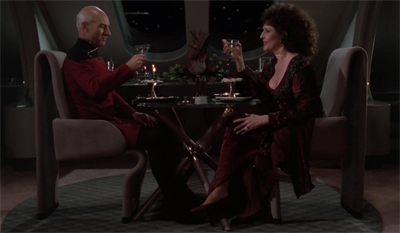
Starlit dinner...

Starlit dinner…

Continue reading