• Following Us

  • Categories

  • Check out the Archives


  • Awards & Nominations

Doctor Who: Doomsday (Review)

To celebrate the fiftieth anniversary of the longest-running science-fiction show in the world, I’ll be taking weekly looks at some of my own personal favourite stories and arcs, from the old and new series, with a view to encapsulating the sublime, the clever and the fiendishly odd of the BBC’s Doctor Who.

Doomsday originally aired in 2006.

Daleks, be warned. You have declared war upon the Cybermen.

This is not war. This is pest control.

We have five million Cybermen. How many are you?

Four.

You would destroy the Cybermen with four Daleks?

We would destroy the Cybermen with one Dalek. You are superior in only one respect.

What is that?

You are better at dying.

– the Cyberleader and Dalek Sec compete for the title of “bitchiest Doctor Who villain”

Part of my frustration with Doomsday is the same problem that I have with the rest of the second season’s weaker episodes. Like Fear Her or Rise of the Cybermen, the second season finalé lacks ambition. It feels complacent, it feels comfortable. It feels like putting the Daleks and the Cybermen together in one episode is enough to merit attention, without anything more than exchanging pithy one-liners. It feels like the separation of the Doctor and his companion is the biggest and most important thing in the universe, without really convincing us that this isn’t the best possible outcome. It feels like the easiest way to make these threats palpable is to set them in modern London, without any real sense of consequence or scale.

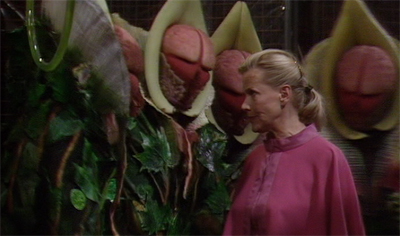
The tears of a Time Lord...

The tears of a Time Lord…

Continue reading

Doctor Who: The Hand of Fear (Review)

To celebrate the fiftieth anniversary of the longest-running science-fiction show in the world, I’ll be taking weekly looks at some of my own personal favourite stories and arcs, from the old and new series, with a view to encapsulating the sublime, the clever and the fiendishly odd of the BBC’s Doctor Who.

The Hand of Fear originally aired in 1976.

Come on, where are we?

We’re in a quarry.

Yes, I know we’re in a quarry, but where?

Well, how do I know? I don’t know all the quarries that–

– the Doctor and Sarah Jane get a bit meta

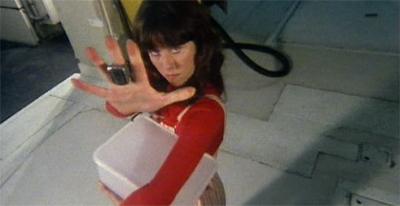
The Hand of Fear is odd, because it’s the end of an era – but it’s not the end of the era for the rather obvious reason that it bids farewell to one of the franchise’s best-loved companion character. The Hand of Fear is best known as the final story to feature Sarah Jane Smith. Indeed, the DVD comes with a helpful sticker informing any potential purchasers of the story’s significance.

However, watching The Hand of Fear with the benefit of hindsight, it isn’t Sarah Jane’s departure that is the most striking part of the show.

Keep it handy...

Keep it handy…

Continue reading

Doctor Who: The Sea Devils (Review)

To celebrate the fiftieth anniversary of the longest-running science-fiction show in the world, I’ll be taking weekly looks at some of my own personal favourite stories and arcs, from the old and new series, with a view to encapsulating the sublime, the clever and the fiendishly odd of the BBC’s Doctor Who.

The Sea Devils originally aired in 1973.

If Horatio Nelson had been in charge of this operation, I hardly think that he would have waited for official instructions.

Yes, a pretty impulsive fellow, if one can believe the history books.

History books? Captain Hart, Horatio Nelson was a personal friend of mine. Come on, Jo.

– Namedropping? The Doctor? Never!

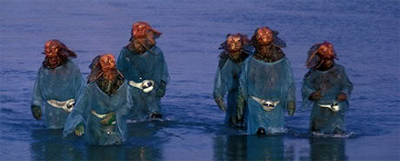
When it comes to Doctor Who, “sequel” stories get a bit of a hard time from fandom. It seems to be easy to dismiss Snakedance in favour of Kinda, and to praise Spearhead from Space at the expense of Terrors of the Autons and even elevate The Daleks above The Dalek Invasion of Earth. It seems that time, and conventional wisdom, tend to favour the original serials. Of course, there are undoubtedly examples where follow-up scripts have disappointed (the ridiculously padded The Monster of Peladon following The Curse of Peladon). Still, for my money, The Sea Devils represents a tighter, complimentary and ambitious sequel to Doctor Who and the Silurians, easily one of the most highly regarded adventures of the seventies. It’s a fairly impressive accomplishment, but The Sea Devils is more than up to it.

Everybody out of the water!

Continue reading

Doctor Who: Cold Blood (Review)

To celebrate the fiftieth anniversary of the longest-running science-fiction show in the world, I’ll be taking weekly looks at some of my own personal favourite stories and arcs, from the old and new series, with a view to encapsulating the sublime, the clever and the fiendishly odd of the BBC’s Doctor Who.

Cold Blood originally aired in 2010.

It is the story of our past and must never be forgotten.

– Eldane attempts to justify the “traditional monster” two-parters the revived show is so fond of

The Hungry Earth wasn’t too bad. It wasn’t great. There was nothing too exciting or novel about it, but it wasn’t a complete failure. It was an interesting and affectionate throwback to an older style of Doctor Who. It wasn’t exceptional, but it was -broadly speaking – functional. Chris Chibnell’s script had some rough edges, mostly around characterisation, but there was nothing too unworkable about the premise, which basically consisted of a selection of classic Doctor Who tropes thrown in a blender and served up to the audience.

However, Cold Blood is much less satisfying. Part of that is because it’s part of a story that can’t be sustained by nostalgia or affectionate references to tales long past. There’s also the fact that it hinges on an emotional climax that asks us to invest in an especially two-dimensional supporting cast. And that’s saying nothing about how the last few minutes of the episode aren’t even devoted to tying up its own threads so much as playing into the much more interesting season-long arc.

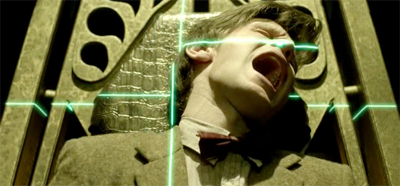
Cold Blood leaves me… well, cold.

Doesn't scan...

Doesn’t scan…

Continue reading

Doctor Who: The Hungry Earth (Review)

To celebrate the fiftieth anniversary of the longest-running science-fiction show in the world, I’ll be taking weekly looks at some of my own personal favourite stories and arcs, from the old and new series, with a view to encapsulating the sublime, the clever and the fiendishly odd of the BBC’s Doctor Who.

The Hungry Earth originally aired in 2010.

Oh look! Big mining thing! Oh, I love a big mining thing. See, way better than Rio. Rio doesn’t have a big mining thing.

– the Doctor looks on the bright side of arriving in not!Rio

The Hungry Earth represents the biggest structural shift of Steven Moffat’s first season of Doctor Who. The writer would indulge in a number of radical structural changes over his time running the show, but his first season as showrunner conforms to the pattern of Russell T. Davies’ four full seasons. There’s the introductory present/past/future trilogy, the two mid-season two-parters and the gigantic two-part season finalé. The content of Moffat’s season might have been markedly different (actual romantic snog! a season building an arc that isn’t just references and easter eggs!), but the format was carried over faithfully.

Moffat’s following two seasons would get more experimental. For one thing, both seasons would be split in half. This allowed Moffat to offer the first genuine cliffhanger in the revival’s history to last more than a week, with a gap of several months between A Good Man Goes to War and Let’s Kill Hitler. His second season would feature the first two-part season opener (and first one-part season finalé) of the revived television show. His third season would feature no two-part episodes, spread across two calendar years.

However, sitting at the tail end of his first season, The Hungry Earth feels like the strangest structural element of Moffat’s first year in charge of Doctor Who. It’s what would traditionally be the first two-parter of the season, pushed back towards the end of the year.

Balancing the scales...

Balancing the scales…

Continue reading

Doctor Who: The Trial of a Time Lord – The Ultimate Foe (Review)

To celebrate the fiftieth anniversary of the longest-running science-fiction show in the world, I’ll be taking weekly looks at some of my own personal favourite stories and arcs, from the old and new series, with a view to encapsulating the sublime, the clever and the fiendishly odd of the BBC’s Doctor Who.

The Trial of a Time Lord originally aired in 1986.

In all my travellings throughout the universe I have battled against evil, against power-mad conspirators. I should have stayed here. The oldest civilisation, decadent, degenerate and rotten to the core. Ha! Power-mad conspirators, Daleks, Sontarans, Cybermen, they’re still in the nursery compared to us. Ten million years of absolute power, that’s what it takes to be really corrupt.

– the Doctor

There really are no excuses for the mess that The Trial of a Time Lord became. I mean, seriously. The producers had eighteen months to plan everything out. The task shouldn’t be that difficult. If you are going to fictionalise the persecution of Doctor Who by the BBC in the form of a trial, you really should have some idea what you plan to do or say at the end of it. If your fourteen episode season-long story arc is about defending a show that is coming close to cancellation, then perhaps it might be a good idea to be able to tell us why it shouldn’t be cancelled. The Trial of a Time Lord is a gigantic mess, and something that makes a stronger case in favour of Michael Grade’s attempts to cancel that show than it does against them.

The Ultimate Foe isn’t as soul-destroyingly horrible as Terror of the Vervoids, but that may be because Pip and Jane Baker only wrote half of it.

Only himself for company...

Only himself for company…

Continue reading

Doctor Who: The Trial of a Time Lord – Terror of the Vervoids (Review)

To celebrate the fiftieth anniversary of the longest-running science-fiction show in the world, I’ll be taking weekly looks at some of my own personal favourite stories and arcs, from the old and new series, with a view to encapsulating the sublime, the clever and the fiendishly odd of the BBC’s Doctor Who.

The Trial of a Time Lord originally aired in 1986.

Mmm. This is a situation that requires tact and finesse. Fortunately, I am blessed with both.

– the Sixth Doctor

Okay, so the “past” and “present” sections of The Trial of a Time Lord haven’t been blow-outs. The Mysterious Planet demonstrated that maybe, once upon a time, Doctor Who had been decidedly average, constructed of a checklist of familiar and inoffensive tropes. Mindwarp demonstrated that Colin Baker’s Doctor was the kind of character who you could probably imagine chaining his companion to a rock on the beach, before leaving her to die… or marry Brian Blessed… or something. But, hey, there was some social commentary! If The Trial of a Time Lord is constructed as a defence by the show to avoid being sentenced to the bleak nether-realms of cancellation, I have to confess that I’m not convinced. And I like the show to begin with.

Still, it’s not a total failure. I mean, whatever the show was or is, it can always be something better, right? And so, this final story, Terror of the Vervoids, could easily prove that the show has a very clear idea of where it’s going next? The future will be better tomorrow, and all that?

Cue incredibly lame "Pussy Galore" joke...

Cue incredibly lame “Pussy Galore” joke…

Continue reading

Doctor Who: The Trial of a Time Lord – Mindwarp (Review)

To celebrate the fiftieth anniversary of the longest-running science-fiction show in the world, I’ll be taking weekly looks at some of my own personal favourite stories and arcs, from the old and new series, with a view to encapsulating the sublime, the clever and the fiendishly odd of the BBC’s Doctor Who.

The Trial of a Time Lord originally aired in 1986.

Hey, keep together. This is a great day for battle. A great day to die!

Does he always go on like that?

Afraid so.

-Ycranos, Tuza and Peri discover she apparently has a type

The Trial of a Time Lord loosely adheres to the structure of A Christmas Carol. If The Mysterious Planet can be seen as the “past” story, then Mindwarp is very clearly the “present” story. The BBC’s sudden “hiatus” for Doctor Who yanked the series suddenly out of Colin Baker’s first season, to the point where dialogue from Baker referencing the planned series opener had to be dubbed out. As a result, for the eighteen month gap, Colin Baker’s first full season in the role was a perpetual “present.” It was the last Doctor Who that had aired, and – as a result – it was the version of the show that first popped into people’s minds when they thought of the series.

So it seems fitting that The Trial of a Time Lord sees Colin Baker yanked directly from an adventure that looks like it could have been filmed as part of his first full year in the role. If The Mysterious Planet evokes a hazy and romantic past, a story constructed from familiar archetypes and plot points, then Mindwarp is a very clear acknowledgement of what the show had evolved into. Given the difficulties facing the programme after that problematic year, Mindwarp is the segment of this over-arching plot that needs to make the most robust defence of the show, or at least deflect the most criticism.

Despite some interesting strengths, Mindwarp doesn’t quite construct a convincing argument in favour of the show. More than that, though, its deflections prove a little weak.

Out of this world...

Out of this world…

Continue reading

Doctor Who: The Trial of a Time Lord – The Mysterious Planet (Review)

To celebrate the fiftieth anniversary of the longest-running science-fiction show in the world, I’ll be taking weekly looks at some of my own personal favourite stories and arcs, from the old and new series, with a view to encapsulating the sublime, the clever and the fiendishly odd of the BBC’s Doctor Who.

The Trial of a Time Lord originally aired in 1986.

Well, this is a charade.

– the Doctor gets the idea quickly enough

The Doctor had been off screens for eighteen months following Revelation of the Daleks. Michael Grade was desperately trying to cancel the show, and it only limped back to screen with a significantly reduced budget and much shorter run of episodes. The show length was also reverted back to its default value. This season would only run for fourteen half-hour episodes – what would become the set length for Doctor Who in the years to come. (Indeed, counting the Christmas Special, the revived series also runs to that length, albeit in forty-five minute episodes.)

By all accounts, the production on the infamous Trial of a Time Lord was a disaster for reasons natural and otherwise. Veteran writer Robert Holmes was to provide the opening and closing scripts, but passed away before his work on the finalé could be finished. Script editor Eric Saward and producer John Nathan-Turner clashed over the climax of the trial, prompting Saward to resign and Nathan-Turner to temporarily become script editor himself. Colin Baker couldn’t make sense of Mindwarp. The last episode of the season was written by two writers wrapping up from Holmes’ first part, but unable to examine his notes on how he planned to conclude it.

Believe me when I state that every last ounce of this behind-the-scenes friction was visible on-screen by the end of the year. Luckily enough, the show does a decent enough job concealing these approaching problems in the first story of the arc. That’s not to say that The Mysterious Planet is an unsung classic, merely to point out that it is at least unburdened by the seemingly real time collapse of Doctor Who.

Ah, it's a fourteen-week adventure about watching Doctor Who!

Ah, it’s a fourteen-week adventure about watching Doctor Who!

Continue reading

Doctor Who: The Gunfighters (Review)

To celebrate the fiftieth anniversary of the longest-running science-fiction show in the world, I’ll be taking weekly looks at some of my own personal favourite stories and arcs, from the old and new series, with a view to encapsulating the sublime, the clever and the fiendishly odd of the BBC’s Doctor Who.

The Gunfighters originally aired in 1966.

Everything excepting that rattlesnake friend of yours Holliday blew in this mornin’. Who’re your friends, Wyatt?

Well I, er–

Oh, quite, quite so. Allow me, sir, to introduce Miss Dodo Dupont, wizard of the ivory keys, and er Steven Regret, tenor. And lastly sir, your humble servant Doctor Caligari.

Doctor who?

Yes, quite right.

– Masterson, Wyatt Earp and the Doctor

I am hesitant to turn my trip into the history of Doctor Who into a series of articles about fan opinion or consensus. If I like a story, or dislike a story, I have my reasons that I will often try to explain away. However, sometimes it’s nice to have a bit of context. It is handy, for example, to know that I like The Talons of Weng-Chiang just a little bit less than most fans seem to. The Gunfighters is an oft-maligned serial. It is part of the show’s troubled third season, building – as it did – off the show’s generally quite solid second year. However, I actually enjoy The Gunfighters for what it is, which is a knack I seem to have for a lot of the stories from William Hartnell’s era.

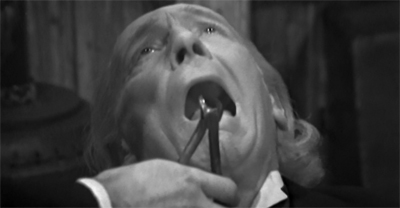
People would try to convince you that it's like pulling teeth...

People would try to convince you that it’s like pulling teeth…

Continue reading