• Following Us

  • Categories

  • Check out the Archives


  • Awards & Nominations

Doctor Who: Destiny of the Daleks (Review)

To celebrate the fiftieth anniversary of the longest-running science-fiction show in the world, I’ll be taking weekly looks at some of my own personal favourite stories and arcs, from the old and new series, with a view to encapsulating the sublime, the clever and the fiendishly odd of the BBC’s Doctor Who.

The Last of the Time Lords originally aired in 1979.

Oh, look! Rocks!

– the Doctor

Destiny of the Daleks is a bit crap. I know that there’s a whole bunch of “a bit crap” Dalek episodes, but Destiny of the Daleks doesn’t suffer because it doesn’t make sense, or it hangs on plot contrivance. Instead, it’s just a little bit dull. At least Resurrection of the Daleks bangs along making no sense in a reasonably exciting manner. In contrast, Destiny of the Daleks just sort of… is. In a way, it serves as the perfect opener to Graham Williams’ final year as producer, perfectly capturing the gap between the production staff the cast and the writers that so often led to bit of a mismatch in this part of the show’s history.

While I have a fondness for Terry Nation, I think it’s perfectly reasonable to argue that his style was hardly progressive or dynamic when he first wrote for the show in 1963. Indeed, my fondness for his work in the early years of the show is mostly down to how it harks backwards to pulpy classic science-fiction. If Nation wasn’t the most forward-looking of writers in 1963, then perhaps he really wasn’t best suited to open a season for Graham Williams and Douglas Adams in 1979.

Romana II goes through one of the oldest companion rites of passage...

Romana II goes through one of the oldest companion rites of passage…

Continue reading

Doctor Who: The Dalek Invasion of Earth (Review)

To celebrate the fiftieth anniversary of the longest-running science-fiction show in the world, I’ll be taking weekly looks at some of my own personal favourite stories and arcs, from the old and new series, with a view to encapsulating the sublime, the clever and the fiendishly odd of the BBC’s Doctor Who.

The Dalek Invasion of Earth originally aired in 1964.

We are the masters of Earth. We are the masters of Earth. We are the masters of Earth.

– who are the Daleks trying to convince?

Watching the early years of Doctor Who, I often find myself struggling to measure the quality of a show as against its importance to the series as a whole. Sixties Doctor Who has perhaps an unfair reputation when it comes to quality. In fact, as a rule, I’ve been pleasantly surprised on my trips back to the archives for these reviews. However, it’s often much more interesting to look at the context and the legacy of these classic episodes, as the show begins to define what it is and what it isn’t, what it can do and what it can’t do.

In that context, The Dalek Invasion of Earth is a massively important story. It features the first returning monsters of the series (go on, guess!), the first departure of a companion, the first invasion of Earth, the first aliens in London. The list goes on and on. There’s an incredibly vast influence that The Dalek Invasion of Earth has on the half-century of Doctor Who that follows. It’s nearly impossible to deny the shadow that this adventure casts.

However, it’s also a very flawed piece of television, for all its iconic status. Indeed, watching these six episodes I’m more often struck by what is important rather than what is good.

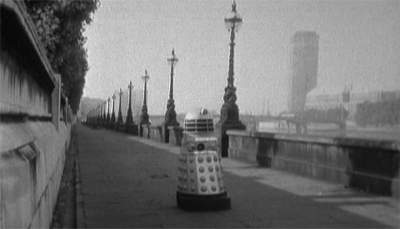
The Daleks of London...

The Daleks of London…

Continue reading

Doctor Who: The Keys of Marinus (Review)

To celebrate the fiftieth anniversary of the longest-running science-fiction show in the world, I’ll be taking weekly looks at some of my own personal favourite stories and arcs, from the old and new series, with a view to encapsulating the sublime, the clever and the fiendishly odd of the BBC’s Doctor Who.

The Keys of Marinus originally aired in 1964.

While the initial thirteen-episode block helped established Doctor Who, it was the follow-up stories that built on those initial blue-prints. Marco Polo was a historical adventure in the style of An Unearthly Child, paying homage to the original educational aim of the series, designed to teach kids about history and science. However, the real breakout of the initial run had been The Daleks, with those adorable psychotic pepper pots. Keen to capitalise on the success of the futuristic adventure, another adventure serial was commissioned to take place on an alien world, with Terry Nation’s The Keys of Marinus helping to establish science fantasy as a concrete part of the show’s identity.

All a-Voord!

Continue reading

Doctor Who: The Daleks (Review)

To celebrate the fiftieth anniversary of the longest-running science-fiction show in the world, I’ll be taking weekly looks at some of my own personal favourite stories and arcs, from the old and new series, with a view to encapsulating the sublime, the clever and the fiendishly odd of the BBC’s Doctor Who.

The Daleks originally aired in 1963-4.

Make! no! attempt! to! capture! them! they! are! to! be! exterminated! you! understand! exterminated!

– four episodes in, the Daleks have a catchphrase

Because of the somewhat confusing naming conventions for the Hartnell era, where each individual episode had its own title, this one goes by a variety of names: The Mutants, The Dead Planet, or The Daleks. Still, if you’re reading this, you probably know the serial I’m talking about. It’s the one that introduced everyone’s favourite psychotic little pepper pots.

Taking the plunger…

Continue reading