• Following Us

  • Categories

  • Check out the Archives


  • Awards & Nominations

Non-Review Review: Star Trek – Generations

This August, to celebrate the upcoming release of Star Trek: Into Darkness on DVD and blu ray, we’re taking a look at the Star Trek movies featuring the original cast. Movie reviews are every Tuesday and Thursday.

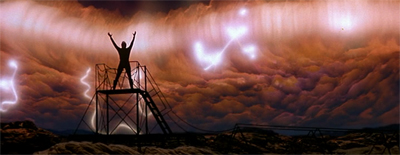
There are lots of problems with Star Trek: Generations. It feels too much like a two-parter from the television show. It tries to fit in a laundry list of demands from the studio. It wastes Malcolm McDowell. It decides that the only part of the original series deserving a send-off is James T. Kirk, and then pushes him off-screen for an hour before dragging him back into the movie to kill him off in the most ironic and anti-climactic manner possible.

Yet, despite these considerable flaws, Generations also has a lot to recommend it. Although the script occasionally feels a little overcooked, the themes concerning mortality lend it a serious amount of weight. Director David Carson demonstrates that he can work wonders on a tiny budget. Cinematographer John A. Alonzo finds a way to shoot familiar sets in a way that makes them look incredibly beautiful. None of these strengths can fully compensate for the very fundamental flaws with the seventh Star Trek cinematic outing, but they do mitigate them somewhat.

Generations isn’t a great Star Trek film, and it isn’t even the best odd-numbered Star Trek film, but it is far from an unmitigated disaster. Well, except for the way it treats Kirk.
Riding the wave...

Riding the wave…

Continue reading

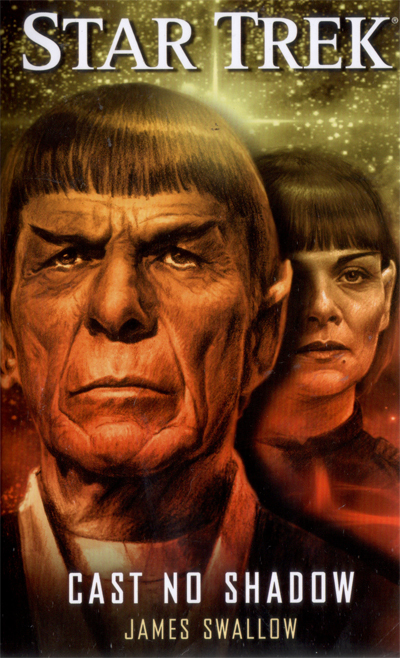
Star Trek – Cast No Shadow by James Swallow (Review)

This August, to celebrate the upcoming release of Star Trek: Into Darkness on DVD and blu ray, we’re taking a look at the Star Trek movies featuring the original cast. Movie reviews are every Tuesday and Thursday.

We’ll be supplementing our coverage of the movies with tie-ins around (and related to) the films. We’ll be doing one of these every week day. This is one such article.

Valeris is a fascinating character who gets a bit lost in the scope of Star Trek VI: The Undiscovered Country. Given the film’s focus on bidding a fond farewell to the iconic crew of the Enterprise, it’s understandable that the newest addition to the crew should get pushed aside. It’s even more notable because Valeris is clearly a stand-in for the character of Saavik, another of Spock’s young female Vulcan protegés, making her not only a newer character, but a substitute for a newer character.

One of the most interesting things about Star Trek tie-in fiction is the scope afforded by the gigantic shared universe. Across the dozen movies and the seven-hundred episodes of television, there are countless supporting characters and concepts thrown out. Due to plotting necessities and the demands of particular stories, some of these ideas are never truly fleshed out. The sheer volume of tie-in material means that writers do get a chance to develop and expand upon these character which might otherwise be forgotten.

Writing a novel centred on Valeris is a very bold idea, but one which acknowledges just how intriguing the concept of Kim Cattrall’s Vulcan traitor is, despite the fact the film treats her as a minor character at best.

castnoshadow

Continue reading

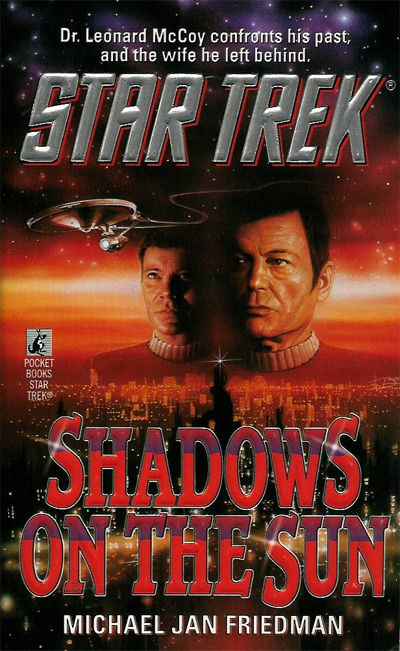
Star Trek – Shadows on the Sun by Michael Jan Friedman (Review)

This August, to celebrate the upcoming release of Star Trek: Into Darkness on DVD and blu ray, we’re taking a look at the Star Trek movies featuring the original cast. Movie reviews are every Tuesday and Thursday.

We’ll be supplementing our coverage of the movies with tie-ins around (and related to) the films. We’ll be doing one of these every week day. This is one such article.

It almost feels like sacrilege to fill in the gap left at the end of Star Trek VI: The Undiscovered Country. The film was such a perfect send-off that picking up a novel directly after the end credits role feels like it might undermine the perfect farewell story for the veteran crew. After all, director Nicholas Meyer suggested that the film was an attempt to capture the spirit of Fukuyama’s “end of history”, representing the “end of history” for the original crew.

Except, of course, it wasn’t the end. In terms of internal Star Trek chronology, episodes of Star Trek: The Next Generation had picked up on the later adventures of Scotty and Spock. Star Trek: Voyager would flashback to a Sulu story unfolding concurrently with The Undiscovered Country. Scotty and Chekov would appear in Star Trek: Generations, which would also serve as a disappointing farewell to one James Tiberius Kirk. It seems bitterly appropriate (if far from fair) that Uhura should remain the only major player whose story actually ends with The
Undiscovered Country
.

Still, despite his passing of the torch appearance in Encounter at Farpoint, you could make an argument that The Undiscovered Country was the end of the line for Leonard McCoy more than Kirk or Spock. And, as such, Michael Jan Friedman’s Shadows on the Sun serves as an effective (if flawed) reflection on the way that McCoy’s presence sort of faded from the 24th century spin-offs. startrek-shadowsonthesun

Continue reading

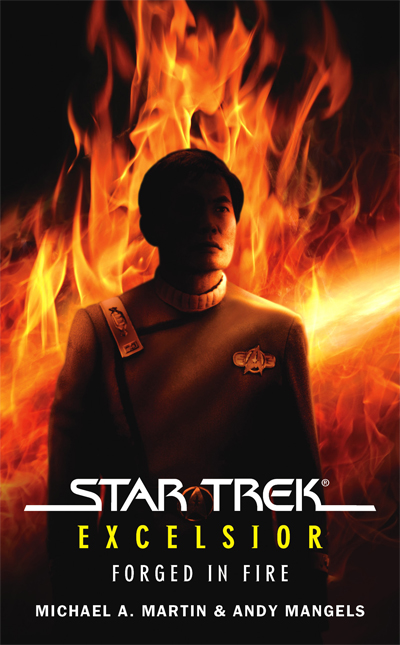
Star Trek: Excelsior – Forged in Fire by Michael A. Martin and Andy Mangels (Review)

This August, to celebrate the upcoming release of Star Trek: Into Darkness on DVD and blu ray, we’re taking a look at the Star Trek movies featuring the original cast. Movie reviews are every Tuesday and Thursday.

We’ll be supplementing our coverage of the movies with tie-ins around (and related to) the films. We’ll be doing one of these every week day. This is one such article.

I have to admit, when I first saw Star Trek VI: The Undiscovered Country, I was a bit surprised to be introduced to Captain Hikaru Sulu. This was a character who didn’t even have a first name before The Undiscovered Country. The name chosen – “Hikaru” – was taken from Vonda N. McIntyre’s 1981 tie-in The Entropy Effect. Still, I suppose it could be worse. Uhura didn’t get a first name on screen until the release of Star Trek in 2009.

So it seemed strange that this supporting character should find himself the commanding officer of a starship, let alone a state-of-art ship of the line which opened the fond farewell to the original series crew. Still, the character of Captain Hikaru Sulu remains one of the most interesting branches sprouting off the trunk of Star Trek. Takei would reprise the role on Star Trek: Voyager, hold down a couple of Simon & Schuster audio adventures and even feature heavily in tie-in novels and comic books. Takei is quite fond of recounting his campaign to launch a television show centred around the character.

It’s quite remarkable, as Sulu is probably the only major character who could credibly “spin-off” from the original Star Trek show, which is remarkable for a supporting performer whose most iconic moment in the classic Star Trek show was waving a sword through the corridors while practically naked.

excelsior-forgedinfire

Continue reading

Star Trek – The Movies (Review)

This August, to celebrate the upcoming release of Star Trek: Into Darkness on DVD and blu ray, we’re taking a look at the Star Trek movies featuring the original cast. Movie reviews are every Tuesday and Thursday.

It’s interesting how radically different the Star Trek feature films were from the show that spawned them. All were anchored in the classic science-fiction series. Star Trek: The Motion Picture felt like it was heavily influenced by The Changeling. Star Trek II: The Wrath of Khan obviously drew on Space Seed. Star Trek III: The Search for Spock evoked The Menagerie. Star Trek IV: The Voyage Home featured the same plot device (and time travel technique) as Tomorrow is Yesterday. Star Trek V: The Final Frontier had Kirk defeating one final god-like being. Star Trek VI: The Undiscovered Country had the crew finally make peace with Klingons.

However, they were quite clearly a very different animal from the original television show. Which makes a great deal of sense. After all, there’s a world of difference between a fifty-minute adventure produced for weekly television and a big theatrical event. However, what’s interesting about these changes is that they weren’t necessarily in the direction you might expect. The television show was a collection of episodic adventures, but what’s really striking about the films is that most of them have a reasonably clear serialised arc.

startrek-themotionpicture

Continue reading

Star Trek – In the Name of Honour by Dayton Ward (Review)

This August, to celebrate the upcoming release of Star Trek: Into Darkness on DVD and blu ray, we’re taking a look at the Star Trek movies featuring the original cast. Movie reviews are every Tuesday and Thursday.

We’ll be supplementing our coverage of the movies with tie-ins around (and related to) the films. We’ll be doing one of these every week day. This is one such article.

The Klingons changed rather dramatically, between the classic Star Trek and Star Trek: The Next Generation. Part of the changes were physical – most obviously, advances in make-up allowed Klingon characters to be shown with their now-iconic forehead ridges. However, there was another interesting change. Somewhere between The Turnabout Intruder and Encounter at Farpoint, the Klingons went from generic communist stand-ins to a fully-formed alien culture with a wealth of ritual and tradition.

To a large extent, this shift took place during the movie era. Klingons wound up being the focus of Star Trek III: The Search for Spock, and were a significant presence in each of the films that followed. Star Trek V: The Final Frontier, produced at the same time as the first season of Star Trek: The Next Generation, suggested that it wasn’t necessary for the Federation and the Klingon Empires to be mortal enemies. The final movie featuring the original cast, Star Trek VI: The Undiscovered Country, tied up Kirk’s adventures with the promise of galactic peace.

Still, it’s hard to reconcile the differences in characterisation between the Klingons seen in the classic Star Trek television show and those from the later spin-offs. With In the Name of Honour, Dayton Ward tries to explore this radical shift and also to bridge The Final Frontier and The Undiscovered Country. He does the former much better than the latter.

startrek-inthenameofhonour

Continue reading

Non-Review Review: Star Trek VI – The Undiscovered Country

This August, to celebrate the upcoming release of Star Trek: Into Darkness on DVD and blu ray, we’re taking a look at the Star Trek movies featuring the original cast. Movie reviews are every Tuesday and Thursday.

Whatever its faults, Star Trek VI: The Undiscovered Country is a fond farewell to the original cast of Star Trek, giving the ensemble one last epic adventure before heading off into legend. Chancellor Gorkon suggests that the “the undiscovered country” that lends the movie its title is “the future.” Most Shakespearean scholars would argue that it is “death.” Perhaps they need to – as Gorkon argues – “experience” it in “the original Klingon”, or perhaps there’s more to it than that.

Perhaps the undiscovered country can be both – the death waiting for all of us eventually, the “chimes at midnight” that Chang alludes to after a disastrous diplomatic dinner. Probably not. Still, The Undiscovered Country does represent a death. It’s the end of an era, the extinguishing of a torch that had already been passed. It’s the last adventure of Kirk’s starship Enterprise, and it feels appropriate that it serves to end the Cold War raging between the Klingons and the Federation.

It’s a beautiful farewell to the crew, to the extent that even the actors’ decision to “sign” the closing credits doesn’t feel over saccharine or manipulative. The movie has more than its fair share of narrative flaws, neither as tight as Star Trek II: The Wrath of Khan nor as energetic as Star Trek IV: The Voyage Home. However, it hangs together remarkably well, in no small part thanks to a solid premise, a strange honesty and a deep affection for the cast and crew.

We're having some old friends for dinner...

We’re having some old friends for dinner…

Continue reading

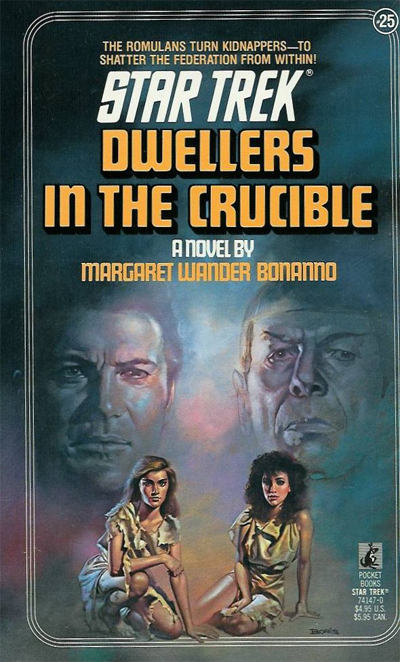
Star Trek – Dwellers in the Crucible by Margaret Wander Bonanno (Review)

This August, to celebrate the upcoming release of Star Trek: Into Darkness on DVD and blu ray, we’re taking a look at the Star Trek movies featuring the original cast. Movie reviews are every Tuesday and Thursday.

We’ll be supplementing our coverage of the movies with tie-ins around (and related to) the films. We’ll be doing one of these every week day. This is one such article.

The state of Star Trek tie-ins in 1985 was radically different than it is today. While the film series was at height of its popularity, generating a great deal of attention for the franchise, authors working on the associated tie-in novels were granted a great deal of freedom. Books from this era tend to be a great deal looser, adapting a sort of “devil may care” attitude towards the type of restrictions one might impose on a Star Trek story. Novels could be dedicated to new characters or to existing aliens, or offer radical twists on the show’s rich mythology. It was almost free-style Star Trek, with authors afforded the freedom to tell the stories that they wanted to tell, no matter how difficult it might be to fit that within the confines of “Star Trek.”

Dwellers in the Crucible captures a lot of the spirit of this era quite well. It’s Margaret Wander Bonanno’s first Star Trek tie-in book, but it’s also her strangest. It’s a rather high-concept piece of trashy “women in prison” fiction that dares to ask a question that nobody in their right mind had ever broached before: what if Kirk and Spock were lesbians?

st-dwellersinthecrucible

Continue reading

Star Trek – The Ashes of Eden by William Shatner et al (DC Comics) (Review)

This August, to celebrate the upcoming release of Star Trek: Into Darkness on DVD and blu ray, we’re taking a look at the Star Trek movies featuring the original cast. Movie reviews are every Tuesday and Thursday.

We’ll be supplementing our coverage of the movies with tie-ins around (and related to) the films. We’ll be doing one of these every week day. This is one such article.

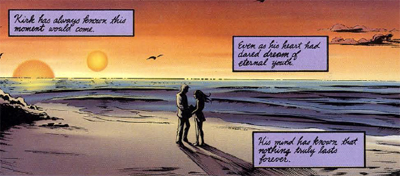
The Ashes of Eden is effectively professionally published Star Trek fan fiction, written by William Shatner. The actor gets some assistance from veteran Star Trek writers Judith and Garfield Reeves-Stevens, but it’s clear that Shatner is the driving force behind The Ashes of Eden. Indeed, an astute reader will spot quite a few thematic overlaps with Shatner’s much-maligned directorial effort, only without the rest of the cast around to temper his efforts to make this a story about Kirk and Kirk alone.

Still, The Ashes of Eden isn’t as bad as it might be. After all, just because something is fan fiction – professionally published or otherwise – says nothing of its quality. The story is probably best read as an exploration between Shatner and his alter ego, but it holds together quite well, providing a much more solid (if still far from perfect) exploration of the themes hinted at in Shatner’s Star Trek V: The Final Frontier.

The dusk of an era...

The dusk of an era…

Continue reading

Star Trek – Music of the Spheres by Margaret Wander Bonanno (Review)

This August, to celebrate the upcoming release of Star Trek: Into Darkness on DVD and blu ray, we’re taking a look at the Star Trek movies featuring the original cast. Movie reviews are every Tuesday and Thursday.

We’ll be supplementing our coverage of the movies with tie-ins around (and related to) the films. We’ll be doing one of these every week day. This is one such article.

Music of the Spheres is something of a legend in Star Trek circles. It’s not quite a ghost story, spoken of in hushed whispers. Indeed, author Margaret Wander Bonanno has made the manuscript available to interested fans via her website, and has used it to raise money for a variety of worth causes. She’s documented the difficult story of how her original novel warped in Probe in a wonderfully wry and insightful essay, offering a glimpse at the inner workings of Pocket Book and Paramount towards the end of the eighties.

It’s a rare peek behind the curtain, with Music of the Spheres serving as a compelling vehicle to explore just what was going on inside Star Trek licensing in the late eighties and early nineties.

startrek-voyagehome8

Continue reading