• Following Us

  • Categories

  • Check out the Archives


  • Awards & Nominations

Star Trek: Enterprise – Season 4 (Review)

This May, we’re taking a look at the fourth (and final) season of Star Trek: Enterprise. Check back daily for the latest review.

This is the end.

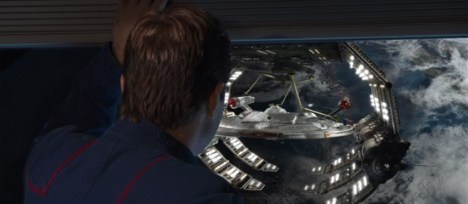
Star Trek: Enterprise would be the first live action Star Trek spin-off to run less than seven seasons. It would mark the end of eighteen years (and twenty-five seasons) of uninterrupted Star Trek on television. It would be the first of the spin-offs to be actively cancelled instead of passively retired on its own terms. It represented the end of the Berman era. The show had been lucky to scrape a fourth season, with UPN considering axing the show after the end of the third season. The fourth season only came about as a result of a lot of compromise by all involved.
ent-home6a

This shadow hangs over the fourth season. It seems quite clear from the outset that nobody involved is counting upon a fifth season. There was massive staff attrition, with veteran writers like Chris Black, David A. Goodman and Phyllis Strong all departing the writers’ room. Rick Berman and Brannon Braga took a step back from the day-to-day running the series. As the year grinds on, the show becomes increasingly (and morbidly) fixated upon its own impending demise. The clock is counting down, and the show is aware of it.

All of this is a massive shame, because the fourth season features some of the best work of the show’s four-year run. It also seems surprisingly aligned with where pop culture is going in the decade ahead, for better and for worse. The result is a season that is intriguing and ambitious, insightful and worthy. The fourth season has a lot to recommend it, and even the elements that do not work are interesting in the way that they do not work. As much as the fourth season closes the book on an era of Star Trek, it also summons the future.

ent-divergence20a

Continue reading

Star Trek: Enterprise – Terra Prime (Review)

This May, we’re taking a look at the fourth (and final) season of Star Trek: Enterprise. Check back daily for the latest review.

It all began with Spock.

The character of Spock was the only character to survive the transition between the two Star Trek pilots produced in the sixties. Leonard Nimoy first appeared as science officer Spock in The Cage, opposite Majel Barrett and Jeffrey Hunter. When the studio vetoed the original pilot, Gene Roddenberry was forced to jettison a lot of the cast and characters before setting to work on a second pilot. Spock survived serving (along with the sets and props) as a bridge between The Cage and Where No Man Has Gone Before.

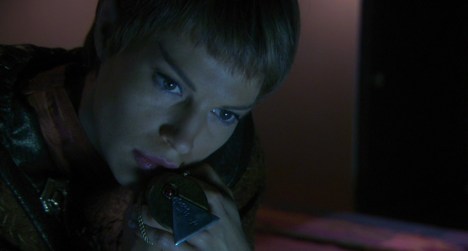
Baby on board.

Baby on board.

Spock is an iconic part of American culture. He is instantly recognisable in a way that very few elements of the franchise can claim to be. He lingers in the collective memory. Leonard Nimoy has repeatedly been favoured over William Shatner as an ambassador of the brand. Nimoy reprised the role of Spock opposite Patrick Stewart in Unification, Part I more than two whole years before Shatner would cross paths with Jean-Luc Picard as James T. Kirk in Star Trek: Generations. Nimoy appeared in a key role in Star Trek; Shatner declined a cameo.

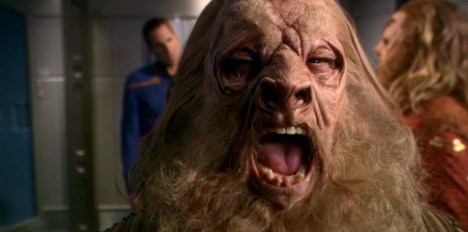
Star Trek: Enterprise was never going to feature a guest appearance from Leonard Nimoy. However, Spock as clearly haunted the fourth season as the embodiment of the franchise spirit. The Vulcan-human hybrid at the centre of Demons and Terra Prime makes little sense in basic plot terms, Elizabeth serves as a harbinger that might summon Spock. And, in doing so, Elizabeth might yet summon the future. It began with Spock, it ends with Spock. At least for now.

Infinite diversity in finite combinations...

Infinite diversity in finite combinations…

Continue reading

Star Trek: Enterprise – Demons (Review)

This May, we’re taking a look at the fourth (and final) season of Star Trek: Enterprise. Check back daily for the latest review.

In some ways, Star Trek: Enterprise ends where it should have began.

A lot of the final stretch of the final season seems dedicated to exploring the show’s original sin, the flaws that came baked into the premise as early as Broken Bow. After all, Bound had taken the cringe-inducing adolescent fixation on “sexiness” that informed ideas like the “decontamination gel” and pushed them to their sexist extremes. Similarly, In a Mirror, Darkly, Part I and In a Mirror, Darkly, Part II offered the revenge of the two members of the ensemble all but forgotten in subsequent years while pushing the show’s early reactionary tendencies to eleven.

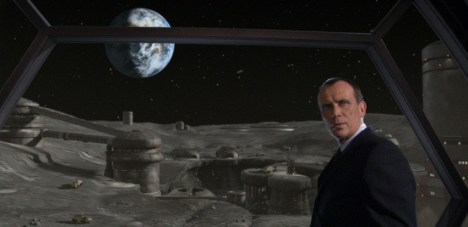
Under the Earthlight. The serious Earthlight.

Under the Earthlight. The serious Earthlight.

Even These Are the Voyages… seemed to confirm fears that the show had been built as a sequel to Star Trek: The Next Generation and Star Trek: First Contact rather than a prequel to the original Star Trek, a fear shared by many fans frustrated by elements like the design of the ship or the appearance of the Nausicaans in Fortunate Son or the Ferengi in Acquisition. That final episode left open the (admittedly remote) possibility that the entire show was nested inside the holodeck of Picard’s ship.

Demons and Terra Prime touch on the same introspective ideas, by taking the show’s final two-parter (if not its de facto finale) and using it to tell a story that probably should have been told half-way through the first season. It seems like the production team have finally decided to grapple with the core themes of Enterprise. Just at the last possible minute.

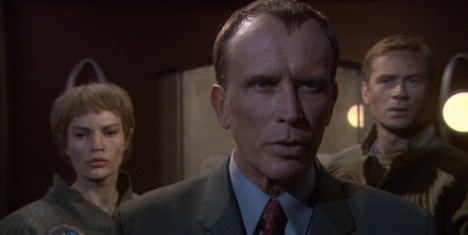
"Dead or alive, you're coming with me."

“Dead or alive, you’re coming with me.”

Continue reading

Star Trek: Enterprise – In a Mirror, Darkly, Part I (Review)

This May, we’re taking a look at the fourth (and final) season of Star Trek: Enterprise. Check back daily for the latest review.

In a Mirror, Darkly, Part I and In a Mirror, Darkly, Part II are very strange pieces of television.

They represent the fifth- and fourth-to-last episodes (and third-to-last story) of Star Trek: Enterprise. They come towards the tail end of the Berman era as a whole, positioned right before Star Trek took a decade-long absence from television. With the fourth season rather consciously building towards integrating the series with the larger shared universe and trying to lay the foundation for the Federation, it would make sense for the final stretch of the season to channel its energy into that particular avenue.

A vigourous constitutional...

A vigourous constitutional…

However, rather than trying to tell a story essential to this particular show or to the franchise as a whole, the production team opted to construct a two-parter that would feature none of the show’s primary cast and which served as a prequel to an episode of television broadcast in October 1967 and a sequel to an episode of television broadcast in November 1968. The two-parter serves to wrap up plot threads that had been left dangling so long that nobody really cared about them any longer. Given how obsessive Star Trek fans are, that is impressive.

This puts Enterprise in the rather strange position where three of its final five episodes (or two of its final three stories) do not feature any of the primary cast, instead focusing on doppelgangers or holograms. Perhaps this is a reflection on the show’s attitude towards its place within the canon. Perhaps Enterprise fears that it will be a secret history, a forgotten story populated by spectres and echoes.

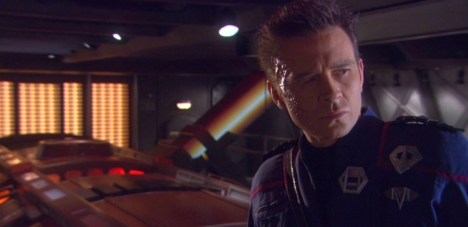
Engines of destiny.

Engines of destiny.

Continue reading

Star Trek: Enterprise – Affliction (Review)

This May, we’re taking a look at the fourth (and final) season of Star Trek: Enterprise. Check back daily for the latest review.

The shift from episodic storytelling to a more serialised format poses all manner of challenges for the Star Trek production team.

By the time that Star Trek: Enterprise embraced long-form storytelling with The Expanse at the end of its second season, the franchise was dangerous behind the curve. During the nineties, genre shows like The X-Files, Buffy: The Vampire Slayer and Babylon 5 had demonstrated the potential of serialisation as a narrative tool. Even within this particular franchise, Star Trek: Deep Space Nine had managed to strike a reasonable balance between standalone stories and the larger narrative framework.

Nothin' but Trip...

Nothin’ but Trip…

This is say nothing of the revolution taking place on a wider scale. HBO had allowed its production team to embrace the potential of long-form storytelling on late nineties shows like Oz or The Sopranos. Within a few years, the cable broadcaster had attracted considerable mainstream attention by embracing serialisation on shows like The Wire, Deadwood and Rome. In the meantime, Star Trek: Voyager had steadfastly refused to move beyond the episodic model. When Ronald D. Moore left the franchise, any experience with serialisation left with him.

As such, it is no surprise that the franchise struggled with some of the challenges posed by a serialised storytelling model. In particular, Enterprise struggled a little bit with integrating its entire ensemble into its new serialised storytelling model. Affliction and Divergence feel like an attempt to rectify this issue, with mixed results.

It's all coming together...

It’s all coming together…

Continue reading

Star Trek: Enterprise – The Aenar (Review)

This May, we’re taking a look at the fourth (and final) season of Star Trek: Enterprise. Check back daily for the latest review.

The United trilogy does not flow as well as the Kir’Shara trilogy did.

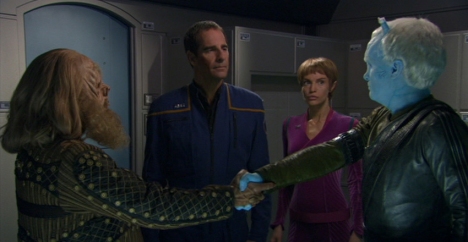
In fact, it is debatable whether these three episodes are best described as a single three-parter or instead as a two-parter with a coda tacked on. After all, the bulk of the action and drama unfolds in Babel One and United, with the penultimate scene of United finding Archer sitting down with the Andorians and Tellarites to begin laying the groundwork for the United Federation of Planets. Even the subplots are neatly tidied up between those two episodes; Trip and Reed get stranded on the Romulan drone in Babel One and rescued by Enterprise in United.

This blue world.

This blue world.

It would be perfectly reasonable to close off the story at that point. The Romulans had been scared off, and Senator Vrax had already made it clear that an embarrassing failure would mean the end of his career and that of Valdour. Even the closing scene of United, revealing an albino Andorian operating the drone ship from Romulus, feels almost tacked on after the previous sequence that had memorably pulled out from the meeting room on Enterprise to emphasise the union of Starfleet, the Vulcans, the Andorians and the Tellarites.

Using that cliffhanger at the end of UnitedThe Aenar pivots away from that to focus on a trip to Andoria. It affords Archer (and Star Trek: Enterprise) one last opportunity to visit Shran’s homeworld.

A cold reception.

A cold reception.

Continue reading

Star Trek: Enterprise – United (Review)

This May, we’re taking a look at the fourth (and final) season of Star Trek: Enterprise. Check back daily for the latest review.

The Romulans are a very curious species.

They have a long history within the Star Trek franchise. They were introduced less than half-way through the first season of the show, in Balance of Terror. The Klingons would not show up until Errand of Mercy, towards the end of that first year. The Romulans have appeared in just about every iteration of the franchise, their reappearance in the final episode of the first season of Star Trek: The Next Generation serving to connect the show to its legacy. Appearing in both Star Trek: Nemesis and Star Trek, they appeared on both sides of the film franchise reboot.

This could be the start of a beautiful friendship...

This could be the start of a beautiful friendship…

Still, the Romulans have never truly been defined. Unlike the Klingons or the Cardassians, the Romulans have never been developed into a fully-formed culture. There are great episodes built around the Romulans, from Balance of Terror and The Enterprise Incident to Face of the Enemy and In the Pale Moonlight. However, there has never been recurring Romulan character afforded the depth of Worf, Martok, Quark, Dukat, Damar or Garak; if populating that list with Star Trek: Deep Space Nine characters feels like cheating, no Romulan measures up to Soval or Shran.

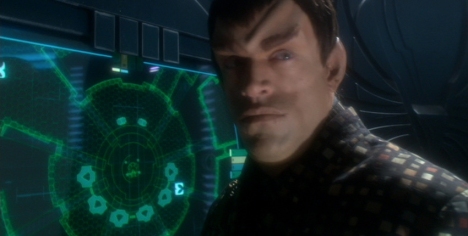
Although they only appear in four episodes of the season, exerting influence over another two, it feels like the fourth season of Star Trek: Enterprise affords more attention to the Romulans than they have received in a long time.

"All right, who arranged the bridge power display to form a smiley face?"

“All right, who arranged the bridge power display to form a smiley face?”

Continue reading

Star Trek: Enterprise – Babel One (Review)

This May, we’re taking a look at the fourth (and final) season of Star Trek: Enterprise. Check back daily for the latest review.

It seems entirely appropriate that the United trilogy sits in the middle of the fourth season.

The three-parter is not the strongest of the season’s multi-episode epics, abandoning the clean three-act structure that made the Kir’Shara trilogy so successful in favour of a disjointed two-parter-and-coda format that prevents the story from feeling as cohesive as it might. It jolts and starts, never really finding the proper flow for the story that it wants to tell. There is a sense that the production team’s desire to do both a “birth of the Federation” story and a “visit to Andoria” story within the same three-part narrative ultimately hinders the storytelling.

"What do you mean I'm not in the third part?!"

“What do you mean I’m not in the third part?!”

However, there is something satisfying in watching Star Trek: Enterprise commit to the idea of the birth of the Federation. It could be argued that this is an example of the fourth season’s continuity pandering, but the Federation is far more fundamental to the fabric of the franchise than something like Klingon foreheads or that ghost ship from that third season episode. If Enterprise is to be a prequel, it should devote some attention to building the fabric of the shared universe. The Federation is an essential part of the idealistic future of Star Trek.

However, the most compelling aspect of the United has nothing to do with continuity and history. Instead, it is simply reassuring to see Enterprise embracing the franchise’s utopianism and hope for the future, particularly in the context of January 2004.

Shran, Shran, he's our Andorian...

Shran, Shran, he’s our Andorian…

Continue reading

Star Trek: Enterprise – Observer Effect (Review)

This May, we’re taking a look at the fourth (and final) season of Star Trek: Enterprise. Check back daily for the latest review.

Much as with Daedalus, there is a weirdly mournful tone to Observer Effect.

The basic plot of the episode follows two Organian characters hopping from body to body while watching Archer and his crew confront a deadly virus that infected Trip and Hoshi during a routine planetary investigation. The closing line of the teaser even features organian!Reed promising “somebody always dies.” Sure enough, that turns out to be true. Both Trip and Hoshi “die” over the course of the episode, while Archer himself is sentenced to certain death. These deaths are ultimately reversed, but they set a tone for the episode.

Trip gets it in the neck.

Trip gets it in the neck.

Observer Effect seems to be a tacit acknowledgement that Star Trek: Enterprise is effectively dead in the water, that the show is now limping towards the end of the fourth season where it might be retired permanently. Two weeks after Observer Effect aired, UPN would announce that Enterprise was cancelled. There would be no last-minute reprieve for the show. Although Observer Effect had been written months before the decision was made, the production team knew that the writing was on the wall.

However, what is most interesting about Observer Effect is not so much the fascination with the inevitable death of Enterprise, but the episode’s fascination with those watching (and commentating upon) the spectacle from the sidelines.

They like to watch.

They like to watch.

Continue reading

Star Trek: Enterprise – Daedalus (Review)

This May, we’re taking a look at the fourth (and final) season of Star Trek: Enterprise. Check back daily for the latest review.

Discussions of the fourth season of Star Trek: Enterprise tend to focus on the multi-part episodes.

That makes a great deal of sense. After all, no Star Trek show had ever built a season around a collection of multi-part arcs. While Star Trek: Deep Space Nine had embraced serialisation in the second half of its run and Star Trek: Voyager had embraced an aesthetic that supported two-part “event” episodes, there had never been a season of the franchise constructed around a string of two- or three-part adventures. Even the third season of Enterprise had really been on long form story with the occasional episodic diversion.

Padding it out.

Padding it out.

These multi-part stories dominate the fourth season. Of the twenty-two episodes of the fourth season, seventeen are part of seven multi-part stories. Of the five episodes that nominally stand alone, Home is very much a thematic introduction to the season that sets up all manner of ideas to pay off later in the run and These Are the Voyages… is effectively an attempt at a coda for the eighteen years (and twenty-five television seasons) of the Berman era as a whole. Discounting these two “bookends”, that leaves only three standalone episodes.

Two of those episodes, Daedalus and Observer Effect aired back to back in the middle of the season. However, although each episode is self-contained in terms of plot, they do feel like spiritual companion pieces.

Turn the lights off on the way out...

Turn the lights off on the way out…

Continue reading