• Following Us

  • Categories

  • Check out the Archives


  • Awards & Nominations

Star Trek – Music of the Spheres by Margaret Wander Bonanno (Review)

This August, to celebrate the upcoming release of Star Trek: Into Darkness on DVD and blu ray, we’re taking a look at the Star Trek movies featuring the original cast. Movie reviews are every Tuesday and Thursday.

We’ll be supplementing our coverage of the movies with tie-ins around (and related to) the films. We’ll be doing one of these every week day. This is one such article.

Music of the Spheres is something of a legend in Star Trek circles. It’s not quite a ghost story, spoken of in hushed whispers. Indeed, author Margaret Wander Bonanno has made the manuscript available to interested fans via her website, and has used it to raise money for a variety of worth causes. She’s documented the difficult story of how her original novel warped in Probe in a wonderfully wry and insightful essay, offering a glimpse at the inner workings of Pocket Book and Paramount towards the end of the eighties.

It’s a rare peek behind the curtain, with Music of the Spheres serving as a compelling vehicle to explore just what was going on inside Star Trek licensing in the late eighties and early nineties.

startrek-voyagehome8

Continue reading

Star Trek (DC Comics, 1984) #7-8 – Saavik’s Story (Review)

This August, to celebrate the upcoming release of Star Trek: Into Darkness on DVD and blu ray, we’re taking a look at the Star Trek movies featuring the original cast. Movie reviews are every Tuesday and Thursday.

We’ll be supplementing our coverage of the movies with tie-ins around (and related to) the films. We’ll be doing one of these every week day. This is one such article.

Star Trek comics are an interesting way of catching a glimpse at the franchise one-step away from the heart of production. While there are other forms of tie-in media, comics are produced on a monthly schedule. While scripts need to be written and art needs to be drawn, there’s less lead-in time required, meaning that contemporary Star Trek comics are often able to react dynamically to on-screen events. While novels might take up to a year from original pitch to the time they hit the stands, there’s something rather more urgent about tie-in comic books.

This is an issue for many tie-ins comics. For example, the syndicated Star Trek newspaper strip launched shortly before the release of Star Trek: The Motion Picture made a point to feature Ilia as a bridge officer on a relaunched USS Enterprise. She rather suddenly disappeared after those involved actually saw the movie and realised that she didn’t quite survive the adventure. Similarly, when it came to detailing the adventures of Kirk and company in the wake of Star Trek III: The Search for Spock, writer Mike W. Barr moved the crew over to the USS Excelsior, in accordance with writer Harve Bennett’s original plan.

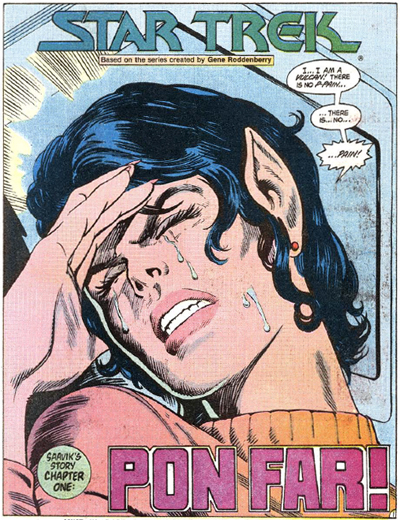
That said, Mike W. Barr’s comic book origin story for Lt. Saavik holds up rather well, fitting quite comfortably with Carolyn Clowes’ origin for the character offered in the superb 1990 book The Pandora Principle. Of course, Barr’s origin sketches the broadest of outlines, and is clearly more preoccupied with crafting a pulpy space opera adventure.

Saving Saavik!

Saving Saavik!

Continue reading

Star Trek – Season 1 (Review)

To celebrate the release of Star Trek: Into Darkness this month, we’ll be running through the first season of the classic Star Trek all this month. Check back daily to get ready to boldly go. It’s only logical.

That came together rather well, didn’t it? With the current success of Star Trek as a blockbuster movie franchise, it’s fun to speculate about the show possibly returning to television. Being honest, I would be nervous about that. In this cut-throat age where ratings need to solidify (or start rising) almost immediately, I wouldn’t trust the first season of a Star Trek spin-off to rope in viewers quick enough. None of the Star Trek spin-offs, from The Next Generation through to Enterprise, had what could be considered “strong” first years. Occasionally there were a few classic episodes buried in there, as with Deep Space Nine, but it always seems to take a Star Trek show some time to find its “space legs”, so to speak. Time that I am not sure it would be afforded in the current market place.

Which makes it all the more spectacular that Star Trek itself started out so phenomenally. The first year of the show (and the franchise) is not only the best first season of any Star Trek show ever, it’s also in the running for the best of the thirty seasons of television that the franchise has produced. Not bad at all, considering that it seems like nobody had any idea what exactly they were doing when they started out.

tos-miri18

Continue reading

Star Trek – Operation — Annihilate!

To celebrate the release of Star Trek: Into Darkness this month, we’ll be running through the first season of the classic Star Trek all this month. Check back daily to get ready to boldly go. It’s only logical.

How do you follow The City on the Edge of Forever? The previous episode is one of the best-loved episodes of Star Trek ever produced, one of the great science-fiction television episodes of the sixties, and one of the best science-fiction romances ever written. It’s a gigantic and massively influential piece of television, one of the cornerstones of Star Trek and perhaps the best indicator of just how thoughtful and how genuine the franchise can be when it tries. So, what’s next? Where do we go from here? What is the next shot after that last scene of Kirk abandoning the Guardian of Forever on a desolate rock?

It’s always interesting to compare the first season of Star Trek to the first year of Star Trek: The Next Generation. The former can be counted among the very best of the show’s thirty televised seasons, while the latter can be counted among the worst. However, they do have something in common. They both probably should have ended an episode early, with The City on the Edge of Forever and Conspiracy serving as effective caps on each show’s first season, leaving the audience a chance to digest what they had seen.

Unfortunately, neither show ended on anything that could be measured among the strongest show of a given year. The Neutral Zone ended the first season of The Next Generation with a moralising whimper. While Operation — Annihilate! is quite entertaining on its own terms, it doesn’t rank among the best of the season. Still, it’s a solid pulpy science-fiction tale, which might not be the worst thing.

Man of action!

Man of action!

Continue reading

Star Trek – Crucible: McCoy – Provenance of Shadows by David R. George III (Review)

To celebrate the release of Star Trek: Into Darkness this month, we’ll be running through the first season of the classic Star Trek all this month. Check back daily to get ready to boldly go. It’s only logical.

We’ll be supplementing our coverage of the episodes with some additional materials – mainly novels and comics and films. This is one such entry.

The classic Star Trek was not really a character-driven show. Of course, everybody recognises Kirk, Spock and McCoy, but the show seldom took the time to really dig into their history or origins. We’d occasionally find out that Kirk had some overlap with the villain of the week. He had served on a starship that had been the victim of a vampire space cloud, or lived on a colony during a brutal massacre. These details added up to something, along with the occasional reference to (and eventual death of) his brother Sam.

Spock got a bit more development, probably due to the fact that he was an alien. After all, developing Spock meant developing an entire exotic alien species, and offered some insight into how Vulcans must live. We’d also get occasional factoids or tidbits (Vulcans can mind meld, they have inner eyes, they had a schism millennia ago) that help to give a concrete picture of the where the character came from and where he might like to go.

McCoy, on the other hand, was a bit of a blank slate. Everybody knows McCoy. He’s the irritable surgeon on the ship, prone to insulting Spock and complaining about the fact that he’s flying through space in a ship filled with mechanical doo-hickeys. However, we never really get a sense of McCoy’s past. We never learn much about his family on-screen, except when the writers wanted a bit of dramatic fodder in the penultimate movie featuring the original cast, Star Trek V: The Final Frontier. But we don’t talk about that.

So David R. George III’s Crucible: McCoy – Provenance of Shadows is an interesting book. Not only because it is a book completely devoted to the least-developed of the iconic leading trio, but also because this relatively under-developed character also gets one of the longest Star Trek tie-in books ever written. And without too much focus on his past.

tos-cruciblemccoy

Continue reading

Star Trek – This Side of Paradise (Review)

To celebrate the release of Star Trek: Into Darkness this month, we’ll be running through the first season of the classic Star Trek all this month. Check back daily to get ready to boldly go. It’s only logical.

Star Trek always had a curious relationship with the hippie movement in the late sixties. On a surface level, you’d assume that the series would have a great deal of empathy for the idealistic and pacifist movement. After all, the show embraced counter-culture in a fairly significant way, offering none-too-subtle criticisms of American foreign policy in episodes like A Taste of Armageddon, and harbouring some very serious concerns about authority in adventures like Dagger of the Mind. What was The Naked Time but an embrace of fin de siècle anxiety mere months before “the summer of love”? After all, the nineteenth century European fin de siècle period had produced Der Wandervogel, considered one of the predecessors to the hippie movement.

And yet the show never seemed entirely comfortable with the youth movement. This would be much more obvious third season’s dire The Way to Eden, but the show’s sense of unease is quite palpable here, as Kirk finds himself trying to deal with a crew that have sampled some mind-altering vegetation and are now embracing free love.

Flower power...

Flower power…

Continue reading

Star Trek – The Return of the Archons (Review)

To celebrate the release of Star Trek: Into Darkness this month, we’ll be running through the first season of the classic Star Trek all this month. Check back daily to get ready to boldly go. It’s only logical.

It is really hard to believe that this is the first time we’ve really had one of these plots, with the Enterprise visiting an alien civilisation, meddling thoroughly and freeing the population from oppression. Of course, that’s probably because the universe seemed so vast an empty in the first few episodes. The only planets seemed to be either lifeless rocks or human colonies. From this point on, the galaxy is going to seem a whole lot busier.

Return of the Archons is a little bit like an expansion of the archetypal Star Trek plot established in What Are Little Girls Made Of? The Enterprise visits an alien world following up on the disappearance of Federation personnel. When they arrive, they discover sinister plans afoot involving evil artificial intelligences that plan on stomping out free will. Kirk promptly uses his humanity to talk the machines into destroying himself.

However, Return of the Archons deals with a whole civilisation trapped in the midst of this sinister robotic plot. Kirk and his crew aren’t strolling through an alien graveyard. This is a living, breathing society. And this is the first time that Kirk would save an entire civilisation.

Some men just want to watch the world burn...

Some men just want to watch the world burn…

Continue reading

Star Trek – Tomorrow is Yesterday (Review)

To celebrate the release of Star Trek: Into Darkness this month, we’ll be running through the first season of the classic Star Trek all this month. Check back daily to get ready to boldly go. It’s only logical.

It’s interesting how easily you can trace a line back from the original Star Trek films to the television show which inspired them. Each of the first four films has a very clear predecessor, an episode broadcast during the show’s run which seems to serve as something of a thematic forerunner. Star Trek: The Motion Picture is so similar to The Changeling that Star Trek: The Original Series 365 dubs it “Where Nomad Has Gone Before.” The Wrath of Khan is obviously rooted in Space Seed. Kirk’s decision to hijack the Enterprise and go against regulations to save his first officer in The Search for Spock feels like a full circle from Spock’s efforts to help Pike in The Menagerie.

And Tomorrow is Yesterday feels like a bit of a dry run for Star Trek IV: The Voyage Home. The crew might not have to save any whales, but it’s a comedic time-travel adventure that finds the Enterprise crew visiting the twentieth century and trying to avoid altering the time-line too much. Tomorrow is Yesterday feels a little simplistic when compared to some of the franchise’s later interactions with time-travel, but it is a fun and entertaining little episode. It’s easy to see why The Voyage Home might be tempted to revisit the set-up.

Flying the friendly skies...

Flying the friendly skies…

Continue reading

Star Trek – The Alternative Factor (Review)

To celebrate the release of Star Trek: Into Darkness this month, we’ll be running through the first season of the classic Star Trek all this month. Check back daily to get ready to boldly go. It’s only logical.

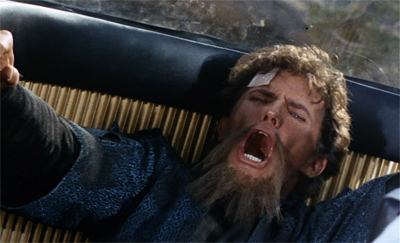
Well, here we are. The Alternative Factor. We’ve had weak episodes before. I’ll concede that shows like Court Martial and The Menagerie, Part II wouldn’t rank among my favourites of the season. However, there was always just enough there to make them interesting, if not compelling. There were good ideas, clumsily executed. There was something value to be found in watching these episodes. The Alternative Factor lacks those sorts of redemptive values, and it’s the first time on this re-watch I have actually wondered where my fifty minutes went, and lamented the fact that watching The Alternative Factor inched me ever-closer to death.

The Alternative Factor is – I’d argue – the weakest episode of a remarkably strong first season of Star Trek. While some would consider it one of the worst episodes the show ever produced, I’m reluctant to commit to that sort of certainty. After all, we still have the third season to come, and I’m hesitant to rank The Alternative Factor as that much worse than The Turnabout Intruder or The Way to Eden or And the Children Shall Lead or Spock’s Brain. Yep, there’s a lot to look forward to if I ever get around to finishing the third season of the show.

Still, the fact that The Alternative Factor might possibly not be the worst thing to happen to Star Trek in its nearly fifty years of existence is damning with faint praise. But I’m sure the episode will take whatever it can get.

It hurts!

It hurts!

Continue reading

Star Trek – Arena (Review)

To celebrate the release of Star Trek: Into Darkness this month, we’ll be running through the first season of the classic Star Trek all this month. Check back daily to get ready to boldly go. It’s only logical.

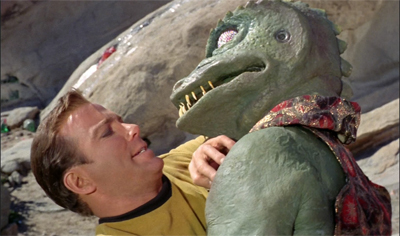
Arena is a fascinating piece of Star Trek, because it’s such an iconic and important piece of franchise history, despite the fact that it’s far from the best that the show has to offer. Indeed, the basic premise of the show is rather generic science-fiction B-movie stuff. Kirk is forced to compete against a lizard-like alien by some god-like beings to ensure the survival of his crew. The script, by producer Gene L. Coon, is credited to a story written by Fredric Brown. Despite its similarities to Brown’s short story of the same name, Arena also shares quite a few plot points with a 1964 episode of The Outer Limits, Fun & Games. None of this is to suggest that Coon was consciously channelling these sources when he wrote the teleplay, just to illustrate how generic the basic plot is.

However, despite (or perhaps because of) this rather straightforward and familiar set-up, Arena is a truly memorable episode of Star Trek. Like quite a few other episodes of the original Star Trek, the episode produced images and concepts that have resonated well outside Star Trek fandom, to the point where elements like the Gorn or Kirk’s highly dubious improvised weapon will be recognisable to people who have never actually seen the episode. However, the episode is also vitally important to the Star Trek franchise itself, as it offers a more thorough expansion and exploration of the back story that has been inconsistently hinted at throughout this first season. Arena is really the first episode to feature a fully-formed framework for the internal logic of the Star Trek universe, one that has informed half-a-century of the franchise.

Plus, you know, Kirk wrestles a lizard man.

Don't pretend you aren't loving every minute of this, Shatner!

Don’t pretend you aren’t loving every minute of this, Shatner!

Continue reading