• Following Us

  • Categories

  • Check out the Archives


  • Awards & Nominations

Star Trek – Arena (Review)

To celebrate the release of Star Trek: Into Darkness this month, we’ll be running through the first season of the classic Star Trek all this month. Check back daily to get ready to boldly go. It’s only logical.

Arena is a fascinating piece of Star Trek, because it’s such an iconic and important piece of franchise history, despite the fact that it’s far from the best that the show has to offer. Indeed, the basic premise of the show is rather generic science-fiction B-movie stuff. Kirk is forced to compete against a lizard-like alien by some god-like beings to ensure the survival of his crew. The script, by producer Gene L. Coon, is credited to a story written by Fredric Brown. Despite its similarities to Brown’s short story of the same name, Arena also shares quite a few plot points with a 1964 episode of The Outer Limits, Fun & Games. None of this is to suggest that Coon was consciously channelling these sources when he wrote the teleplay, just to illustrate how generic the basic plot is.

However, despite (or perhaps because of) this rather straightforward and familiar set-up, Arena is a truly memorable episode of Star Trek. Like quite a few other episodes of the original Star Trek, the episode produced images and concepts that have resonated well outside Star Trek fandom, to the point where elements like the Gorn or Kirk’s highly dubious improvised weapon will be recognisable to people who have never actually seen the episode. However, the episode is also vitally important to the Star Trek franchise itself, as it offers a more thorough expansion and exploration of the back story that has been inconsistently hinted at throughout this first season. Arena is really the first episode to feature a fully-formed framework for the internal logic of the Star Trek universe, one that has informed half-a-century of the franchise.

Plus, you know, Kirk wrestles a lizard man.
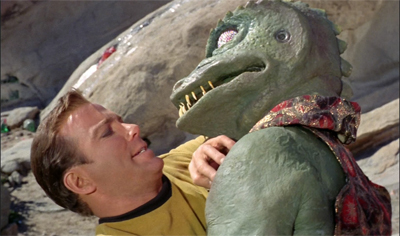
Don't pretend you aren't loving every minute of this, Shatner!

Don’t pretend you aren’t loving every minute of this, Shatner!

Continue reading

Star Trek – The Squire of Gothos (Review)

To celebrate the release of Star Trek: Into Darkness this month, we’ll be running through the first season of the classic Star Trek all this month. Check back daily to get ready to boldly go. It’s only logical.

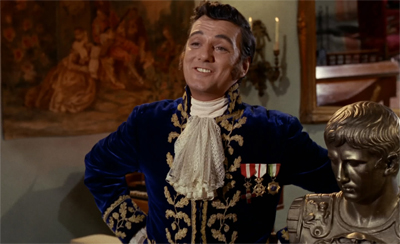
It’s easy to see why The Squire of Gothos has become such a Star Trek touchstone. The show is iconic, but there are particular images and ideas that resonate beyond the core fanbase. Captain Pike’s wheelchair from The Menagerie is one such example, as is the fight with the Gorn from Arena. It’s amazing that Star Trek could produce so many memorable and distinctive images so quickly. Trelane might not have the same name recognition, or even the same pop culture cache, but The Squire of Gothos makes quite an impression.

Indeed, the image of a god-like being acting like a spoilt child, dressed in all manner of period military clothing is a great visual, and it’s little wonder that Roddenberry would return to that idea when he was writing Encounter at Farpoint, the first episode of Star Trek: The Next Generation. Similarly, The Squire of Gothos is one of the major influences on Futurama‘s superb parody/homage, Where No Fan Has Gone Before, right down to the wonderful “twist” ending that has been spoiled by almost half-a-century of pop culture osmosis.

Still, even apart from its massive influence on pop culture, The Squire of Gothos is still a fantastic piece of television, and an example of Star Trek at its very best.

It's hip to be squire...

It’s hip to be squire…

Continue reading

Star Trek – Charlie X (Review)

To celebrate the release of Star Trek: Into Darkness this month, we’ll be running through the first season of the classic Star Trek all this month. Check back daily to get ready to boldly go. It’s only logical.

It really is incredibly difficult to divorce Star Trek from the sixties. I know that this has become something of a (very obvious) theme in these daily reviews, but Charlie X is the kind of Star Trek episode that could only have been produced for television in the sixties. It isn’t necessarily the presence of a single factor, it’s more the package as a whole. While the general concept (“The Day Charlie Became God”, to quote Roddenberry’s succinct synopsis from his 1964 Star Trek Is… pitch) could easily be adapted for any of the spin-offs (and Hide & Q clearly plays on the same idea), the execution is so firmly anchored in the sixties that it’s very hard to separate and parse.

Part of it is the weird use of coloured lighting on the mostly grey Enterprise sets, something that Inside Star Trek suggests was down to the fact that NBC was owned at the time by RCA, a major manufacturer of colour television sets. Part of it is the somewhat confused sexuality that is a weird mix of liberated and outdated. Part of it is the fact that the show features an impromptu musical and dance number. The idea of Charlie X might be fairly simplistic, but the execution is very clearly and very distinctively Star Trek.

Screaming to the Evans...

Screaming to the Evans…

Continue reading