• Following Us

  • Categories

  • Check out the Archives


  • Awards & Nominations

Star Trek: Deep Space Nine – The Passenger (Review)

Star Trek: Deep Space Nine is twenty years old this year. To celebrate, I’m taking a look at the first season. Check back daily for the latest review or retrospective.

And here we hit what amounts to the rock bottom of Star Trek: Deep Space Nine‘s first season. The Passenger and Move Along Home exist as the two weakest stories in this first season, and the point from which Deep Space Nine begins to map a path towards recovery, climaxing in the best final two episodes of any first season in the history of Star Trek. We’re a long way from that, and we seem furthest from it here.

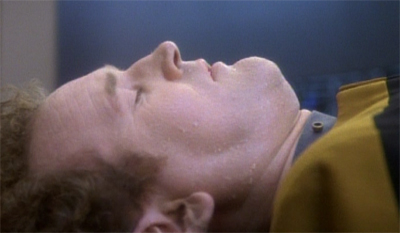
While Move Along Home is a legitimately bad episode, one with flaws that probably should have been spotted in any of the episode’s troubled development history, The Passenger suffers because it is the most bland and generic of the first season Deep Space Nine episodes. It accomplishes nothing, but it feels worse because its ambitions were so low. It’s the kind of story that could easily have been told on any Star Trek show, or any science-fiction series, but with no sense of local colour to give it distinctive flavour.

The Passenger is just as bland as the title makes it sound.

The not-so-good Doctor...

The not-so-good Doctor…

Continue reading

Star Trek: Deep Space Nine – Captive Pursuit (Review)

Star Trek: Deep Space Nine is twenty years old this year. To celebrate, I’m taking a look at the first season. Check back daily for the latest review or retrospective.

Much like Babel, it’s not too difficult to reimagine Captive Pursuit as an episode of Star Trek: The Next Generation. It’s notable for being one of the few episodes of Deep Space Nine to really feature the famous “Prime Directive”, something of a staple of the original Star Trek, The Next Generation and even Voyager. Like a lot of episodes from the middle of Deep Space Nine‘s first season, this seems almost like an attempt to port on episode concept directly over from The Next Generation. In particular, the notion of the crew dealing with a fugitive while wrestling with the Prime Directive feels like a retread of The Hunted.

That said, Captive Pursuit does work quite well, taking a familiar concept and putting a twist on it unique to the show. Despite the fact the episode’s premise feels like it has been carried over, the execution is careful enough to distinguish Deep Space Nine from its older sibling.

The hunted...

The hunted…

Continue reading

Star Trek: Deep Space Nine – Babel (Review)

Star Trek: Deep Space Nine is twenty years old this year. To celebrate, I’m taking a look at the first season. Check back daily for the latest review or retrospective.

With Babel, we hit the most significant flaw in the first season of Star Trek: Deep Space Nine. Put frankly, Babel is the first story that could easily have worked as an episode of the original Star Trek or of Star Trek: The Next Generation. Indeed, Michael Piller concedes in Captains’ Logs Supplemental – The Unauthorized Guide to the New Trek Voyages that Babel had a history longer than that of Deep Space Nine itself:

We had this premise for over five years at Next Generation. It was written by the same person who wrote “Hollow Pursuits” for us, and we had always been attracted to the idea that you could suddenly lose the ability to use language and communicate, and how people are able to communicate with each other.

This isn’t necessarily a bad thing, but it’s worth noting that the first season of Deep Space Nine was airing concurrently with the sixth season of The Next Generation. If people wanted to see stories that could work on The Next Generation, it made more sense to see them executed on that show by a production team with experience in these sorts of plots.

While Babel isn’t a bad episode by any means, there’s a sense that it has been cobbled together from leftovers at another table, and the result isn’t nearly as satisfying as it should be.

Chief concerns...

Chief concerns…

Continue reading

Star Trek: Deep Space Nine – Prophecy & Change: Ha’Mara by Kevin G. Summers (Review)

Star Trek: Deep Space Nine is twenty years old this year. To celebrate, I’m taking a look at the first season. Check back daily for the latest review or retrospective.

We’ll be supplementing our coverage of the episodes with some additional materials – mainly novels and comics and films. This is one such entry.

Comparing and contrasting the anniversary short story anthologies for Star Trek: The Next Generation and Star Trek: Deep Space Nine can be highly informative. The Sky’s the Limit, released to celebrate the twentieth anniversary of The Next Generation, features fourteen stories. Most of these stories serve as prologues or epilogues to existing Next Generation episodes. Suicide Note provides closure to The Defector; Turncoats follows a character from Face of the Enemy after the camera stops rolling; Four Lights is an epilogue to Chain of Command.

In contrast, Prophecy and Change, released to celebrate the tenth anniversary of Deep Space Nine, tends to focus on short stories that fit gracefully between episodes – fleshing out connective tissue and explaining how one plot development or character decision led to another. That says quite a lot about the two shows and the way that their stories were told, with much of Prophecy and Change feeling ling deleted scenes or inserts loosely inserted between what was seen in television.

Ha’Mara is the first short story of the collection, following the introduction and the mysterious Revisited – a book-ending wrap-around written by an author who has yet to be publicly identified. Written by Kevin G. Summers, who provided Isolation Ward 4 to Strange New Worlds IV, the short story is set in the immediate aftermath of Emissary, attempting to smooth over the rough edges transitioning from the pilot to the rest of the show.

ds9-prophecyandchange

Continue reading

Star Trek: Terok Nor – Day of the Vipers by James Swallow (Review)

Star Trek: Deep Space Nine is twenty years old this year. To celebrate, I’m taking a look at the first season. Check back daily for the latest review or retrospective.

We’ll be supplementing our coverage of the episodes with some additional materials – mainly novels and comics and films. This is one such entry.

Star Trek: Deep Space Nine comes with back story. A lot of back story. In fact, the opening scene of Emissary establishes the show in the context of The Best of Both Worlds, Part II, introducing a lead character whose tragic origin is rooted in an encounter that we had only fleetingly glimpse in Star Trek: The Next Generation. Due to the setting and nature of the show, history and continuity were major parts of Deep Space Nine‘s identity, and a large part of what set the show apart from its predecessors. (And successors, for that matter.)

Although the Klingons would dominate the show’s fourth season and remain a presence throughout the show’s run, and the Romulans might occasionally be glimpsed lurking in the back ground, the series largely focused on two alien races that had been introduced in The Next Generation. The Cardassians had been introduced in the show’s fourth season, in The Wounded, and the Bajorans first appeared during the fifth season in Ensign Ro.

Officially part of The Lost Era series of novels designed to flesh out the history of the shared Star Trek universe, the Terok Nor trilogy exists as a bridge into Emissary, something of an extended history lesson that contextualises the events of Deep Space Nine by providing an account of the Occupation of Bajor, an atrocity that only ended shortly before Emissary actually began.

teroknordayofthevipers1

Continue reading