• Following Us

  • Categories

  • Check out the Archives


  • Awards & Nominations

Star Trek – Balance of Terror (Review)

To celebrate the release of Star Trek: Into Darkness this month, we’ll be running through the first season of the classic Star Trek all this month. Check back daily to get ready to boldly go. It’s only logical.

I’ve talked about it about it quite a bit in my earlier reviews, so I won’t dwell on it too much here, but Star Trek got really good really quickly. Balance of Terror is only the ninth ever episode of Star Trek ever produced, but it stands as one of the finest entries in the original series, and perhaps even the franchise. It also represents the moment where the model of what Star Trek would be really sort of solidified. The first eight episodes had contained any number of classic Star Trek tropes.

The Cage and Charlie X gave us old and immeasurably powerful alien civilisations, while Where No Man Has Gone Before gave us a god-like being. The Man Trap gave us space monsters. Mudd’s Women gave us awkward gender politics. The Enemy Within created the whole “transporter malfunction” and “evil duplicate” subgenres. However, Balance of Terror is the first episode to suggest outer space might be more than the place where crazy stuff happens and our heroes bump into monsters or ancient civilisations. The universe might have its own politics, its own history, its own civilisations that will emerge, contrasted with mankind’s expansion into space.

The Klingons are undoubtedly the most recognisable and iconic of the classic Star Trek races, but the Romulans are the first of the franchise mainstays to appear, and Balance of Terror is the first episode to devote considerable effort to world-building the Star Trek universe.
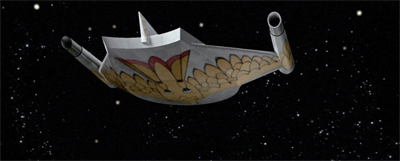
The not-so-great bird of the galaxy...

The not-so-great bird of the galaxy…

Continue reading

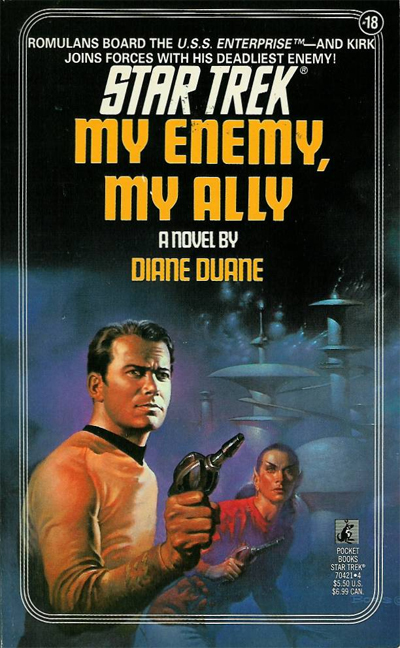
Star Trek – My Enemy, My Ally by Diane Duane (Review)

To celebrate the release of Star Trek: Into Darkness this month, we’ll be running through the first season of the classic Star Trek all this month. Check back daily to get ready to boldly go. It’s only logical.

We’ll be supplementing our coverage of the episodes with some additional materials – mainly novels and comics and films. This is one such entry.

1984 was a hell of a year of Star Trek tie-in novels. John M. Ford’s The Final Reflection was published in May 1984. It was followed by a tie-in adaptation of Star Trek III: The Search for Spock, but the very next original novel would by My Enemy, My Ally by Diane Duane. Both novels feel like kindred spirits, really pushing the boundaries of what you could do with Star Trek tie-in novels.

In particular, both works devoted considerable time to developing some of the iconic and memorable aliens of Star Trek. Ford’s The Final Reflection extrapolated an entire Klingon culture, while Duane’s My Enemy, My Ally dared to imagine a complex Romulan Empire, so distinct and well-defined that it isn’t even known as Romulan (apparently the term outsiders use for the species), but Rihannsu.

myenemymyally

Continue reading

Star Trek: The Next Generation – The Neutral Zone (Review)

To celebrate the twenty-fifth anniversary of Star Trek: The Next Generation, and also next year’s release of Star Trek: Into Darkness, I’m taking a look at the recent blu ray release of the first season, episode-by-episode. Check back daily for the latest review.

Watching The Neutral Zone, it’s hard not to feel that the first season of Star Trek: The Next Generation should have wrapped up with Conspiracy. At least that would have represented a bold step forwards, even if it wasn’t the direction that the show would ultimately take. In contrast, a lot of The Neutral Zone falls back into the trite, patronising arrogance that we’ve seen our crew demonstrate repeatedly over this first year, treating three refugees from twenty-first century Earth as an excuse to lord their superiority over the viewers at home. It’s a rather strange direction to take, and it certainly doesn’t make for good television. Which feels like a bit of a waste, given that the B-plot is actually quite workable.

"We're back."

“We’re back.”

Continue reading

Star Trek: The Next Generation – Heart of Glory (Review)

To celebrate the twenty-fifth anniversary of Star Trek: The Next Generation, and also next year’s release of Star Trek: Into Darkness, I’m taking a look at the recent blu ray release of the first season, episode-by-episode. Check back daily for the latest review.

I think Heart of Glory is, ironically, one of the first times that Star Trek: The Next Generation is consciously trying to force its way out of the shadows of its illustrious predecessor. Episodes like The Naked Now and Justice felt like hold-overs from the classic sixties Star Trek, with little acknowledgement that the world (both inside and outside the show) had dramatically changed in the two decades since Star Trek appeared. I used the adjective “ironically”, because Heart of Glory actually sees the return of one of the most classic Star Trek aliens, and one of the most recognisable pop culture extraterrestrials.

The series bible famously stated the show had no real interest in going back to the Klingons, but Heart of Glory suggests that following up with the funky foreheaded aliens might have been the smartest thing that the first season did.

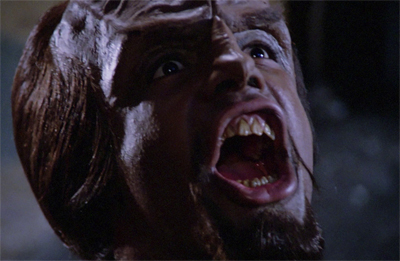
I am Klingon, hear me roar!

I am Klingon, hear me roar!

Continue reading

Star Trek: The Next Generation – The Battle (Review)

To celebrate the twenty-fifth anniversary of Star Trek: The Next Generation, and also next year’s release of Star Trek: Into Darkness, I’m taking a look at the recent blu ray release of the first season, episode-by-episode. Check back daily for the latest review.

The Battle represents a curious midpoint in the evolution of the Ferengi. When they first appeared in The Last Outpost (after being mentioned in Encounter at Farpoint), the aliens had been considered as viable replacements for the Klingons and Romulans as the primary antagonists of Star Trek: The Next Generation. Despite the presence of Worf on the Bridge, the bible for The Next Generation expressly forbade plots involving the Klingons or Romulans, with the creators afraid of returning to that particular well. (It would be towards the end of the season that both races would make a comeback, in big ways.) With neither of those races available, there was a void, and the Ferengi had been created to fill that void.

However, their introduction in The Last Outpost had been an unmitigated disaster, reducing the species to failed comic relief in their very first episode. The Battle is the second story to feature the aliens, and it never seems quite sure how to handle them. Does it present them as a credible threat, or merely as an awkward annoyance not to be taken seriously? The Battle can’t decide, and that’s just the most obvious of the episode’s fundamental problems.

They have yet to figure out an angle that works for the Ferengi…

Continue reading

Star Trek: The Next Generation – The Last Outpost (Review)

To celebrate the twenty-fifth anniversary of Star Trek: The Next Generation, and also next year’s release of Star Trek: Into Darkness, I’m taking a look at the recent blu ray release of the first season, episode-by-episode. Check back daily for the latest review.

You know, a lot of people would argue that Star Trek is about understanding. That it’s about embracing and respecting cultures, even when they hold values different than your own. Sometimes that is to a fault, like in the last episode (Code of Honour) where Picard allowed his Chief of Security to engage in a fight to the death to avoid violating local custom. (Which he then violated by reviving the loser.) However, it appears that such open-mindedness only applies when you look and act appropriately human enough.

If you are a Ferengi, then your culture shouldn’t be respected and acknowledged. It should be mocked and ridiculed.

He’s all ears…

Continue reading