• Following Us

  • Categories

  • Check out the Archives


  • Awards & Nominations

Doctor Who: The Claws of Axos (Review)

To celebrate the fiftieth anniversary of the longest-running science-fiction show in the world, I’ll be taking weekly looks at some of my own personal favourite stories and arcs, from the old and new series, with a view to encapsulating the sublime, the clever and the fiendishly odd of the BBC’s Doctor Who.

The Claws of Axos originally aired in 1971.

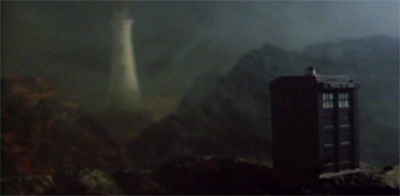
Are you trying to tell me you can absorb the total output of this complex in a police box?

Yes.

– Hardiman and the Master discover that self-confidence is a genetic Time Lord trait

The Claws of Axos tends to come in for a fair bit of criticism for pretty much being the quintessential Earth-based Jon Pertwee story, with very little exceptional to distinguish it from the pack. Personally, I’m actually quite fond of it, perhaps precisely for that reason. I think you’re hard-pressed to find an adventure in the early part of Jon Pertwee’s tenure that so effectively and so efficiently captures the spirit of the show – both good and bad. That kind of makes The Claws of Axos stand out if only because it so perfectly embodies those early Pertwee years.

Eye see you…

Continue reading

Doctor Who: The Vampires of Venice (Review)

To celebrate the fiftieth anniversary of the longest-running science-fiction show in the world, I’ll be taking weekly looks at some of my own personal favourite stories and arcs, from the old and new series, with a view to encapsulating the sublime, the clever and the fiendishly odd of the BBC’s Doctor Who.

The Vampires of Venice originally aired in 2010.

Tell me the whole plan!

One day that will work.

– the Doctor

The Vampires of Venice is interesting because it looks very different in 2013 as compared to when it was originally broadcast in 2010. In 2010, it looked a bit overly familiar, a collection of the tropes and storytelling tricks that we took for granted in the show under Russell T. Davies. The elements felt, at the time, a little over-familiar. Indeed, it seemed like Toby Whithouse’s script owed a great deal to his earlier adventure School Reunion.

However, Doctor Who looks very different in 2013. The show has definitely radically changed, so that these familiar plot points don’t seem quite so familiar any longer. Whereas The Vampires of Venice didn’t feel so strange after five years of Russell T. Davies, it does seem a bit more unique after three years of Steven Moffat. It doesn’t seem so much an attempt to repackage these story elements as it does one final celebration of them, a fond farewell to many of the narrative bits and pieces that we’d come to take for granted.

How times change.

A late-night bite...

A late-night bite…

Continue reading

Doctor Who: Horror of Fang Rock (Review)

To celebrate the fiftieth anniversary of the longest-running science-fiction show in the world, I’ll be taking weekly looks at some of my own personal favourite stories and arcs, from the old and new series, with a view to encapsulating the sublime, the clever and the fiendishly odd of the BBC’s Doctor Who.

Horror of Fang Rock originally aired in 1977.

So you found the trouble then?

Yes, I always find trouble.

– Vince and the Doctor

The show was on something of a hot streak when Horror of Fang Rock aired. While producer Philip Hinchcliffe’s tenure on the show is roundly praised, and is a personal favourite, the standard of the show had been particularly high. The beloved Talons of Weng-Chiang had closed out the previous season, following hot-on-the-heels of the well-regarded Robots of Death – both classic and iconic stories that stand as the very best of Tom Baker’s time in the lead role. Horror of Fang Rockis right on up there, as perhaps one of the best gothic horrors that the series has ever produced.

Something wicked this way comes...

Continue reading

Doctor Who: The Unquiet Dead (Review)

To celebrate the fiftieth anniversary of the longest-running science-fiction show in the world, I’ll be taking weekly looks at some of my own personal favourite stories and arcs, from the old and new series, with a view to encapsulating the sublime, the clever and the fiendishly odd of the BBC’s Doctor Who.

The Unquiet Dead originally aired in 2005.

What the Shakespeare is going on?

– Charles Dickens

It feels appropriate that Mark Gatiss should script the first episode of the revived Doctor Who not written by Russell T. Davies himself. Davies wrote the bulk of the first season’s thirteen episodes, and you could argue that he occasionally spread himself a bit too thin. However, I would argue that the first year of the revived show also had the strongest string of secondary writers on the bench, including Rob Shearman writing Dalek, Steven Moffat writing The Empty Child and The Doctor Dances, Paul Cornell writing Father’s Day and Gatiss writing The Unquiet Dead.

Gatiss and Moffat are two of the most prolific writers for the new series, with Moffat even succeeding Davies as showrunner. It’s also worth noting that both Gatiss and Moffat are fans of the classic show with considerable writing experience in television. It’s very clear that Davies isn’t just recruiting fans of the classic show, even those who may have written material while it was off the air (Gatiss wrote spin-off novels, Moffat wrote The Curse of Fatal Death), but recruiting those with practical experience about how television today works.

And that was a very shrewd decision.

Ghosts of Cardiff...

Ghosts of Cardiff…

Continue reading

Doctor Who: The Talons of Weng-Chiang (Review)

To celebrate the fiftieth anniversary of the longest-running science-fiction show in the world, I’ll be taking weekly looks at some of my own personal favourite stories and arcs, from the old and new series, with a view to encapsulating the sublime, the clever and the fiendishly odd of the BBC’s Doctor Who.

The Talons of Weng-Chiang originally aired in 1977.

Ah! Eureka! Do you know what that is?

You ask me so that you can tell me.

That’s right. It’s a trionic lattice, an integral part of a time cabinet. It’s impossible to open it without it.

You mean it’s a key.

Yes. He’s not only a scientific fool, he’s an absent-minded one.

Perhaps he has another eureka.

No, eureka’s Greek for “this bath is too hot.”

– the Doctor and Leela

The Talons of Weng-Chiang is generally agreed to be one of the (if not the) greatest Doctor Who adventures ever produced. It tends to hover around the top of various official polls, with only Caves of Androzani and City of Death coming close to it in public opinion. As such, I feel a little bit guilty when I confess that it doesn’t rank as one of my absolute favourite adventures. I like it a great deal, I think it embodies a great deal of what works about the Philip Hinchcliffe era of the show. However, if I’m looking for a dark pseudo-historical adventure, I am more likely to pick either The Pyramids of Mars or The Horror of Fang Rock.

I can see why a lot of people respond to The Talons of Weng-Chiang, and it has a lot to recommend it, but there are a number of minor problems that hold the serial back from the cusp of perfection, in my opinion.

Read it at your (Yellow) Peril...

Read it at your (Yellow) Peril…

Continue reading

Doctor Who: Bad Wolf (Review)

To celebrate the fiftieth anniversary of the longest-running science-fiction show in the world, I’ll be taking weekly looks at some of my own personal favourite stories and arcs, from the old and new series, with a view to encapsulating the sublime, the clever and the fiendishly odd of the BBC’s Doctor Who.

Bad Wolf originally aired in 2005.

The Dalek stratagem nears completion. The fleet is almost ready. You will not intervene.

Oh, really? Why’s that, then?

We have your associate. You will obey or she will be exterminated.

No.

Explain yourself.

I said no.

What is the meaning of this negative?

It means no.

But she will be destroyed.

No! Because this is what I’m going to do. I’m going to rescue her. I’m going to save Rose Tyler from the middle of the Dalek fleet and then I’m going to save the Earth, and then, just to finish off, I’m going to wipe every last stinking Dalek out of the sky!

But you have no weapons, no defences, no plan.

Yeah. And doesn’t that scare you to death. Rose?

Yes, Doctor?

I’m coming to get you.

– the Daleks, the Doctor and Rose give the Ninth Doctor perhaps his best moment

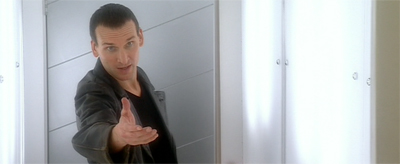
Looking back at the first season, I’d argue that it’s the most cohesive run of episodes that Russell T. Davies produced on the dhow. Now because of the whole “bad wolf” thing, as that feels a bit like a clumsy link randomly inserted. Instead, as we watch the final episode, it becomes quite clear what Davies was trying to do with his first year on the show. The patterns, the themes, the subtext, the references – it all becomes quite clear. More than any other season of Davies’ tenure, the first season is really one gigantic story – and not just because the show never leaves Earth or the finalé returns to the setting of The Long Game.

The first season is a bridge. It’s a link between the last years of the classic series into the new and revived show as written by Davies. It’s a moment to gather up the dead, tidy away the loose ends and basically manage the stage so that the show can really come into its own. One of the things I loved about Davies’ Doctor Who was how accessible it all was, but it still had all this continuity ticking away in the background.

This first season finalé feels like it isn’t only a conclusion to Christopher Eccleston’s time in the lead role, it’s also closing the last of the dangling threads from the eras of Colin Baker and Sylvester McCoy in the eighties. As soon as David Tennant steps into the lead role, it seems the show is entirely and utterly free of everything that came before. It’s a testament to Davies’ skill that we’re not even sure that he’s doing it.

Come with me if you want to live...

Come with me if you want to live…

Continue reading

Doctor Who: The Girl Who Waited (Review)

You always said that for Christmas dinner, you wish there were two of you.

– Rory tries to look on the bright side

The Girl Who Waited might just be the most Moffat-esque Doctor Who script that wasn’t written by the man himself. “Timey wimey” hijinks, killer robots, glitchy technology and cultural misunderstandings all tie together one of the best episodes of the show’s sixth season. Writer Tom MacRae even throws in a juicy character dilemma to add flavour. Offering a fairly explicit example of why travelling with the Doctor might not necessarily be a good thing, despite how much fun it might seem, The Girl Who Waited serves as a prelude to The God Complex, while continuing the season’s exploration of just how tough it is to be the companion.

The waiting room…

Continue reading