• Following Us

  • Categories

  • Check out the Archives


  • Awards & Nominations

Star Trek (DC Comics, 1989) Annual #2 – Starfleet Academy!

This August, to celebrate the upcoming release of Star Trek: Into Darkness on DVD and blu ray, we’re taking a look at the Star Trek movies featuring the original cast. Movie reviews are every Tuesday and Thursday.

We’ll be supplementing our coverage of the movies with tie-ins around (and related to) the films. We’ll be doing one of these every week day. This is one such article.

Multimedia franchises tend to have very strange lives. These iconic pop culture characters rarely seem to ride off into the sunset in any real way. Their story might end, but there’s always a new beginning just waiting for them. When veteran Star Trek writer Ronald D. Moore took charge of the reboot of Battlestar Galactica, he even wove the idea into the fabric of the show. “All of this has happened before and will happen again,” the characters repeated.

It’s been a Hollywood fad for the last decade, with high-budget reboots like Batman Begins and The Amazing Spider-Man suggesting that icons never die, they just get reinvented. However, it has always been a feature of the pop culture landscape. Think of how many adaptations of Batman have run their course, or how many times in how many different media Sherlock Holmes has played out his game of wits. Life for these iconic properties is something of a spinning wheel. It seems that no sooner are you off one side than you are back on the other.

So, with the release of Star Trek: The Undiscovered Country in 1991, it seemed the ideal time for Star Trek author Peter David to venture back to the very beginning, and to explore Kirk’s time at Starfleet Academy!

"By the way, I like David as a name..."

“By the way, I like David as a name…”

Continue reading

X-Men: Fatal Attractions (Review/Retrospective)

I’ll freely concede that I feel a bit conflicted when it comes to the X-Men comic books in the nineties. On the one hand, they were prone to nineties excesses, seemingly constantly in the midst of a sales-boasting crossover event, increasingly toyetic with steretypical portrayals and male and female anatomy. Also, to be entirely honest, they were never as exciting or creative as they had been when Claremont was directing the line – even his more esoteric efforts developed key themes and harboured a hint more ambition and sophistication than most of what followed.

However, I don’t want to give the impression I’m not fond of the X-Men in the nineties. That era, through the toys and the cartoon show, introduced me to the team. And, to be entirely fair, the books were very far ahead of the worst of what Marvel was publishing (as I’m currently reading The Crossing, I can vouch for that). I also have a certain amount of sympathy for a bunch of writers trying to find a direction for an entire line of books after a monumental and defining run by Chris Claremont. In many ways, Fatal Attractions reads like an attempt to draw a line in the sand under Claremont’s contributions to the franchise, and to boldly push forward with a modern take on the merry mutants.

It’s his magnetism, Charles…

Continue reading

X-Men: Messiah Complex (Review/Retrospective)

This is the seventh in a series of comic book reviews that will look at the direction of Marvel’s core continuity (and in particular their “Avengers” franchise) over the past five or so years, as they’ve been attempting to position the property at the heart of their fictional universe. With The Avengers planned for a cinematic release in 2012, I thought I’d bring myself up to speed by taking a look at Marvel’s tangled web of continuity.

It has been commonly accepted that the “golden days” of X-Men crossovers are behind us. Of course, “golden days” is a subjective term – for every Age of Apocalypse, there was an Onslaught Saga – but there’s no way to argue that the mutants didn’t dominate Marvel’s output in the nineties. One would have thought that with Bryan Singer’s X-Men helping give birth to the superhero genre, this past decade might have been an even better one for the franchise, but it was not to be. In fact, The Avengers seem to have replaced the X-Men as the engine driving Marvel’s storytelling universe. Some might suggest that it is so blatant that it looks intentional (prompting a movie-related “conspiracy theory”), although Marvel have casually denied it – with vice president Tom Brevoort stating “these things tend to go in waves”. However, Messiah Complex is the first of a series of crossovers with the X-Men titles following House of Mwhich would chart the franchise’s gradual return to the status quo.

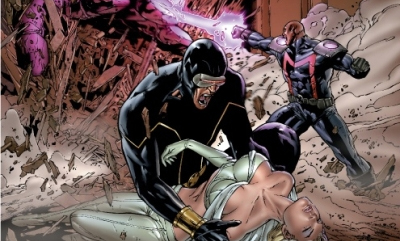
Cyclops has warmed to Ms. Frost…

Continue reading

Non-Review Review: Hulk

Ang Lee directing a superhero movie? He’s certainly a strange choice to handle the first big screen adaptation of Marvel’s iconic green monster to the big screen, but arguably a smart one. Hulk is at its best when it hints at the psychological melodrama playing out behind its lead character, but suffers greatly from the fact that it is apparently really uncertain about its source material or what it wants to be. It’s weird to see a movie so wonderfully risky in one sense, but so utterly bland in others. Hulk is an experiment, but sadly isn’t consistent enough to be a successful one.

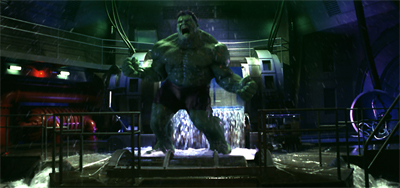
"Hulk Splash!"

Continue reading