• Following Us

  • Categories

  • Check out the Archives


  • Awards & Nominations

Star Trek: Deep Space Nine – Armageddon Game (Review)

Star Trek: Deep Space Nine is twenty years old this year. To celebrate, I’m taking a look at the first and second seasons. Check back daily for the latest review or retrospective.

It’s been a while since we’ve had a fairly generic “could have happened on any Star Trek episode of Deep Space Nine. So it’s a lot easier to forgive Armageddon Game its simplicity and lack of nuance. This isn’t a story specific to Deep Space Nine. The basic concept could – rather easily – have been tailored to fit Star Trek: The Next Generation or even Star Trek: Voyager, with two crew members on the run for their lives on an alien world.

Armageddon Game is another story idea from Morgan Grendel, a writer who tends towards extremes. The Inner Light remains one of the best episodes of Star Trek ever produced. The Passenger ranks among the worst episodes of Deep Space Nine ever to make it to the screen. Armageddon Game sits somewhere in the middle.

Talk about chemistry...

Talk about chemistry…

Continue reading

Star Trek: Deep Space Nine – The Forsaken (Review)

Star Trek: Deep Space Nine is twenty years old this year. To celebrate, I’m taking a look at the first season. Check back daily for the latest review or retrospective.

Following on directly from If Wishes Were Horses…, The Foresaken combines another bunch of familiar Star Trek clichés into a plot that fells like it has been elsewhere. To be fair, the “malfunctioning computer” plot is a plot that lends itself to a Star Trek setting, and the key is the execution of that most familiar set up. The franchise has done it quite well in the past. I’m fond of Star Trek: The Next Generation‘s foray into the subgenre with Disaster. Even Star Trek: Deep Space Nine would do a number of later episodes working quite well from this starting point – Civil Defense and Starship Down ranking quite highly.

The problem with The Foresaken, then, isn’t the fact that it falls back on a bunch of familiar Star Trek clichés, but it fails to use them to tell an especially compelling story.

Oh, what a world!

Oh, what a world!

Continue reading

Star Trek: Deep Space Nine – If Wishes Were Horses… (Review)

Star Trek: Deep Space Nine is twenty years old this year. To celebrate, I’m taking a look at the first season. Check back daily for the latest review or retrospective.

And after Progress gives us the most Deep-Space-Nine-y” episode yet, If Wishes Were Horses… offers the most generic Star Trek episode this side of The Passenger. The plot here should be very familiar. Like in Imaginary Friend or Shore Leave, the characters find their imaginations seem to be bringing things to life. Of course, it turns out to be an advanced alien intelligence that really just wants to study our crew, like in The Observer Effect or Scientific Method or even Schism. What I’m getting at here is that there’s really very little in this premise which hasn’t been done before or since on Star Trek, and nothing which wouldn’t feel more at home on Star Trek: The Next Generation or Star Trek: Voyager.

While it’s not as bad as The Passenger or Move Along Home, it is terribly generic and it feels like a waste of an episode in an already truncated season.

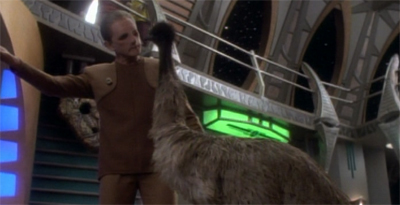
If wishes were emus...

If wishes were emus…

Continue reading

Star Trek: Deep Space Nine – The Storyteller (Review)

Star Trek: Deep Space Nine is twenty years old this year. To celebrate, I’m taking a look at the first season. Check back daily for the latest review or retrospective.

The Storyteller should not work half as well as it does. While some episodes this season (notably The Passenger and Battle Lines) feel like they were simply lifted directly from the “reject” pile within the writers’ room on Star Trek: The Next Generation, The Storyteller is actually a rejected pitch from that show’s first season. Written by Kurt Michael Bensmiller, the writer responsible for Time Squared, one of the stronger installments of the show’s first two years, it was also written late in 1992, about a month before Star Trek: Deep Space Nine would actually air.

And yet, despite that, The Storyteller really feels like a show that wouldn’t work on any of the other Star Trek spin-offs. A lot of that seems to be down to the work by Ira Steven Behr to polish up Bensmillers’ draft and to add a lot of character work and development to what is a decidedly high concept. As producer Michael Piller confessed in Captains’ Logs Supplemental – The Unauthorized Guide to the New Trek Voyages, “Ira did a lot of work on that script.”

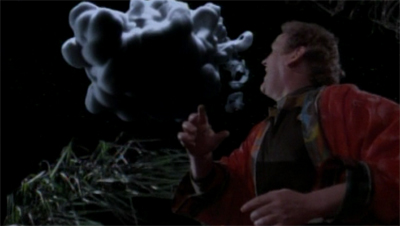
O'Brien's mind is a bit clouded right now...

O’Brien’s mind is a bit clouded right now…

Continue reading

Star Trek: Deep Space Nine – Battle Lines (Review)

Star Trek: Deep Space Nine is twenty years old this year. To celebrate, I’m taking a look at the first season. Check back daily for the latest review or retrospective.

Battle Lines is, quite frankly, not a very good piece of television. Like a few of the episodes scattered throughout the first season of Star Trek: Deep Space Nine, it feels like it was pulled from a list of rejected scripts for Star Trek: The Next Generation. Ironically, it feels more like a reheated left-over than the next episode, The Storyteller, which was actually a recycled script from the first season of The Next Generation. Were it not for the involvement of Kai Opaka and a few hints about Bajoran spirituality, Battle Lines would feel almost as generic as The Passenger.

The concept is fascinating, and it represents another long-term shift in Deep Space Nine, but the script from Hilary J. Bader feels too functional and broad to do the episode justice. Instead, it feels fairly bland, which is a bit disappointing for an episode where Sisko accidentally gets the pope caught up in the universe’s most deadly game of laser tag.

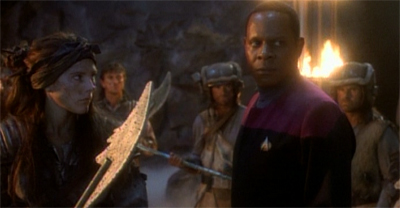
Taking a stab at bringing peace...

Taking a stab at bringing peace…

Continue reading

Star Trek: Deep Space Nine – Captive Pursuit (Review)

Star Trek: Deep Space Nine is twenty years old this year. To celebrate, I’m taking a look at the first season. Check back daily for the latest review or retrospective.

Much like Babel, it’s not too difficult to reimagine Captive Pursuit as an episode of Star Trek: The Next Generation. It’s notable for being one of the few episodes of Deep Space Nine to really feature the famous “Prime Directive”, something of a staple of the original Star Trek, The Next Generation and even Voyager. Like a lot of episodes from the middle of Deep Space Nine‘s first season, this seems almost like an attempt to port on episode concept directly over from The Next Generation. In particular, the notion of the crew dealing with a fugitive while wrestling with the Prime Directive feels like a retread of The Hunted.

That said, Captive Pursuit does work quite well, taking a familiar concept and putting a twist on it unique to the show. Despite the fact the episode’s premise feels like it has been carried over, the execution is careful enough to distinguish Deep Space Nine from its older sibling.

The hunted...

The hunted…

Continue reading

Star Trek: Deep Space Nine – A Man Alone (Review)

Star Trek: Deep Space Nine is twenty years old this year. To celebrate, I’m taking a look at the first season. Check back daily for the latest review or retrospective.

To be fair to Star Trek: Deep Space Nine, it’s clear that the show’s heart is in the right place. After all, a Star Trek television show isn’t quite the gambit that it was in 1987. The producers expect that the series will be going for quite some time. After all, the regulars signed six-year contracts, one of the reasons that the show managed to make it to its penultimate season without losing a primary cast member.

As such, a lot of the early episodes of Deep Space Nine seem prudent – they effectively amount to good housekeeping. While Star Trek: The Next Generation got its cast together and couldn’t wait to start telling bold Star Trek stories, you can see that Deep Space Nine is laying a lot of groundwork. The ensemble doesn’t gel instantly. Episodes are devoted to little more than set-up for something that will pay off over the coming year. A vast supporting cast is systematically established.

This is world-building, and it’s world-building to a purpose, even if Deep Space Nine doesn’t seem to really know what that purpose is yet. So it’s quite hard to fault these early episodes, even if they feel more like set-up for delayed pay-off.

The writing's on the wall for Odo...

The writing’s on the wall for Odo…

Continue reading