• Following Us

  • Categories

  • Check out the Archives


  • Awards & Nominations

Millennium – Owls (Review)

This May and June, we’re taking a trip back in time to review the fifth season of The X-Files and the second season of Millennium.

I am like a pelican of the wilderness; I am become as an owl of the waste places.

– Psalm 102:6

Birds of prey...

Birds of prey…

Continue reading

The X-Files – Patient X (Review)

This May and June, we’re taking a trip back in time to review the fifth season of The X-Files and the second season of Millennium.

This should not work.

There are lots of reasons why Patient X and The Red and the Black should simply implode under their own weight. Most obviously, they are scripts that are rather blatantly just piling more and more back story and convolution onto a framework that is already overloaded and over-stretched. They are introducing new characters at a late stage of the game. They rely on contrivance and sketchy character development. They seem to exist at odds with the script for The X-Files: Fight the Future, which had been written and shot, but was awaiting release.

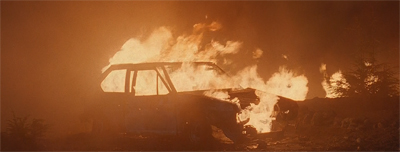
Everything burns...

Everything burns…

However, despite all this, Patient X and The Red and the Black work very well together. They are the strongest story-driven mythology two-parter since Nisei and 731 at the start of the third season. There is an energy and drive to Patient X and The Red and the Black that has been largely absent from the show’s big blockbuster two-parters since Herrenvolk at the start of the fourth season. After a year-and-a-half treading water as the release date of the movie draws ever closer, it is nice to see Chris Carter cut completely loose.

Patient X and The Red and the Black form a story which doesn’t seem at all worried about what any of this means for the summer realise of Fight the Future. Parts of it become quite difficult to reconcile with the film as released. However, the two-parter is all the stronger for it.

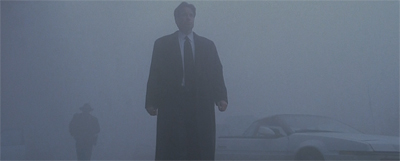
Fog of war...

Fog of war…

Continue reading

The X-Files (Topps) #37 – The Face of Extinction (Review)

This May and June, we’re taking a trip back in time to review the fifth season of The X-Files and the second season of Millennium.

Suspension of disbelief is a curiously fickle thing.

It is a concept that generates considerable debate in its function and application. After all, the normal mode of fiction generally accepts that fiction is… well, fictional. There is no real belief to shatter, because there is an innate understanding between artist and audience that a work of art should be interpreted as a representation of reality rather than a piece of reality. Even in the case of “true stories”, audiences will willingly and readily accept alterations and adjustments designed to streamline the story in question.

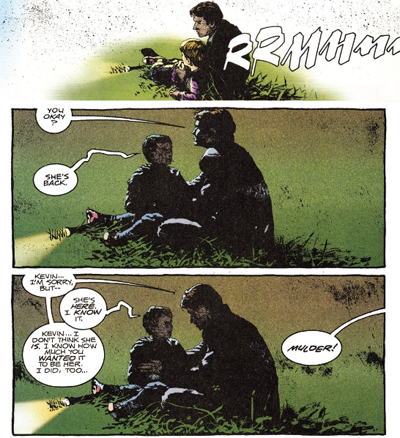
Ramming speed...

Ramming speed…

After all, the concept of “suspension of disbelief” is quite firmly disengaged from the concept of reality. The old cliché about “truth being stranger than fiction” illustrates the distinction. The real world (and the stories of the people who inhabit it) are full of coincidences and contrivances that audiences would consider to be lazy writing or poor construction if they appeared in a work of fiction. Nevertheless, while “suspension of disbelief” might be more complex than its three-word nature would suggest, it is a useful philosophy.

What “breaks” a work of fiction? At what point does the artist – whether intentionally or otherwise – push the audience out of the story? What causes a double take to occur or a quizzical eyebrow to raise? What story developments prompt angry sighs or bitter grumbling? There is no hard and fast answer. The line will always be arbitrary, varying from audience member to audience member. Everybody has different expectations when it comes to art, and so that threshold is distinct for every person.

"Don't worry, Scully! Stay right there... I'm going to get my camera."

“Don’t worry, Scully! Stay right there… I’m going to get my camera.”

Sometimes people can agree on where the line falls on a certain work, but everybody has their limits. There are some people who embrace perceived absurdities or inconsistencies or incongruities in their stories; there are some people who simple do not consider those absurdities or inconsistencies or incongruities to exist at all. One of the great things about The X-Files as a television show is the sense of adventure and excitement that the premise generates. It is highly flexible, allowing for almost anything.

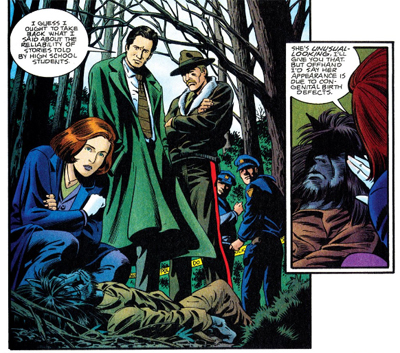
At the same time, it seems quite clear that writer John Rozum and artist Alex Saviuk find themselves charging head-first towards that highly arbitrary and high flexible boundary with The Face of Extinction, a story about a secret race of intelligent goat people who have lived alongside human civilisation for millennia and who also (conveniently) speak perfect English. It is a rather absurd concept, and one that seems at odds with the relatively grounded style of the first five seasons of The X-Files.

Beastly.

Beastly.

Continue reading

The X-Files: Season One (Topps) #4 – Conduit (Review)

This May and June, we’re taking a trip back in time to review the fifth season of The X-Files and the second season of Millennium.

Conduit is an interesting choice for a Season One comic.

It is the last of the first season mythology episodes to be adapted by Roy Thomas as part of the Season One brand. The Pilot and Deep Throat had launched both The X-Files and the mythology, but Conduit was really the show that emphasised that The X-Files would be returning to the idea of alien abduction quite frequently in the months and years ahead. Conduit paved the way for later first season episodes like Fallen Angel or E.B.E. Neither Fallen Angel nor E.B.E. were ever adapted for the Topps Season One range. Neither was solicited when the line was cancelled.

Myth-making...

Myth-making…

At the same time, Conduit is an episode that has not dated particularly well. As the fourth episode of the first season, it was quite effective at spelling out who Mulder was and how the abduction of Samantha motivated him to do what it was that he was doing. It was not subtle or nuanced character development, but there was a certain blunt appeal to it. Viewers had only just been introduced to Fox Mulder, so it was perfectly reasonable to bludgeon them over the head with his motivation and his back story.

However, the show has marched on. Mulder has developed and grown into a multifaceted character. Samantha will always be an essential part of his character arc, but she is no longer the only motivating factor. Indeed, David Duchovny even improvised a line into Oubliette that criticised Scully for behaving like Samantha was the only motivating factor in Mulder’s life. As such, it feels strange to go back to Conduit after all this time, and to see a very basic and early take on Mulder’s character. It underscores how far the show has come.

Far afield...

Far afield…

Continue reading

The X-Files – Redux I (Review)

This May and June, we’re taking a trip back in time to review the fifth season of The X-Files and the second season of Millennium.

Redux I hits on the same problem that haunted The Blessing Way. It is very hard to structure a three-parter that bridges two seasons of television. The biggest problem is the second episode, which has the unfortunate position of having to serve as a season premiere while carrying the baggage from the last season finalé and remaining unable to resolve anything. So the episode inevitably becomes an exercise in spinning wheels as the show saves all of its potential resolutions for the third episode.

A particular cynical commentator might suggest that Redux I plays as Chris Carter’s twisted take on Aaron Sorkin. Sorkin is famous for his sequences of characters walking through corridors while trading witty banter – a very nice way of keeping physical movement in the midst of largely dialogue-driven plots. This would become a defining feature of The West Wing, the show that Sorkin would launch in September 1999. Redux I seems to prefigure the style, albeit with a twist. There is lots of walking through corridors as characters talk to themselves in monologue.

"Wow, and I though my filing system was bad..."

“Wow, and I thought my filing system was bad…”

Redux I plays as a collection of voice-over monologues transposed over sequences of Mulder wandering through corridors in the Pentagon. One immediately wonders how the Department of Defence could have staged such a complex and convincing hoax against the American people when they cannot find one lost FBI agent inside the Pentagon. The drab setting makes for a shockingly dull episode; the majesty of the Yukon Mountains is lost, replaced by long sequences of grey walls and red doors.

Redux I has more than a few interesting ideas, but its structure is a mess. Sitting between Gethsemane and Redux II, the episode has no clear sense of purpose or momentum; no drive or ambition or excitement.

Don't worry, it could still make sense...

Don’t worry, it could still make sense…

Continue reading

Star Trek: Enterprise – Future Tense (Review)

Next year, Star Trek is fifty years old. We have some special stuff planned for that, but – in the meantime – we’re reviewing all of Star Trek: Enterprise this year as something of a prequel to that anniversary. This April, we’re doing the second season. Check back daily for the latest review.

The Temporal Cold War arguably works better as a metaphor than a plot.

There is something quite compelling about the imagery of Star Trek‘s past and future doing battle within the confines of a troubled prequel, of outside forces meddling in a narrative, of the characters caught in the grip of forces they cannot understand. To expect the Temporal Cold War to make sense is to miss the point; to expect clear resolution is foolhardy. Instead of serving as a strong narrative thread running through Star Trek: Enterprise, it serves as a visual manifestation of the troubles haunting the show. It also serves as a very effective story backdrop.

Let's do the time warp again...

Let’s do the time warp again…

Future Tense has a pretty straightforward story. Archer and his crew discover a piece of floating space debris. They bring it aboard, discovering it is not what it appears to be. The Suliban show up, claiming salvage rights. The Tholians arrive, demanding the same. A chase ensues, as Archer tries to outrun the two alien species desperate to get their hands on the technology. Future Tense is a classic chase narrative, as multiple parties fight over what Hitchcock described as a “macguffin.” Little is revealed, nothing is proven, everything is resolved so neatly that it seems divine intervention is at work. Maybe it is.

And yest, despite – or perhaps because – of this narrative simplicity, Future Tense stands as a highlight of the troubled second season. Future Tense leaves almost every question about the Temporal Cold War unanswered, but it is a tight and efficient action adventure. Like Cold Front before it, it recognises that the Temporal Cold War is a story as much as a backdrop. The fact that it is mysterious and nonsensical and arbitrary make it all the more compelling. After all, that is how it must appear to Archer.

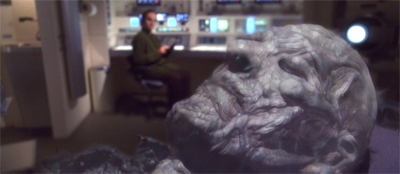
Alien bodies...

Alien bodies…

Continue reading

Millennium – Paper Dove (Review)

This February and March, we’re taking a trip back in time to review the fourth season of The X-Files and the first season of Millennium.

Millennium is an odd show in a number of ways.

The most obvious of these oddities is the sense that each of the three seasons feels like a different television show. The first season is markedly distinct from the second, the second is clearly delineated from the third. It is a very strange structure, one explained by the fact that the three seasons were overseen by three different creative teams with three very different visions of the show. One of the results of this approach is that each season finalé becomes a de facto series finalé, an episode bidding farewell to a particular vision of the show.

This is what it feels like... when doves cry...

This is what it feels like… when doves cry…

Paper Dove bids farewell to the “serial-killer-of-the-week” mechanics of the first season. Of course, there would be later episodes that would feature serial killers. In fact, The Mikado is possibly the best serial killer the show ever did. The Beginning and the End seems explicitly about killing off the “serial-killer-of-the-week” so that the show can invest its time and energy in other pursuits. However, stripped down to its core, Paper Dove takes the show’s approach to serial killers to its logic conclusion.

Although the show has featured serial killers with motivations that might be easily understood and perhaps even pitiable, Henry Dion is the show’s first serial killer to becomes almost sympathetic; it is one of the rare times that the show manages to capture the banality of evil, as opposed to the show’s traditional approach – one that brushes up against (and occasionally crosses over into) a sensationalist or gratuitous approach to serial killer pathology.

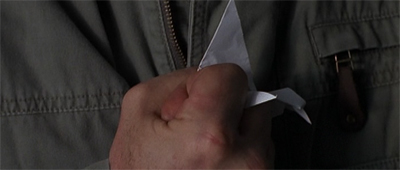
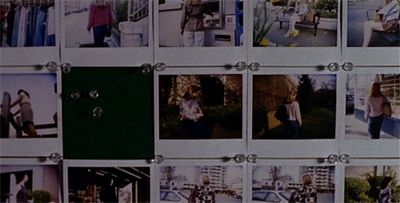
Picture this...

Picture this…

Continue reading

The X-Files – Demons (Review)

This February and March, we’re taking a trip back in time to review the fourth season of The X-Files and the first season of Millennium.

The fourth season of The X-Files is an oddity.

That is particularly true when it comes to the show’s mythology. Not only has any sense of narrative progression stalled after the “to be continued…” hook of Talitha Cumi, the fourth season seems to branch the mythology out in multiple directions that never really get anywhere. Tunguska and Terma introduce a Russian conspiracy that quickly becomes a footnote. Tempus Fugit and Max focuses on private military contractors who are never mentioned again. Memento Mori gives Scully cancer halfway through the season, and the rest of the year tries to catch up.

A cigarette-smoking spectre...

A cigarette-smoking spectre…

Demons is an episode that sits rather awkwardly as the penultimate episode of the season. An episode about Mulder undergoing aggressive therapy to recover lost memories seems a little out of place with everything else going on around him. After Memento Mori, you would imagine he would be worried about Scully. After Zero Sum, you imagine he would be wary about putting himself in a vulnerable position. Demons feels very much like it would make a good first season episode, a product of the time when Samantha Mulder was our lead’s primary driving motivation.

Instead, Demons sits awkwardly before the big season finalé with its own clear agenda. Scully’s closing monologue is clearly designed to lead into Gethsemane as almost a four-part season-bridging epic. However, the execution feels a little too haphazard, a little too casual, a little too disorganised. Demons feels less like the lead-in to an earth-shattering story and more like a script designed to plug a gap late in the season.

"Hey, look on the bright side, this time next year, you'll be in a psychiatric institution."

“Hey, look on the bright side, this time next year, you’ll be in a psychiatric institution.”

Continue reading

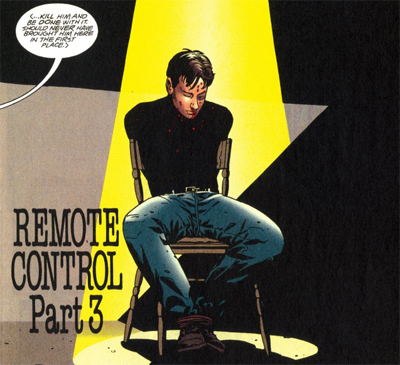
The X-Files (Topps) #27-29 – Remote Control (Review)

This February and March, we’re taking a trip back in time to review the fourth season of The X-Files and the first season of Millennium.

In many respects, Remote Control is a very “big” story.

It is the biggest story that writer John Rozum has told to date on the comic book, one that spans three issues and seems to brush against the edge of the mythology most associated with The X-Files. Not only does Remote Control feature secret CIA experiments into psychic phenomenon, it also involves a UFO that is being transported through the United States and is hijacked by a foreign power. To top it all off, there is a super-soldier who can render himself invisible and make himself immune to bullets.

Everything is under control...

Everything is under control…

There is a very clear sense of scale to Remote Control, one that suggests this is a blockbuster adventure. This is the comic book equivalent of those mythology episodes that air during sweeps. At the same time, however, Remote Control brushes up against the limitations imposed upon the comic book by Topps and Ten Thirteen. While Remote Control offers the highest stakes that the comic book has seen since Feelings of Unreality, the script is quite clear that this is a story separate and divorced from anything happening in the show.

There are points where it feels like Remote Control goes out of its way to remind readers that this is just a tie-in comic book, and is thus secondary to the television show.

Mulder is a little tied up right now...

Mulder is a little tied up right now…

Continue reading

The X-Files – Max (Review)

This February and March, we’re taking a trip back in time to review the fourth season of The X-Files and the first season of Millennium.

Reportedly, Tempus Fugit and Max took twenty-eight days to shoot. Assistant director Tom Braidwood described the two-parter as a “pretty challenging” effort for the show. The series built an air plane cabin specifically so that it could film those fantastic abduction sequences. There are fields and hangars strewn with dead bodies and the wreckage of a passenger air plane. By just about any definition, Tempus Fugit and Max comprise the most ambitious and large-scale two-part episode that the show has produced to date.

Paradoxically, this is also the smallest two-part episode that the show has produced to date. It brings back a minor guest star from a first season episode, only to kill him off casually in the teaser for the first episode. None of the big players show up for the drama. The most significant consequence of Tempus Fugit and Max is the death of Agent Pendrell. In many ways, Tempus Fugit and Max is the post-mortem story of a little guy who was crushed by the weight of something much larger than himself – caught between forces of immeasurable power.

In-flight serve will now resume...

In-flight service will now resume…

Tempus Fugit and Max do very little to advance the central mythology arc, which has stalled somewhat in the fourth season. However, they manage to encapsulate so many of the core themes of that central storyline. This is a story about the victimisation of the weak by the powerful; this is a tale about the sacrifices that are made in pursuit of the truth; this is a reflection on the appeal of conspiracy theory; this is a morality play about balancing lives against “the greater good.”

In many ways, Tempus Fugit and Max are the quintessential mythology episodes, despite not being that closely related at all.

Things are looking up...

Things are looking up…

Continue reading