• Following Us

  • Categories

  • Check out the Archives


  • Awards & Nominations

The X-Files: Season 10 (IDW) #11-15 – Pilgrims (Review)

This June, we’re going to be taking a look at the current run of The X-Files, beginning with the IDW comic book revival and perhaps taking some detours along the way. Check back daily for the latest review.

Pilgrims is essentially an attempt to do a mid-season mythology episode in the style of Colony and End Game or Tunguska and Terma, a big sprawling epic populated by familiar faces and impossible scale that is driven more by questions and mysteries than by answers or revelations. It is in many ways a testament to writer Joe Harris’ desire to emulate the basic structure and framework of The X-Files, right down to the manner in which he structures The X-Files: Season 10.

There are a lot of obvious markers and touches that help Pilgrims to feel like a classic mid-season mythology episode. There is an international scope, as seen in the trip to the Arctic in End Game or to Hong Kong in Piper Maru or to Russia in Terma. The first half of Pilgrims unfolds in Saudi Arabia, with Mulder and Scully dispatched to investigate what initially appears to be a terrorist attack on an oil operation but is promptly revealed to be something far more sinister.
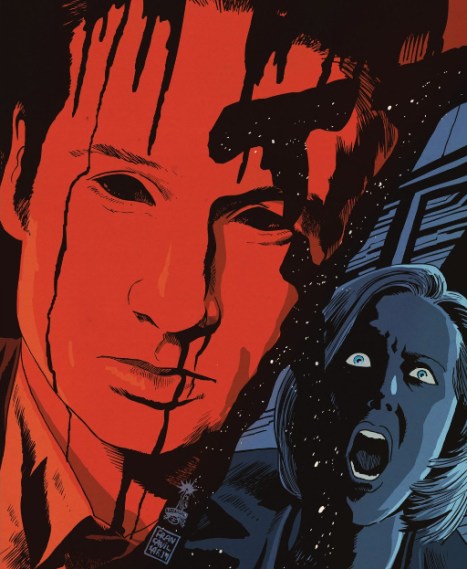
The red and the black.

The red and the black.

Similarly, in keeping with the style and tone of many of the best mythology two-parters, the basic plot is relatively straightforward even as complications appear at the edge of the frame. In End Game, Mulder is racing to recover his lost sister as details about secret cloning experiments spill out around him. In Nisei, Mulder is trapped in a traincar with a ticking time bomb and a dangerous assassin as he digs away at the conspiracy. In Apocrypha, the black oil just wants to go home. The same is true in Pilgrims, which follows an alien trying to escape.

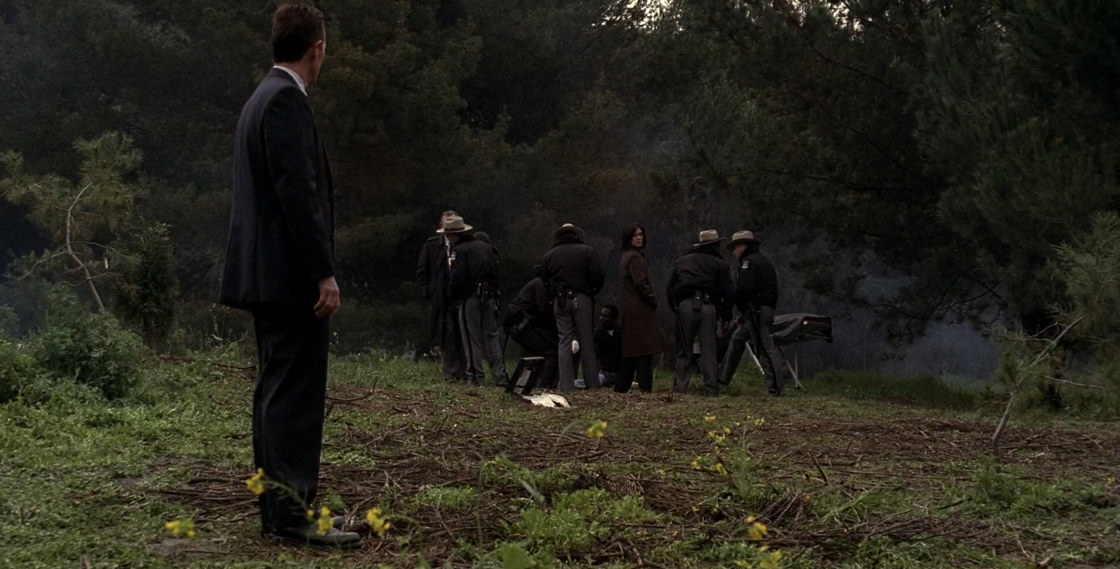
Even the structure of the five-issue arc recalls that of many X-Files two-parters, with a massive pivot coming between the third and fourth issues in the same way that many two-parters would switch premises at the half-way point. The Saudi Arabia plot wraps up at the end of the third issue, while Gibson Praise is introduced at the start of the fourth. The first three issues focus on the mystery of the Saudi attack, while the final two put a much greater emphasis on the traditional trappings of the X-Files mythology including the conspirators and Skyland Mountain.
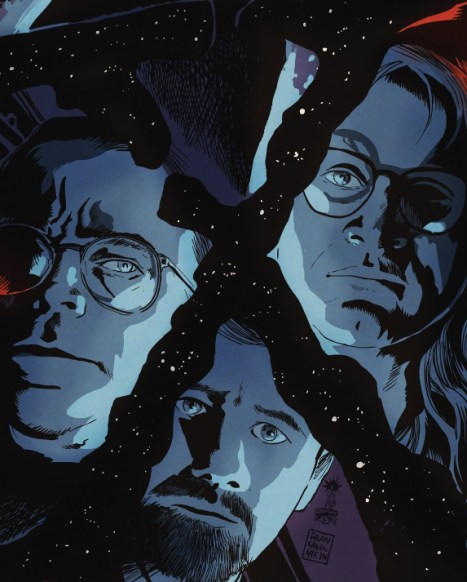
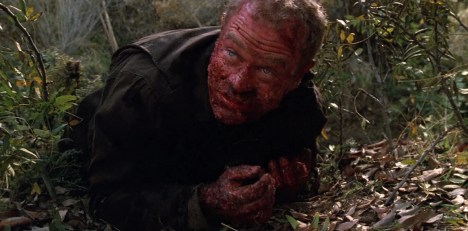
Lone survivors.

Lone survivors.

It is remarkable how faithful Joe Harris is to the format of those classic X-Files mythology episodes. Of course, this is something of a double-edged sword. As with a lot of The X-Files: Season 10, the biggest weakness of Pilgrims is the fact that it all feels a little overly familiar and a little too indulgent. Krycek was one of the most popular supporting characters from the nine-season run of The X-Files, but bringing him back at the centre of a five-part epic mythology story feels like pandering and fan service. Harris is not inventing his own mythology, but resurrecting an old one.

Then again, that might seem to be the point. The black oil discovered in Pilgrims is compared to the oil resting beneath Saudia Arabia. In that respect, it is the remains of long-dead organisms compressed and decayed and converted into fuel. There is something more than a little appropriate about that.
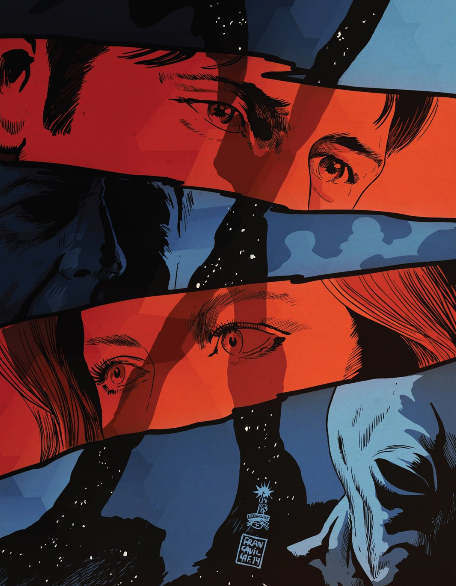
Eye see.

Eye see.

Continue reading

The X-Files – The Truth (Review)

This December, we’re taking a trip back in time to review the ninth season of The X-Files.

It is interesting how the popular memory of a thing can differ from the actual thing itself.

Memory was always a key theme of The X-Files, particularly in the early years of the show. Although the aliens and the conspirators were plucked from the demented imaginations of the most paranoid tinfoil hat enthusiasts, a surprising amount of the show was rooted in real history that had been allowed to slip by under the radar: the genocide of the Native Americans; the resettlement of German and Japanese war criminals after the Second World War; radiation experiments upon prisoners; the Tuskegee syphilis experiment.

Daddy's home.

Daddy’s home.

The truth is contained in the gap between memory and history. In a way, then, it feels entirely appropriate that the popular memory of The X-Files should remain quite distinct from the show itself. The popular memory of The X-Files tends to suggest that the mythology makes no sense, that it does not fit together in any tangible form. This is an opinion repeated so often that it has become a critical shorthand when discussing the end of the show; much like the assertion “they were dead all along” tends to come when discussing Lost.

The truth is that the mythology of The X-Files largely made sense. Sure, there were lacunas and contradictions, inconsistencies and illogicalities, but the vast majority of the mythology was fairly linear and straightforward. It had been fairly straightforward for quite some time. The show had been decidedly ambiguous in its first few seasons, only confirming that colonisation was the conspiracy’s end game in Talitha Cumi at the end of the third season. Elements like the black oil and the bees tended to cloud matters, but the internal logic was clear.

Everything burns...

Everything burns…

Significant portions of both The X-Files: Fight the Future and Two Fathers and One Son had been dedicated to spelling out the finer details of the mythology in great detail. Mankind were not the original inhabitants of Earth; the former occupants had returned and were making a rightful claim; the conspirators had agreed to help them, selling out mankind for a chance to extend their own lives. Everything else was window dressing. The production team had laid everything out during the fifth and sixth seasons.

Still, the general consensus of The X-Files was that it was a show driven by mysteries that was always more interested in questions than answers. This was certainly true, but it was somewhat exaggerated. When the cancellation was announced, the media immediately demanded answers. A month before The Truth was broadcast, Tim Goodman complained about how the show offered “precious few answers to Carter’s riddles.” Two days before the broadcast, Aaron Kinney wondered of the conspirators, “Who are these people and what is their agenda?”

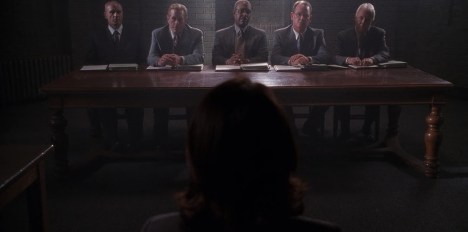
The Truth on trial...

The Truth on trial…

It does not matter that these answers have mostly been provided and that the truth is mostly know. This was the context of the conversation unfolding around The Truth, and it likely explains a number of the creative decisions taken during the production of the episode. The Truth plays as an extended video essay dedicated to providing answers that were offered three or four seasons earlier in relation to mysteries that are no longer part of the show. The Truth is a passionate and intense argument that the mythology of The X-Files does make sense.

For viewers tuning back into the show for the first time in years, this means long expository monologues and skilfully edited montages that do not tie into the plot of the episode in any significant way. For those who stuck with the show for these past few seasons, it means rehashing everything that the show has taken for granted since the fifth or sixth season. While it feels like The Truth is desperately longing for vindication, to the extent where the show puts itself on trial in the person of Fox Mulder, this does not make for compelling viewing.

Happy ending.

Happy ending.

Continue reading

The X-Files – Provenance (Review)

This December, we’re taking a trip back in time to review the ninth season of The X-Files.

Provenance and Providence are a landmark moment for The X-Files. They represent the last mid-season two-parter.

The mid-season two-parter has been an institution since the early second season, when external factors forced the production team to improvise around Gillian Anderson’s pregnancy. It was decided that the character of Scully would marginalised and written out so as to avoid dealing with the pregnancy, and the centre-piece of that plan was an epic two-parter that would air during in October 1994. Duane Barry and Ascension were such a big hit that the production team opted to do a second mid-season two-parter in February 1995, with Colony and End Game.

The Truth will not be buried...

The Truth will not be buried…

The show never looked back. Those episodes quickly codified the mythology, becoming a highlights in the season schedule. The two-parters typically aired during Sweeps and occasionally managed to garner press and media attention. They featured bigger budgets and impressive scale, with many of those two-parters standing out as prime examples of The X-Files as “event” television. The submarine in the ice in End Game, the leap to the train in Nisei, the mid-air alien abduction in Max. These were blockbuster moments.

Provenance and Providence would mark the end of this rich tradition. Sadly, they do not embody the finest attributes of the form.

Burnt notice.

Burnt notice.

Continue reading

The X-Files – Trust No 1 (Review)

This December, we’re taking a trip back in time to review the ninth season of The X-Files.

Trust No 1 is an episode that is more relevant now than it was in January 2002. And not just because “trustno1” is still among the most popular (and least secure) internet passwords.

The core ideas of Trust No 1 are fascinating. In hindsight, it is impressive that the production team were able to produce something like Trust No 1 so quickly after the events of 9/11. The type of surveillance state depicted in Tust No 1 would turn out to be quite close to reality in the era of Edward Snowden and the scandal National Security Ageny. “They’re watching,” the words at the end of the title sequence tease, words which seem even more ominous over a decade after initial broadcast.

Circle the odd one out...

Circle the odd one out…

Unfortunately, while Trust No 1 seems to get more and more relevent with each passing year, the episode itself is a mess. As powerful and resonant as its central themes might be, Trust No 1 is very clearly the work of a production team with no idea of where the show is going or where they want to take it. All the worst excesses of the ninth season mythology are on display here, from the heartbreaking obsession with Mulder through to the marginalisation of Scully. The dialogue is overwrought and the climax is absurd. Trust No 1 simply doesn’t work.

And yet, despite all that, it exerts an odd power. It is a power muted by some of the creative decisions around it, and by some of the choices made in structuring the teleplay, but it is power nonetheless.

Night vision, deserves a quiet night...

Night vision, deserves a quiet night…

Continue reading

The X-Files 104: Ten “Monster of the Week” Episodes (Seasons 6-9)

Next week sees the release of The X-Files on blu ray for the first time, just over a month before the new six-episode series premieres on Fox in January. We’re running daily reviews of the show (and its spin-offs) between now and the end of the year, but we thought it might be worth compiling some guides for newer viewers who are looking to experience the length and breadth of what The X-Files has to offer. Every day this week, we’ll be publishing one quick list of recommended episodes every day, that should offer a good place to start for those looking to dive into the show.

Everything changed between the fifth and sixth seasons of The X-Files. The release of The X-Files: Fight the Future perhaps represented the peak of the show’s popularity, but the summer of 1998 saw the show moving its production from Vancouver to Los Angeles. This had a tremendous impact on how the show was produced; working in Los Angeles meant higher budgets, bigger guest stars and a completely different environment. Gone was the rainy atmosphere of Canada, replace with California sun. It was almost a new show.

xfiles-millennium37a

Continue reading

The X-Files – Season 8 (Review)

This October/November, we’re taking a trip back in time to review the eighth season of The X-Files and the first (and only) season of The Lone Gunmen.

The eighth season of The X-Files would be the perfect last season of the show, and a pretty solid first season of a new show born from the ashes.

In many ways, television is a conservative medium – more in an artistic sense than a political one. Network television is largely built around churn, a conveyor belt model that is designed to generate product according to tight schedules and oppressive deadlines. Routine and familiarity make the production schedule easier to manage, particularly for shows with large season orders. More than that, if a show has figured out an approach that has worked, it makes no sense to deviate from that pattern.

xfiles-deadalive33a

Why risk changing something that has been proven to work and to which the audience has responded? For all the (deserved) praise The X-Files gets for popularising (or repopularising) serialised storytelling in prime-time television, it was just as conservative as any other show. The production team were working under incredible pressure, so it makes sense they would not want to change a formula that made sense. As such, the really big changes to the show were largely driven by external factors.

The mythology largely developed from Scully’s abduction in Duane Barry and Ascension, an attempt by the writers to work around Scully’s abduction. The decision to film The X-Files: Fight the Future between the fourth and fifth seasons was at the behest of Fox rather than the production team. David Duchovny forces the move to Los Angeles in the sixth season. The eighth season represents the most seismic shift in the creative life of The X-Files, and – as with those other big decisions – it was largely driven by choices outside the production team.

xfiles-thisisnothappening13a

In hindsight, it seems obvious that the show could not continue forever. Duchovny and Anderson were headlining a show that filmed twenty-odd episodes a season. The show had begun diffusing its focus in the fourth and fifth seasons by focusing on members of the supporting cast, but it was still effectively a two-lead show. That is a tremendous strain. Something had to give. It turned out that something was Duchovny. At the end of the seventh season, with everything coming down to the wire, Duchovny made it clear he would not appear in a full eighth season.

This forced the show to change, but in a way that afforded some measure of stability. The idea of doing The X-Files without either Mulder or Scully was horrifying to the production team and horrifying to certain sections of fandom, but Duchovny’s willingness to stick around for half of the eighth season afforded some measure of compromise. The change did not need to be jarring. Easing David Duchovny out of the show would allow for a smoother transition. It would allow the show to say a proper (and extended) farewell to Mulder.

xfiles-empedocles23a

This is perhaps the strongest aspect of the eighth season, the sense that it has a certainty and finality that the seventh season lacked. Even during the post-production of Requiem, the production team had no idea whether the seventh season would be the final season of the show. As a result, the seventh season is decidedly non-committal on the issue of closure. The eighth season is a lot more enthusiastic about the prospect of wrapping things up, once and for all. There is a sense that this is the final season of a version of the show, at the very least.

The eighth season finds itself in the impossible position of having to imagine The X-Files without Mulder. The only real issue is that it succeeds all too well. The biggest problem with the eighth season is that it is followed by a ninth season.

xfiles-without2a Continue reading

The X-Files – Existence (Review)

This October/November, we’re taking a trip back in time to review the eighth season of The X-Files and the first (and only) season of The Lone Gunmen.

This is not the end.

But it really should be. At least for Mulder and Scully.

There was no season nine. What are you talking about?

There was no season nine.
What are you talking about?

Continue reading

The X-Files – Essence (Review)

This October/November, we’re taking a trip back in time to review the eighth season of The X-Files and the first (and only) season of The Lone Gunmen.

The mythology of The X-Files is a strange beast.

In the show’s declining years, it frequently became a stick with which the show might be beaten by critics and fans who had grown exhausted of ambiguity and labyrinthine plotting. Steven King lamented the fact that the show “blundered off into a swamp of black oil, and in that swamp it died.” In assessing the impact of the series, Joyce Millman described the mythology as a “sadistically convoluted plot line.” Juliette Harrisson complained that the entire mythology ended up “so twisted and incomprehensible by the end.”

Oh, baby.

Oh, baby.

In hindsight, it seems like history has not been kind to the mythology. In the years since the show went off the air, it seems that fans have come to value the episodic “monster of the week” stories ahead of the central story arc about aliens plotting to colonise the planet. This is ironic, given the attention devoted to the mythology while the show was on the air. The mythology dominated season premieres and finalés, taking the limelight during Sweeps and commanding impressive production values.

This assessment of the mythology is at once fair and unfair. Examined from far enough away, the mythology was linear and logical: alien colonists were coming back to reclaim the planet and enslave (or exterminate) mankind. Everything else was just window-dressing, with the mythology exploring the compromise and collaboration that facilitated this plan. The mythology was, at its best, an exploration of human weakness and the corruption of authority; a timeless (and almost Shakespearean) tragedy. From a sufficient distance, it was not hard to follow.

Oh, alien baby.

Oh, alien baby.

However, the details tend to create confusion, with everything getting a little muddled as The X-Files piles compelling and memorable visuals on top of one another. Are the bees intended to spread smallpox to thin the population as Zero Sum suggests, or to spread the black oil to aid in repopulation as The X-Files: Fight the Future implies? Is the black oil a sinister body-hopping parasite as suggested in Piper Maru and Vienen, or is it an organism that turns the body into a host for a gestating alien organism like in Fight the Future or The Beginning?

The eighth season does a lot to simplify the mythology by stripping out the conspirators and the vaccine and the rebels and the hybrids, replacing them with a more blunt central narrative about “alien replicants” mounting a stealth invasion. That said, things begin to get a bit cluttered and crowded as the season reaches its conclusion. Essence and Existence have a very clear structure and clear objectives, but there is a sense that that the narrative could still be streamlined a bit.

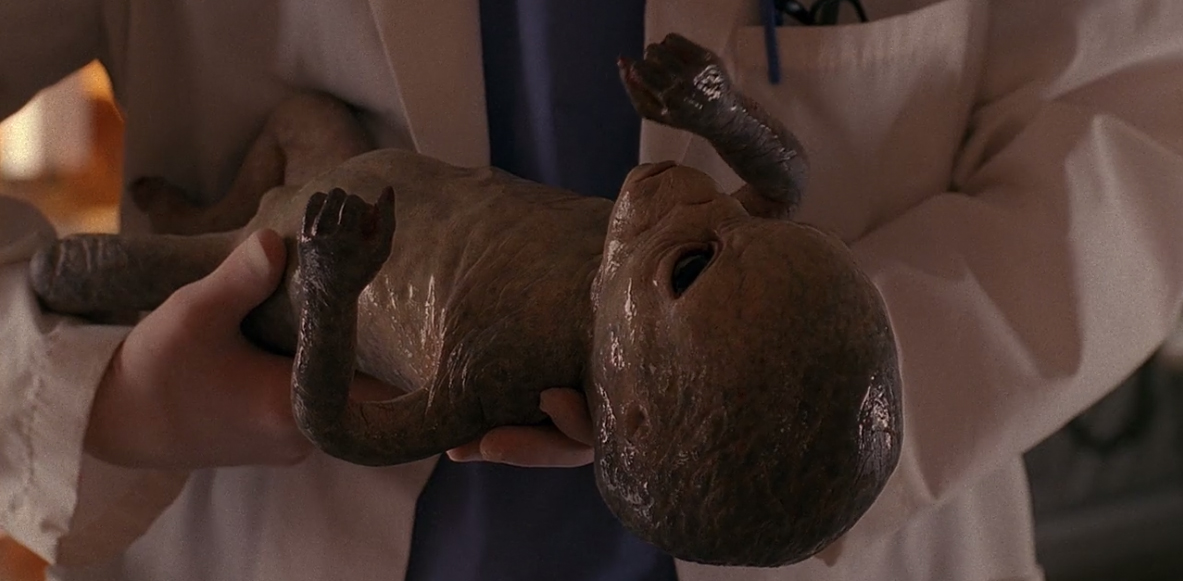
Oh, blood-splattered alien babies...

Oh, blood-splattered alien babies…

Continue reading

The X-Files – Vienen (Review)

This October/November, we’re taking a trip back in time to review the eighth season of The X-Files and the first (and only) season of The Lone Gunmen.

It feels strange to see the black oil after such a long time.

Technically, the last time that the black oil was brought up was in Two Fathers and One Son, where it was retroactively confirmed to be the “Purity” alluded to in The Erlenmeyer Flask. However, the last time it was an active plot element was really The X-Files: Fight the Future. After that, it lost amid plot developments involving gestating aliens and faceless rebels. So, in a way, putting the black oil at the centre of Vienen feels just a little surreal against the backdrop of “super soldiers” and other more immediate concerns.

Explosive action!

Explosive action!

Vienen feels very old-fashioned. Even the structure of the episode harks back to the first season mythology episodes, when the show was allowed to use aliens and conspiracies without the burden of tying them to a larger narrative. It features the black oil, but Vienen feels closer to Fallen Angel or E.B.E. than Tunguska or Terma. Trying to tie it into the larger plot of the mythology is an exercise in futility, but that is not the point here. Vienen is no more or less a mythology episode than Empedocles, despite its inclusion in the “mythology” DVD collections.

It is an excuse to bring back an iconic baddie for one last run-around with Mulder, continuing the orderly transition of power from the what the show was to what it might be in the future.

You should really use a dipstick for that...

You should really use a dipstick for that…

Continue reading

The X-Files – Empedocles (Review)

This October/November, we’re taking a trip back in time to review the eighth season of The X-Files and the first (and only) season of The Lone Gunmen.

Empedocles returns to one of the most enduring Ten Thirteen themes: the idea of evil as contagion.

Both The X-Files and Millennium have touched upon this theme. On The X-Files, episodes like Aubrey and Grotesque suggested that evil was something that could be passed from person to person. Despite the fact that Millennium was based around a forensic profiler, Chris Carter described it as a show about “the limits of psychology”; it seemed like evil could often be traced to sinister forces at work in the world. Looking at Ten Thirteen’s output as a whole, it seems that Carter believes wholeheartedly in the idea of evil as an external force.

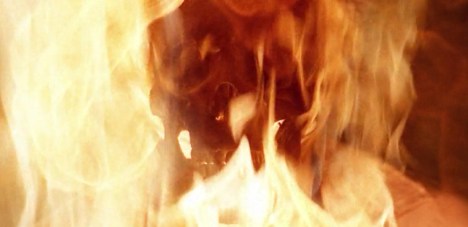
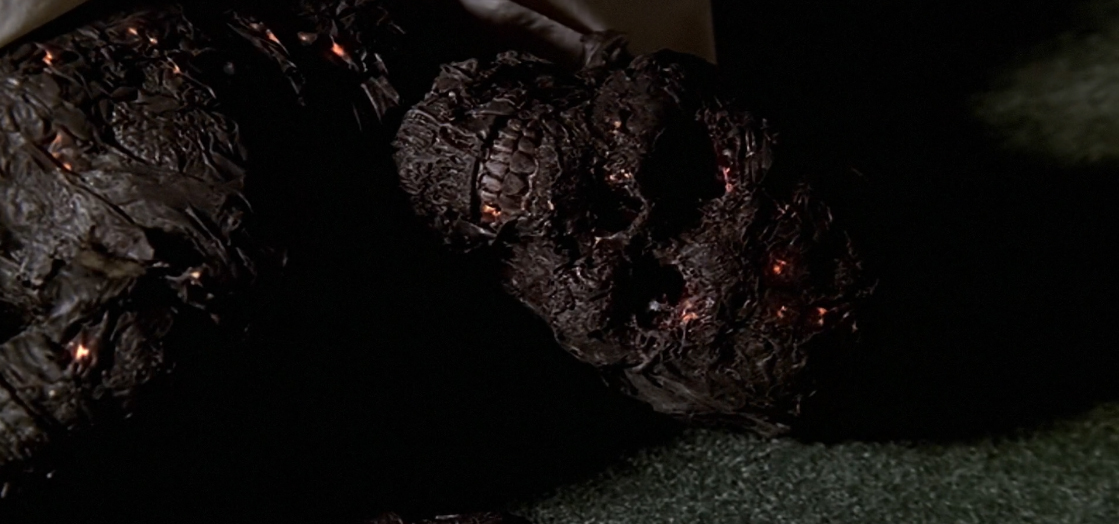
Man on fire...

Man on fire…

Empedocles offers perhaps the most straightforward example of this recurring theme. Reyes describes the case as “a thread of evil… connecting through time, through men, through opportunity.” It is a narrative thread that connects from the murder of Luke Doggett in New York to a workplace shooting in New Orleans. Evil is at work in the world, in a way that is palpable and discernible. Empedocles is not a subtle episode of television, linking this contagion of evil images of hellfire and burning.

There is undoubtedly something just a little simplistic about all of this. One of the luxuries of conspiracy theory, as The X-Files has repeatedly suggested, is the way that it serves to impose a logical and linear narrative on trauma; to make sense of acts and events that would otherwise suggest a brutally random universe. The mythology running through the first six seasons of the show suggested a conspiracy of powerful men might provide such a nexus of causation, but Empedocles offers something a bit broader.

It burns...

Burn with me.

As with a lot of the eighth season mythology, Empedocles cuts out the middle-man. The eighth season largely eschews the blending of “self” and “other” that run through first seven seasons of the show, largely rejecting the narrative of collaboration and complicity implied by the Syndicate. The eighth season of The X-Files repeatedly suggests that evil is inhuman, presenting its antagonists as distinctly “other” forms that infiltrate and pervert the body in perhaps the purest distillation of the show’s many viral metaphors.

In its own way, Empedocles is just as much a mythology or conspiracy episode as Three Words or Vienen. Like those episodes, Empedocles posits a conspiracy theory based upon the subversion of human identity by something alien and external. Empedocles posits a conspiracy of evil.

Crispy...

Crispy…

Continue reading