• Following Us

  • Categories

  • Check out the Archives


  • Awards & Nominations

Millennium – The Time is Now (Review)

This May and June, we’re taking a trip back in time to review the fifth season of The X-Files and the second season of Millennium.

The second season of Millennium holds together very well as a season of television.

It is arguably more cohesive in terms of plotting and theme than any individual season of The X-Files, with the possible exception of the eighth season. Ideas, characters and themes are all set up early in the season so that they might pay-off at the climax. Watching The Fourth Horseman and The Time is Now, it is very hard to believe that the season could have ended any other way. That is a tremendous accomplishment on the part of Glen Morgan and James Wong, who steered the second season as Chris Carter brought his focus back to The X-Files.
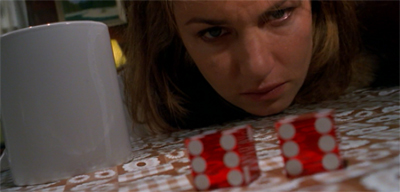
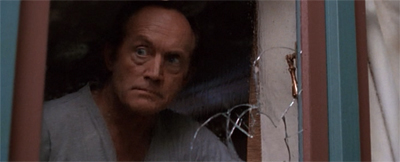
Dicey proposition...

Dicey proposition…

The attention to detail is staggering. There are lots of little touches, from the way that the use of chickens in The Fourth Horseman calls back to the story that bookends Monster to the reference to the fate of Brian Roedecker to the quick shot of Frank placing the statue of the angel on his father’s grave. Glen Morgan has repeatedly stated that the character of Lara Means was introduced in Monster knowing her fate in The Time is Now, and that seems to be true of most of the character and plot arcs over the stretch of the second season.

However, what is truly touching about the second season of Millennium is the way that the show manages to remain deeply personal and emotional, despite the scale of what is unfolding.
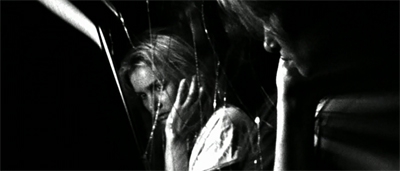
Shattered mirror...

Shattered mirror…

Continue reading

Millennium – The Fourth Horseman (Review)

This May and June, we’re taking a trip back in time to review the fifth season of The X-Files and the second season of Millennium.

The second season of Millennium has been consciously building towards an apocalypse.

Actually, that is not entirely true. The second season of Millennium has been building to an almost infinite number of apocalypses. The collapse of Michael Beebe’s home in Beware of the Dog, the destruction of an entire community in Monster, the dissolution of the tribe in A Single Blade of Grass, the potential loss of a child in 19:19, an author’s acceptance of his fading skills and relevance in Jose Chung’s “Doomsday Defense”, the stealing of a soul in The Pest House, the breaking of a spirit in A Room With No View. The second season is populated with apocalypses.

Everything dies...

Everything dies…

Ever since The Beginning and the End opened with Frank Black staring into space as he contemplated cosmic forces of entropy and decay, it has been clear that the second season of Millennium is about more than just the end of the world. It is about the end of worlds. Over the course of The Fourth Horseman and The Time is Now, Peter Watts loses his faith (and maybe his life) as Lara Means loses her sanity. Frank Black loses his father and his friends – and, ultimately, his wife. The Marburg Virus is just a blip on the radar compared to all of this.

The Fourth Horseman and The Time is Now combine to form one of the most interesting and compelling finalés ever produced. The two-parter is the perfect conclusion to the second season of Millennium. Indeed, it would be the perfect conclusion to the entire series. Perhaps the biggest problem with The Fourth Horseman and The Time is Now is the fact that The Innocents is lurking only a few months away.

Cracking up...

Cracking up…

Continue reading

Millennium – Somehow, Satan Got Behind Me (Review)

This May and June, we’re taking a trip back in time to review the fifth season of The X-Files and the second season of Millennium.

Somehow, Satan Got Behind Me is Darin Morgan’s last script for Millennium.

It is an interesting script. It not as straightforward (and linear) as his scripts for Clyde Bruckman’s Final Repose or Jose Chung’s “Doomday Defense”, but it is not as outwardly complex (and intricate) as Jose Chung’s “From Outer Space.” These descriptors are all relative, of course. Somehow, Satan Got Behind Me is a Darin Morgan script through-and-through. It is clever, well-constructed, and thoughtful. It is one of the most eccentric episodes in a season full of eccentric episodes.

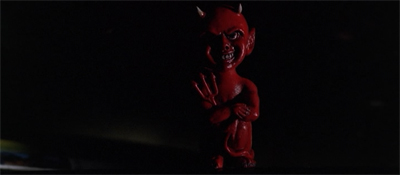
Little devil...

Little devil…

However, Somehow, Satan Got Behind Me remains rather hard to pin down. It doesn’t feel as cohesive or as singular as Morgan’s other scripts. Morgan tends to build his episodes around big thematic tentpoles. There are ideas and themes that reverberate across and throughout Somehow, Satan Got Behind Me, but the nature of the script means that the episode lacks the unity of purpose that viewers have come to expect from Darin Morgan. Somehow, Satan Got Behind Me is a rollercoaster of an episode, which seems to hop from one idea to another.

Of course, that would seem to be the point. Somehow, Satan Got Behind Me is a bold and experimental script in its own way. Morgan has essentially constructed a set of four interlocking (and occasionally thematically overlapping) short stories that are built around his own core themes and ideas. These are small and intimate tales, lying at the intersection between the mundane and the surreal. As such, it seems like the perfect place for Darin Morgan to take his second bow.

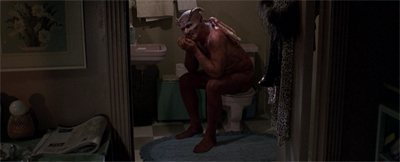
A demon crying on a toilet. What more could you want?

A demon crying on a toilet.
What more could you want?

Continue reading

Millennium – A Room With No View (Review)

This May and June, we’re taking a trip back in time to review the fifth season of The X-Files and the second season of Millennium.

“This is how it will all end,” Jose Chung idly speculated half-way through Jose Chung’s “Doomsday Defense.” He advised Frank that the end of the world will not begin “with floods, earthquakes, falling comets or gigantic crabs roaming the earth. No, doomsday will start simply out of indifference.” He may have been correct. It is one thing to kill a person; it is quite another to destroy their spirit, hollowing out the shell before slotting them comfortably back into a functioning society.

A Room With No View plays Chung’s observation and plays it straight. Well, mostly – there is something darkly comical about Landon’s reaction to discovering that he is being abducted into Oregon. Appropriately enough, Lucy Butler’s hideout in Hood County is relatively close to the town of Boring, Oregon. A Room With No View is a bleak and cynical piece of work, an existential apocalyptic horror story perfectly suited to Millennium. It is an episode that would seem strange or unusual in any circumstances, but fits quite comfortably here.

Here's Lucy!

Here’s Lucy!

On paper, A Room With No View could easily seem cynical or exploitative. It is the story about a sadistic kidnapper who abducts teenagers to torture and sexually abuse them in a dungeon. The basic plot elements of A Room With No View come from the pop culture serial killer playbook, to the point where it is not too hard to image the episode as a trashy instalment of CSI or Criminal Minds or – truth be told – the first season of this show. In basic structure, A Room With No View could seem as crude as Wide Open or Weeds or Loin Like a Hunting Flame.

However, it is the execution of A Room With No View that marks as a genuine classic. For all that the episode trades in the stock tropes of serial killer fiction, it is doing something unique and provocative with them. Writer Ken Horton and director Thomas J. Wright construct a potent allegory for abuse and under-achievement, a haunting horror story that is all the more unsettling for its refusal to conform to audience expectations for a story like this.

Blue is not always the warmest colour...

Blue is not always the warmest colour…

Continue reading

Millennium – Anamnesis (Review)

This May and June, we’re taking a trip back in time to review the fifth season of The X-Files and the second season of Millennium.

In Arcadia Ego and Anamnesis form a strange late-season duology, exploring the roles of important female Christian icons.

In Arcadia Ego was the story of a (possibly) divine conception and birth, one evoking the story of the Virgin Mary. Initially, it seems like Anamnesis is another story about the Virgin Mary, when a bunch of high-school girls claim to have seen a religious apparition in their local church. However, after a bit of investigation, it quickly becomes clear that the religious figure at the centre of Anamnesis is not the Virgin Mary, but is instead the other major female character from the Gospels; it is Mary Magdalene.

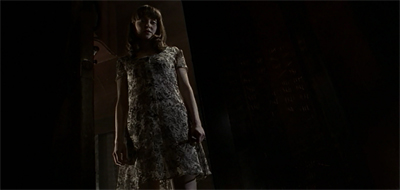
Holy Mary...

Holy Mary…

Appropriately enough for an episode built around a female character who is often ignored and overlooked, Anamnesis is an episode largely driven by two of  the series’ three most prominent female characters. Anamnesis follows an investigation into this hysteria led by Catherine Black and assisted by Lara Means. As a matter of fact, Anamnesis is the only episode of Millennium that does not feature Frank Black. According to an interview with Back to Frank Black, writers Kay Reindl and Erin Maher had considered including him via phonecall, but quickly dropped that idea.

Anamnesis is a fascinating piece of television. It is a script written by two female writers, driven by two female regulars, investigating a case built around a mostly female guest cast. It is a testament to just how far Millennium has come in its second season that it can do a show like this. The first season had no female writers and had only Catherine Black as a prominent female character. It is the great that show can something like this, but do it so casually and effortlessly. Anamnesis is an underrated and overlooked second season script.

Going around in circles...

Going around in circles…

Continue reading

Millennium – In Arcadio Ego (Review)

This May and June, we’re taking a trip back in time to review the fifth season of The X-Files and the second season of Millennium.

A relatively recent study of teenage pregnancies accounted for forty-five virgin births in the United States, based on data from 1995, 2008 and 2009. Extrapolating from this data, the researchers estimate that almost 1% of births in the United States could be considered virgin births.

Of course, the researchers suggest a notable correlation between these self-described virgin births and other interesting social factors – virgin mothers are statistically quite likely to have low levels of sex education and are quite likely to have taken chastity vows. The myth of a virgin birth is powerful, and it is easy to understand in the context of contemporary attitudes about sex and sexuality that almost one in every hundred pregnant teenagers would rather claim a virgin birth than admit that they had sexual intercourse.

And Frank's left holding the baby...

And Frank’s left holding the baby…

In Arcadia Ego is not a particularly subtle script. Writer Chip Johannessen is quite candid about how he feels about all of this, telling a story about a modern-day immaculate conception featuring two escaped prisoners just looking for a reprieve from all the abuse and violence that they have encountered. In Arcadia Ego is a very socially-conscious piece of work, a rather pointed episode that pokes and prods at some the hypocrisies and inconsistencies in how we talk about sex and women in contemporary society. It is never too hard to tell how Johannessen feels on the matter.

At the same time, In Arcadia Ego is also a thoughtful and moving story about love, hope and faith. After a stretch of episodes that have seen Frank becoming more and more uncertain, In Arcadia Ego casts Frank as a pillar of moral certitude. While it might be a little clumsy in places, In Arcadia Ego is never less than well-intentioned.

Bloody murder...

Bloody murder…

Continue reading

Millennium – Siren (Review)

This May and June, we’re taking a trip back in time to review the fifth season of The X-Files and the second season of Millennium.

Even when the second season of Millennium doesn’t quite work, it remains a fascinating piece of television.

Siren is the last script written by Glen Morgan and James Wong before they drafted the two-part second season finalé, The Fourth Horseman and The Time is Now. The duo wrote a phenomenal stretch of the second season. They wrote six of the first eight episodes to air; Siren ends another run of four episodes credited to the duo in the middle of the season. Including the two-part finalé, the pair wrote twelve of the season’s twenty-three episodes. That is a phenomenal workload, even discounting the work of producing and re-writing the other eleven teleplays.

Where's your head at?

Where’s your head at?

Given that the duo were writing what amounts to a full-season order for some modern shows, and producing similar volume of episodes, it seems inevitable that one of their episodes would have to slip. Siren is mess. The script feels like it was stitched together from two different story ideas – each of which might have sustained its own intriguing forty-five minute episode. However, cramming both of those ideas into a single script means that neither feels as developed or as explored as it might be.

At the same time, the careful structuring of the season makes it quite what Siren is trying to do. There are a wealth of interesting ideas here that very clearly and very logically serve the larger arc of the second season. However, it often feels like this weight derives not from Siren itself, but from the outline of Siren created when all the other episodes in the season click together.

Hear him out...

Hear him out…

Continue reading

Millennium – Roosters (Review)

This May and June, we’re taking a trip back in time to review the fifth season of The X-Files and the second season of Millennium.

Then Peter remembered the word Jesus had spoken: “Before the rooster crows, you will disown me three times.” And he went outside and wept bitterly.

– Matthew 26:72

Everything is in runes...

Everything is in runes…

Continue reading

Millennium – Owls (Review)

This May and June, we’re taking a trip back in time to review the fifth season of The X-Files and the second season of Millennium.

I am like a pelican of the wilderness; I am become as an owl of the waste places.

– Psalm 102:6

Birds of prey...

Birds of prey…

Continue reading

Millennium – The Pest House (Review)

This May and June, we’re taking a trip back in time to review the fifth season of The X-Files and the second season of Millennium.

Millennium is largely a show about the nature of evil.

It feels a little redundant to point that out more than halfway through the second of three seasons, but it is worth repeating. When Chris Carter created Millennium, he designed the show to explore the many faces of evil in a variety of ways. It could be argued that Millennium was largely spawned from episodes of The X-Files like Irresistible or Grotesque, stories fascinated by very human forms of evil that almost become supernatural. Carter and his writers played with that idea over the course of the first season, particularly in episodes like The Pilot and Lamentation.

A pointed commentary?

A pointed commentary?

However, Carter was not the guiding visionary for all of Millennium‘s run. He remained involved in the production of the show, but the day-to-day running of the series was handed over to Glen Morgan and James Wong, who immediately reinvented it from the ground up. One of the more interesting aspects of this transition is watching the differences in how the two creative teams approach various aspects of Millennium. In many ways, The Pest House would be read as an exploration and critique of Carter’s approach towards the concept of evil by Morgan and Wong.

Carter’s work seems to suggest that evil is an external and infectious force – a contagion or pathogen that can be passed from one person (or generation) to another. In contrast, Morgan and Wong seem to argue that evil must be rooted in a person, that it must come from inside rather than outside. The Pest House contrasts these two different visions of evil, finding Morgan and Wong playing with the recurring Ten Thirteen trope of evil as a transferable quantity that can be moved and reallocated. And The Pest House seems horrified by such a concept.

A bloody mess...

A bloody mess…

Continue reading