• Following Us

  • Categories

  • Check out the Archives


  • Awards & Nominations

Star Trek – Romulans: Pawns of War by John Byrne (Review)

To celebrate the release of Star Trek: Into Darkness this month, we’ll be running through the first season of the classic Star Trek all this month. Check back daily to get ready to boldly go. It’s only logical.

We’ll be supplementing our coverage of the episodes with some additional materials – mainly novels and comics and films. This is one such entry.

Where were the Klingons? That seems to be one of the most frequently asked questions when a modern writer re-visits the early part of the first season of Star Trek. It makes sense. The Klingons are the franchise’s flagship aliens, and their long-term relations with the Federation mark one of the show’s earliest examples of continuity. The Organian Peace Treaty from Errand of Mercy is mentioned once or twice, but it informs a lot of the appearances of the Klingons in the classic Star Trek, as the warriors are prevented from engaging in direct warfare with the Federation.

However, when first introduced in Errand of Mercy, towards the end of the first season, the Klingons have just declared war on the Federation. However, it seems like this has been expected for a long time. Kirk speaks of the Klingons like old enemies. Kor knows that captain of the Enterprise by name. There’s a sense of a pre-established history, which makes their appearance towards the tale-end of the season all the more perplexing. Apparently they have been there all along, even if we haven’t seen them before.

John Byrne’s Alien Spotlight issue might have been themed around the Romulans, and the collected edition might be Romulans: Pawns of War, but it seems more devoted to exploring what exactly the Klingons were up to behind the scenes between their appearances on Star Trek.
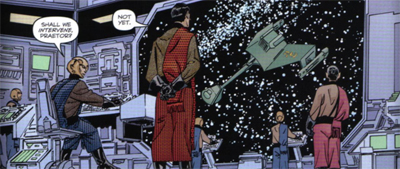
Cry havok, and let slip the dogs of war...!

Cry havok, and let slip the dogs of war…!

Continue reading

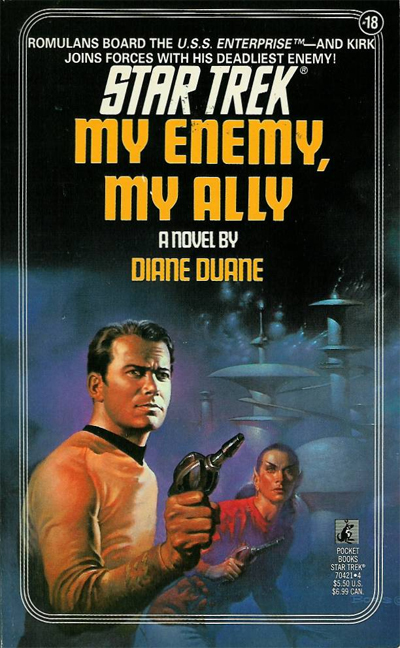
Star Trek – My Enemy, My Ally by Diane Duane (Review)

To celebrate the release of Star Trek: Into Darkness this month, we’ll be running through the first season of the classic Star Trek all this month. Check back daily to get ready to boldly go. It’s only logical.

We’ll be supplementing our coverage of the episodes with some additional materials – mainly novels and comics and films. This is one such entry.

1984 was a hell of a year of Star Trek tie-in novels. John M. Ford’s The Final Reflection was published in May 1984. It was followed by a tie-in adaptation of Star Trek III: The Search for Spock, but the very next original novel would by My Enemy, My Ally by Diane Duane. Both novels feel like kindred spirits, really pushing the boundaries of what you could do with Star Trek tie-in novels.

In particular, both works devoted considerable time to developing some of the iconic and memorable aliens of Star Trek. Ford’s The Final Reflection extrapolated an entire Klingon culture, while Duane’s My Enemy, My Ally dared to imagine a complex Romulan Empire, so distinct and well-defined that it isn’t even known as Romulan (apparently the term outsiders use for the species), but Rihannsu.

myenemymyally

Continue reading

Star Trek – Mudd’s Women (Review)

To celebrate the release of Star Trek: Into Darkness this month, we’ll be running through the first season of the classic Star Trek all this month. Check back daily to get ready to boldly go. It’s only logical.

I think it’s fair to say that Star Trek had some gender issues. I say that as a fan of the show, and as a person with an immense fondness for the ensemble. It’s tempting to write off those sexist moments and decisions as attitudes that were socially acceptable at the time. After all, the sixties are almost half a lifetime away at this point. However, that doesn’t account for the fact that many of the same gender issues plagued Star Trek: The Next Generation in the late eighties, which lost two of its three female leads in its first season, and opened its second year by subjecting the remaining female lead to The Child.

Even disregarding that, though, there comes a point where even the time when a work was produced can’t excuse certain attitudes or approaches. Star Trek doesn’t feature too many strong female characters, relegating recurring female characters like Uhura and Janice Rand to the background. This is dodgy enough, but the show’s problems with gender become a lot more obvious when a show throws sexuality into focus. Mudd’s Women is such a show. It famously introduced one of the few recurring non-crewmember characters, and it plays into the “Star Trek as space western” theme, but it is also very sexist. Very, very sexist.

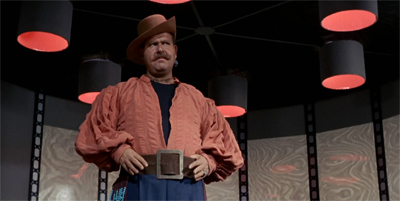
Mudd-ying the waters...

Mudd-ying the waters…

Continue reading

Star Trek – Crew by John Byrne (Review)

To celebrate the release of Star Trek: Into Darkness this month, we’ll be running through the first season of the classic Star Trek all this month. Check back daily to get ready to boldly go. It’s only logical.

We’ll be supplementing our coverage of the episodes with some additional materials – mainly novels and comics and films. This is one such entry.

Majel Barrett Roddenberry was the first lady of the Star Trek franchise, in more ways than one. She was married to Gene Roddenberry and remained a part of the franchise after his death. She guest starred on the shows occasionally, continued to lend her voice to the computers and offered the occasional interview to the press. Although her actual influence on the television shows was relatively minimal (and she was occasionally prone to protesting various plot developments including the Dominion War on Star Trek: Deep Space Nine), she did remain involved in Star Trek until she passed away in 2008.

However, she was also involved from the start. She had the recurring role of Christine Chapel throughout the original television show, and appeared in the unaired pilot, The Cage, as Christopher Pike’s first officer. Identified only as “Number One”, this almost made her the literal “first lady” of Star Trek. I’m surprised that Number One hasn’t been used more often as a character, with her appearances in tie-ins generally restricted to her time on board Pike’s Enterprise.

John Byrne’s miniseries might have the title Crew, and feature supporting roles for Christopher Pike and Mister Spock, but it is very much the story of Number One. Published a year after her death, and dedicated to her memory, Crew feels like a fitting farewell to the actress responsible for one of the franchise’s earliest and most intriguing supporting characters.

Fate protects fools, little children... and ships named Enterprise.

Fate protects fools, little children… and ships named Enterprise.

Continue reading

Star Trek: The Next Generation – Loud as a Whisper (Review)

To celebrate the twenty-fifth anniversary of Star Trek: The Next Generation, and also next year’s release of Star Trek: Into Darkness, I’m taking a look at the recent blu ray release of the first season (and a tiny bit of the second), episode-by-episode. Check back daily for the latest review.

At the very least, Loud as a Whisper has its heart in the right place. At least of most of its run time. Essentially an issue-driven (and guest-star-driven) show that is determined to prove to the audience that a disability need not define a person, it’s a little undermined by a subplot where Pulaski and Geordi discuss the possibility of making the Chief Engineer “normal” again. However, once you get past the earnestness of it all, Loud of a Whisper seems a little clunky as television drama, with all manner of potentially interesting ideas that are never really explored. The result is a massively disappointing story that feels a bit like a clumsy after-school special.

What goes around...

What goes around…

Continue reading

Star Trek: The Next Generation – Where Silence Has Lease (Review)

To celebrate the twenty-fifth anniversary of Star Trek: The Next Generation, and also next year’s release of Star Trek: Into Darkness, I’m taking a look at the recent blu ray release of the first season (and a tiny bit of the second), episode-by-episode. Check back daily for the latest review.

If we ignore The Child as an aberration, a recycled script necessitated by the Writers’ Guild of America Strike of 1988, Where Silence Has Lease actually makes for a much stronger starting point for the second season of Star Trek: The Next Generation. We’re not quite at the point where we’re getting consistently good episodes on a weekly basis, but episodes like Where Silence Has Lease and the following Elementary, Dear Data demonstrating that the show was at least learning what worked and what didn’t in the bets of the first season episodes.

In particular, Where Silence Has Lease allows the show to tell a straight-up science-fiction exploration story that provides commentary on the human condition, but in a manner that isn’t as clumsy as first-season efforts like Lonely Among Us. It’s not a classic episode, but it’s a solid one. However, a solid episode of the second season can stand alongside the best episodes of the first season, demonstrating that the show is making significant progress towards the consistent quality it would eventually maintain.

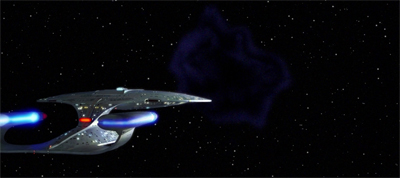
Into the void...

Into the void…

Continue reading

Star Trek: The Next Generation – The Neutral Zone (Review)

To celebrate the twenty-fifth anniversary of Star Trek: The Next Generation, and also next year’s release of Star Trek: Into Darkness, I’m taking a look at the recent blu ray release of the first season, episode-by-episode. Check back daily for the latest review.

Watching The Neutral Zone, it’s hard not to feel that the first season of Star Trek: The Next Generation should have wrapped up with Conspiracy. At least that would have represented a bold step forwards, even if it wasn’t the direction that the show would ultimately take. In contrast, a lot of The Neutral Zone falls back into the trite, patronising arrogance that we’ve seen our crew demonstrate repeatedly over this first year, treating three refugees from twenty-first century Earth as an excuse to lord their superiority over the viewers at home. It’s a rather strange direction to take, and it certainly doesn’t make for good television. Which feels like a bit of a waste, given that the B-plot is actually quite workable.

"We're back."

“We’re back.”

Continue reading

Star Trek: The Next Generation – Arsenal of Freedom (Review)

To celebrate the twenty-fifth anniversary of Star Trek: The Next Generation, and also next year’s release of Star Trek: Into Darkness, I’m taking a look at the recent blu ray release of the first season, episode-by-episode. Check back daily for the latest review.

I suppose that Arsenal of Freedom could be worse. At its heart, it’s the sort of issue-driven story that the classic Star Trek did so very well. The original Star Trek was fond of constructing clever (and not so clever) explorations of the issues of the day, giving the audience a relatively simplistic morality play about the dangers of certain vices and the risks that they might pose to a civilised society. Later on its run, Star Trek: The Next Generation would handle its own morality plays with just a bit more nuance and sophistication, favouring deliberate and considerate probing rather than its predecessor’s endearing brashness. Like so much of the first season, Arsenal of Freedom feels like it is an attempt to capture the flavour of those sixties episodes.

At least, though, the show concedes that time has passed, and that social mores have shifted. The social issues of the day are no longer hippies (The Way to Eden) or simplistic racism (Let That Be Your Last Battlefield), and Arsenal of Freedom is a “message show” for the eighties. It is a morality tale about the dangers of unchecked capitalism and the risks of weapons development. It’s clumsy, awkward and a little forced, with The Next Generation not quite suited to this particular form of heavy-handed moralising, but it could be a lot worse. Which, I suppose, is something.

Looks like we've got a Minos problem here...

Looks like we’ve got a Minos problem here…

Continue reading

Star Trek: The Next Generation – Heart of Glory (Review)

To celebrate the twenty-fifth anniversary of Star Trek: The Next Generation, and also next year’s release of Star Trek: Into Darkness, I’m taking a look at the recent blu ray release of the first season, episode-by-episode. Check back daily for the latest review.

I think Heart of Glory is, ironically, one of the first times that Star Trek: The Next Generation is consciously trying to force its way out of the shadows of its illustrious predecessor. Episodes like The Naked Now and Justice felt like hold-overs from the classic sixties Star Trek, with little acknowledgement that the world (both inside and outside the show) had dramatically changed in the two decades since Star Trek appeared. I used the adjective “ironically”, because Heart of Glory actually sees the return of one of the most classic Star Trek aliens, and one of the most recognisable pop culture extraterrestrials.

The series bible famously stated the show had no real interest in going back to the Klingons, but Heart of Glory suggests that following up with the funky foreheaded aliens might have been the smartest thing that the first season did.

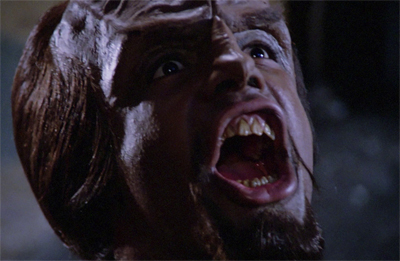
I am Klingon, hear me roar!

I am Klingon, hear me roar!

Continue reading

Star Trek: The Next Generation – Angel One (Review)

To celebrate the twenty-fifth anniversary of Star Trek: The Next Generation, and also next year’s release of Star Trek: Into Darkness, I’m taking a look at the recent blu ray release of the first season, episode-by-episode. Check back daily for the latest review.

Any time I worry that I might have been too kind on Datalore, watching Angel One tends to set me straight relatively quickly. Watching Angel One feels like somebody in the writers’ room said, “I really liked the racism in Code of Honour! Can we do that again, but with sexism?” It’s very difficult to imagine to imagine how the script got into production without somebody raising red flags about it. While a lot of the racism of Code of Honour arose from the decision to cast the Ligonian characters as black, sexism in hardwired into the DNA of Angel One, making it one of the most unfortunate scripts in a long line of unfortunate scripts.

I believe in Angel One... something crappy in every season of TNG...

I believe in Angel One… something crappy in every season of TNG…

Continue reading