• Following Us

  • Categories

  • Check out the Archives


  • Awards & Nominations

Star Trek: The Next Generation – Requiem by Michael Jan Friedman & Kevin Ryan (Review)

To celebrate the release of Star Trek: Into Darkness this month, we’ll be running through the first season of the classic Star Trek all this month. Check back daily to get ready to boldly go. It’s only logical.

We’ll be supplementing our coverage of the episodes with some additional materials – mainly novels and comics and films. This is one such entry.

At the risk of stating the obvious, Star Trek is a franchise spanning almost half-a-century with six leading actors and five different television shows. Due to its nature, one of the more enjoyably fanboy-ish pastimes is attempting to reimagine various confrontations and encounters, swapping out the characters involved. How would Kirk have responded to the Borg? Would Sisko have been ideally suited to dealing with the Xindi threat? What if Janeway faced the Doomsday Machine? Different characters have different defining moments, and those moments often play to their particular strengths. It might be fun to watch Khan spar with Picard, but it probably wouldn’t work as well as it did with Kirk. Q and Kirk would probably have difficulty striking it off.

Still, Kirk’s confrontation with the Gorn in Arena stands as one of the most iconic moments in the whole of the franchise, to the point where the weird toga-wearing god-like being at the end barely gets a look-in. Indeed, based on Sisko’s fanboy gushing in Trials and Tribble-ations, it seems to be one of Kirk’s defining moments within the shared Star Trek universe. So it might be fun to take Captain Jean-Luc Picard, and put him through that same sort of confrontation.

tng-requiem

Continue reading

Star Trek – The Squire of Gothos (Review)

To celebrate the release of Star Trek: Into Darkness this month, we’ll be running through the first season of the classic Star Trek all this month. Check back daily to get ready to boldly go. It’s only logical.

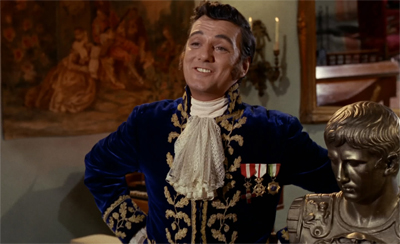
It’s easy to see why The Squire of Gothos has become such a Star Trek touchstone. The show is iconic, but there are particular images and ideas that resonate beyond the core fanbase. Captain Pike’s wheelchair from The Menagerie is one such example, as is the fight with the Gorn from Arena. It’s amazing that Star Trek could produce so many memorable and distinctive images so quickly. Trelane might not have the same name recognition, or even the same pop culture cache, but The Squire of Gothos makes quite an impression.

Indeed, the image of a god-like being acting like a spoilt child, dressed in all manner of period military clothing is a great visual, and it’s little wonder that Roddenberry would return to that idea when he was writing Encounter at Farpoint, the first episode of Star Trek: The Next Generation. Similarly, The Squire of Gothos is one of the major influences on Futurama‘s superb parody/homage, Where No Fan Has Gone Before, right down to the wonderful “twist” ending that has been spoiled by almost half-a-century of pop culture osmosis.

Still, even apart from its massive influence on pop culture, The Squire of Gothos is still a fantastic piece of television, and an example of Star Trek at its very best.

It's hip to be squire...

It’s hip to be squire…

Continue reading

Star Trek – Shore Leave (Review)

To celebrate the release of Star Trek: Into Darkness this month, we’ll be running through the first season of the classic Star Trek all this month. Check back daily to get ready to boldly go. It’s only logical.

When I talk about the surreal sixties energy that really holds quite a bit of Star Trek together, it’s quite possible that it sounds like a back-handed compliment, a cheap and easy gig at a cult television show. However, I mean that sincerely. When I argue that the illogical and somewhat scattershot dynamism of the last act of Court Martial can barely hold the patchwork script together, it’s quite possible that I sound like I’m being sarcastic. However, my affection for the mad-cap mayhem particular to the first iteration of Star Trek is entirely genuine. Although it makes no sense, the climax to Court Martial isn’t the problem. Everything leading up to it is.

I think Shore Leave is pretty much the perfect iteration of this concept. It is, from start to finish, absolutely insane nonsense that threatens to fall apart if one concentrates too hard on any particular detail. However, it’s executed with enough energy and drive that it becomes a compelling and surreal piece of television, and one of the best illustrations of the kind of weirdness that the classic Star Trek could pull off almost effortlessly.

No bunny business...

No bunny business…

Continue reading

Star Trek – The Menagerie, Part II (Review)

To celebrate the release of Star Trek: Into Darkness this month, we’ll be running through the first season of the classic Star Trek all this month. Check back daily to get ready to boldly go. It’s only logical.

I will admit that I am sceptical of Gene Roddenberry as a writer. There’s no denying that Roddenberry was a fantastic ideas man. After all, his concepts and characters have stood the test of time. Without Roddenberry, there would be none of the Star Trek that we all love so dearly. As such, I feel a little guilty when I criticise his writing, or when I argue that his influence on the early years of Star Trek: The Next Generation held the show back from greatness. (I’d suggest that it was only when Roddenberry’s involvement was minimised, and the writers were allowed to add shading to his futuristic utopia that The Next Generation truly came into its own.)

Still, Roddenberry was always an excellent salesman, and his script for The Menagerie brings out that quality in abundance. The Menagerie is effectively an excuse for why the show ran out of original scripts half-way through its first year, and Roddenberry might not make the most convincing argument, but he still makes it compelling.

Watching Star Trek on Star Trek...

Watching Star Trek on Star Trek…

Continue reading

Star Trek – The Menagerie, Part I (Review)

To celebrate the release of Star Trek: Into Darkness this month, we’ll be running through the first season of the classic Star Trek all this month. Check back daily to get ready to boldly go. It’s only logical.

Ah, clip shows. The bane of modern television. Okay, I’m being a bit harsh. After all, home media is a relatively recent invention. Up until the past couple of decades, it seemed that most people would only catch their television shows on… well, television. The audience was generally thought to be somewhat transient, the realities of scheduling and life making it highly unlikely that everybody would see everything. Indeed, most fans of old television shows found themselves at the mercy of fickle network schedules. Particularly for long-running shows, it was reasonable to assume that a significant portion of your audience might not be intimately familiar with the show.

Of course, the emergence of DVD box sets and on-line streaming have radically changed the way that television operates. Most obviously, there has been a massive a swing towards serialisation in the past few years, overlapping with the expansion of home media. While it’s tough to imagine a show like The Wire or Game of Thrones working in the early nineties, the fact that people can record and download and own their television shows means that producers can get away with assuming that everybody has seen everything.

What I’m getting at here  is that there was a time when clip shows were an understandable, maybe even desirable, part of the network television landscape. They could bring new viewers up to speed, or allow old viewers to celebrate the favourite parts of the show that they would otherwise never see again. Indeed, The Menagerie, the only two-part episode of the classic Star Trek, has a better excuse than most. The clip sections of this adventure are taken from the 1964 pilot, The Cage. Not only was this footage two years old when The Menagerie was broadcast, it had also never been aired.

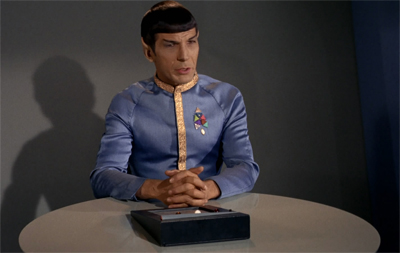
Spock the difference...

Spock the difference…

Continue reading

Star Trek: Early Voyages #12-15 – Futures, Parts I, II, III & IV (Review)

To celebrate the release of Star Trek: Into Darkness this month, we’ll be running through the first season of the classic Star Trek all this month. Check back daily to get ready to boldly go. It’s only logical.

We’ll be supplementing our coverage of the episodes with some additional materials – mainly novels and comics and films. This is one such entry.

As we discussed before, Star Trek: Early Voyages is about as close to a series starring Christopher Pike as we are ever likely see. A monthly comic book running for about a year-and-a-half, told by Dan Abnett and Ian Edginton, the book followed the adventures of Christopher Pike’s Enterprise, a prelude to the classic Star Trek television show, filling some gaps left by The Cage and The Menagerie. However, the comic had the benefit of being told after a lot of Star Trek had aired.

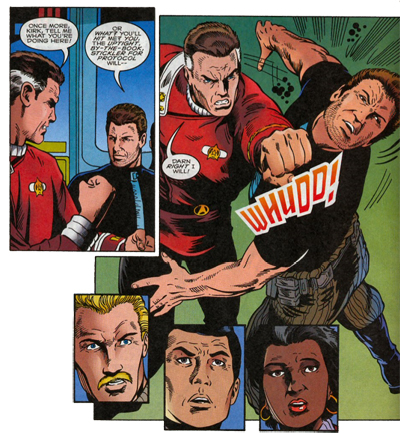
First published in 1997, it hit stands after the big-screen adventures of the Kirk era had officially wrapped up in Star Trek: Generations, and long after Star Trek: The Next Generation had gone off the air. Even Star Trek: Deep Space Nine was more than half way through its run. This puts Early Voyages in an interesting place. It is set in the past, but knows how the future plays out. The epic four-part Futures storyline plays with this concept, offering us a glimpse of an imperfect future where Captain Kirk is a rogue running a cargo ship, the Klingons have annexed considerable portions of the Federation and are on the verge of war…

Oh, and Christopher Pike is happy. That’s how you know it’s a flawed universe.

"And THAT is for stealing my show!"

“And THAT is for stealing my show!”

Continue reading

Star Trek – Court Martial (Review)

To celebrate the release of Star Trek: Into Darkness this month, we’ll be running through the first season of the classic Star Trek all this month. Check back daily to get ready to boldly go. It’s only logical.

It’s hard not to be impressed by the sheer versatility of Star Trek as a format. For a show about exploring the universe, the creators have really managed to incorporate just about any and all genres of television story. Over the franchise’s 700-episode history, there’s been a wealth of quirky episodes that explore types of stories that one might consider quite surreal for a show about a ship travelling to the stars. A court room episode might not be the most radical of these shifts, but Court Martial is still fascinating as an evolution of Star Trek as a concept, broadening the kind of stories that could be told within a Star Trek framework. After all, the fact that there’s a whole subgenre of Star Trek involving court room drama is probably rooted in this first-season adventure.

While its influence is absolutely massive, Court Martial is still a problematic episode. Despite demonstrating what writers could really do within the context of the show, Court Martial suffers because it’s really not that good.

Running rings around the prosecution...

Running rings around the prosecution…

Continue reading

Star Trek – The Galileo Seven (Review)

To celebrate the release of Star Trek: Into Darkness this month, we’ll be running through the first season of the classic Star Trek all this month. Check back daily to get ready to boldly go. It’s only logical.

It’s amazing to think that only now, almost half-way through the first year of Star Trek, the show is doing a Spock-centric episode. Spock is an iconic and instantly recognisable part of Star Trek lore, to the point that Leonard Nimoy’s version of the character served as the link between the classic series and JJ Abrams’ 2009 reboot of the franchise. The character appeared in The Cage, the very first episode of Star Trek ever produced. He is perhaps even more iconic than James T. Kirk himself.

So it feels slightly weird, then, that The Galileo Seven should serve as the first episode of the series completely devoted to Spock as a character, pushing Jim firmly to the background as we get a look at Spock’s first command experience.

Talk about carrying dead weight...

Talk about carrying dead weight…

Continue reading

Star Trek – The Conscience of the King (Review)

To celebrate the release of Star Trek: Into Darkness this month, we’ll be running through the first season of the classic Star Trek all this month. Check back daily to get ready to boldly go. It’s only logical.

The Conscience of theKing continues the work of Balance of Terror in fleshing out the fictional universe of Star Trek. While the first few episodes of the show gave little thought to this universe’s shared history and our characters’ origins, The Conscience of the King offers us a glimpse into the past of Captain James T. Kirk. Like Dagger of the Mind, another episode borrowing its title from Shakespeare, it builds off the suggestion that humanity is still a long way from perfection, and that the fact we have reached the cold expanse of space does not mean that our troubles can be left entirely behind. In contrast to some of Roddenberry’s later decisions about the Star Trek franchise, it is clear that utopia is a path, and not a clear destination.

His mask is slipping...

His mask is slipping…

Continue reading

Star Trek 102: The Best of The Next Generation

To celebrate the release of Star Trek: Into Darkness, we’re holding a month full of Star Trek  related fun. We’re reviewing every episode of the show’s first season, from The Cage through to Operation — Annihilate!, one-per-day for all of May. We’re also looking at some of the various spin-offs, tie-ins and pop culture intersections, so there’s always something going on to do with Star Trek. Anyway, with the release of the new film, we thought it might be interesting to make some recommendations for fans of the new films who wanted to “dip their toes in the water” so to speak. Today, we’re making recommendations from the first of the 24th century spin-offs, Star Trek: The Next Generation.

tng-encounteratfarpoint1

Continue reading