• Following Us

  • Categories

  • Check out the Archives


  • Awards & Nominations

Star Trek – Crew by John Byrne (Review)

To celebrate the release of Star Trek: Into Darkness this month, we’ll be running through the first season of the classic Star Trek all this month. Check back daily to get ready to boldly go. It’s only logical.

We’ll be supplementing our coverage of the episodes with some additional materials – mainly novels and comics and films. This is one such entry.

Majel Barrett Roddenberry was the first lady of the Star Trek franchise, in more ways than one. She was married to Gene Roddenberry and remained a part of the franchise after his death. She guest starred on the shows occasionally, continued to lend her voice to the computers and offered the occasional interview to the press. Although her actual influence on the television shows was relatively minimal (and she was occasionally prone to protesting various plot developments including the Dominion War on Star Trek: Deep Space Nine), she did remain involved in Star Trek until she passed away in 2008.

However, she was also involved from the start. She had the recurring role of Christine Chapel throughout the original television show, and appeared in the unaired pilot, The Cage, as Christopher Pike’s first officer. Identified only as “Number One”, this almost made her the literal “first lady” of Star Trek. I’m surprised that Number One hasn’t been used more often as a character, with her appearances in tie-ins generally restricted to her time on board Pike’s Enterprise.

John Byrne’s miniseries might have the title Crew, and feature supporting roles for Christopher Pike and Mister Spock, but it is very much the story of Number One. Published a year after her death, and dedicated to her memory, Crew feels like a fitting farewell to the actress responsible for one of the franchise’s earliest and most intriguing supporting characters.

Fate protects fools, little children... and ships named Enterprise.

Fate protects fools, little children… and ships named Enterprise.

Continue reading

X-Men: The Dark Phoenix Saga – 30th Anniversary Edition (Review/Retrospective)

With our month looking at Avengers comics officially over, we thought it might be fun to dig into that other iconic Marvel property, the X-Men. Join us for a month of X-Men related reviews and discussion.

Chris Claremont enjoyed the company of some of the most respected and renowned artists in comics while working on Uncanny X-Men. He had the pleasure of helping to establish talent like John Romita Jr., Marc Silvestri and Jim Lee, all modern giants working in the field. However, it’s hard to argue that Claremont ever worked in tighter synergy than he did with John Byrne. Byrne succeeded artist Dave Cockrum on the book, and helped Claremont helm several iconic and defining X-Men stories, delivering pay-off on years of set-up and radically reshaping notions of what a superhero comic could and could not do. Though the pair produced several genuine classics, The Dark Phoenix Saga stands as the artistic triumph of their run. One could make a compelling case that it’s Claremont’s finest X-Men story, or the finest X-Men story, or – if one weren’t feeling especially modest – perhaps the finest mainstream superhero story ever told.

Bird of prey…

Continue reading

Acts of Vengeance: Uncanny X-Men – Wolverine, Jubilee & Psylocke vs. The Mandarin (Review/Retrospective)

April (and a little bit of May) are “Avengers month” at the m0vie blog. In anticipation of Joss Whedon’s superhero epic, we’ll have a variety of articles and reviews published looking at various aspects of “Earth’s Mightiest Heroes.”

In celebration of the release of The Avengers, this weekend we’re taking a look at the massive 1989-90 crossover “Acts of Vengeance”, which pitted various villains against some unlikely heroes. I’ll be looking at some of the most fun match-ups. This arc is collected in the companion omnibus.

I know that a lot of people would argue that Claremont’s Uncanny X-Men sort of lost the plot a bit after Inferno, when he first sent the team to live in the Outback and then sent them through the Siege Perilous, essentially disintegrating the iconic superhero team and scattering its members to the wind with little idea of who or what they are. I, for the record, actually quite liked that period of Uncanny X-Men history, if only because it was so breathtakingly ambitious and completely unlike anything I ever expected in a superhero team book.

Detractors would, not unreasonably, suggest that there was a very good reason that Claremont’s approach was completely distinct from anything ever tried in a superhero team book. However, most of those who decry that era of Uncanny X-Men will concede that there were some highlights to be found. The Acts of Vengeance tie-ins, featuring the wonderful artwork of Jim Lee, are among the more widely-praised of Claremont’s work in this era, and I find it quite tough to disagree.

Big Trouble in Big China…

Continue reading

Acts of Vengeance: X-Factor – Apocalypse vs. Loki (Review/Retrospective)

April (and a little bit of May) are “Avengers month” at the m0vie blog. In anticipation of Joss Whedon’s superhero epic, we’ll have a variety of articles and reviews published looking at various aspects of “Earth’s Mightiest Heroes.”

In celebration of the release of The Avengers, this weekend we’re taking a look at the massive 1989-90 crossover “Acts of Vengeance”, which pitted various villains against some unlikely heroes. I’ll be looking at some of the most fun match-ups. This arc is collected in the companion omnibus.

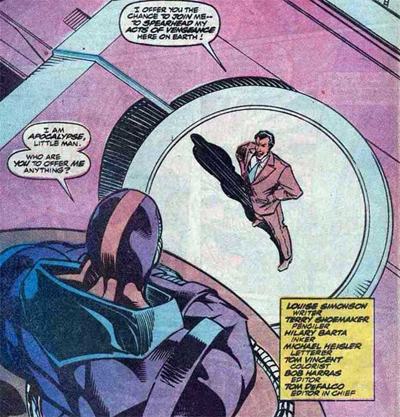
It is very clear, reading some of the issues connected to John Byrne’s Acts of Vengeance, that some writers weren’t entirely on board with the crossover. After all, it was a giant line-wide event that existed purely to pit heroes against villains who traditionally faced other heroes – there was no more rhyme or reason than that. In many cases, that meant derailing whatever was happening in the book at the time, or even reversing or setting back characterisation. Magneto, in particular, found himself reverted back to little more than a villain. While a lot of books were implicitly critical of the event, Louise Simonson’s X-Factor seems particularly bothered by the intrusion, to the point that the only real tie-in to Acts of Vengeance sees the big villain Apocalypse effectively booting Loki out of his book.

I’m not sure Loki’s enthusiasm will crossover quite well…

Continue reading

Acts of Vengeance Omnibus (Review/Retrospective)

April (and a little bit of May) are “Avengers month” at the m0vie blog. In anticipation of Joss Whedon’s superhero epic, we’ll have a variety of articles and reviews published looking at various aspects of “Earth’s Mightiest Heroes.”

As The Avengers is getting its U.S. theatrical release this weekend, I thought I’d celebrate by taking a look at a gigantic crossover. I’ll be reviewing individual tie-ins over the weekend, so check back!

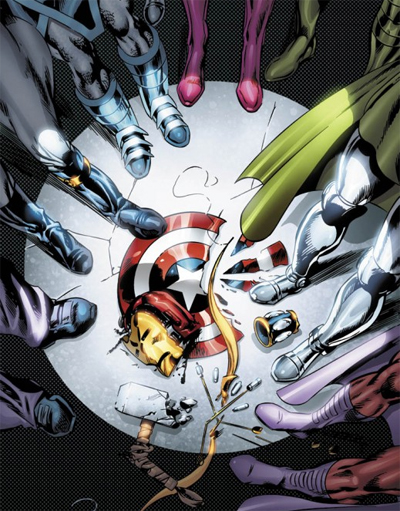
Truth be told, I would have been quite disappointed if I made it all the way to the end of the month without taking a look at one of those token “big, dumb” crossovers featuring Marvel’s iconic characters. Truth be told, Acts of Vengeance just looked kinda fun. Although it spread to Marvel’s whole line, it was directed by writer and artist John Byrne, who was behind Avengers and West Coast Avengers at the time, so I’m totally counting it as an Avengers crossover. It’s one of those incredibly silly concepts that could only ever work in the context of superhero comic books. Basically, tired of being soundly defeated by their heroes, a bunch of supervillains decide to band together and exchange partners. Hilarity ensues as the line struggles to maintain editorial consistency.

Shattered heroes…

Continue reading

Fantastic Four by John Byrne Omnibus (Review/Retrospective)

Celebrating the 50th anniversary of the Fantastic Four, I’m taking a look at some of the stories featuring the characters over the past half-century.

John Byrne’s Fantastic Four run is pretty major as Marvel comic book runs go. It’s generally regarded to be one of the better comic book runs of the eighties, alongside Frank Miller’s Daredevil and Walt Simonson’s Thor, but it’s also widely regarded as the best run on Marvel’s flagship family since Stan Lee and Jack Kirby finished their record-setting run establishing both the series and the shared Marvel Universe. (The length of the run has since been surpassed, appropriately enough, by Brian Michael Bendis and Mark Bagley on Ultimate Spider-Man.) This was my first time reading the run, which has received the massive omnibus treatment from Marvel. I have to admit, while not quite blown away by it, I was remarkably impressed by the love and craftsmanship that Byrne poured into the run. I wouldn’t class it as iconic or genre-defining, but it’s a remarkably solid examination of the franchise that launched the Marvel Universe.

Fantastic!

Continue reading