• Following Us

  • Categories

  • Check out the Archives


  • Awards & Nominations

Star Trek: The Next Generation – The Schizoid Man (Review)

This January and February, we’ll be finishing up our look at the second season of Star Trek: The Next Generation and moving on to the third year of the show, both recently and lovingly remastered for high definition. Check back daily for the latest review.

I should probably hate The Schizoid Man. It is certainly a very, very flawed piece of television. It would be a lot more forgivable had it aired during the first season of Star Trek: The Next Generation, when the show was still trying to find its feet – including it early in the second season feels like the show is pushing it a little. In many respects, The Schizoid Man embodies a lot of the (legitimate) complaints about the weaknesses of The Next Generation as a television show: the performances from the peripheral members of the main cast are a bit ropey, there’s an incredibly false sense of urgency generated by techno-babble and the dialogue is just terrible.

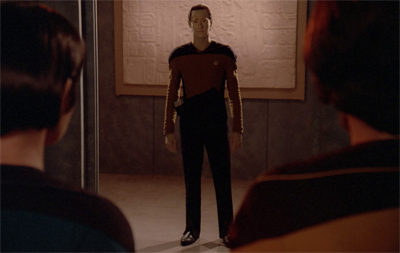
And yet, despite that, there’s quite a lot here to like. Stripping away the terrible dialogue and the unnecessary convolutions, The Schizoid Man is a very basic morality play, one touching on themes the show will handle a lot better a few episodes down the line. Brent Spiner is surprisingly creepy as Graves-as-Data, and W. Morgan Sheppard is pretty great in an admittedly thankless part as the misogynistic and creepy Ira Graves.
23rd century Schizoid Man...

23rd century Schizoid Man…

Continue reading

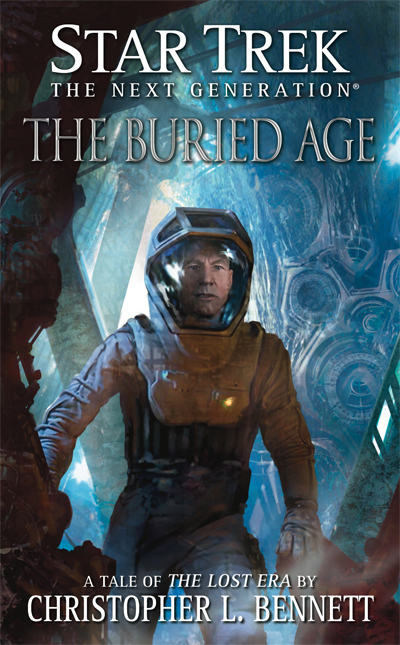
Star Trek: The Lost Era – The Buried Age by Christopher L. Bennett (Review)

This January and February, we’ll be finishing up our look at the second season of Star Trek: The Next Generation and moving on to the third year of the show, both recently and lovingly remastered for high definition. Check back daily for the latest review.

We’ll be supplementing our coverage of the episodes with some additional materials – mainly novels and comics and films. This is one such entry. This is actually supplementary to the first season of the Next Generation, specifically the episode Encounter at Farpoint.

“I’m offering the chance to find something entirely new,” Picard teases at one point in The Buried Age. “To begin filling in a tremendous gap in our understanding of galactic history.” In a way, Picard might as well be addressing the reader, explaining one of the many joys of Christopher L. Bennett’s The Buried Age. It is a chance to delve into the world of Star Trek, exploring the lacuna that exists leading directly into Encounter at Farpoint.

tng-theburiedage

Continue reading

Star Trek: Myriad Universes – Echoes and Refractions: A Gutted World by Keith R. A. DeCandido (Review)

Star Trek: Deep Space Nine is twenty years old this year. To celebrate, I’m taking a look at the first and second seasons. Check back daily for the latest review or retrospective.

We’ll be supplementing our coverage of the episodes with some additional materials – mainly novels and comics and films. This is one such entry.

“What if” stories are inherently fascinating. Naturally, they are predicated on investment in the original story, but it’s always fascinating to imagine the branching possibilities, the ripples in the stream. Sometimes, these are used to explore the grand philosophical questions of Star Trek in a new light; to imagine how, were you to change one variable in a complex formula, the answer might be radically different.

However, Keith R. A. DeCandido’s A Gutted World feels different. It is a massive story, spanning a huge amount of time and space, drawing in a massive ensemble cast and gently probing the politics of five or six different Star Trek culture, as DeCandido explores what might have happened if the Cardassians never withdrew from Bajor, if Terok Nor never became Deep Space Nine.

To put it more succinctly, if the show never happened, but its central storyline still did.

st-myriaduniverses

Continue reading

Star Trek: Deep Space Nine – Emissary (Review)

Star Trek: Deep Space Nine is twenty years old this year. To celebrate, I’m taking a look at the first season. Check back daily for the latest review or retrospective.

Star Trek: Deep Space Nine is a phenomenal piece of television. It’s often a bit overlooked because of its unique setting. After all, the words Star Trek evoke space ships and new worlds – “new life forms and new civilisations.” As such, a Star Trek series about a space station feels counter-intuitive. “To boldly sit” is the hardly the most dynamic premise. And yet, despite that, there’s a very serious argument to be made that Deep Space Nine is the crowning accomplishment of television Star Trek. It’s certainly the last great attempt to boldly push the franchise forward, with Star Trek: Voyager and Star Trek: Enterprise feeling just a tad regressive and conservative in comparison.

Indeed, Deep Space Nine represents a massive narrative leap forward from the success of Star Trek: The Next Generation, which remains one of the greatest science-fiction shows ever produced. For better or worse, Emissary makes it quite clear that Deep Space Nine is not an attempt to copy its direct predecessor, even if some of the other episodes in the first season might back-pedal a bit. In fact, it’s surprising just how well the pilot for this strangest of Star Trek shows holds up, suggesting a firmer grasp of its own identity than a few of the subsequent episodes could claim.

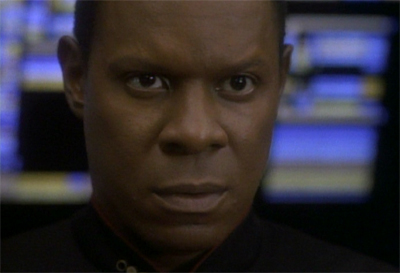
A Commanding presence...

A Commanding presence…

Continue reading

Non-Review Review: Star Trek – Generations

This August, to celebrate the upcoming release of Star Trek: Into Darkness on DVD and blu ray, we’re taking a look at the Star Trek movies featuring the original cast. Movie reviews are every Tuesday and Thursday.

There are lots of problems with Star Trek: Generations. It feels too much like a two-parter from the television show. It tries to fit in a laundry list of demands from the studio. It wastes Malcolm McDowell. It decides that the only part of the original series deserving a send-off is James T. Kirk, and then pushes him off-screen for an hour before dragging him back into the movie to kill him off in the most ironic and anti-climactic manner possible.

Yet, despite these considerable flaws, Generations also has a lot to recommend it. Although the script occasionally feels a little overcooked, the themes concerning mortality lend it a serious amount of weight. Director David Carson demonstrates that he can work wonders on a tiny budget. Cinematographer John A. Alonzo finds a way to shoot familiar sets in a way that makes them look incredibly beautiful. None of these strengths can fully compensate for the very fundamental flaws with the seventh Star Trek cinematic outing, but they do mitigate them somewhat.

Generations isn’t a great Star Trek film, and it isn’t even the best odd-numbered Star Trek film, but it is far from an unmitigated disaster. Well, except for the way it treats Kirk.

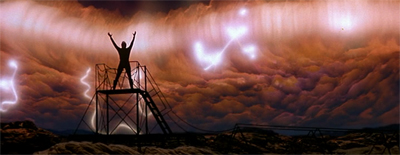
Riding the wave...

Riding the wave…

Continue reading

Star Trek: The Next Generation – Requiem by Michael Jan Friedman & Kevin Ryan (Review)

To celebrate the release of Star Trek: Into Darkness this month, we’ll be running through the first season of the classic Star Trek all this month. Check back daily to get ready to boldly go. It’s only logical.

We’ll be supplementing our coverage of the episodes with some additional materials – mainly novels and comics and films. This is one such entry.

At the risk of stating the obvious, Star Trek is a franchise spanning almost half-a-century with six leading actors and five different television shows. Due to its nature, one of the more enjoyably fanboy-ish pastimes is attempting to reimagine various confrontations and encounters, swapping out the characters involved. How would Kirk have responded to the Borg? Would Sisko have been ideally suited to dealing with the Xindi threat? What if Janeway faced the Doomsday Machine? Different characters have different defining moments, and those moments often play to their particular strengths. It might be fun to watch Khan spar with Picard, but it probably wouldn’t work as well as it did with Kirk. Q and Kirk would probably have difficulty striking it off.

Still, Kirk’s confrontation with the Gorn in Arena stands as one of the most iconic moments in the whole of the franchise, to the point where the weird toga-wearing god-like being at the end barely gets a look-in. Indeed, based on Sisko’s fanboy gushing in Trials and Tribble-ations, it seems to be one of Kirk’s defining moments within the shared Star Trek universe. So it might be fun to take Captain Jean-Luc Picard, and put him through that same sort of confrontation.

tng-requiem

Continue reading

Star Trek: The Next Generation – Loud as a Whisper (Review)

To celebrate the twenty-fifth anniversary of Star Trek: The Next Generation, and also next year’s release of Star Trek: Into Darkness, I’m taking a look at the recent blu ray release of the first season (and a tiny bit of the second), episode-by-episode. Check back daily for the latest review.

At the very least, Loud as a Whisper has its heart in the right place. At least of most of its run time. Essentially an issue-driven (and guest-star-driven) show that is determined to prove to the audience that a disability need not define a person, it’s a little undermined by a subplot where Pulaski and Geordi discuss the possibility of making the Chief Engineer “normal” again. However, once you get past the earnestness of it all, Loud of a Whisper seems a little clunky as television drama, with all manner of potentially interesting ideas that are never really explored. The result is a massively disappointing story that feels a bit like a clumsy after-school special.

What goes around...

What goes around…

Continue reading

Star Trek: The Next Generation – The Outrageous Okona (Review)

To celebrate the twenty-fifth anniversary of Star Trek: The Next Generation, and also next year’s release of Star Trek: Into Darkness, I’m taking a look at the recent blu ray release of the first season (and a tiny bit of the second), episode-by-episode. Check back daily for the latest review.

Well, I’m not sure if you can call two solid episodes in succession a “streak” or a “roll”, but Where Silence Has Lease and Elementary, Dear Data were two hours of television that demonstrated how far the second season of Star Trek: The Next Generation had come since its rocky first season. However, it appears that the two very good episodes in a row did not represent a sudden change in direction and did not assure consistency. The Outrageous Okona is a bad episode, by just about any measure. It’s not necessarily as offensive as Angel One or Code of Honour, but it is quite painful to watch.

Unlike a lot of the bungled “message” shows in the first season that contained misjudged ideas or offensive elements, The Outrageous Okona is merely a terribly written and unfunny mess of an episode that simply gnaws at the viewer.

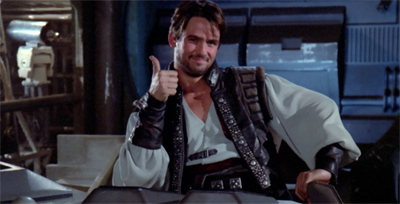
He works best Solo...

He works best Solo…

Continue reading

Star Trek: The Next Generation – Elementary, Dear Data (Review)

To celebrate the twenty-fifth anniversary of Star Trek: The Next Generation, and also next year’s release of Star Trek: Into Darkness, I’m taking a look at the recent blu ray release of the first season (and a tiny bit of the second), episode-by-episode. Check back daily for the latest review.

If you needed more evidence of the improvement of Star Trek: The Next Generation between the first and second seasons of the show, Elementary, Dear Data certainly provides it. Like Where Silence Has Lease directly before it, Elementary, Dear Data works so well because it takes a couple of ideas hinted at and teased in the first season and then develops them just a little bit further.

There’s a sense that the universe of The Next Generation is slowly expanding. While the first season treated our main characters as masters of all they surveyed, Elementary, Dear Data hints that the universe still has more to teach them and that they have a lot to learn.

Unfortunately, the trend would not continue into the next episode, but Elementary, Dear Data proves that the writing team (and the cast) are learning to play to the show’s strengths and that the pieces are all positioned to allow for a solidly entertaining hour of television.

Things take a turn for the better...

Things take a turn for the better…

Continue reading

Star Trek: The Next Generation – Where Silence Has Lease (Review)

To celebrate the twenty-fifth anniversary of Star Trek: The Next Generation, and also next year’s release of Star Trek: Into Darkness, I’m taking a look at the recent blu ray release of the first season (and a tiny bit of the second), episode-by-episode. Check back daily for the latest review.

If we ignore The Child as an aberration, a recycled script necessitated by the Writers’ Guild of America Strike of 1988, Where Silence Has Lease actually makes for a much stronger starting point for the second season of Star Trek: The Next Generation. We’re not quite at the point where we’re getting consistently good episodes on a weekly basis, but episodes like Where Silence Has Lease and the following Elementary, Dear Data demonstrating that the show was at least learning what worked and what didn’t in the bets of the first season episodes.

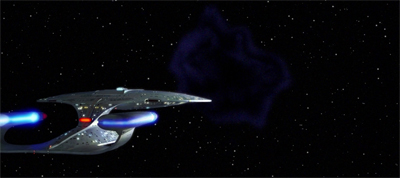
In particular, Where Silence Has Lease allows the show to tell a straight-up science-fiction exploration story that provides commentary on the human condition, but in a manner that isn’t as clumsy as first-season efforts like Lonely Among Us. It’s not a classic episode, but it’s a solid one. However, a solid episode of the second season can stand alongside the best episodes of the first season, demonstrating that the show is making significant progress towards the consistent quality it would eventually maintain.

Into the void...

Into the void…

Continue reading