• Following Us

  • Categories

  • Check out the Archives


  • Awards & Nominations

Star Trek – The Enemy Within (Review)

To celebrate the release of Star Trek: Into Darkness this month, we’ll be running through the first season of the classic Star Trek all this month. Check back daily to get ready to boldly go. It’s only logical.

One thing that I don’t think the original Star Trek gets nearly enough credit for is the quality of the writers that Gene Roddenberry recruited to contribute scripts. Television obviously operated under a different model at the time, but there’s an impressive selection of science-fiction literary giants who contributed scripts to the show. More than that, it’s impressive how many of those stories became truly iconic Star Trek stories.

The Enemy Within is the work of author Richard Matheson, best known for stories like I Am Legend or What Dreams May Come. It’s very much a high-concept science-fiction story, but it’s also notable because it establishes two of what would become the show’s favourite tropes: transporter accidents and evil duplicates. Indeed, the two devices would be reunited in the following season’s Mirror, Mirror. These narrative elements even featured in the last season of Star Trek: Enterprise to air, in episodes like Daedalus and In a Mirror, Darkly.

Perhaps it’s a demonstration of how important these outside writers were to the development of Star Trek as a franchise that Matheson would effectively codify two stock narrative devices that would still be in use four decades later.
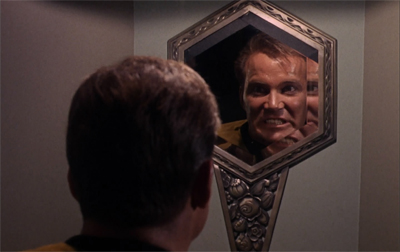
Mirror, mirror...

Mirror, mirror…

Continue reading

Star Trek – The Corbomite Manoeuvre (Review)

To celebrate the release of Star Trek: Into Darkness this month, we’ll be running through the first season of the classic Star Trek all this month. Check back daily to get ready to boldly go. It’s only logical.

Again, The Corbomite Manoeuvre is one of those early episodes of Star Trek that was shuffled around in the broadcast order. Not that there’s too much internal continuity to mess up or anything like that, but it is particularly noticeable when episodes at the start of a television show get shuffled around. The writers are establishing characters and concepts, so it feels strange to watch the first episode written with McCoy after we’ve already seen him established as the ship’s doctor.

(The first episode aired, The Man Trap, centres around McCoy, which makes it strange when the ship suddenly has a different Chief Medical Officer in the Where No Man Has Gone Before.)

Fortunately though, The Corbomite Manoeuvre is the last time that this really becomes a concern, as Star Trek seems to iron out all the difficulties and the nuances on a new television show. Effectively the first regular episode of the show produced after two pilots, a large part of the charm of The Corbomite Manoeuvre is really watching it all come together.

What a dummy...

What a dummy…

Continue reading

Star Trek – Where No Man Has Gone Before (Review)

To celebrate the release of Star Trek: Into Darkness this month, we’ll be running through the first season of the classic Star Trek all this month. Check back daily to get ready to boldly go. It’s only logical.

In a way, there’s a very clear divide between The Cage and Where No Man Has Gone Before. It’s clearer than the strange new actor sitting in the middle of the Bridge or the fact that Spock is suddenly a lot less casual. In a way, each is perfectly positioned in popular consciousness. The Cage was produced in late 1964, but wouldn’t be shown on television until 1988, after spending years touring the fan circuit. It remains a strange bit of Star Trek history, sitting simultaneously outside any of the five television shows, and simultaneously a completely inexorable part of the franchise’s evolution. It’s where it all began, but not where the first Star Trek began.

In contrast, Where No Man Has Gone Before feels more like the pilot episode of Star Trek. Sure, the fashion changes a bit in the episodes to come, the entire cast has yet to be assembled, but this is recognisably the same ship and the same show as The Corbomite Manoeuvre or The Man Trap. It’s more than the actors filling roles, the consistent characterisation of Spock or the fact that it actually aired on television in September 1966. This is what the next three years of Star Trek will be like. It’s an aesthetic or an approach to storytelling that is markedly different to the way that The Cage tackled many of the same themes and ideas.

While The Cage laid down many of the philosophical underpinnings of the broader Star Trek universe – including the classic show – it is also a lot less physical and visceral than the classic Star Trek. Indeed, The Cage featured the Captain of the Enterprise reasoning with an advanced bunch of god-like aliens, appealing to human virtues. The action sequences felt a bit extraneous. In contrast, Where No Man Has Gone Before sees the Captain of the Enterprise punching a god-like being repeatedly in the face while hitting on the same themes.

I think that’s perhaps the most dynamic difference between not only The Cage and Where No Man Has Gone Before, but between Star Trek and its spin-offs.

All the old familiar faces...

All the old familiar faces…

Continue reading

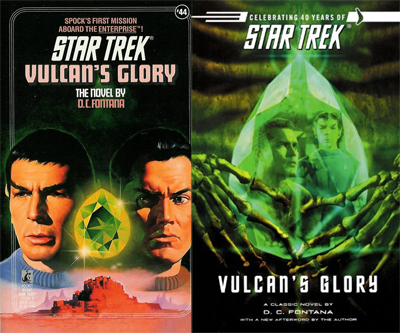
Star Trek – Vulcan’s Glory by D.C. Fontana (Review)

To celebrate the release of Star Trek: Into Darkness this month, we’ll be running through the first season of the classic Star Trek all this month. Check back daily to get ready to boldly go. It’s only logical.

We’ll be supplementing our coverage of the episodes with some additional materials – mainly novels and comics and films. This is one such entry.

I’ve never really felt too strongly one way or another about continuity. I never got too upset about Klingon forehead ridges, or the fact that Khan somehow remembered Chekov from an episode that took place before he joined the Enterprise. I’ve always found the use of the term “canon” to describe the shared continuity as more than a little indulgent or absurd. I consider some of the better tie-in novels I have read to be a worthy part of the Star Trek universe, regardless of the fact that they may not fit, or they may contradict what was depicted on-screen. I’ve never been too tightly tied to the notion that something is “important” or “in continuity” among this 700-episode franchise.

Still, I can’t help but feel like there’s something almost legitimate about Vulcan’s Glory. It is a novel from writer D.C. Fontana, who served as script editor and writer on the classic Star Trek show, and is regarded as one of the guiding lights of the franchise. She went on to write for both Star Trek: The Next Generation and Star Trek: Deep Space Nine. Given her importance to the show over its extended history, anything Fontana writes about it is worthy of note. Indeed, Vulcan’s Glory was originally published in 1989 and was reissued in 2006 for the franchise’s fortieth anniversary.

Even to somebody reluctant to consign “importance” or “worthy” to a tie-in based on outside factors, the story of Spock’s first mission on board the Enterprise, written by one of the strongest writers of the original Star Trek and a guiding influence on the franchise, still jumps out as a pretty important book.

vulcansglory

Continue reading

Star Trek: The Next Generation – Skin of Evil (Review)

To celebrate the twenty-fifth anniversary of Star Trek: The Next Generation, and also next year’s release of Star Trek: Into Darkness, I’m taking a look at the recent blu ray release of the first season, episode-by-episode. Check back daily for the latest review.

Skin of Evil is a mess of an episode. It’s a whole bunch of concepts thrown together, and executed in the most ridiculous and banal manner possible. There’s a lot of the disparate elements of Skin of Evil that could easily work if handled properly. Most notably, the idea of a character dying in the line of duty rather than as a hero is a fascinating one, and the eponymous monster could be an interesting twist on the “god-like beings” we seem to stumble across once every couple of weeks in the Star Trek universe. However, Skin of Evil winds up feeling the one thing it should be impossible for an episode like this to be. Despite all the different stuff happening involving all the different characters: it’s boring.

A slick operator...

A slick operator…

Continue reading

Star Trek: The Next Generation – Home Soil (Review)

To celebrate the twenty-fifth anniversary of Star Trek: The Next Generation, and also next year’s release of Star Trek: Into Darkness, I’m taking a look at the recent blu ray release of the first season, episode-by-episode. Check back daily for the latest review.

I’ve been complaining pretty consistently throughout this rocky first year of Star Trek: The Next Generation that the show is trying too hard to be a carbon copy of the classic Star Trek, rather than trying to define its own distinct identity. By that logic, I concede that I should detest Home Soil. Much like the less-than-classic The Naked Now, it is pretty much an attempt to update an episode from the original show.

In this case, the story of a bunch of terraformers provoking an unconventional native lifeform recalls The Devil in the Dark, one of the best-loved episodes of Star Trek‘s pretty stellar first year. While Home Soil doesn’t quite measure up to its rather wonderful progenitor, it does manage to put its own slant on the story, to the point where Home Soil doesn’t feel like a recycled Star Trek script; rather, it feels like a story told from the perspective of The Next Generation.

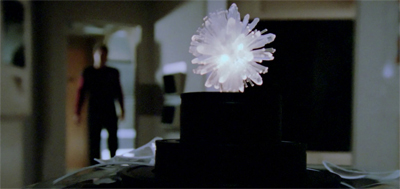
Spark of life...

Spark of life…

Continue reading

Star Trek: The Next Generation – Too Short a Season (Review)

To celebrate the twenty-fifth anniversary of Star Trek: The Next Generation, and also next year’s release of Star Trek: Into Darkness, I’m taking a look at the recent blu ray release of the first season, episode-by-episode. Check back daily for the latest review.

Too Short a Season falls back on one of those classic Star Trek stand-bys, the story of a dangerously obsessed senior officer who proceeds to put the lives of the crew at risk in order to feed his own ego. I’ve always found it hilarious that Starfleet seems to have truly terrible psychological screening, or maybe they just kick the more unreliable officers upstairs. After all, while Admiral Jameson is clearly a sandwich short of a picnic, at least he’s out of the line of fire. Too Short a Season winds up seeming like quite a trite episode, despite the fact that some of the elements are arguably intriguing on their own. It feels a little too safe, a little too comfortable, and far too predictable for its own good.

A shady character...

A shady character…

Continue reading

Star Trek: The Next Generation – Datalore (Review)

To celebrate the twenty-fifth anniversary of Star Trek: The Next Generation, and also next year’s release of Star Trek: Into Darkness, I’m taking a look at the recent blu ray release of the first season, episode-by-episode. Check back daily for the latest review.

If you absolutely, positively, positronically have to do an evil twin story, then I guess that Data is the best character to use. Datalore is hardly the finest or strongest episode of the first season. It’s riddled with plot holes, it feels overly contrived, it punishes the viewer for actually paying attention to the set-ups and plot devices, and it is awkwardly paced and sluggishly delivered. That said, it does offer some real stakes and an opportunity for Brent Spiner to ham it up a notch. So, while we’re not in “classic” (or even “good”) territory here, it’s certainly more watchable than a lot of the episodes around it.

That is not saying much.

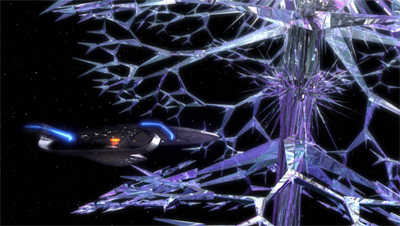
The threat is crystal clear...

The threat is crystal clear…

Continue reading

Star Trek: The Next Generation – The Battle (Review)

To celebrate the twenty-fifth anniversary of Star Trek: The Next Generation, and also next year’s release of Star Trek: Into Darkness, I’m taking a look at the recent blu ray release of the first season, episode-by-episode. Check back daily for the latest review.

The Battle represents a curious midpoint in the evolution of the Ferengi. When they first appeared in The Last Outpost (after being mentioned in Encounter at Farpoint), the aliens had been considered as viable replacements for the Klingons and Romulans as the primary antagonists of Star Trek: The Next Generation. Despite the presence of Worf on the Bridge, the bible for The Next Generation expressly forbade plots involving the Klingons or Romulans, with the creators afraid of returning to that particular well. (It would be towards the end of the season that both races would make a comeback, in big ways.) With neither of those races available, there was a void, and the Ferengi had been created to fill that void.

However, their introduction in The Last Outpost had been an unmitigated disaster, reducing the species to failed comic relief in their very first episode. The Battle is the second story to feature the aliens, and it never seems quite sure how to handle them. Does it present them as a credible threat, or merely as an awkward annoyance not to be taken seriously? The Battle can’t decide, and that’s just the most obvious of the episode’s fundamental problems.

They have yet to figure out an angle that works for the Ferengi…

Continue reading

Star Trek: The Next Generation – Justice (Review)

To celebrate the twenty-fifth anniversary of Star Trek: The Next Generation, and also next year’s release of Star Trek: Into Darkness, I’m taking a look at the recent blu ray release of the first season, episode-by-episode. Check back daily for the latest review.

I’ve been harping on quite a bit about how too much of the first season of Star Trek: The Next Generation is trying to hard to be classic Star Trek, without acknowledging that the original series was the product of a very different society and outlook. You can’t literally map familiar beats and metaphors on a one-for-one basis and expect them to work perfectly inside a storytelling engine that is radically different. It’s easy enough to imagine Justice working as a classic Star Trek episode.

Indeed, it seems quite similar to The Apple, among others. However, it’s the differences that are telling, and it’s the differences that serve to take what might have been an entertaining piece of fluff from the sixties and turn it into a near-catastrophic misfire in the eighties.

“This show is about Riker trying to what an alien?”

Continue reading