• Following Us

  • Categories

  • Check out the Archives


  • Awards & Nominations

Star Trek: The Next Generation – The Dauphin (Review)

This January and February, we’ll be finishing up our look at the second season of Star Trek: The Next Generation and moving on to the third year of the show, both recently and lovingly remastered for high definition. Check back daily for the latest review.

The Dauphin ends what looked like the beginning of a winning streak for the second season of Star Trek: The Next Generation. Both A Matter of Honour and The Measure of a Man represented a significant shift in gear for the show – a demonstration of just what The Next Generation was capable of at the top of its game. The Dauphin, in contrast, is a decidedly generic little episode.

It doesn’t help that it’s a character episode devoted to Wesley Crusher as a teenage protagonist on the Enterprise. Wesley was always a character who posed a bit of a problem for the show. There were times when bad writing and Wheaton’s less-than-nuanced performance saw the character threatening to turn The Next Generation into a plucky teenage science-fiction adventure series. Watch the boy genius save the ship while the trained professionals around him are useless!

While A Matter of Honour teased a way of making Wesley work in the context of the show, The Dauphin falls back into familiar traps. It’s a poorly-written teenage romance with some awful dialogue and two rather wooden leads, using familiar Star Trek trappings.
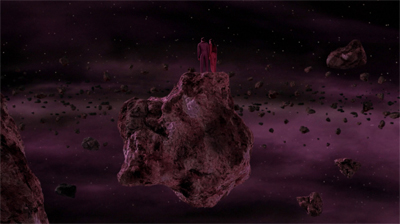
A rocky relationship?

A rocky relationship?

Continue reading

Star Trek: Deep Space Nine – The Jem’Hadar (Review)

Star Trek: Deep Space Nine is twenty years old this year. To celebrate, I’m taking a look at the first and second seasons. Check back daily for the latest review or retrospective.

In terms of sheer quality of execution, The Jem’Hadar is probably the weakest of Star Trek: Deep Space Nine‘s season finalés. It lacks the gut punch of A Call to Arms, the shock twist of Broken Link, the atmosphere of The Adversary or even the timeliness of In the Hands of the Prophets. It is, at its most basic level, a story about a disastrous first contact that occurs during a father-son bonding trip that goes horribly wrong, ending with precious little actually advanced.

However, in terms of conceptual ideas, The Jem’Hadar is a game-changer. It is the cornerstone upon which Deep Space Nine would construct its most iconic narrative arc. It caps off two years of trying to develop the Ferengi as more than one-note jokes. It’s a bold statement about the freedom that Deep Space Nine would enjoy with Star Trek: The Next Generation retiring from the airwaves. It cemented the notion that Deep Space Nine never really dealt in two-part episodes to bridge seasons.

For Deep Space Nine, season finalés did not exist simply as pieces of Lego designed to snugly fit those other pieces at the start of the following season, crafting some illusion of continuity flow between two different seasons of television. Instead, cliffhangers on Deep Space Nine changed the rules, shook up the status quo, and teased the changing face of things to come.

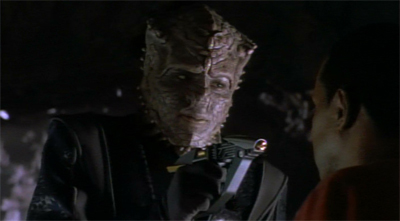
A Jem?

A Jem?

Continue reading

Star Trek: Deep Space Nine – The Collaborator (Review)

Star Trek: Deep Space Nine is twenty years old this year. To celebrate, I’m taking a look at the first and second seasons. Check back daily for the latest review or retrospective.

It’s surprising how long we’ve had since a solid Bajoran episode of Star Trek: Deep Space Nine. Barring the dark reflection of Bajor as a power-broker (and brief allusion to a colony in the Gamma Quadrant) in Crossover, the last episode to really explore the planet’s political and religious structure was probably Sanctuary, which aired more than half a season earlier. After a reasonably high concentration of Bajoran political adventures in the first season and the first half of the second, it seems that further explorations will be more broadly spaced.

Indeed, the first season ended (and the second season began) with a five-episode run that was heavily anchored in the show’s Bajoran surroundings. However, as of late, it feels we’ve been strangely disengaged from the show’s stated objective of welcoming Bajor to the Federation. With episodes like The Maquis, it seems like the show is making a conscious effort to disentangle Cardassian politics from those of Bajor.

In a way, this probably represents Deep Space Nine growing into the form that it will take for the rest of its run. The second season has really been about Deep Space Nine figuring out what it wants to be, and what it doesn’t want to be. With The Collaborator‘s focus on Bajoran politics feeling conspicuous by the lack of other Bajor-centric episodes in this half of the season, it seems like Deep Space Nine doesn’t want to be a show about Bajor.

Enough rope to hang himself...

Enough rope to hang himself…

Continue reading

Star Trek: Deep Space Nine – The Maquis, Part II (Review)

Star Trek: Deep Space Nine is twenty years old this year. To celebrate, I’m taking a look at the first and second seasons. Check back daily for the latest review or retrospective.

Oddly enough, for an episode designed to serve as a launching pad for Star Trek: Voyager, The Maquis, Part II really feels like the point where Star Trek: Deep Space Nine becomes Ira Steven Behr’s show. Deep Space Nine had been created by Michael Piller and Rick Berman. While Berman oversaw the franchise as a whole, Piller had been a guiding influence during the first two seasons of Deep Space Nine. However, his attention would wander to both Voyager and the pending films based on the Star Trek: The Next Generation film franchise.

As a result, producer Ira Steven Behr would be left in the driving seat of Deep Space Nine. Behr had some experience with the franchise. he was part of the wonderful writers’ room responsible for the massive upswing in the quality of The Next Generation, but left after a year on that show – describing it as “the Connecticut of Star Trek.” Years later, he was aggressively pursued by Piller to work on Deep Space Nine, where Piller felt his philosophy might be more at home.

The Maquis, Part II is far from Behr’s first writing credit on the show, and it’s certainly not the first time his influence has been felt. It is, however, the point at which it feels like Behr’s creative vision is firmly cemented the show’s outlook. Piller would move further away over the course of the next year, and Behr’s influence would grow even stronger, but this is the point where Behr’s vision of Deep Space Nine really takes hold.

Burning bridges...

Burning bridges…

Continue reading

Star Trek: Deep Space Nine – Playing God (Review)

Star Trek: Deep Space Nine is twenty years old this year. To celebrate, I’m taking a look at the first and second seasons. Check back daily for the latest review or retrospective.

Playing God is – structurally – quite similar to Shadowplay. The episode follows the same basic format. We have three plots running concurrently. One of these plots is a science-fiction plot while the other two are centred around character development. What’s interesting about Playing God is that the script essentially changes the priority of these plot threads. In Shadowplay, the central plot concerned the science-fiction mystery in the Gamma Quadrant, while here the ethical quandary is pushed firmly to the background. (Much to the chagrin of writer Jim Trombetta.)

Instead, Playing God brings the character plotline to the front, giving us the first Dax-centric episode firmly based around Jadzia rather than the symbiote inside of her.

Quark smells a rat... er... I mean vole...

Quark smells a rat… er… I mean vole…

Continue reading

Star Trek: Deep Space Nine – Shadowplay (Review)

Star Trek: Deep Space Nine is twenty years old this year. To celebrate, I’m taking a look at the first and second seasons. Check back daily for the latest review or retrospective.

Shadowplay is a great example of the kinds of things that Star Trek: Deep Space Nine is beginning to do very well. While the main plot works very well (so well, in fact that Star Trek: Enterprise would borrow it – and Rene Auberjones – for their first season episode Oasis), it’s remarkable how much of Shadowplay is given over to the two character-development subplots unfolding back on the station. Indeed, Dax and Odo have effectively solved the mystery of the missing villagers by about two-thirds of the way into the episode.

The character-development stuff in Shadowplay is interesting because the two subplots are not written with resolutions in mind. Indeed, they don’t even kick off the respective character arcs. Kira and Bariel have been waiting to become a couple since The Siege at the latest. The last episode, Paradise hinted that Jake might not be cut out to be a Starfleet officer.

In short, what is interesting about Shadowplay is the fact that it’s really just demonstrating that the show has reached the point where it is doing the things that it does relatively well. Deep Space Nine has found its groove, that point in a show’s history when it seems like it’s relatively easy to produce an hour of television of reasonable quality.

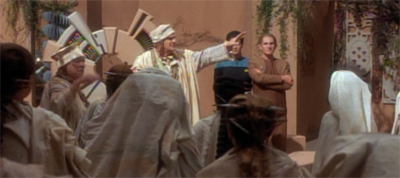
A holo crowd...

A holo crowd…

Continue reading

Star Trek: Deep Space Nine – Armageddon Game (Review)

Star Trek: Deep Space Nine is twenty years old this year. To celebrate, I’m taking a look at the first and second seasons. Check back daily for the latest review or retrospective.

It’s been a while since we’ve had a fairly generic “could have happened on any Star Trek episode of Deep Space Nine. So it’s a lot easier to forgive Armageddon Game its simplicity and lack of nuance. This isn’t a story specific to Deep Space Nine. The basic concept could – rather easily – have been tailored to fit Star Trek: The Next Generation or even Star Trek: Voyager, with two crew members on the run for their lives on an alien world.

Armageddon Game is another story idea from Morgan Grendel, a writer who tends towards extremes. The Inner Light remains one of the best episodes of Star Trek ever produced. The Passenger ranks among the worst episodes of Deep Space Nine ever to make it to the screen. Armageddon Game sits somewhere in the middle.

Talk about chemistry...

Talk about chemistry…

Continue reading

Star Trek: Deep Space Nine – The Alternate (Review)

Star Trek: Deep Space Nine is twenty years old this year. To celebrate, I’m taking a look at the first and second seasons. Check back daily for the latest review or retrospective.

Well, at least the second season of Star Trek: Deep Space Nine is experimental. It might not always pay-off, but there’s a clear sense that the show is trying new things, bending various genres to make them fit within the broad outline of a Star Trek show. Necessary Evil was a fascinating attempt to construct a noir episode, while Rivals was a less-than-successful sit-com in space. The Alternate is very much doing “Star Trek as monster movie”, which is surprisingly fun.

To be fair, it’s not a subgenre new to the franchise. Indeed, the first episode of the original show to air, The Man Trap, was essentially a monster horror in space. Still, The Alternate feels a bit more sinister and dark than  anything that Star Trek: The Next Generation might attempt. (Schisms probably comes closest, but – even then – there’s no sense that the monsters are stalking the starship. They have to abduct their victims to experiment on them.)

More than that, though, The Alternate is also a fascinating exploration of Odo as a character, looking at the relationship that Odo has with his co-workers and how that is rooted in his relationship with the man who claims to be his “father.”

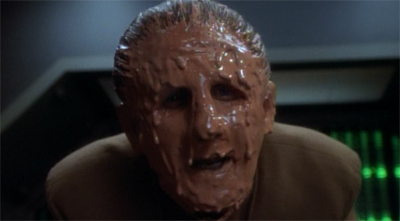
Melting! Melting! Oh what a world!

Melting! Melting! Oh what a world!

Continue reading

Star Trek: Deep Space Nine – Sanctuary (Review)

Star Trek: Deep Space Nine is twenty years old this year. To celebrate, I’m taking a look at the first and second seasons. Check back daily for the latest review or retrospective.

Sanctuary is a very weird little episode, a nice concept with too much padding, reserving its best hook and twist for the final ten minutes, but capping it off with an attempt to soften the harsh blow somewhat. It’s another of those “shows we could only do on Star Trek: Deep Space Nine from the series’ second season, and it’s certainly more interesting and ambitious than Second Sight. However, for all the clever stuff that it does, it feels somewhat oddly structured and paced, as if the writing staff knew there were good ideas wrapped up inside here, but weren’t exactly sure how to get them out.

A blip on the radar...

A blip on the radar…

Continue reading

Star Trek: Deep Space Nine – Necessary Evil (Review)

Star Trek: Deep Space Nine is twenty years old this year. To celebrate, I’m taking a look at the first season. Check back daily for the latest review or retrospective.

Commence Station Security log. Stardate 47282.5. At the request of Commander Sisko, I will hereafter be recording a daily log of law enforcement affairs. The reason for this exercise is beyond my comprehension, except perhaps that humans have a compulsion to keep records and lists and files. So many, in fact, that they have to invent new ways to store them microscopically, otherwise their records would overrun all known civilisation. My own very adequate memory not being good enough for Starfleet, I am pleased to put my voice to this official record of this day. Everything’s under control. End log.

Necessary Evil continues to deliver on the promise of “things you can’t do anywhere but Star Trek: Deep Space Nine that Michael Piller made at the start of the show’s second season. It’s a genuinely ambitious piece of Star Trek, all the stronger for the fact that it’s idea that could go horribly and spectacularly wrong. Movies like Blade Runner demonstrated that it is possible to blend the aesthetics of science-fiction and film noir, but it seems like a mix that would sit rather uncomfortably in the bright utopian future of Star Trek.

However, Deep Space Nine was never afraid to experiment with its format. This wasn’t always successful, but it did give the show a unique flavour. And when it did work, as it does here, it offered something new and exciting to the franchise’s playbook.

Time for a Changeling...

Time for a Changeling…

Continue reading