• Following Us

  • Categories

  • Check out the Archives


  • Awards & Nominations

Star Trek: The Next Generation – A Matter of Perspective (Review)

This January and February, we’ll be finishing up our look at the second season of Star Trek: The Next Generation and moving on to the third year of the show, both recently and lovingly remastered for high definition. Check back daily for the latest review.

A Matter of Perspective is a bit of a disappointment. However, it’s a disappointment for the same reason that The High Ground is a disappointment. The third season of Star Trek: The Next Generation is at least trying new things, and playing with big ideas for a syndicated television science-fiction show in the late eighties and early nineties. There is some charm to the episode’s basic premise (Rashomon in space… with the holodeck!”), but the script never quite manages to deliver on that wonderful set up.

Instead, we end up with a show that lacks the nuance to follow through on its central themes, and a mystery that confuses techno-babble for a satisfying solution.

Painting a pretty picture...

Painting a pretty picture…

Continue reading

Star Trek: Deep Space Nine – The Homecoming (Review)

Star Trek: Deep Space Nine is twenty years old this year. To celebrate, I’m taking a look at the first and second seasons. Check back daily for the latest review or retrospective.

The Homecoming is notable for a number of reasons. It kicks off the franchise’s first three parter. Sure, Family provided a nice epilogue to The Best of the Both Worlds, but The Homecoming, The Circle and The Siege represents the first explicit three-part story in the history of the franchise. Star Trek: Enterprise would develop a fondness for the format in its final season and one of those three-parters (The Forge, The Awakening and Kir’Shara) would owe a conscious debt to this opening trilogy.

It also pretty much sets the tone of season premieres on Star Trek: Deep Space Nine. Star Trek: The Next Generation and Star Trek: Voyager would both display a fondness for bridging their seasons with two-part adventures. The opening episode would air as a season finalé, with the resolution airing as the opening episode of the following season. Deep Space Nine was not so literal minded. While each season premiere was informed by the themes and events of the last season’s closing episode, Deep Space Nine tended to favour opening with multi-part episodes rather than conclusions to narrative hooks.

Rather than wrapping up the threads hinted at in In the Hands of the Prophets, The Homecoming only builds on them. It suggests that the problems and the difficulties facing Bajor won’t magically disappear because ninety minutes of screen time have elapsed.

Dynamic Kira action pose!

Dynamic Kira action pose!

Continue reading

Star Trek: Deep Space Nine – If Wishes Were Horses… (Review)

Star Trek: Deep Space Nine is twenty years old this year. To celebrate, I’m taking a look at the first season. Check back daily for the latest review or retrospective.

And after Progress gives us the most Deep-Space-Nine-y” episode yet, If Wishes Were Horses… offers the most generic Star Trek episode this side of The Passenger. The plot here should be very familiar. Like in Imaginary Friend or Shore Leave, the characters find their imaginations seem to be bringing things to life. Of course, it turns out to be an advanced alien intelligence that really just wants to study our crew, like in The Observer Effect or Scientific Method or even Schism. What I’m getting at here is that there’s really very little in this premise which hasn’t been done before or since on Star Trek, and nothing which wouldn’t feel more at home on Star Trek: The Next Generation or Star Trek: Voyager.

While it’s not as bad as The Passenger or Move Along Home, it is terribly generic and it feels like a waste of an episode in an already truncated season.

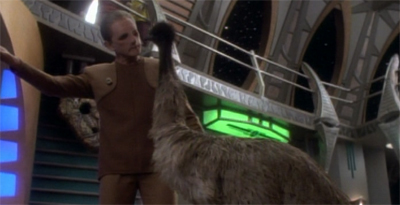
If wishes were emus...

If wishes were emus…

Continue reading

Star Trek: The Next Generation – We’ll Always Have Paris (Review)

To celebrate the twenty-fifth anniversary of Star Trek: The Next Generation, and also next year’s release of Star Trek: Into Darkness, I’m taking a look at the recent blu ray release of the first season, episode-by-episode. Check back daily for the latest review.

It’s hard to believe that we got this far into the show without a Picard-centred episode. Sure, the original Star Trek was reluctant to probe too deeply into Kirk’s background, but Star Trek: The Next Generation had already demonstrated that it was more willing to probe the histories of characters like Data (Datalore), Worf (Heart of Glory), Yar (Code of Honour and The Naked Now) and Troi (Haven). Star Trek shows, by they nature, tend to gravitate around their leading actor, and Patrick Stewart has been shown to hold the show together through sheer force of will at certain points. However, We’ll Always Have Paris marks the first time we’ve really delved that deeply into the character of Captain Jean-Luc Picard.

While we don’t peer nearly deeply enough, it’s fun to base an episode around Patrick Stewart, and time-travel was always a fun story-telling device on The Next Generation.

Picard's love life is solid as a rock...

Love on the rock…

Continue reading

Star Trek: The Next Generation – The Big Goodbye (Review)

To celebrate the twenty-fifth anniversary of Star Trek: The Next Generation, and also next year’s release of Star Trek: Into Darkness, I’m taking a look at the recent blu ray release of the first season, episode-by-episode. Check back daily for the latest review.

I actually enjoyed The Big Goodbye on a lot of levels. It’s not a great Star Trek episode, but I don’t think that the first season of Star Trek: The Next Generation produced a great episode. Even those episodes I do not actively hate are still significantly flawed. The Big Goodbye has more than its fair share of problems, but it does several things right. It never pretends to be more than it is, and it allows Patrick Stewart to do a lot of the heavy-lifting. Stewart is effectively charged with selling the episode to the audience, and he does a tremendous job. The result is something quite similar to the eponymous holonovel – something diverting and entertaining, but hardly profound or essential. Given the quality of the surrounding episodes, “diverting and entertaining” seems like just what the doctor ordered.

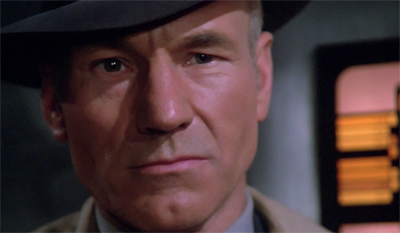
Over the Hill?

Over the Hill?

Continue reading