• Following Us

  • Categories

  • Check out the Archives


  • Awards & Nominations

Star Trek: Voyager – Real Life (Review)

Real Life is in some ways a departure for Star Trek: Voyager.

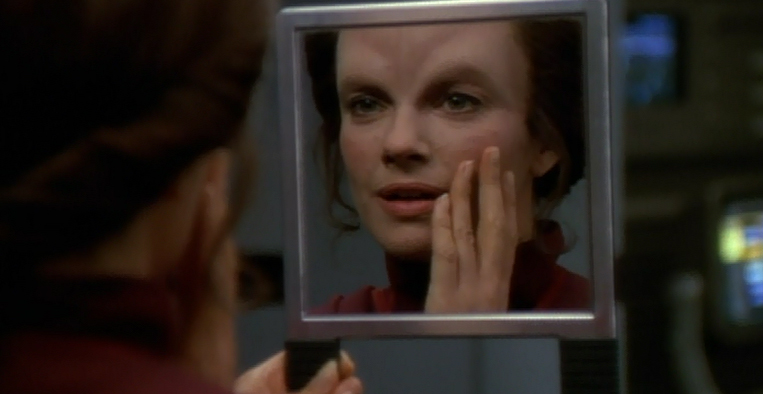
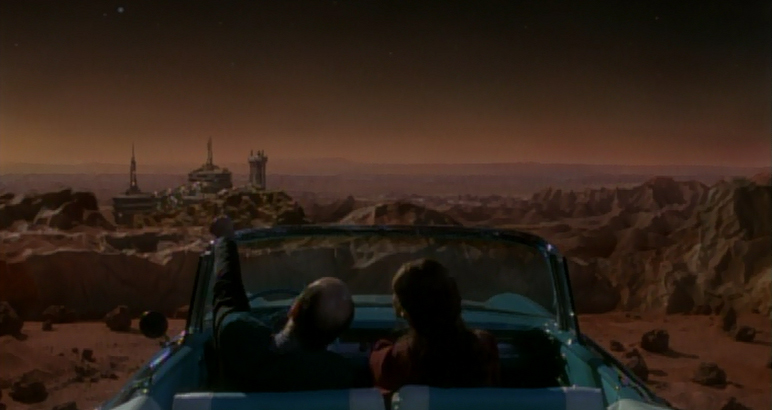
That much is obvious from the teaser, which introduces three new characters on a new set. More than that, the three characters comprise a nuclear family and the set is built to resemble the stereotypical American family home. It is a very strange image, even before the characters begin talking like they escaped from The Brady Bunch. In what might be the best teaser of the entire third season, it is revealed that the EMH has fashioned himself a holographic family and is “commuting” to work in sickbay from the holodeck.
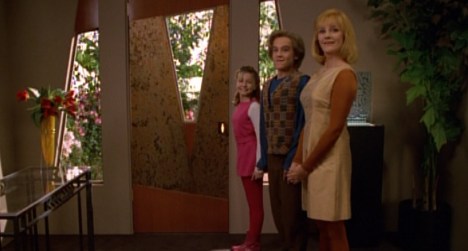
Projections.

Projections.

It is certainly an interesting idea, one that consciously brushes up against the kinds of limitations and expectations that Voyager has faced. It feels experimental, quite removed from the broader third season attempts to position Voyager as the most generic of the Star Trek spin-offs. This does not look or feel like any other episode in the franchise’s history. Indeed, with its focus on family dynamics and conflict, it feels like an extension of Ronald D. Moore’s work on episodes like Family and Doctor Bashir, I Presume.

This makes the episode’s failure to follow through on any of that potential even more disappointing. The third season of Voyager has dramatically scaled down its ambition following the spectacular misfires of the second season. The show is no longer attempting to create long-form stories or introduce iconic new recurring alien species, instead setting more modest goals for itself. There is something disheartening in seeing Voyager set more modest challenges for itself in episodes like Macrocosm or Fair Trade, only to spectacularly bungle the handling of those challenges.
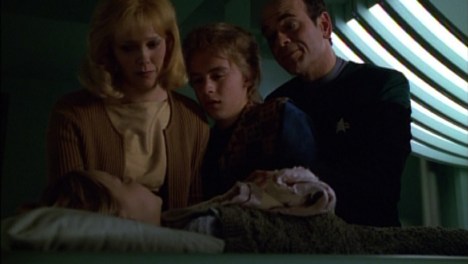
Family matters.

Family matters.

Real Life is another example of the trend. The premise is interesting, and the episode hits on any number of intriguing ideas. There is a great story to be told using this premise, exploring core themes about the human condition in a way that is quite different from the normal storytelling on Voyager. However, the episode flirts with the premise and then balks at it. Real Life is terrified of the implications of its story, padding out the plot with an unnecessary techno-babble-laden diversion and casually discarding the holographic family at the end of the script.

Real Life is an underwhelming story, rendered all the more disappointing for the promise that it squanders.
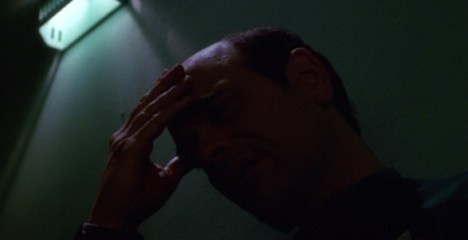
Photon father.

Photon father.

Continue reading

Star Trek: Voyager – Darkling (Review)

There is something to be said for the pulpier side of Star Trek: Voyager, the aspect of the show that plays like a cheesy sci-fi b-movie.

Brannon Braga is very much the driving force behind this aspect of the show, as evidenced by his scripts for the belated Cold War body-swapping horror of Cathexis or the psychological nightmare of Projections or the trashy psychedelic terror of Cold Fire or even the weird evolutionary anxieties of Threshold and Macrocosm. These sorts of episodes often feel like they belong in a late night movie slot reserved for forgotten horror flicks from the fifties and sixties. Of course, Braga is not alone in this; episodes like Meld and The Thaw also fit the pattern.

Blurred lines.

Blurred lines.

Of course, these episodes do not always hit the mark. Charitably, it could be argued that they land about half the time and misfire spectacularly about one third of the time. However, there is something strangely compelling about these episode. They feel distinct from what audiences expect from Star Trek. Even if they are arguably just an extension of late Star Trek: The Next Generation episodes like Sub Rosa or Genesis or Eye of the Beholder, they feel like something different from the show’s more conventional “let’s do archetypal Star Trek” plotting.

Darkling is an episode that doesn’t quite work, but which is oddly endearing in its dysfunction. It is a ridiculous central premise executed in a deeply flawed (and occasionally uncomfortable) manner. However, there is something weirdly compelling about wedding the show’s science-fiction premise to gothic horror through the fractured psyche of a computer program.

Patchy.

Patchy.

Continue reading

Star Trek: Voyager – Lifesigns (Review)

This February and March, we’re taking a look at the 1995 to 1996 season of Star Trek, including Star Trek: Deep Space Nine and Star Trek: Voyager. Check back daily Tuesday through Friday for the latest review.

Lifesigns is a fascinating piece of television.

In hindsight, it seems a shame that the production team decided to focus on the Kazon during the first two seasons of Star Trek: Voyager. The Kazon are perhaps the most unfortunate and misguided recurring alien species to appear across the entire Star Trek franchise, never quite afforded the redemption that turned the Klingons and Ferengi from two-dimensional caricatures into fully-formed and well-realised species. The Kazon were a misguided creation in Caretaker; they remained so in Basics, Part II. Shattered offers no redemption.

The face of the frenemy...

The face of the frenemy…

In contrast, the Vidiians are much more interesting. To be fair, it is possible that the Vidiians are so interesting precisely because they are underused; their appearances tend to be motivated by the demands of individual episodes rather than by some grand desire to create an iconic Star Trek species. At the same time, it is perhaps too much to suggest that the Vidiians are fully-formed or multi-faceted; the show never offers them the same opportunity for development afforded to species like the Kazon or the Borg or the Hirogen.

Despite all this, Lifesigns demonstrates the Vidiians can be used in an interesting and creative way. Even as the episode dedicates considerable space to demonstrating that Kazon are a much less interesting new species.

Starin' at the stars...

Starin’ at the stars…

Continue reading

Star Trek: Voyager – Projections (Review)

This September and October, we’re taking a look at the jam-packed 1994 to 1995 season of Star Trek, including Star Trek: Deep Space Nine and Star Trek: Voyager. Check back daily for the latest review.

Projections is really the first episode of Star Trek: Voyager that feels like it is the right script coming from the right staff writer. At the start of the show’s first season, it seemed like writing assignments were handed out almost at random, with no real acknowledgement of the relative strength of any of the writers involved.

Brannon Braga is one of the best science-fiction high-concept writers in the history of franchise, but he was assigned the character-driven second episode Parallax and the issue-driven Emanations; Michael Piller’s personal strengths were always more firmly aligned with character development, so it felt strange to see him writing the time travel adventure Time and Again and the anomaly of the week in The Cloud.

All by myself...

All by myself…

Pushing the boundaries of a writing staff is something worth doing – forcing various members of the team to ease themselves out of their comfort zone – but it felt counter-productive to do this during the first season of a new Star Trek show. After all, the first season is about putting the best foot forward, and many of the early scripts for the show feel like they were handed to the wrong writers during the development process.

With Projections, it feels like Brannon Braga finally has a Voyager script that plays entirely to his strengths as a writer. It is arguably his most character-driven script on the franchise to date, but it also anchored in a pretty fascinating existential dilemma. In many respects, it is a spiritual companion to Frame of Mind, a sixth season episode of Star Trek: The Next Generationpreoccupied with questions about what reality actually might be.

Everything falls apart...

Everything falls apart…

Following on from Heroes and Demons, Projections is only the second episode of Voyager to focus on the character of the Doctor. However, much like Heroes and Demons, it demonstrates the versatility of the character and the range of the actor. Projections is a very clever script that relies on its central character to really carry it across the line. At this point in Voyager‘s run, Robert Picardo seems to be one of the few members of the ensemble who could really pull it off.

The result is one of the (if not the) strongest episode of the show’s first two seasons – somewhat appropriate, given the way the show straddles the gap between the first and second seasons.

He's not all there...

He’s not all there…

Continue reading

Star Trek: Voyager – Heroes and Demons (Review)

This September and October, we’re taking a look at the jam-packed 1994 to 1995 season of Star Trek, including Star Trek: Deep Space Nine and Star Trek: Voyager. Check back daily for the latest review.

In many ways, Heroes and Demons is a watershed moment for Star Trek: Voyager. The two previous episodes, Prime Factors and State of Flux, may have been far from perfect, but they did at least hint at a direction for the show. They suggested that maybe Voyager might be interested in engaging in some of the big philosophical questions raised by the crew’s unique situation. Stranded seventy thousand light-years from home, the ship was cut off from the Federation. It was isolated and alone. That meant that tough choices at least had to be debated.

While neither Prime Factors nor State of Flux made for particularly exciting television, they were episodes that felt specific to Voyager in a way that a lot of the first season really doesn’t. Unfortunately, Heroes and Demons represents a step backwards. Far from telling a story specific to Star Trek: Voyager, this feels like a script that could easily have been recycled from Star Trek: The Next Generation or Star Trek: Deep Space Nine.

Can the Doctor hack it?

Can the Doctor hack it?

It’s written by veteran Next Generation writer Naren Shankar, who had also served on the staff of Deep Space Nine. He wrote Heroes and Demons as a freelancer, pitching the idea very early in the development cycle. Perhaps what is most remarkable is how little of Shankar’s script was adapted or edited from that first draft. In fact he described it to The Official Star Trek: Voyager Magazine as “the best experience I’ve ever had as a writer, in terms of writing something as a first draft and then seeing those exact words on screen.”

There’s a sense that Heroes and Demons is a fun story that could have really worked in any context, and doesn’t fit particularly well into the mould of Voyager‘s first season. This should be the year where Voyager is trying to find its own voice, rather than simply imitating that of its older siblings.

Only mostly armless...

Only mostly armless…

Continue reading