• Following Us

  • Categories

  • Check out the Archives


  • Awards & Nominations

Doctor Who: The Greatest Show in the Galaxy (Review)

To celebrate the fiftieth anniversary of the longest-running science-fiction show in the world, I’ll be taking weekly looks at some of my own personal favourite stories and arcs, from the old and new series, with a view to encapsulating the sublime, the clever and the fiendishly odd of the BBC’s Doctor Who.

The Greatest Show in the Galaxy originally aired in 1988.

Sometimes I think it’s you that’s crazy, not Deadbeat here.

Anybody remotely interesting is mad in some way or another.

– Ace and the Doctor cut to the heart of Doctor Who

It’s very hard to believe that The Greatest Show in the Galaxy aired as the final story of the twenty-fifth season of Doctor Who. Stories like Remembrance of the Daleks and Silver Nemesis were clearly anniversary fodder, celebrating the progress of the show to this point. The Happiness Patrol was a delightfully surreal oddity that has only really been noticed by the general public in recent years, with news breaking in 2010 that Andrew Cartmel had been using Doctor Who to tell politically subversive stories. Which, I suppose, confirms just how few people were watching The Happiness Patrol in 1988.

The Greatest Show in the Galaxy is as concerned with the legacy of Doctor Who as Remembrance of the Daleks or Silver Nemesis, but it lacks the nostalgic shine. Instead, it’s a stunningly bitter piece of television that offers a pretty damning indictment of what Doctor Who had become by the late eighties, a critique of selling out and chasing ratings and living in constant fear that the gods of entertainment – the middle-class families so desperately courted and so carefully catered to – might tune out and consign the show to oblivion.

The Doctor welcomes you to The Greatest Show in the Galaxy...

The Doctor welcomes you to The Greatest Show in the Galaxy…

Continue reading

Doctor Who: Genesis of the Daleks (Review)

To celebrate the fiftieth anniversary of the longest-running science-fiction show in the world, I’ll be taking weekly looks at some of my own personal favourite stories and arcs, from the old and new series, with a view to encapsulating the sublime, the clever and the fiendishly odd of the BBC’s Doctor Who.

Genesis of the Daleks originally aired in 1975.

Genesis of the Daleks is a great little story, and a strong contender for the title of “best Dalek story ever.” It works because Terry Nation takes his creations “back to basics” – not only in terms of time period, but also in terms of basic principles. If the Daleks are the embodiment of total warfare, it makes perfect sense to return to the war that spawned them, giving us an insight into their creation, and the philosophy that launched these deadly xenophobes into the wider universe.

Face of evil...

Continue reading

Doctor Who: The Unicorn and the Wasp (Review)

To celebrate the fiftieth anniversary of the longest-running science-fiction show in the world, I’ll be taking weekly looks at some of my own personal favourite stories and arcs, from the old and new series, with a view to encapsulating the sublime, the clever and the fiendishly odd of the BBC’s Doctor Who.

The Unicorn and the Wasp originally aired in 2008.

Oh, it’s you… I was just doing a little research… I say, what are you doing with that lead piping? But that’s impossible. Oh, no!

– Professor Peach discovers the point of crossover between Agatha Christie and Doctor Who

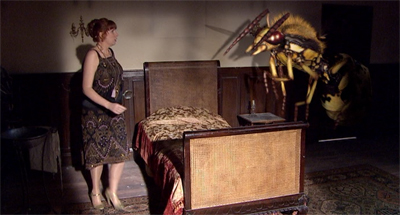
The Unicorn and the Wasp is the most fun episode of the fourth season, by a significant margin. It’s a high-concept high-energy run-around that has a great deal of fun playing with a genre mash-up, as the Doctor intrudes on an Agatha Christie mystery (starring Agatha Christie!) to create curious horror/sci-fi/mystery/class drama hybrid of an episode. It’s an episode that really benefits from the lighter tone of the fourth season. Despite some of the darkness creeping in at the edge of the frame, especially towards the final scenes, it’s an astonishingly light-hearted and playful episode.

In spite of Christie’s stern admonishings, it’s hard not to seize on the story with same glee as the Doctor does.

A sting in the tale...

A sting in the tale…

Continue reading

Doctor Who: Partners in Crime (Review)

To celebrate the fiftieth anniversary of the longest-running science-fiction show in the world, I’ll be taking weekly looks at some of my own personal favourite stories and arcs, from the old and new series, with a view to encapsulating the sublime, the clever and the fiendishly odd of the BBC’s Doctor Who.

Partners in Crime originally aired in 2008.

Would you rather be on your own?

No. Actually, no. But the last time, with Martha, like I said, it, it got complicated. And that was all my fault. I just want a mate.

You just want to mate?

I just want a mate!

You’re not mating with me, sunshine!

A mate. I want a mate.

Well, just as well, because I’m not having any of that nonsense. I mean, you’re just a long streak of nothing. You know, alien nothing.

There we are, then. Okay.

– Donna and the Doctor sort out the ground rules

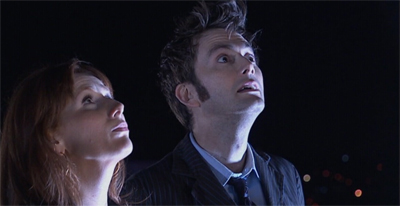
From the outset, Partners in Crime makes it clear that the fourth season of Doctor Who is probably going to be lighter going than the show’s third year. To be fair, it was heavily foreshadowed by a Christmas special that drew heavily from the work of Douglas Adams, whose influence is keenly felt across this entire season – right down to repeated references to the bees disappearing.

Casting Catherine Tate, best know for her work on The Catherine Tate show, as the season’s female companion was a bit of an indicator, but Partners in Crime makes it quite clear – playing more as an affectionate spoof of a classic Doctor Who run-around rather than something equal parts witty and terrifying.

Then again, given that the end of the third season featured the death of one tenth of the world’s population, the assassination of the President of the United States, the destruction of a companion’s life and the Doctor’s crushing realisation that he’s so lonely he’d retire to serving as the Master’s warden, one might argue that “lighter” was the only way to go.

Things are looking up...

Things are looking up…

Continue reading

Doctor Who: The Web of Fear (Review)

To celebrate the fiftieth anniversary of the longest-running science-fiction show in the world, I’ll be taking weekly looks at some of my own personal favourite stories and arcs, from the old and new series, with a view to encapsulating the sublime, the clever and the fiendishly odd of the BBC’s Doctor Who.

The Web of Fear originally aired in 1968.

See, now this is interesting.

The Enemy of the World had the luxury of arriving almost unannounced, a genuine honest-to-goodness classic story that had been written off by all but a minority of fans as a generic run-around James Bond pastiche. It was recovered, it turned out to be quite brilliant, and so was a massive surprise. Indeed, even if it had been merely “good” or “fine”, it would have been a joy to watch, because the episode was being measured against a popular imagination that had never really been too bothered with it. I don’t think it was too near the top of the majority of fans’ “would love to recover…” lists.

There were no expectations, so The Enemy of the World didn’t have to worry about measuring up to anything. The fact that it was quite brilliant was icing on the cake. In contrast, The Web of Fear has a lot of expectations to live up to. It is being measured not against the weight of continuity – featuring a much loved monster and introducing a recurring character – nor the sky-high expectations of fans. It is measured against the popular imagination. While The Enemy of the World probably seemed like an after-though to most Doctor Who fans, The Web of Fear is a massive part of what Doctor Who is to the general public.

Fur and loathing...

Fur and loathing…

Continue reading

Doctor Who: The Enemy of the World (Review)

To celebrate the fiftieth anniversary of the longest-running science-fiction show in the world, I’ll be taking weekly looks at some of my own personal favourite stories and arcs, from the old and new series, with a view to encapsulating the sublime, the clever and the fiendishly odd of the BBC’s Doctor Who.

The Enemy of the World originally aired in 1967-68.

One chance, my friend. I said one chance.

– Patrick Troughton gets his David Tennant on

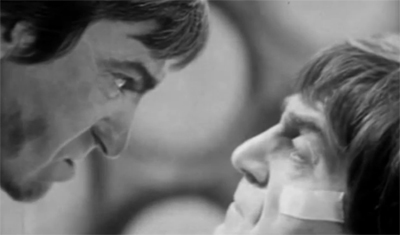
The Enemy of the World is an absolute joy from start to finish. Far too often, six-part Doctor Who serials tend to feel over-padded or over-stuffed, more a result of budget and production constraints than of any creative imperative to tell a story spread across six weeks. Instead, The Enemy of the World is a thoughtful, playful and fin six-part adventure that shows off Patrick Troughton at his best, with Dennis Whitaker’s script toying with various genre expectations and some interesting ideas about who the Doctor really is.

Face to face...

Face to face…

Continue reading

Doctor Who: The Ice Warriors (Review)

To celebrate the fiftieth anniversary of the longest-running science-fiction show in the world, I’ll be taking weekly looks at some of my own personal favourite stories and arcs, from the old and new series, with a view to encapsulating the sublime, the clever and the fiendishly odd of the BBC’s Doctor Who.

The Ice Warriors originally aired in 1967.

It’s strange that the Jon Pertwee era tends to attract so much criticism for adhering so rigidly to formula, with Barry Letts and his team rigidly working within well-defined lines and trying hard to produce television that doesn’t suck. Outside of the political criticism of the Pertwee era, there’s a train of thought that suggests the show became a little too formulaic, a little too predictable, failing to really push its own boundaries, with a few scattered exceptions.

And yet the Patrick Troughton era was arguably just as much a slave to routine and formula. The Troughton era is defined by its “base under siege” stories, so massively influential that they’ve become a Doctor Who subgenre unto themselves. Episodes like Earthshock and The Almost People arguably serve as homages to the genre that peaked during the late sixties. Indeed, allowing for some measure of flexibility, six of the seven adventures in this season could be described as “base under siege” stories.

I can’t help but wonder if the destruction of so many Troughton-era stories has led many Doctor Who fans to become blinded by nostalgia reflecting on the era. The Tomb of the Cybermen is, after all, much more exciting as the sole surviving “base under siege” story of the fifth season than it as the first of six adventures loosely adhering to the same structure and conventions.

Ice to meet you...

Ice to meet you…

Continue reading

Doctor Who: Doomsday (Review)

To celebrate the fiftieth anniversary of the longest-running science-fiction show in the world, I’ll be taking weekly looks at some of my own personal favourite stories and arcs, from the old and new series, with a view to encapsulating the sublime, the clever and the fiendishly odd of the BBC’s Doctor Who.

Doomsday originally aired in 2006.

Daleks, be warned. You have declared war upon the Cybermen.

This is not war. This is pest control.

We have five million Cybermen. How many are you?

Four.

You would destroy the Cybermen with four Daleks?

We would destroy the Cybermen with one Dalek. You are superior in only one respect.

What is that?

You are better at dying.

– the Cyberleader and Dalek Sec compete for the title of “bitchiest Doctor Who villain”

Part of my frustration with Doomsday is the same problem that I have with the rest of the second season’s weaker episodes. Like Fear Her or Rise of the Cybermen, the second season finalé lacks ambition. It feels complacent, it feels comfortable. It feels like putting the Daleks and the Cybermen together in one episode is enough to merit attention, without anything more than exchanging pithy one-liners. It feels like the separation of the Doctor and his companion is the biggest and most important thing in the universe, without really convincing us that this isn’t the best possible outcome. It feels like the easiest way to make these threats palpable is to set them in modern London, without any real sense of consequence or scale.

The tears of a Time Lord...

The tears of a Time Lord…

Continue reading

Doctor Who: Warriors of the Deep (Review)

To celebrate the fiftieth anniversary of the longest-running science-fiction show in the world, I’ll be taking weekly looks at some of my own personal favourite stories and arcs, from the old and new series, with a view to encapsulating the sublime, the clever and the fiendishly odd of the BBC’s Doctor Who.

Warriors of the Deep originally aired in 1984.

“Release the Myrka.”

– three words to create dread in even the toughest Doctor Who fan

I’ve always been somewhat less fond of Johnny Byrne’s Doctor Who than most fans. I can never, for example, understand the high esteem generally reserved for The Keeper of Traken (although it is a better story than Logopolis), and I really disliked Arc of Infinity. So I suspect some of the problems with Warriors of the Deepwere quite fundamental. However, there’s also a sense that those flaws were only exaggerated by a combination of other factors, including a low budget, a tight schedule and a script editor who believed an adventure’s pathos could be measured by its bodycount.

Everybody's dead, Davison...

Continue reading

Doctor Who: The Trial of a Time Lord – Terror of the Vervoids (Review)

To celebrate the fiftieth anniversary of the longest-running science-fiction show in the world, I’ll be taking weekly looks at some of my own personal favourite stories and arcs, from the old and new series, with a view to encapsulating the sublime, the clever and the fiendishly odd of the BBC’s Doctor Who.

The Trial of a Time Lord originally aired in 1986.

Mmm. This is a situation that requires tact and finesse. Fortunately, I am blessed with both.

– the Sixth Doctor

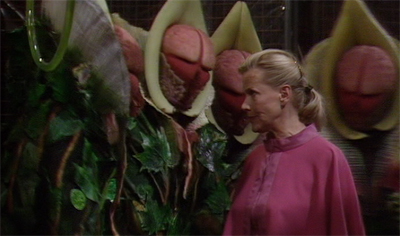
Okay, so the “past” and “present” sections of The Trial of a Time Lord haven’t been blow-outs. The Mysterious Planet demonstrated that maybe, once upon a time, Doctor Who had been decidedly average, constructed of a checklist of familiar and inoffensive tropes. Mindwarp demonstrated that Colin Baker’s Doctor was the kind of character who you could probably imagine chaining his companion to a rock on the beach, before leaving her to die… or marry Brian Blessed… or something. But, hey, there was some social commentary! If The Trial of a Time Lord is constructed as a defence by the show to avoid being sentenced to the bleak nether-realms of cancellation, I have to confess that I’m not convinced. And I like the show to begin with.

Still, it’s not a total failure. I mean, whatever the show was or is, it can always be something better, right? And so, this final story, Terror of the Vervoids, could easily prove that the show has a very clear idea of where it’s going next? The future will be better tomorrow, and all that?

Cue incredibly lame "Pussy Galore" joke...

Cue incredibly lame “Pussy Galore” joke…

Continue reading