• Following Us

  • Categories

  • Check out the Archives


  • Awards & Nominations

Millennium – In Arcadio Ego (Review)

This May and June, we’re taking a trip back in time to review the fifth season of The X-Files and the second season of Millennium.

A relatively recent study of teenage pregnancies accounted for forty-five virgin births in the United States, based on data from 1995, 2008 and 2009. Extrapolating from this data, the researchers estimate that almost 1% of births in the United States could be considered virgin births.

Of course, the researchers suggest a notable correlation between these self-described virgin births and other interesting social factors – virgin mothers are statistically quite likely to have low levels of sex education and are quite likely to have taken chastity vows. The myth of a virgin birth is powerful, and it is easy to understand in the context of contemporary attitudes about sex and sexuality that almost one in every hundred pregnant teenagers would rather claim a virgin birth than admit that they had sexual intercourse.
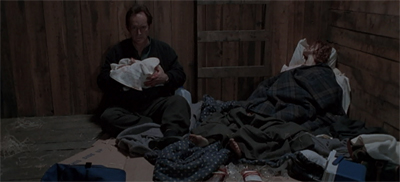
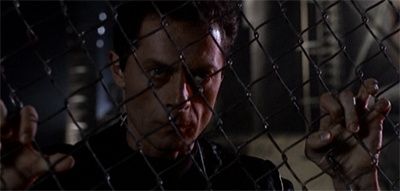
And Frank's left holding the baby...

And Frank’s left holding the baby…

In Arcadia Ego is not a particularly subtle script. Writer Chip Johannessen is quite candid about how he feels about all of this, telling a story about a modern-day immaculate conception featuring two escaped prisoners just looking for a reprieve from all the abuse and violence that they have encountered. In Arcadia Ego is a very socially-conscious piece of work, a rather pointed episode that pokes and prods at some the hypocrisies and inconsistencies in how we talk about sex and women in contemporary society. It is never too hard to tell how Johannessen feels on the matter.

At the same time, In Arcadia Ego is also a thoughtful and moving story about love, hope and faith. After a stretch of episodes that have seen Frank becoming more and more uncertain, In Arcadia Ego casts Frank as a pillar of moral certitude. While it might be a little clumsy in places, In Arcadia Ego is never less than well-intentioned.
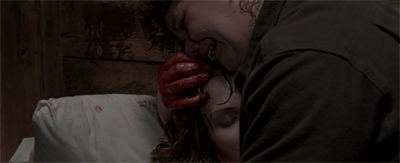
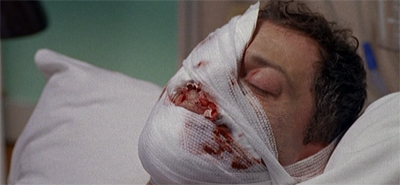
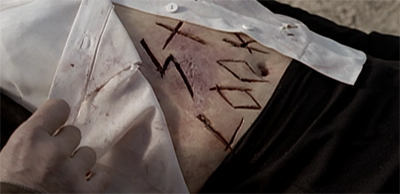
Bloody murder...

Bloody murder…

Continue reading

Millennium – Luminary (Review)

This May and June, we’re taking a trip back in time to review the fifth season of The X-Files and the second season of Millennium.

Why is Frank Black still involving himself with the Millennium Group?

The second season of Millennium is a fantastically constructed piece of television, but there are a number of fundamental criticisms that can be leveled at this particular incarnation of the show. To some viewers, it is too much to watch the Millennium Group transformed from a consultancy firm in the style of the Academy Group into an ancient Christian cult obsessed with doomsday. Other fans may not be particularly fond of the surreal eschatology of the second season, finding it a bit more “out there” than stories about serial killers and more mundane evil.

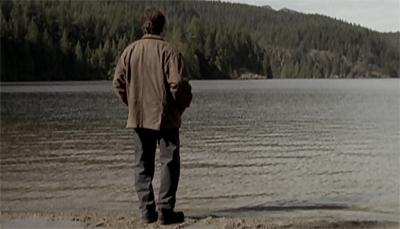
Cooling off period...

Cooling off period…

However, there are fans who have difficulty reconciling the version of Frank Black presented in the second season with the iteration who appeared throughout the first season of the show. The second season gave Frank a fondness for Bobby Darin and a sense of humour, but the change is more fundamental than that. The moral and righteous Frank was a pillar of certainty in an uncertain world. To some fans, it seems strange that Frank would remain involved in the Millennium Group as their paranoia and cultish behaviour became more and more apparent.

In many respects, Luminary seeks to answer that question. The second of Chip Johannessen’s three scripts for the second season ranks among his very best work for the show and the very best of the show in general. Johannessen has admitted that he was a little frustrated with the direction that Glen Morgan and James Wong took the show in its second year, and that scepticism bleeds through into Luminary. It is also what makes Luminary so compelling. It is a story about how Frank Black has lost himself over the last half-season, and needs to find his way back.

Night lights...

Night lights…

Continue reading

Millennium – Maranatha (Review)

This February and March, we’re taking a trip back in time to review the fourth season of The X-Files and the first season of Millennium.

Maranatha provides a nice close to Chip Johannessen’s four scripts for the first season of Millennium.

At its core, Maranatha is a story about stories. It is a tale about mythmaking and storytelling. It is about a monstrous man who seeks to transform himself into a creature of legend, brutally slaughtering innocent people in order to feed the idea that he is something much more than a corrupt political official. As such, the story sits quite comfortably alongside Johannessen’s other three scripts for the season, each of which is about storytelling or mythmaking in some form or another.

The power of Antichrist compels you...

The power of Antichrist compels you…

In Blood Relatives, James Dickerson attends the funerals of people he never knew, pretending to have been a part of the lives of the recently deceased; he tells stories and memories that never happened. In Force Majeure, Frank Black encounters a radical group of people who believe in the story of the end times; whether true or false, this story provides meaning to the life of the otherwise lost Dennis Hoffman. In Walkabout, Frank Black tries to piece together his recent history, constructing a narrative to account for out-of-character behaviour.

Maranatha serves as something of a culmination of this approach to Millennium. It the story of a sadist who seeks to elevate himself to the status of legend, dictating and shaping his own narrative through fear and manipulation.

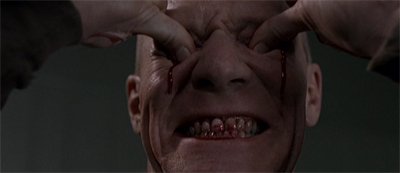
"I wanna take his face... off!"

“I wanna take his face… off!”

Continue reading

Millennium – Walkabout (Review)

This February and March, we’re taking a trip back in time to review the fourth season of The X-Files and the first season of Millennium.

Walkabout continues to demonstrate the flexibility of Millennium‘s format.

Millennium is often unfairly dismissed as a “serial-killer-of-the-week” show, an impression undoubtedly created by the stretch of early- to mid-season episodes that adopted an almost procedural formula in their exploration of evil. However, after Sacrament, the show takes a break from those narratives to do something a little more experimental and nuanced. Covenant had seen Frank investigating a murder that had already been solved. Here, Frank finds himself struggling to piece together a fractured memory of his own recent experiences.

A bleedin' disaster!

A bleedin’ disaster!

Walkabout is the third of four scripts from writer Chip Johannessen in the first season of Millennium. Each is a rather strange entity; doing something strange or unconventional for the show, helping to define the boundaries for this young television series. Walkabout is perhaps most interesting for the way that it engages with an aspect of Millennium that has been bubbling away in the background since The Pilot. Although Walkabout never explores the nature or purpose of Frank’s visions, the episode is built around the visions as a concept rather than simply a tool.

Walkabout is an unsettling and effective mood piece that grows more conventional as it progresses. While the final act is a little clunky, Walkabout is a fascinating piece of television and a demonstration of how Millennium has found its own voice.

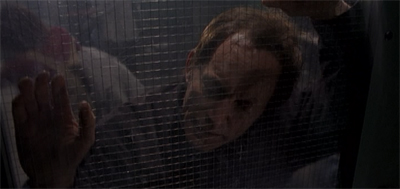
"Let me outta here!"

“Let me outta here!”

Continue reading

Millennium – Blood Relatives (Review)

This February and March, we’re taking a trip back in time to review the fourth season of The X-Files and the first season of Millennium.

Blood Relatives is the best episode of Millennium to air within the first half of the first season. It is an episode that seems to recognise the potential of a show like Millennium to be more than just a formulaic procedural, acknowledging that the show needs to find its own unique narratives in the same way that The X-Files did during its first season. Blood Relatives adheres rather loosely to the serial-killer-of-the-week format, but is rather more interested in the stories of the characters around the murders than in the murders themselves.

Blood Relatives is also notable as the first Millennium script written by Chip Johannessen. Johannessen would go on to become one of the defining voices of the show’s run, writing some of the best episodes of the first two seasons and steering the show through its troubled two years. Johannessen was good to Millennium, and Millennium was good to Johannessen. It transitioned the writer from shows like Married… With Children, Beverly Hills 90210 and The Monroes towards 24, Dexter and Homeland.

Not cut out for all this...

Not cut out for all this…

As with his next script, Force Majeure, Johannesson hones in quite beautifully on the potential of Millennium. Blood Relatives is an episode of television that is almost perfectly tailored for Millennium. While it retains the elements of a procedural, it is hard to image the episode working on something like Law & Order or CSI, more rigidly-structured television shows with clearer boundaries. Indeed, it seems like Johannessen recognised Millennium as a show spun out of Irresistible, and chose to play Blood Relatives on the same sort of themes about loss and dysfunction.

Blood Relatives is a superbly constructed piece of television, one that marks Johannessen as a talent to watch going forward.

Wading in...

Wading in…

Continue reading

Homeland: Season 1 (Review)

In many respects, Homeland feels like a more character-oriented version of 24. The comparison makes sense, beyond the spy games and the paranoia and the espionage, if only because of massive overlap between the production staff on both shows – with Howard Gordon, Sean Callery and Chip Johannessen working on both projects. I don’t think 24 gets enough respect as an exploration of the post-9/11 zeitgeist, probably due to its admittedly pulpy nature. Homeland feels a little bit more restrained, and more firmly grounded. The show is anchored in two fantastic lead performances from Claire Danes and Damien Lewis, and the series works best when it’s centred around the two main characters, driven by their issues and their demons.

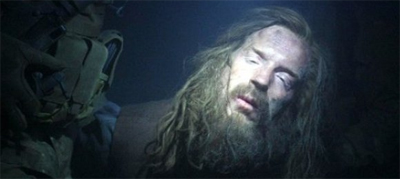
Nicholas Brody and his “great big bushy beard!”

Continue reading