• Following Us

  • Categories

  • Check out the Archives


  • Awards & Nominations

Millennium – Season 2 (Review)

This May and June, we’re taking a trip back in time to review the fifth season of The X-Files and the second season of Millennium.

The second season of Millennium is understandably polarising.

It is returned from its summer hiatus as what was, on the surface, a radically different television show. The Millennium Group was no longer simply a forensic consultancy firm, but had transformed into a secret society dating back millennia; it had become, as Frank would concede in The Fourth Horseman, “a cult.” More than that, the show had changed around the Millennium Group. Serial killers had been the show’s bread and butter in its first season, prompting some critics to describe it as a “serial killer of the week” procedural; now they were a rare occurrence.
millennium-thebeginningandtheend2

More than that, Frank Black had also changed. In interviews around the first season, Lance Henriksen had been very proud to play a hero who solved problems with his mind rather than with a gun. In contrast, the second season opened with Frank Black brutally murdering the man who kidnapped his wife. The yellow house had been a symbol of everything pure and good in the world of Frank Black, of the family he worked hard to protect. The second season had exiled Frank Black from this family and had him move deeper and deeper into the Millennium Group itself.

However, there were other changes that were less profound, but just as striking. Frank Black was suddenly a fan of the music of Bobby Darin. He suddenly had a sense of humour that led him to crack more than two jokes in a season. at the same time, he was also more short-tempered and grouchy. The first season had presented Frank Black as a rock in the middle of otherwise chaotic seas; in the second season, it was clear that Frank himself was feeling the strain and the stress. In short, Frank Black felt a lot more human.
millennium-aroomwithnoview9

The entire mood of the show changed around Frank. Millennium was suddenly a lot weirder. Though the first season had largely moved away from the classic “Frank hunts a serial killer” formula by the end of the year, the second season abandoned any sense of formula altogether. Watching the second season of Millennium on a week-to-week basis, it was almost impossible to predict what the next show would be like. Although there was a very strong thematic continuity between episodes, there was less of a rigid structure to their construction.

The second season of Millennium was a radical departure from what had come before. It was also the best season of television ever produced by Ten Thirteen.
millennium-luminary28

Continue reading

The X-Files – The X-Files Game (Review)

This May and June, we’re taking a trip back in time to review the fifth season of The X-Files and the second season of Millennium.

At the end of its fifth season, with the release of The X-Files: Fight the Future looming large, it was the perfect time to cash in the popularity of The X-Files. The show had already branded comic books and music albums, so an honest-to-goodness video game was the next logical step. The X-Files Game was released at the end of May 1998, right between the broadcast of The End and the theatrical release of Fight the Future. Fans who could not wait three weeks to see the big budget feature film would have the game to keep them occupied.

To be fair, The X-Files Game was not the first digital project to cash in on the success of The X-Files. Unrestricted Access had been released over a year earlier – a database of information relating to the show that could be read in Internet Explorer 4. Spanning seven discs, The X-Files Game was a much more ambitious project, a series of live-action sequences stitched together to form an interactive video game narrative. However, the game suffers from a somewhat repetitive design and the fact that, while it tries to emulate the look and feel of the show, it simply can’t.

xfiles-game4

Continue reading

The X-Files – The End (Review)

This May and June, we’re taking a trip back in time to review the fifth season of The X-Files and the second season of Millennium.

The End is a watershed moment for the show.

There is a reasonable argument to be made that The End accomplishes very little in terms of narrative. It doesn’t really do a great job bridging to The X-Files: Fight the Future. It certainly doesn’t do a great job wrapping up any of the show’s long-running concerns. Indeed, it adds two characters who will go on to become major (if controversial) players in the show’s overarching mythology. Even the big dramatic twist at the end of the episode feels familiar, with The End closing on a more memorable visualisation of the cliffhanger to The Erlenmeyer Flask.

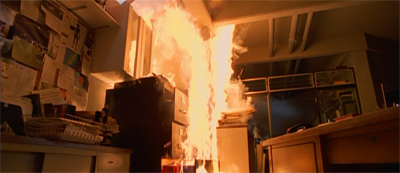
Burn, baby, burn...

Burn, baby, burn…

Nevertheless, The End does feel like an end of sorts. It closes out five seasons of The X-Files. Carter had suggested in interviews that he only wanted to do five seasons of the show before transitioning into feature films, and so The End marks the conclusion of the run that Carter had originally planned for the show. After all, The X-Files had crossed the hundred episode mark earlier in the year. It was ripe for syndication. It was at the stage where Fox and Ten Thirteen did not need to keep the show on the air to keep printing money.

At the same time, The End marks another more definitive sort of end. It would be the last piece of The X-Files to be filmed in Vancouver until The X-Files: I Want to Believe a decade later. Vancouver was a part of the show’s DNA. It had been the show’s production hub since The Pilot. More than two decades later, The X-Files would return to Vancouver for its six-episode wrap-up miniseries. Discussing the revival, Carter argued that Vancouver was “a natural place to make a show like The X-Files.” Certainly, the mood and atmosphere lent itself to the series.

"My video collection!"

“My video collection!”

So The End marks a fond farewell from the production team to a city and region that had served them well.  In that respect, it feels like a more definitive sort of ending. The End opens with a scene that is confident enough to let Canada be Canada. As with the opening scene of Herrenvolk, it is almost comical how hard The End flags its “and starring Canada as Canada” cred, to the point where a mountie rushes to the aid of an assassination victim. The closing scene of The End burns down the show’s most iconic and memorable sets.

While The End is not necessarily a satisfying mythology episode or season finalé in its own right, it does feel like a suitably big moment in the evolution of the show.

Smoking gun...

Smoking gun…

Continue reading

Millennium – The Time is Now (Review)

This May and June, we’re taking a trip back in time to review the fifth season of The X-Files and the second season of Millennium.

The second season of Millennium holds together very well as a season of television.

It is arguably more cohesive in terms of plotting and theme than any individual season of The X-Files, with the possible exception of the eighth season. Ideas, characters and themes are all set up early in the season so that they might pay-off at the climax. Watching The Fourth Horseman and The Time is Now, it is very hard to believe that the season could have ended any other way. That is a tremendous accomplishment on the part of Glen Morgan and James Wong, who steered the second season as Chris Carter brought his focus back to The X-Files.

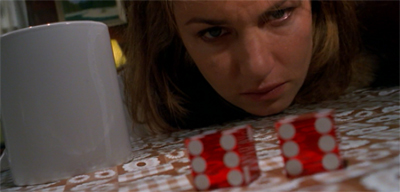
Dicey proposition...

Dicey proposition…

The attention to detail is staggering. There are lots of little touches, from the way that the use of chickens in The Fourth Horseman calls back to the story that bookends Monster to the reference to the fate of Brian Roedecker to the quick shot of Frank placing the statue of the angel on his father’s grave. Glen Morgan has repeatedly stated that the character of Lara Means was introduced in Monster knowing her fate in The Time is Now, and that seems to be true of most of the character and plot arcs over the stretch of the second season.

However, what is truly touching about the second season of Millennium is the way that the show manages to remain deeply personal and emotional, despite the scale of what is unfolding.

Shattered mirror...

Shattered mirror…

Continue reading

The X-Files – Folie à Deux (Review)

This May and June, we’re taking a trip back in time to review the fifth season of The X-Files and the second season of Millennium.

Folie à Deux is the last stand-alone episode of the fifth season, and the last stand-alone episode to be produced in Vancouver. It is also a pretty essential episode before The X-Files: Fight the Future, reinforcing just how essential Mulder and Scully are to one another shortly before the movie threatens to break them up for good.

Folie à Deux is also one of Vince Gilligan’s most underrated scripts from the show’s entire run, a thoughtful examination of the relationship between Mulder and Scully that provides a clever counterpoint to his script of Bad Blood. If Bad Blood was essentially a story about how Mulder and Scully see the universe differently, then Folie à Deux represents an attempt to heal that rift, perhaps suggesting that Mulder and Scully have come to share their own unique form of madness.

Bugging Skinner...

Bugging Skinner…

Continue reading

Millennium – The Fourth Horseman (Review)

This May and June, we’re taking a trip back in time to review the fifth season of The X-Files and the second season of Millennium.

The second season of Millennium has been consciously building towards an apocalypse.

Actually, that is not entirely true. The second season of Millennium has been building to an almost infinite number of apocalypses. The collapse of Michael Beebe’s home in Beware of the Dog, the destruction of an entire community in Monster, the dissolution of the tribe in A Single Blade of Grass, the potential loss of a child in 19:19, an author’s acceptance of his fading skills and relevance in Jose Chung’s “Doomsday Defense”, the stealing of a soul in The Pest House, the breaking of a spirit in A Room With No View. The second season is populated with apocalypses.

Everything dies...

Everything dies…

Ever since The Beginning and the End opened with Frank Black staring into space as he contemplated cosmic forces of entropy and decay, it has been clear that the second season of Millennium is about more than just the end of the world. It is about the end of worlds. Over the course of The Fourth Horseman and The Time is Now, Peter Watts loses his faith (and maybe his life) as Lara Means loses her sanity. Frank Black loses his father and his friends – and, ultimately, his wife. The Marburg Virus is just a blip on the radar compared to all of this.

The Fourth Horseman and The Time is Now combine to form one of the most interesting and compelling finalés ever produced. The two-parter is the perfect conclusion to the second season of Millennium. Indeed, it would be the perfect conclusion to the entire series. Perhaps the biggest problem with The Fourth Horseman and The Time is Now is the fact that The Innocents is lurking only a few months away.

Cracking up...

Cracking up…

Continue reading

The X-Files (Topps) #40 – Devil’s Advocate (Review)

This May and June, we’re taking a trip back in time to review the fifth season of The X-Files and the second season of Millennium.

Devil’s Advocate is a perfectly serviceable comic.

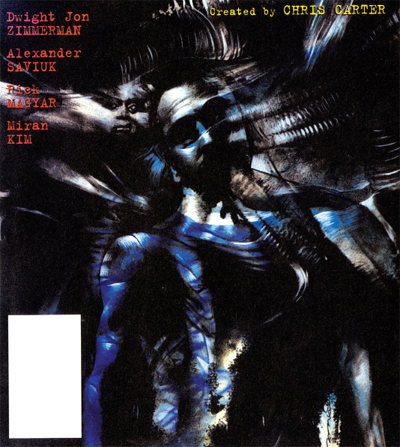
Its most distinguishing feature is the fact that it was not written by John Rozum, even though the art is provided by Alex Saviuk. This is not the first time that Rozum had taken a break from the monthly title. Writer Kevin J. Anderson had substituted in for Family Portrait, providing a quick two-issue fill-in rather early in the run. Here, executive editor Dwight Jon Zimmerman steps in to script the issue, possibly freeing up Rozum to finish work on the adaptation of The X-Files: Fight the Future that Topps planned to publish to mark the release of the film.

Ghosts in the machine...

Ghosts in the machine…

Dwight Jon Zimmerman was an industry veteran. He had worked at Marvel during the late eighties, writing for characters like Spider-Man and Wolverine. He joined Topps when they announced their plan to expand into the world of comic book publishing. Zimmerman worked as both an executive editor and as a writer. He worked on the company’s Mars Attacks! line. He also wrote Once Upon a Time…, the illustrated biography of Princess Diana that was published by the company in 1997.

Zimmerman’s interests tend towards the military. He has written articles on American military history for American Heritage, the Naval Institute Press, and Vietnam Magazine. He served as President of the Military Writers’ Society of America. As such, it is no surprise that Devil’s Advocate plays to those strengths. It is an old-fashioned “military cover-up” story, with little to distinguish or define it from dozens of similar stories told using these characters over years and years.

"This is why we should go rafting in the daytime, Scully."

“This is why we should go rafting in the daytime, Scully.”

Continue reading

The X-Files – The Pine Bluff Variant (Review)

This May and June, we’re taking a trip back in time to review the fifth season of The X-Files and the second season of Millennium.

The Pine Bluff Variant is probably John Shiban’s best solo script for The X-Files.

It is the kind of story that the show does very well, a taut conspiracy thriller packed with sharp twists and turns. Not all of those twists and turns make a great deal of sense, but there is an incredible momentum to the episode that keeps it moving forward. John Shiban’s script is beautifully brought to life by Rob Bowman’s direction, with Bowman demonstrating once again why he was the perfect choice to direct The X-Files: Fight the Future. The Pine Bluff Variant is a well-constructed piece of television.

He who hunts monsters...

He who hunts monsters…

It also fits quite comfortably in the context of where the show is at this point in time. The fourth and fifth seasons of The X-Files saw the show really engaging with the dark underbelly of conspiracy culture just as Mulder when through his own dark midnight of the soul. After three seasons of endorsing paranoia and skepticism, The X-Files was ready to deal with the sorts of organised groups that believed in such conspiracies. The Pine Bluff Variant has Mulder infiltrating a militia a few months before the release of Fight the Future would recreate the Oklahoma City Bombing.

It is a thread with which the show had been playing since The Field Where I Died early in the fourth season. The Pine Bluff Variant is the last time that the series pushes these sorts of militia groups to the fore, with Mulder reaffirming and regaining his faith at the climax of Fight the Future. It is a suitably satisfying farewell to this recurring thematic motif.

Fleshing out the threat...

Fleshing out the threat…

Continue reading

Millennium – Somehow, Satan Got Behind Me (Review)

This May and June, we’re taking a trip back in time to review the fifth season of The X-Files and the second season of Millennium.

Somehow, Satan Got Behind Me is Darin Morgan’s last script for Millennium.

It is an interesting script. It not as straightforward (and linear) as his scripts for Clyde Bruckman’s Final Repose or Jose Chung’s “Doomday Defense”, but it is not as outwardly complex (and intricate) as Jose Chung’s “From Outer Space.” These descriptors are all relative, of course. Somehow, Satan Got Behind Me is a Darin Morgan script through-and-through. It is clever, well-constructed, and thoughtful. It is one of the most eccentric episodes in a season full of eccentric episodes.

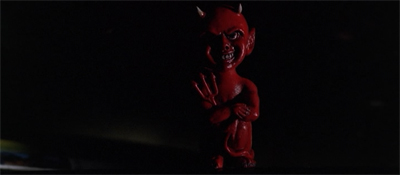
Little devil...

Little devil…

However, Somehow, Satan Got Behind Me remains rather hard to pin down. It doesn’t feel as cohesive or as singular as Morgan’s other scripts. Morgan tends to build his episodes around big thematic tentpoles. There are ideas and themes that reverberate across and throughout Somehow, Satan Got Behind Me, but the nature of the script means that the episode lacks the unity of purpose that viewers have come to expect from Darin Morgan. Somehow, Satan Got Behind Me is a rollercoaster of an episode, which seems to hop from one idea to another.

Of course, that would seem to be the point. Somehow, Satan Got Behind Me is a bold and experimental script in its own way. Morgan has essentially constructed a set of four interlocking (and occasionally thematically overlapping) short stories that are built around his own core themes and ideas. These are small and intimate tales, lying at the intersection between the mundane and the surreal. As such, it seems like the perfect place for Darin Morgan to take his second bow.

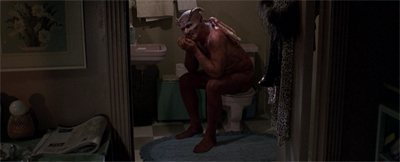
A demon crying on a toilet. What more could you want?

A demon crying on a toilet.
What more could you want?

Continue reading

The X-Files (Topps) #39 – Scum of the Earth (Review)

This May and June, we’re taking a trip back in time to review the fifth season of The X-Files and the second season of Millennium.

Scum of the Earth taps right into the sweet spot for John Rozum’s sensibilities.

Rozum’s work on Topps’ monthly X-Files comic book might not have been quite as ambitious as that of his predecessor, but he had his own areas of interest and recurring themes. Scum of the Earth provides the perfect intersection between the classic horror comic aesthetic of stories like The Kanashibari and Donor and the more environmentally-conscious storytelling of scripts like Skybuster or Cam Rahn Bay. It is essentially a retelling of The Blob starring Mulder and Scully, in which the blob is created by toxic waste and bio-terrorism.

The green death...

The green death…

Scum of the Earth is not particularly elegant in its storytelling. Rozum’s script covers a lot of ground in the space of a single issue, presenting Mulder and Scully with a crisis that could easily threaten the entirety of the United States. it genuinely feels like Mulder and Scully have wandered into some lost fifties b-movie, capturing a lot of the atmosphere to which Ivan Reitman seemed to aspire by casting David Duchovny in Evolution a few years later. Scum of the Earth is an exceedingly silly comic book, and unashamedly so.

It is also great fun, which is something that really can’t be undersold when you are talking about an X-Files tie-in comic book.

Swamp Thing!

Swamp Thing!

Continue reading