• Following Us

  • Categories

  • Check out the Archives


  • Awards & Nominations

Star Trek: Voyager – Coda (Review)

In many ways, the Jeri Taylor era of Star Trek: Voyager represented a reaction to the direction that the show had taken under Michael Piller.

Michael Piller had imagined a more dynamic and adventurous version of the show, focusing on two crews thrown together by fate and forced to coexist while journeying through uncharted territory. After seven seasons of Star Trek: The Next Generation, Piller was understandably (and perhaps justifiably) concerned that the second iteration of Star Trek might have been growing somewhat stale. Star Trek: Deep Space Nine was in the process of breaking new ground, and Piller felt that it was necessary for the franchise to find a new direction and identity.
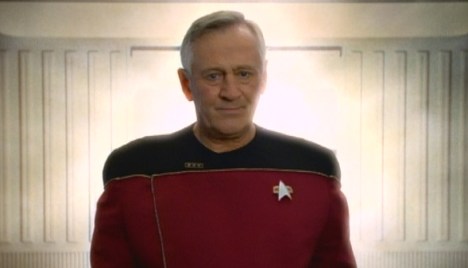
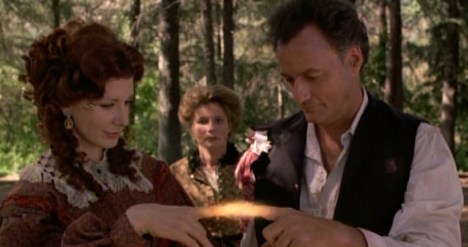
Daddy's home.

Daddy’s home.

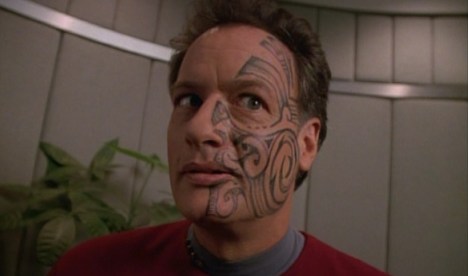
This is a good idea in theory. In practice, Michael Piller’s vision was disastrous. Piller wanted to do new things, but found himself working with a staff vehemently opposed to his vision of the series and phoning in scripts that should have been provocative like Alliances or Investigations. More than that, Piller was unable to properly realise his own ambitions, citing scripts like Tattoo as incredibly accomplishments rather than recognising them for the embarrassing failures that they were. When Piller was ousted after the second season, Jeri Taylor took over.

Jeri Taylor would oversee the third and fourth seasons of Voyager. She had a very clear vision of what Voyager should be, a rather conservative and generic iteration of the larger Star Trek franchise. Traditionally, the third season had served as a point of transition for the Star Trek spin-offs. It was in their third seasons that The Next Generation and Deep Space Nine really broke the mould and discovered their own unique identities. In contrast,t he third season of Voyager marked a point of retreat from the basic premise of the show.
Carry on regardless.

Carry on regardless.

Taylor wanted to focus on telling very safe and familiar Star Trek stories, ones that did not necessarily rely upon the premise of the show. There are any number of episodes where this approach simply did not work, with episodes like Warlord or The Q and the Grey or Alter Ego feeling like reheated Star Trek leftovers. However, there were points at which Taylor’s approach paid off. Future’s End, Part I and Future’s End, Part II were pure popcorn, but they worked on those terms. It didn’t matter that nobody seemed too bothered at getting Voyager back to Earth.

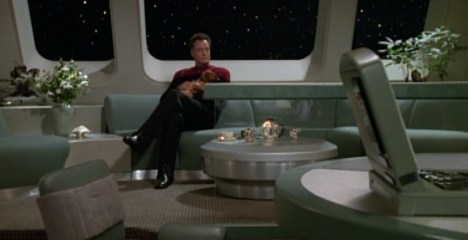
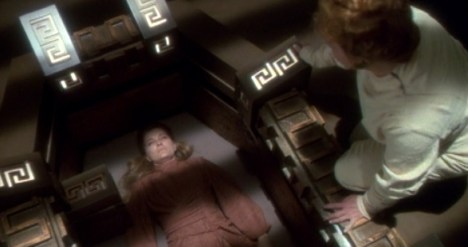
Coda is another example of the strengths of Taylor’s approach to Voyager. It is a very familiar and archetypal episode of Star Trek, one that might have been assembled from the leftover pieces of Cause and Effect or Tapestry. However, that relative simplicity becomes a strength, allowing Taylor to craft a script focusing on Janeway and giving Kate Mulgrew some meaty material into which she might sink her teeth. There is nothing particularly new or exciting here, but there is something to be said for executing old standards with such charm.

Of course he's evil. He's an admiral.

Of course he’s evil. He’s an admiral.

Continue reading

Star Trek: Voyager – Alter Ego (Review)

Following on from the aborted promise of a new beginning in Fair Trade, things get back to normal.

Alter Ego is another episode of Star Trek: Voyager that feels like it might have been wholly repurposed from an earlier Star Trek show. On the surface, it is a fairly standard “holodeck run amok” story in the style of earlier episodes like Heroes and Demons or Projections. However the contours of the plot recall a very specific (and very good) episode of Star Trek: The Next Generation. As Alter Ego seems to suggest that a holographic character has achieved sentience and threatens to destroy the ship, it recalls the far superior Ship in a Bottle.

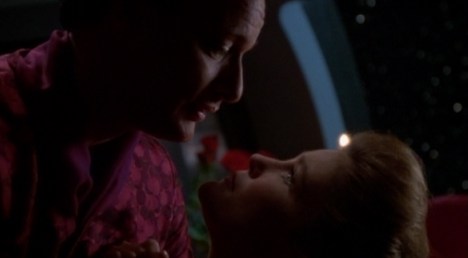
Forced attraction.

Forced attraction.

There are differences, of course. Ship in a Bottle is a far stronger episode, one of the best holodeck stories ever produced. More than that, the climax of Alter Ego reveals that the holodeck programme has not become sentient but is instead being used as the avatar of an outside force. Still, this twist is confined to the last act of the episode, and so it feels more like an embellishment than a revision. For the bulk of its runtime, Alter Ego plays as a pale imitation of a much stronger piece of television.

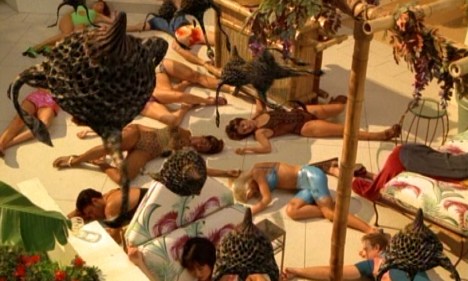
It does not help matter that Alter Ego‘s novel twist on that central premise is to paint its central guest star as a psychotic stalker with a crush.

A whole ball of crazy.

A whole ball of crazy.

Continue reading

Star Trek: Voyager – Fair Trade (Review)

In theory, Fair Trade is precisely the episode that Star Trek: Voyager needs right now.

From the outset, the show has struggled with several major problems. Superficially, Voyager has struggled to distinguish the Delta Quadrant from the Alpha Quadrant, to the point that the Kazon felt like low-rent Klingons and the various aliens-of-the-week seemed largely indistinguishable from the aliens-of-the-week featured on the sibling shows. More fundamentally, the show failed to conjure an air of mystery and intrigue about the region. Everything about the show felt too safe, right down to the characters. This was a show where terrorists became model officers.

Venting plasma...

Venting plasma…

Fair Trade feels like it should offer the perfect remedy to all of this. The opening scenes find Voyager brushing up against “the Nekrit Expanse.” It is a region of space that is pointedly different and alien. Neelix has no idea what lies beyond. The sensors cannot penetrate it. Voyager is forced to dock at a local space station to take supplies, one crowded with aliens of multiple species engaged in shady dealings. More than that, the episode hinges on the neglected character of Neelix. It returns to early undeveloped suggestions the Neelix is not all he claims to be.

However, in practice, Fair Trade is disappointing. The episode lacks the courage of its convictions, both as a script of itself and as clear demarcation within the third season. It is a show rich with promise that offers up any number of intriguing ideas, but lacks the courage necessary to follow through on them.

In a bit of a Wix.

In a bit of a Wix.

Continue reading

Star Trek: Voyager – Macrocosm (Review)

If Star Trek: Voyager is going to commit itself to emulating Star Trek: The Next Generation, there are probably worse ways to do it.

Macrocosm is not a bad riff on Genesis, another sci-fi monster story from Brannon Braga. Braga has an interest in the overlap between horror and retro science-fiction, as demonstrated by scripts from Schisms to Sub Rosa to Threshold. While none of these episodes count among Braga’s best work, and many are considered among his worst, they very clearly represent a subject of interest to him. Given the third season misfires with Warlord and The Q and the Grey, a light run-around action story is not the worst episode that Voyager could produce at this point.

Going viral.

Going viral.

Macrocosm has more than its fair share of problems. It is structured oddly, it is laboured with exposition, it is not technically as tight as it needs to be. However, there is a lot to be said for an episode that casts Kathryn Janeway as John Rambo, stalking killer monsters through the dimly-lit corridors of her own starship. It is at the very least a refreshing change of pace. Besides, if Jean-Luc Picard gets to be an action hero in scripts like Starship Mine or Star Trek: First Contact, it seems only fair that Janeway should get her chance.

The biggest problem with Macrocosm is the episode that it might have been. The original pitch for the episode was much more ambitious than the version that made it to screen. Unfortunately, this is very much the narrative of the third season of Voyager, and perhaps the show as a whole. Macrocosm was a bold idea that was gradually watered down to form a passable imitation of The Next Generation.

"It's going to get very First Contact in here, very quickly."

“It’s going to get very First Contact in here, very quickly.”

Continue reading

Star Trek: Voyager – The Q and the Grey (Review)

The Q and the Grey is an extraordinary cynical piece of work.

What better way to mark the release of Star Trek: First Contact into cinemas than to ensure that the very next episode of Star Trek: Voyager to broadcast features a guest appearance from one of the most beloved recurring characters to have appeared on Star Trek: The Next Generation? After all, the series had just led into the release of the movie with Future’s End, Part I and Future’s End, Part II providing a mid-nineties reimagining of the beloved Star Trek IV: The Voyage Home.

Pitching Q.

Pitching Q.

More than that, with Michael Piller gone from the writers’ room, the production staff had laid out a vision for the future of Voyager. The series effectively jettisoned any number of ideas that Piller had fostered over the first two seasons, from tension between Starfleet and the Maquis to the Kazon to Lon Suder to the idea of long-form storytelling to the relationship between Neelix and Kes. Instead, Voyager had decided to pitch itself as the most generic Star Trek ever, with little reference to the central premise of the series from here on out.

Indeed, The Q and the Grey is the second story in a very short space of time to make light of the crew’s journey home by refusing to press a more powerful guest star for assistance. In Future’s End, Part I and Future’s End, Part II, the ship’s temporally displaced return to Earth was shrugged with only a few lines of dialogue used to explain why this trip halfway across the galaxy could not be exploited to shorten their journey home. In The Q and the Grey, Janeway declines Q’s offer of assistance to get the crew home.

Bold-faced liar.

Bold-faced liar.

“My crew and I will get home,” Janeway informs Q. “We’re committed to that. But we’re going to do it through hard work and determination. We are not looking for a quick fix.” It is effectively the “building character” excuse for why Janeway doesn’t simply ask Q to return the ship home at the end of the story when the dust settles; nobody actually knows why that is, but it is probably best to offer some moral argument. The fact the Q could easily return the ship home, saving the lives of those who will die in the years ahead, is glossed over.

However, that does not matter, because Voyager has largely rejected its central premise. This no longer a series about a crew desperately longing to get home, except when it provides a convenient motivation. This is a Star Trek spin-off that is content to offer reheated leftovers inherited from The Next Generation. In this case, The Q and the Grey feels like a retread of Q Pid, a particularly uninspiring Next Generation episode. Next, Macrocosm will offer its own take on Genesis, another less than iconic Next Generation story.

And your little dog, too.

And your little dog, too.

All of this is building, to Voyager‘s most blatant and obvious inheritance from The Next Generation. The Borg are coming to Voyager, in greater numbers and higher concentration than they ever appeared on The Next Generation, as the show continues awkwardly trying on its older sibling’s clothes. It is disappointing and uninspiring by equal measure, watching Voyager abandon any pretence of its own identity in favour of something safer and more familiar. Then again, this was always a Star Trek show about longing for the comforts of home.

However, The Q and the Grey is not merely unoriginal and uninspired, it is also unfortunate. Kenneth Biller’s script is cringe-inducing and embarrassing, illogical and misogynistic. The biggest issue with The Q and the Grey is not that Voyager has settled for offering a pale imitation of The Next Generation. The problem is that that the imitation is downright terrible in its own right.

It fingers.

It fingers.

Continue reading

Star Trek: Voyager – Warlord (Review)

Warlord is another example of Star Trek: Voyager pitching itself as the most generic iteration of Star Trek.

At its core, Warlord is an example of the old Star Trek staple, the body-swapping personality-swap episode. There are dozens of examples from across the length and breadth of the franchise, asking regular performers to play different characters. The loosest definition would include William Shatner’s work in The Enemy Within or Roxann Dawson’s work in Faces. A more narrow sampling would include episodes like The Turnabout Intruder or The Schizoid Man. There were plenty of these episodes before Warlord, and there will be plenty after.

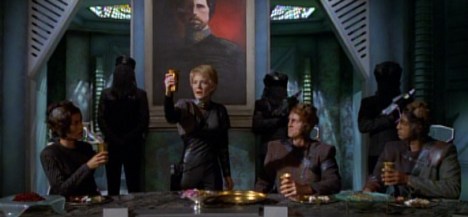
"A toast, to that most reliable of plot devices..."

“A toast, to that most reliable of plot devices…”

It is not a bad device, in theory. After all, playing the same character for twenty-odd episodes a year can be exhausting for a performer. Many actors relish the opportunity to shake things up, to put a new spin on an old role. (Chris Pine has only played Kirk three times, but already relishes the opportunity to see the character “go dark.”) It can be refreshing for the audience as well, giving them the opportunity to see exciting new sides of familiar characters. Warlord certainly has an intriguing enough hook in that regard: casting Jennifer Lien as a psychotic dictator.

The extent to which a given possession episode work is largely a matter of execution rather than concept. By that measure, Warlord comes up very short.

Make love, not Warlord.

Make love, not Warlord.

Continue reading

Star Trek: Voyager – Future’s End, Part II (Review)

In a very real way, the Rick Berman era of Star Trek ends with Future’s End, Part I and Future’s End, Part II.

Future’s End, Part I and Future’s End, Part II marks the point at which Star Trek: Voyager stops moving forward. It is the point at which the show decides that it has accomplished just about everything that it could ever want to accomplish, and that it has crystalised into its final form. There are some changes still to come, with the introduction of Jeri Ryan in Scorpion, Part II and the departure of Jeri Taylor following Hope and Fear, but (by and large) the show has pretty much figured out the kinds of stories that it wants to tell and the ways in which it wants to tell those stories.

More like a hole-o deck character...

More like a hole-o deck character…

Future’s End, Part I and Future’s End, Part II feels like an appropriate place at which to draw that line in the sand. It is the two-parter that really introduces the concept of big blockbuster storytelling to Voyager, and which restructures the series as a mechanism through which generic Star Trek stories might be told. The template for the remaining three-and-a-half seasons can be found in this episode, from the “everything is back to normal” ending through to the idea of giving Janeway a a singular action-movie antagonist against which she might define herself.

The two-parter seems to freeze Voyager in amber, and set its storytelling sensibilities in stone. There will be no more experimentation, no more evolution. This is how things are to be from this point onwards. Appropriately enough, Future’s End, Part I and Future’s End, Part II mark the future’s end.

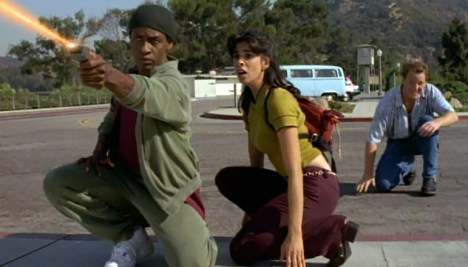
Tom and Tuvok's Bogus Journey...

Tom and Tuvok’s Bogus Journey…

Continue reading

Star Trek: Voyager – Future’s End, Part I (Review)

In a very real way, the third season of Star Trek: Voyager begins with Future’s End, Part I and Future’s End, Part II.

After all, the episode airs directly after Sacred Ground. Although mixed into the broadcast order with a bunch of episodes that had been produced during the third season, Sacred Ground was the last episode of the second season production block to be broadcast. (Basics, Part II had been the last episode to be produced.) Sacred Ground was the last episode of Voyager to be tied to producer Michael Piller, who had been working on the franchise since the start of the third season of Star Trek: The Next Generation. There is some sense of symmetry there.

Tuvok and roll.

Tuvok and roll.

Sacred Ground feels like an appropriate place to draw a line under the first two seasons of Voyager, to suggest that the earlier incarnation of the show is finished and that a new era is beginning. After all, Sacred Ground was really the last gasp of the New Age mysticism that Michael Piller had tried to infuse into Voyager through episodes like The Cloud or Tattoo. (Piller would return to that New Age fascination with Star Trek: Insurrection.) Sacred Ground even featured something of a rebirth of Captain Kathryn Janeway.

However, if Sacred Ground represents the end of the second season, what about the start of the third season? What makes Future’s End, Part I and Future’s End, Part II such an effective new beginning?

Feels like going home.

Feels like going home.

Continue reading

Star Trek: Voyager – Season 2 (Review)

This February and March (and a little bit of April), we’re taking a look at the 1995 to 1996 season of Star Trek, including Star Trek: Deep Space Nine and Star Trek: Voyager. Check back daily for the latest review.

The second season of Star Trek: Voyager was a disaster.

There is no other way to describe it. The second season of Voyager is a messy run populated with malformed episodes and terrible creative decisions, compounded by the sense that the production team has turned upon itself and the network is feeling more and more uncomfortable with its flagship show. The first season of Voyager had debuted at the franchise’s cultural zenith, as the cast of Star Trek: The Next Generation transitioned to the big screen with Star Trek: Generations and as Paramount chose the franchise to be the cornerstone of its new network.

voy-basicspart1w

However, there was very clearly trouble in paradise. It could be argued that Voyager was in a large part the victim of the franchise’s success. Frustration over how Paramount chose to assign the writing duties for Generations led Michael Piller to divorce himself from the franchise to develop other ideas.While UPN was very lucky to have a show like Voyager, the network consciously pushed the production team away from narrative experimentation in favour of cookie-cutter plotting.

The basic premise of “Starfleet and Maquis find themselves roughing it in the Delta Quadrant” was eroded surprisingly quickly over the course of that first year. All the Maquis crew members were in Starfleet uniforms by the start of Parallax. Any hint of conflict between the two was downplayed with a joint Starfleet and Maquis mutiny in Prime Factors. Luxury items like the holodeck were able to run in episodes like Heroes and Demons and Cathexis. A Romulan guest starred in Eye of the Needle. So the first season betrayed a lot of what made the initial idea interesting.

voy-resolutions26a

Continue reading

Star Trek: Voyager – Sacred Ground (Review)

This February and March (and a little bit of April), we’re taking a look at the 1995 to 1996 season of Star Trek, including Star Trek: Deep Space Nine and Star Trek: Voyager. Check back daily for the latest review.

Sacred Ground is a rather strange episode.

In a way, this is where the second season of Star Trek: Voyager dies. This is certainly true in a literal sense; it is the last of the four episodes held over from the end of the second season, buried between a quarter and a third of the way into the show’s third year. However, the episode also closes out some of themes that were bubbling through the first two years of the show. Michael Piller had imbued the first two seasons of the show with a new age spirituality, mostly through the character of Chakotay. Sacred Ground closes that out.

Holy plot.

Holy plot.

There is a sense that the show is uncomfortable with Sacred Ground. Although it was the first of those four carryover episodes to be produced, Sacred Ground was the last of the four to be broadcast. While the decision to air Basics, Part II at the start of the season makes logical sense, it is strange that the production team would choose to bury the episode as far into the season as possible. Of those four episodes, the production team were ready to air False Profits before Sacred Ground. That is a frightening thought.

It is understandable. Voyager‘s previous attempts at new age mysticism had not gone well, reducing Chakotay to a Native American cliché in episodes like The Cloud and Tattoo. However, it is also quite frustrating, as Sacred Ground comes closer to working than any of Piller’s earlier attempts.

Burying the consequences.

Burying the consequences.

Continue reading