• Following Us

  • Categories

  • Check out the Archives


  • Awards & Nominations

Star Trek – Wink of an Eye (Review)

This July and August, we’re celebrating the release of Star Trek Beyond by taking a look back at the third season of the original Star Trek. Check back every Monday, Wednesday and Friday for the latest update.

The third season of Star Trek has an ethereal and mystical quality to it.

The Tholian Web is probably the best example of this, an episode structured as a ghost story in space. However, there are other examples; the barely-there ghost town of Spectre of the Gun, the legend of the Gorgan in And the Children Shall Lead, the H.P. Lovecraft monster at the heart of Is There in Truth No Beauty?, the half-formed world of The Empath, the siren of That Which Survives and the planetary madhouse of Whom the Gods Destroy. In the third season of Star Trek, it increasingly seems like space is an irrational place, a haunted and spectral realm.

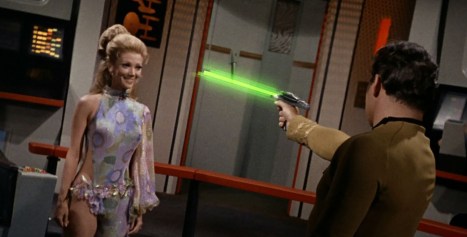
It doesn't faze her in the slightest.

It doesn’t faze her in the slightest.

Wink of an Eye fits quite comfortably within that tradition. This is the perfect example of an episode which makes little sense as a science-fiction story, but which plays quite well as fantasy. Much like The Tholian Web draws upon centuries of stories about ghost ships, Wink of an Eye draws from another rich literary genre. This is the story about a man who is mysterious spirited away by a queen and her people, only to discover that time has been distorted in this mysterious realm.

In other words, Wink of an Eye fits quite comfortably in the tradition of fairy stories.

All's fair in love and war.

All’s fair in love and war.

Continue reading

Star Trek – Plato’s Stepchildren (Review)

This July and August, we’re celebrating the release of Star Trek Beyond by taking a look back at the third season of the original Star Trek. Check back every Monday, Wednesday and Friday for the latest update.

Another third season episode. Another iconic episode.

As with a lot of third season episodes, Plato’s Stepchildren is easily reduced to a selection of imagery and iconography. It is one of the episodes most likely to be cited as an “important” moment in the cultural evolution of Star Trek, full of clips that are likely to pop up on documentaries covering the history of television. Plato’s Stepchildren is an episode that has permeated popular culture, in large part due to a singular and memorable image that ultimately has very little to do with what the story is actually about.

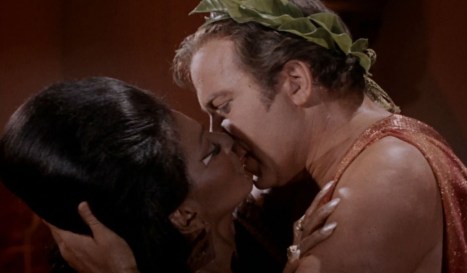
"A kiss can be even deadlier, if you mean it."

“A kiss can be even deadlier, if you mean it.”

There is something frustrating about this. It feels inappropriate that Plato’s Stepchildren should have become such an important part of the history and the mythology of Star Trek. Not only is Plato’s Stepchildren offensive in ways that deliberately and brutally cut against the imagery that is so lauded, it is also a terrible piece of television in its own right. As with a lot of the third season of Star Trek, it seems like the mythology of the show is brushing up against the quality of the show itself.

Plato’s Stepchildren is memorable and important, but it is all boring and offensive. It encapsulates a lot of the third season, all in all.

"I can see you."

“I can see you.”

Continue reading

Star Trek – Day of the Dove (Review)

This July and August, we’re celebrating the release of Star Trek Beyond by taking a look back at the third season of the original Star Trek. Check back every Monday, Wednesday and Friday for the latest update.

It is striking how iconic and influential the third season of Star Trek is.

The third season is often written off, by both fans of the show and members of the production team. There are any number of reasons for this; a slashed budget, an exodus of talent, a new producer, conflicts behind the scenes. There is also the simple fact that the third season is wildly more variable than either the first or second seasons of the series, with its most consistent string of episodes being the three episodes from Is There in Truth No Beauty? to The Tholian Web.

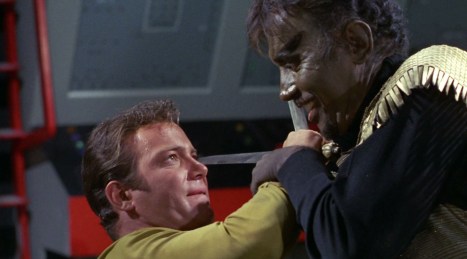
Crossed swords.

Crossed swords.

However, in spite of that, there is a sense that a lot of what modern fans consider to be Star Trek is rooted in this dysfunctional assemblage of episodes. This applies to all sorts of things. The third season offers more than its fair share of continuity minutiae, from the first appearance of a Klingon ship and the first space battle in Elaan of Troyius to the first appearance of the IDIC in Is There in Truth No Beauty? to the memorable appearance of the Tholians in The Tholian Web. However, the season’s legacy is more than just one of continuity.

It occasionally seems like the franchise’s philosophy is truly galvinising over the third season, that Star Trek is coming close to explicitly embracing a utopian humanist philosophy. With The Empath, the show laid out a template for the “humans are special” stories that would dominate the early years of Star Trek: The Next Generation, a much more effective (and less condescending and patronising) celebration of humanity’s potential than later episodes like Lonely Among Us, The Last Outpost and The Neutral Zone.

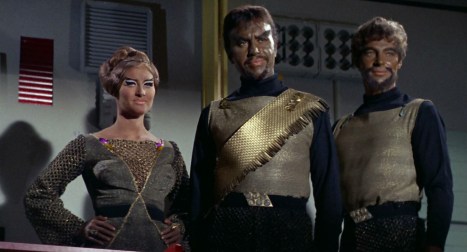
Into darkness.

Into darkness.

Day of the Dove is an episode that is singularly influential in terms of the future of the franchise, both in terms of continuity detail and in terms of its core themes. Most superficially, Day of the Dove offers the first real suggestion that the Klingons might be anything more than vaguely Asian antagonists, suggesting a culture that makes sense internally and allowing them an agency earlier stories lacked. Kang is in many ways the first true Klingon, who would fit comfortably with the spin-offs’ interpretations of the Klingons.

The episode’s influence runs deeper than that. Like The Empath before it, there is a clear sense that Day of the Dove has embraced the idea of the twenty-third century as a utopia in which mankind has transcended all of their hate and violence. Star Trek is presented as something approaching a paradise.

Don't blame me. I voted for Kodos.

Don’t blame me. I voted for Kodos.

Continue reading

Star Trek – For the World is Hollow and I Have Touched the Sky (Review)

This July and August, we’re celebrating the release of Star Trek Beyond by taking a look back at the third season of the original Star Trek. Check back every Monday, Wednesday and Friday for the latest update.

Well, at least it has a great title.

For the World is Hollow and I Have Touched the Sky is one of the great Star Trek titles, at once lyrical and pretension, poetic and absurd. It is a turn of phrase that nobody would ever use in conversation, but which so beautifully evokes the science-fiction concept that drives the episode. It is certainly a lot more memorable and compelling than the stock “The [noun]” naming convention employed all too readily in television production. (The Changeling, The EmpathThe SurvivorThe Battle, The Enemy, The Forsaken. And so on.)

Shockingly bad.

Shockingly bad.

Indeed, For the World is Hollow and I Have Touched the Sky seems to be the gold-standard of Star Trek naming. Earlier episodes like The Conscience of the King or Dagger of the Mind had quoted from Shakespeare, while Is There in Truth No Beauty? alluded to the work of Keats. However, it seemed like every subsequent Star Trek title would stand in the shadow of this third season instalment. Star Trek: Deep Space Nine would make a valiant effort with titles like … Nor the Battle to the Strong or Let He Who Is Without Sin…

Unfortunately, the title is very much best thing about For the World is Hollow and I Have Touched the Sky. Outside of that, the episode is a rather generic and conventional stew of old Star Trek standards thrown together with a bunch of half-hearted soap opera clichés. It is all rather hollow.

"I will love you forever. Or until the end of the episode. Whichever is sooner."

“I will love you forever. Or until the end of the episode. Whichever is sooner.”

Continue reading

Star Trek – The Tholian Web (Review)

This July and August, we’re celebrating the release of Star Trek Beyond by taking a look back at the third season of the original Star Trek. Check back every Monday, Wednesday and Friday for the latest update.

Who hath seen the Phantom Ship,
Her lordly rise and lowly dip,
Careering o’er the lonesome main,
No port shall know her keel again…
Ah, woe is in the awful sight,
The sailor finds there eternal night,
‘Neath the waters he shall ever sleep,
And Ocean will the secret keep

– Albert Pinkham Ryder, 1897

Here there be ghosts...

Here there be ghosts…

Continue reading

Star Trek – The Empath (Review)

This July and August, we’re celebrating the release of Star Trek Beyond by taking a look back at the third season of the original Star Trek. Check back every Monday, Wednesday and Friday for the latest update.

Like Is There in Truth No Beauty? before it, The Empath is very much “weird big ideas” version of Star Trek.

It is a simple story, as Kirk and his away team visit a planet in a star system about to go nova. It deals with fairly universal themes, like compassion and humanity. There are stakes, there are aliens, there is a test of worthiness. In many ways, The Empath is a quintessential Star Trek episode, one of those classic “humanity proves their worth to a powerful alien species” narratives in the style of Arena or Spectre of the Gun. The biggest deviation from that template is the fact that it is not humanity on trial; it is an unknown species represented by an anonymous mute.

The triumvirate triumphant.

The triumvirate triumphant.

However, The Empath works in large part due to this simplicity. There is an elegance to the story, one that distils a lot of core Star Trek ideals down to their very essence. The Empath is very much a “humans are special” story, in the vein of episodes like Lonely Among Us or The Last Outpost. However, it works better than most of these stories because it hits on a very strong core idea. The Empath suggests that what makes humanity special is not necessarily unique or intrinsic or intangible. According to The Empath, what makes humanity special is pretty basic.

As the title implies, humanity’s greatest virtue might be its empathy or its compassion.

Shirtless Shat.

Although humanity also offers “Shirtless Shat.”

Continue reading

Star Trek – Is There in Truth No Beauty? (Review)

This July and August, we’re celebrating the release of Star Trek Beyond by taking a look back at the third season of the original Star Trek. Check back every Monday, Wednesday and Friday for the latest update.

The third season of Star Trek is very odd. It stands quite apart from the previous two seasons.

There are a lot of reasons for this; a new executive producer, the loss of veterans from the first two seasons, production limitations imposed by a slashed budget. Star Trek was never a lavish show, and it always faced production challenges, but those challenges were never more acute than during the third season. In a lot of cases, that oddness is not a good thing. And the Children Shall Lead and Spock’s Brain are very strange pieces of television, but not in a good way. They are clumsy, cheap, ill-judged and ill-advised.

Healthy green glow.

Healthy green glow.

At the same time, that strange vibe of the third season is not inherently bad. There are a number of episodes produced during the third season (particularly during this stretch of the third season) that feel weird and odd, but also refreshing and exciting. Episodes like Is There in Truth No Beauty?, The Empath and The Tholian Web have an eccentric and ethereal quality to them that feels quite removed from the first two seasons of the show. They are also three of the strongest episodes of the season, feeling adventurous and playful.

After all, for all that the third season is maligned, it is surprisingly influential. The third season of Star Trek contributes a great deal to the language and iconography of the franchise, perhaps as a result of the unusual constraints and production realities that inform it. Is There in Truth No Beauty? is an odd little tale, but it is also a clever and effective metaphor that explores grand ideas in the classic Star Trek tradition.

Jonesing for for some Diane Muldaur.

Jonesing for for some Diane Muldaur.

Continue reading

Star Trek – Spock’s Brain (Review)

This July and August, we’re celebrating the release of Star Trek Beyond by taking a look back at the third season of the original Star Trek. Check back every Monday, Wednesday and Friday for the latest update.

Spock’s Brain is not the worst episode of Star Trek ever produced.

Indeed, Spock’s Brain is not even the worst episode of the third season as a whole. More than that, Spock’s Brain is not even the worst episode of the third season to this point. Spock’s Brain is a pretty bad piece of television, but it seems difficult to argue that the episode is quantifiably worse than Elaan of TroyiusThe Paradise Syndrome or And the Children Shall Lead. However, the episode’s reputation looms large in the broader context of the Star Trek canon. Many would point to this as the worst episode that the show ever produced.

"Check out the big brain on Spock!"

“Check out the big brain on Spock!”

To be fair, Star Trek fandom has never been entirely consistent or even-handed when it comes to identifying the worst that the franchise has to offer. This is a fandom that decided that Star Trek Into Darkness was somehow a worse film than Star Trek V: The Final Frontier or Star Trek: Nemesis, and that Threshold was somehow the worst episode of Star Trek: Voyager despite sharing a season with episodes like Tattoo and Alliances. When dealing with consensus fan opinion, it is always interesting to wonder why such things matter over others.

Spock’s Brain is pretty dire. It is sexist, it is ill-judged, it looks cheap, and its underlying premise is beyond absurd. It was also the first episode of the third season to be broadcast. In a way, it seemed like the ultimate affront to fandom. After all, these fans had worked really hard to convince NBC to bring the show back for a third season. Having those same hardcore fans tune into the new time slot to catch Spock’s Brain must have seemed like the ultimate insult, a hokey sci-fi b-movie premise executed on a tiny budget from a show that normally did much better.
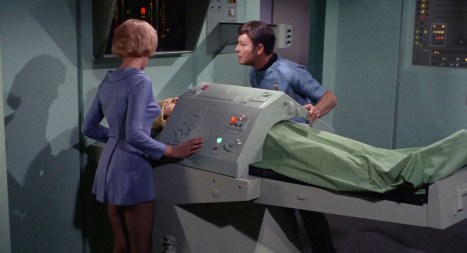
The brains of the operation.

The brains of the operation.

There is an element of nostalgia to this reading of Star Trek. The franchise has always had a goofy side, even beyond the necessity for science-bending budget-saving plot devices like warp drive or the transporter. The franchise has a long history of misunderstanding the concept of evolution (see GenesisThreshold or Dear Doctor) or embracing Erich von Däniken (see Return to TomorrowThe Paradise Syndrome or The Chase). Star Trek has always run on ridiculous ideas, opening with a story about how voyaging outside the universe turns a person into a god.

Indeed, goofiness is part of the joy of Star Trek, from the giant green space hand in Who Mourns for Adonais? through to the pleasures of space!Lincoln in The Savage Curtain. More than that, the goofiness can even lead to truly spectacular episodes and stories in its own right, as with the weird space!amoeba in The Immunity Syndrome or the “planet of the gangsters” in A Piece of the Action. (Similarly, the “planet of the Romans” in Bread and Circuses and “planet of the Nazis” in Patterns of Force are also underrated episodes.)
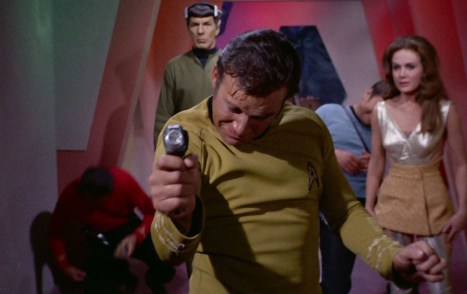
Okay, Kirk. It's not THAT painful.

Okay, Kirk. It’s not THAT painful.

It is perhaps a combination of factors that accounts for the hatred directed at Spock’s Brain. It is not just the goofy premise, because there have been goofier premises before. It is not just the sexism, because there has been more overt sexism before and there is more overt sexism to follow. It is not just the bad script, because there have been terrible scripts before. It is not just the cheapness of the episode, because the show’s ambition always outstripped its production budget.

It is a combination of these factors, culminating in the decision that Spock’s Brain should be the show to open the third season of Star Trek on television. This is the stalking horse for the disjointed and uneven third season, and it seems like it is the first show caught in the cross-hairs.

Matters come to a head.

Matters come to a head.

Continue reading

Star Trek – And the Children Shall Lead (Review)

This July and August, we’re celebrating the release of Star Trek Beyond by taking a look back at the third season of the original Star Trek. Check back every Monday, Wednesday and Friday for the latest update.

Come mothers and fathers
Throughout the land
And don’t criticize
What you can’t understand
Your sons and your daughters
Are beyond your command
Your old road is rapidly agin’
Please get out of the new one if you can’t lend your hand
For the times they are a-changin’.

– Bob Dylan, The Times, They Are A-Changin’, 1964

Either you Gorgan, or you be gone.

Either you Gorgan, or you be gone.

And the Children Shall Lead is a notoriously terrible episode of television.

It is also another reminder that the sixties are coming to an end, and (with them) Star Trek. For a so that is widely considered progressive and utopian, Star Trek often seemed to struggle with its perspective on the various social issues of the sixties. Fans might point to episodes like A Taste of Armageddon or Errand of Mercy as sweeping condemnations of the Vietnam and the Cold War, but they tend to gloss over the patriotic defence of United States foreign policy in episodes like A Private Little War or The Omega Glory.

"I regret to inform you, Captain, that the script is indeed 'that bad'."

“I regret to inform you, Captain, that the script is indeed ‘that bad’.”

Star Trek seemed very strongly divided on the countercultural movement. In many ways, Spock spoke to a generation of young people distanced from their parents and disenfranchised from the status quo, while the franchise imagined a bright future in which people of different colours and creeds worked together. On the other hand, the show was also quite anxious and condescending about the threat counterculture posed to the establishment, as demonstrated in episodes like Operation — Annihilate! or This Side of Paradise.

Although The Way to Eden tends to get treated as the third season’s definitive statement on the hippie movement, And the Children Shall Lead is a much more patronising and reactionary response. It is a fifty-minute public service message about the dangers that radical ideas pose to young minds and why those young minds should never dare to question their elders, who almost certainly know best.

A healthy green glow...

A healthy green glow…

Continue reading

Star Trek – The Enterprise Incident (Review)

This July and August, we’re celebrating the release of Star Trek Beyond by taking a look back at the third season of the original Star Trek. Check back every Monday, Wednesday and Friday for the latest update.

The Enterprise Incident is generally regarded as one of the masterpieces of Star Trek‘s much troubled third season.

The third season of Star Trek has cultivated a reputation as a failure or a disappointment, a collection of episodes that are wildly disjointed at best and openly frustrating at worst. This disappointment is largely justified. While the third season struggled with a number of problems beyond its control, there were also a number of serious self-inflicted wounds. The production team consciously chose to bury Spectre of the Gun deep in the running order while pulling Spock’s Brain forward to be the season premiere.

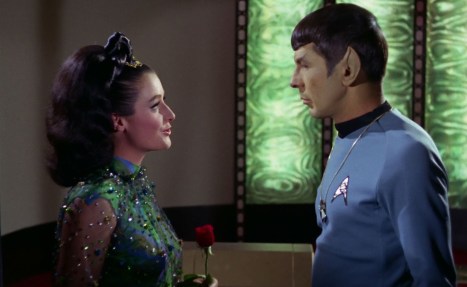
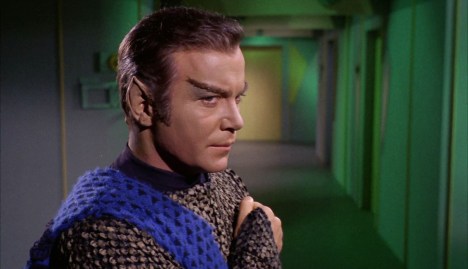
When on Romulus...

When on Romulus…

However, the third season of Star Trek is not the disaster that many would claim. Taken as a whole, the season is much weaker than the first two seasons, but it also has its share of strong and classic episodes. There are classics upon which everybody agrees, like The Enterprise Incident or The Tholian Web. However, there are also any number of delightful oddities like Spectre of the Gun or The Empath. Still, there is a sense that the show is not everything that it once was, and that things have changed.

In some respects, The Enterprise Incident is the most conventional and “classic” of the third season episodes, the episode that feels the most “of a piece” with the first two seasons. It is also the last Star Trek episode of the original series to be credited to franchise veteran Dorothy Fontana.

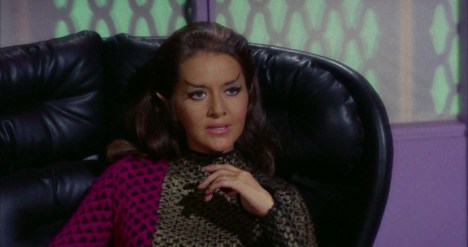
A Commanding presence.

A Commanding presence.

Continue reading