• Following Us

  • Categories

  • Check out the Archives


  • Awards & Nominations

Star Trek – And the Children Shall Lead (Review)

This July and August, we’re celebrating the release of Star Trek Beyond by taking a look back at the third season of the original Star Trek. Check back every Monday, Wednesday and Friday for the latest update.

Come mothers and fathers
Throughout the land
And don’t criticize
What you can’t understand
Your sons and your daughters
Are beyond your command
Your old road is rapidly agin’
Please get out of the new one if you can’t lend your hand
For the times they are a-changin’.

– Bob Dylan, The Times, They Are A-Changin’, 1964

Either you Gorgan, or you be gone.

Either you Gorgan, or you be gone.

And the Children Shall Lead is a notoriously terrible episode of television.

It is also another reminder that the sixties are coming to an end, and (with them) Star Trek. For a so that is widely considered progressive and utopian, Star Trek often seemed to struggle with its perspective on the various social issues of the sixties. Fans might point to episodes like A Taste of Armageddon or Errand of Mercy as sweeping condemnations of the Vietnam and the Cold War, but they tend to gloss over the patriotic defence of United States foreign policy in episodes like A Private Little War or The Omega Glory.

"I regret to inform you, Captain, that the script is indeed 'that bad'."

“I regret to inform you, Captain, that the script is indeed ‘that bad’.”

Star Trek seemed very strongly divided on the countercultural movement. In many ways, Spock spoke to a generation of young people distanced from their parents and disenfranchised from the status quo, while the franchise imagined a bright future in which people of different colours and creeds worked together. On the other hand, the show was also quite anxious and condescending about the threat counterculture posed to the establishment, as demonstrated in episodes like Operation — Annihilate! or This Side of Paradise.

Although The Way to Eden tends to get treated as the third season’s definitive statement on the hippie movement, And the Children Shall Lead is a much more patronising and reactionary response. It is a fifty-minute public service message about the dangers that radical ideas pose to young minds and why those young minds should never dare to question their elders, who almost certainly know best.

A healthy green glow...

A healthy green glow…

Continue reading

Star Trek – The Enterprise Incident (Review)

This July and August, we’re celebrating the release of Star Trek Beyond by taking a look back at the third season of the original Star Trek. Check back every Monday, Wednesday and Friday for the latest update.

The Enterprise Incident is generally regarded as one of the masterpieces of Star Trek‘s much troubled third season.

The third season of Star Trek has cultivated a reputation as a failure or a disappointment, a collection of episodes that are wildly disjointed at best and openly frustrating at worst. This disappointment is largely justified. While the third season struggled with a number of problems beyond its control, there were also a number of serious self-inflicted wounds. The production team consciously chose to bury Spectre of the Gun deep in the running order while pulling Spock’s Brain forward to be the season premiere.

When on Romulus...

When on Romulus…

However, the third season of Star Trek is not the disaster that many would claim. Taken as a whole, the season is much weaker than the first two seasons, but it also has its share of strong and classic episodes. There are classics upon which everybody agrees, like The Enterprise Incident or The Tholian Web. However, there are also any number of delightful oddities like Spectre of the Gun or The Empath. Still, there is a sense that the show is not everything that it once was, and that things have changed.

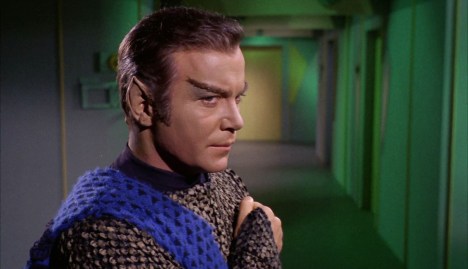
In some respects, The Enterprise Incident is the most conventional and “classic” of the third season episodes, the episode that feels the most “of a piece” with the first two seasons. It is also the last Star Trek episode of the original series to be credited to franchise veteran Dorothy Fontana.

A Commanding presence.

A Commanding presence.

Continue reading

The X-Files Reviews Master List

Our X-Files reviews are now more-or-less update, covering twenty-three years of the franchise and related materials.

Somebody got in contact with me to point out that there is not a complete list anywhere on the site of all the reviews and all the supplemental material in a rough “reading order” for somebody looking to get a sense of just what this project covered. So here that is. Think of it as a rough table of contents for our X-Files coverage, including every episode and various other goodies – crossovers, tangents, best-of lists, sister series, projects involving key creative personal.

xfiles-hollywoodad38

The ordering on the list is approximate at best, but it does offer a sense of how various pieces of coverage relate to one another. As one might expect, the fourth and fifth seasons were very much the “peak” of the show and its coverage, with the various threads getting more esoteric from that point onward.

Just a quick thanks to everybody who read these pieces, commented upon them and engaged with them. Thanks to everybody who pointed me in good directions, and those who offered constructive criticism. I hope you enjoy. I’ll be back when the show is.

xfiles-jesouhaite28a

Continue reading

Star Trek – Elaan of Troyius (Review)

This July and August, we’re celebrating the release of Star Trek Beyond by taking a look back at the third season of the original Star Trek. Check back every Monday, Wednesday and Friday for the latest update.

The strangest thing about Elaan of Troyius is just how influential the episode is.

In many respects, Elaan of Troyius codified Journey to Babel as a genre of Star Trek episode unto itself, the kind of story where the crew find themselves assigned the task of ferrying foreign dignitaries around while intrigue and pseudo-science happens around them. This would become something of a template in the early years of Star Trek: The Next Generation, even carrying over to Star Trek: Deep Space Nine and Star Trek: Voyager. Lonely Among Us, Loud as a Whisper, The Price, The Forsaken, Remember.

The Dohlman wants YOU!

The Dohlman wants YOU!

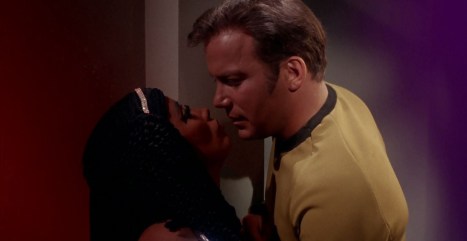
However, in that respect, Elaan of Troyius was simply extrapolating from Journey to Babel by demonstrating that the franchise could employ this basic storytelling model with some frequency. The innovations in Elaan of Troyius are in grafting a “sexy alien babe” narrative into that existing “ferry around” template, which would lead to future stories like The Perfect Mate, Precious Cargo or Bound. In some respects, it was prefigured by Mudd’s Women, an earlier episode about women who exert an unnatural influence over our male lead(s).

The influence of Elaan of Troyius over the rest of the franchise is quite simply astounding. Particularly given how terrible it is.

Elas, my love, it is time to go...

Elas, my love, it is time to go…

Continue reading

Star Trek – Spectre of the Gun (Review)

This July and August, we’re celebrating the release of Star Trek Beyond by taking a look back at the third season of the original Star Trek. Check back every Monday, Wednesday and Friday for the latest update.

Star Trek is dead.

Not in a literal or technical sense. The show had been brought back from the brink of cancellation, offered a last-minute reprieve by NBC following a number high-profile fan campaigns. As far as outside observers were concerned, Star Trek lived. Kirk and Spock would continue their voyages into the space, the production team offering new and exciting interstellar adventures for the delectation of the audience at home. The execution had been stayed, Star Trek was back on television for another season.

End of the line.

End of the line.

However, the show had been mortally wounded. Star Trek was clearly not a top priority for NBC. The show was moved to the infamous “graveyard slot” of Fridays at 10pm. The budget was slashed even further. Most of the top tier creative talent left, including veteran producers Dorothy Fontana and Gene L. Coon along with creator Gene Roddenberry. Tensions were simmering behind the scenes. Even before NBC cut the season order to twenty-four episodes later in the season, it was clear that the series was on its last legs.

Star Trek was very much in limbo. Indeed, looking at third season as a whole, many such analogies suggest themselves. Star Trek was a show limping and lurching towards its own funeral, hobbled and humbled by forced outside of its control. These creative problems bubbled through the production into the finished product, with much of the third season inheriting a haggard and defeated disposition. There is a funereal tone to a lot of the third season, distinct even from the Lovecraftian horror that bubbled through the show’s earliest episodes.

The brains of the operation...

The brains of the operation…

Spectre of the Gun is part of that funereal tone, although it is also something different. Spectre of the Gun was the first episode of the season to be produced, although it was shuffled into the sixth broadcast slot. To be fair, this rescheduling seems appropriate; Spectre of the Gun aired both the week of Halloween and one day shy of the eighty-seventh anniversary of the gunfight at the O.K. Corral. The episode has a haunted quality to it, a more mournful horror than that on display in the franchise’s previous “Halloween episode”, Catspaw.

In some ways, there is an interesting contrast between the first episode of the third season to be produced and the first episode of the third season to air. Both Spectre of the Gun and Spock’s Brain speak to the grim realities of the third season, offering a taste of the anxieties simmering through the show. Both seem to acknowledge that Star Trek is a shell of its former self, whether in the half-remembered ghost town of Spectre of the Gun or the brainless Spock shuffling his way through Spock’s Brain. The only difference is that Spectre of the Gun is a good episode.

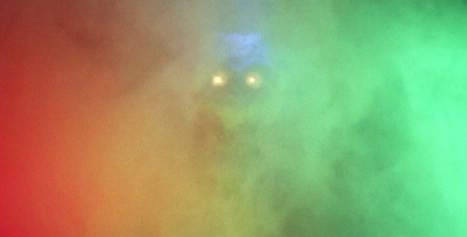
Men of mist-ery.

Men of mist-ery.

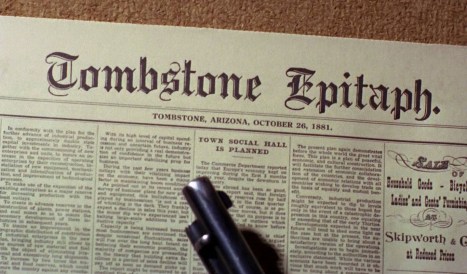
Death stalks through Spectre of the Gun. Seeking to confront the Melkotians, Kirk and his crew beam down to a formless world that is nothing more than swirling clouds of gas. When they find themselves transported to Tombstone, the sky is an ominous red and the Earps are cast as horsemen of the apocalypse. The world seems hollow; the sound stage is incomplete. Time ticks down, albeit to a fictional five o’clock deadline rather than the historical three o’clock shout out. During the final confrontation, the wind howls as if the world itself is screaming in anguish.

Spectre of the Gun confronts Kirk with a world of phantoms. It evokes a world long vanished into fading memory, populated by characters who died long before. It traps Kirk and his crew in what is effectively a death trap, cutting off all of their narrative options as it marches them inexorably towards a bloody finale. It is even written by a ghost, with Lee Cronin a convenient fiction allowing former producer Gene L. Coon the chance to write a few scripts for a show he had already departed and which was not long for this world. The setting is even called “Tombstone.”

Even the newspaper is in on it!

Even the newspaper is in on it!

Continue reading

The X-Files: Season 11 (IDW) (Review)

This June, we’re going to be taking a look at the current run of The X-Files, beginning with the IDW comic book revival and perhaps taking some detours along the way. Check back daily for the latest review.

The X-Files: Season 11 is a relatively lean beast.

The X-Files: Season 10 seemed to struggle to map out a clear direction or identity for itself. This was most obvious in the context of the comic book’s mythology, as writer Joe Harris and his collaborators frequently found themselves revising and rewriting the mythology from one story to the next. All the elements introduced in Believers were reduced to a footnote in Monica & John. Although Gibson Praise made his first reappearance in the final pages of Believers, the mythology only truly galvinised around him over the course of Elders.

xfiles-endgames1

In contrast, The X-Files: Season 11 has a very clear idea of where it is going and room for a minimal amount of distractions along the way. While the art team on Season 10 changed quite frequently, the nine comic book issues that comprise Season 11 are all handled by the core team of writer Joe Harris, penciller Matthew Dow Smith and colourist Jordie Bellaire. There is a consistency and focus to the run that is striking. There is no time for exploration or improvisation. Everything serves its purpose in the context of the story being told.

This is a double-edged sword. While it does reduce the chance of an endearing standalone story like Chitter or Immaculate, it does afford the run a purity and energy that was somewhat lacking as Harris had to revise and rewrite his mythology while the revival miniseries moved closer and closer to public announcement. In some respects, Season 11 feels kind of like the version of The X-Files that some fans wanted when the revival was announced. It is an efficient attempt to resolve dangling plot threads and bring closure to the story being told.

xfiles-homeagain2

Continue reading

The X-Files – Season 10 (Review)

This June, we’re going to be taking a look at the current run of The X-Files, beginning with the IDW comic book revival and perhaps taking some detours along the way. Check back daily for the latest review.

The six episode revival miniseries is a strange beast.

It is hard to think of it as the tenth season of the show. In fact, the marketing of the DVD and blu ray sets describes it as “the event series”, perhaps a tact acknowledgement of that fact. There are a number reasons why it is difficult to think of these six episodes comprising a tenth season. Most obviously, the season is only six episodes. Even in the current context of truncated episode orders and split season, that is a short season. By modern standards, it would be a short half-season. Referring to it as the tenth season of The X-Files feels like false advertising.

xfiles-homeagain56a

However, there are other reasons that it is difficult to think of these six episodes as constituting a season. Quite frankly, the six episodes are wildly variable in tone and quality, to the point that it is difficult to distill a singular unifying theme or meaning from. They are six random episodes of television, some good and some less good, with one masterpiece and one boldly ambitious mess. It is almost easier to talk about the episodes individually than it is to discuss them as a single season television.

Then again, that’s what makes them feel so much like The X-Files.

xfiles-mulderandscullymeettheweremonster49

Continue reading

The X-Files Deviations (IDW) #1 – Being and Time (Review)

This June, we’re going to be taking a look at the current run of The X-Files, beginning with the IDW comic book revival and perhaps taking some detours along the way. Check back daily for the latest review.

Being and Time is not a good comic book.

There are a number of reasons why the comic doesn’t work, but the simple fact of the matter is that it has an interesting premise but does little of interest with that premise. Nevertheless, there is something quite intriguing the set-up, an “out-of-continuity” tale that offers a glimpse of a parallel universe where Fox Mulder was abducted in the place of his sister Samantha. More to the point, it seems entirely telling that the only supplemental X-Files comic to be published by IDW during the entirety of The X-Files: Season 11 was one entirely outside continuity.

What might have been.

What might have been.

Continue reading

The X-Files – My Struggle II (Review)

This June, we’re going to be taking a look at the current run of The X-Files, beginning with the IDW comic book revival and perhaps taking some detours along the way. Check back daily for the latest review.

“This is the end,” the opening credits tease.

This is not the end.

This is not the end.

Continue reading

The X-Files: Season 11 (IDW) #6-8 – Endgames (Review)

This June, we’re going to be taking a look at the current run of The X-Files, beginning with the IDW comic book revival and perhaps taking some detours along the way. Check back daily for the latest review.

With Endgames, it all comes to an end.

The grand epic story that writer Joe Harris had built across thirty-five issues of The X-Files: Season 10 and The X-Files: Season 11 comes to a close with this three-part story. Given that the default length of a mythology-heavy story in Season 10 was five issues, Endgames cannot help but feel somewhat truncated. However, there has always been a sense that Season 11 is winding down rather than ratcheting up.

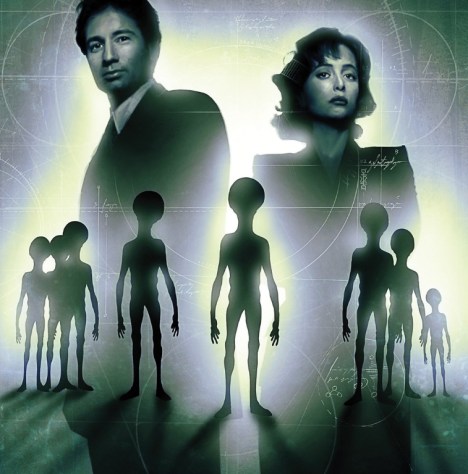
Alien nation.

Alien nation.

In some ways, Endgames suffers from being overly ambitious. Harris reintroduced the faceless rebels into his mythology with My Name is Gibson and The X-Files Christmas Special 2015, but they feel like they crowd out what is otherwise a straightforward confrontation with Mulder and Scully squaring off against Gibson Praise. It is in some ways disappointing that all of Gibson’s plans build to a handful of trucks in the desert.

And, yet, in spite of that, there is something oddly charming about Endgames. The three-parter might be a compromised twist on the ending that Joe Harris originally envisaged for his massive epic, but it is still an ending.

Full circle.

Full circle.

Continue reading