• Following Us

  • Categories

  • Check out the Archives


  • Awards & Nominations

Star Trek: Deep Space Nine – In Purgatory’s Shadow (Review)

In Purgatory’s Shadow and By Inferno’s Light represent a fantastic accomplishment for Star Trek: Deep Space Nine.

In keeping with the television of the time, the first Star Trek show had been firmly episodic, to the point that there are arguments about the order in which episodes happened. Even in the context of the early nineties, Star Trek: The Next Generation tended to shy away from making dramatic decisions with huge consequences. The Klingon Civil War is resolved in Redemption, Part I and Redemption, Part II. The failed Romulan invasion of Vulcan in Unification, Part I and Unification, Part II is never mentioned again.

"Mister Worf, we really shouldn't have mounted this mission during Sweeps."

“Mister Worf, we really shouldn’t have mounted this mission during Sweeps.”

Deep Space Nine grew increasingly adventurous over the course of its run. The series had flirted with up-ending the status quo before, from the introduction of the Defiant and the Founders in The Search, Part I and The Search, Part II through to the dismantling of the Khitomer Accords in The Way of the Warrior. While those decisions had very long-term consequences for the show, their impact was not as dramatic and immediate as that seen here. Even the defeat of the Cardassians and Romulans in Improbable Cause and The Die is Cast took time to ripple down.

In contrast, In Purgatory’s Shadow and By Inferno’s Light change a lot of what the audience think they know about Deep Space Nine. The fifth season pivots on this two-parter, which serves to enable just about every major dramatic development between this point and the end of the series. This only serves to make it all the more impressive that the two-parter is so firmly rooted in its characters and characterisation.

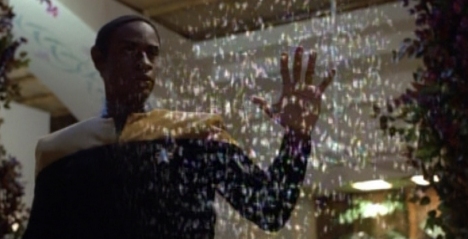
Gripping drama.

Gripping drama.

Continue reading

Star Trek: Voyager – Blood Fever (Review)

Blood Fever is a strange and dysfunctional episode.

By this point in the third season, Star Trek: Voyager has abandoned any sincere attempt to develop or define its own identity. Instead, the series has committed itself to being the most generic Star Trek show imaginable. In many ways, this represents a disappointing betrayal of an interest premise and a fascinating cast of characters. In other ways, this allows the show to focus on telling archetypal Star Trek stories like Remember or Distant Origins or Living Witness, stories that deal with broad themes through science-fiction allegory.

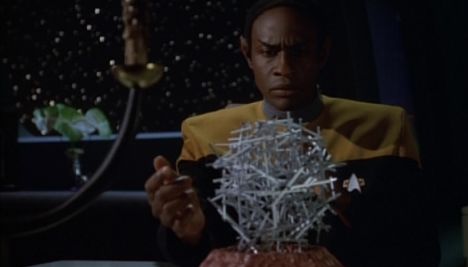
Tunnels of love.

Tunnels of love.

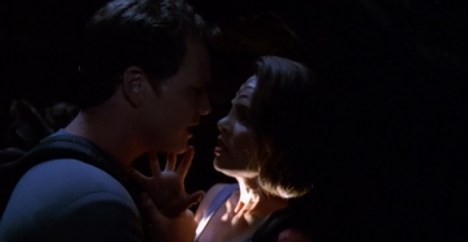
In its strongest moments, Blood Fever feels like it wants to be that kind of classic Star Trek metaphorical exploration of contemporary society. In many ways, Blood Fever is an exploration of contemporary attitudes towards sex and sexuality, of the damage that can be wrought by sexual repression on levels both personal and societal. It is building upon the idea of pon’farr as introduced by Theodore Sturgeon (and refined by D.C. Fontana) in Amok Time, as the volcanic eruption of sexual desire following years of repression.

Unfortunately, Blood Fever lacks the courage of its convictions. The script feels like a victim of the same social mores that it seeks to critique, either unable or unwilling to talk about sex and sexuality in a manner that is suitably candid. As a result, Blood Fever ends up a muddled and ineffective piece of television that seems unwilling to call out its characters and which inevitably builds towards a tired rehash of an iconic Star Trek scene. Waiting seven seasons for this must be very unsatisfying.

Droning on.

Droning on.

Continue reading

Star Trek: Deep Space Nine – For the Uniform (Review)

For the Uniform forms the second entry in a loose trilogy of Michael Eddington stories, sitting between For the Cause and Blaze of Glory.

Much like The Begotten before it, For the Uniform feels like Star Trek: Deep Space Nine is tidying up a bunch of loose ends before it barrels into the second half of the season with In Purgatory’s Shadow and By Inferno’s Light. It is offering one last story built on the status quo established by The Maquis, Part I and The Maquis, Part II before things change dramatically. It is also quite heavy on the kind of impressive space battles that will become a major part of the final two seasons.

Terrorise this!

Terrorise this!

The episode even puts an increased emphasis upon the series’ military themes, with much made of the crippling blow dealt to the Defiant by Eddington’s virus and the operational protocols that this attack necessitates. With Nog standing on the edge of the bridge echoing Sisko’s orders to Engineering, For the Uniform occasionally feels more like like a submarine movie than an episode of Star Trek. This is to say nothing of the attention paid to the Defiant’s departure from Deep Space Nine itself, which plays up the military protocol of such a launch.

However, there is more to For the Uniform than all of that. It is an episode that touches upon a number of key themes for Deep Space Nine. It is a story about moral compromise and ambiguity, about narrative and mythmaking. It is a tale about obsession and vindictiveness, rooted in the flaws of its central character. For the Uniform struggles a little bit in how it approaches Sisko’s monomaniacal pursuit of Eddington, wrapping up so fast that the closing lines offer a sense of tonal whiplash. Nevertheless, it is a bold and breathtaking piece of television.

Shadow boxing...

Shadow boxing…

Continue reading

Star Trek: Voyager – Coda (Review)

In many ways, the Jeri Taylor era of Star Trek: Voyager represented a reaction to the direction that the show had taken under Michael Piller.

Michael Piller had imagined a more dynamic and adventurous version of the show, focusing on two crews thrown together by fate and forced to coexist while journeying through uncharted territory. After seven seasons of Star Trek: The Next Generation, Piller was understandably (and perhaps justifiably) concerned that the second iteration of Star Trek might have been growing somewhat stale. Star Trek: Deep Space Nine was in the process of breaking new ground, and Piller felt that it was necessary for the franchise to find a new direction and identity.

Daddy's home.

Daddy’s home.

This is a good idea in theory. In practice, Michael Piller’s vision was disastrous. Piller wanted to do new things, but found himself working with a staff vehemently opposed to his vision of the series and phoning in scripts that should have been provocative like Alliances or Investigations. More than that, Piller was unable to properly realise his own ambitions, citing scripts like Tattoo as incredibly accomplishments rather than recognising them for the embarrassing failures that they were. When Piller was ousted after the second season, Jeri Taylor took over.

Jeri Taylor would oversee the third and fourth seasons of Voyager. She had a very clear vision of what Voyager should be, a rather conservative and generic iteration of the larger Star Trek franchise. Traditionally, the third season had served as a point of transition for the Star Trek spin-offs. It was in their third seasons that The Next Generation and Deep Space Nine really broke the mould and discovered their own unique identities. In contrast,t he third season of Voyager marked a point of retreat from the basic premise of the show.

Carry on regardless.

Carry on regardless.

Taylor wanted to focus on telling very safe and familiar Star Trek stories, ones that did not necessarily rely upon the premise of the show. There are any number of episodes where this approach simply did not work, with episodes like Warlord or The Q and the Grey or Alter Ego feeling like reheated Star Trek leftovers. However, there were points at which Taylor’s approach paid off. Future’s End, Part I and Future’s End, Part II were pure popcorn, but they worked on those terms. It didn’t matter that nobody seemed too bothered at getting Voyager back to Earth.

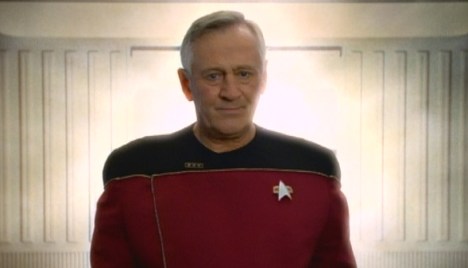
Coda is another example of the strengths of Taylor’s approach to Voyager. It is a very familiar and archetypal episode of Star Trek, one that might have been assembled from the leftover pieces of Cause and Effect or Tapestry. However, that relative simplicity becomes a strength, allowing Taylor to craft a script focusing on Janeway and giving Kate Mulgrew some meaty material into which she might sink her teeth. There is nothing particularly new or exciting here, but there is something to be said for executing old standards with such charm.

Of course he's evil. He's an admiral.

Of course he’s evil. He’s an admiral.

Continue reading

New Podcast! The X-Cast – Season 2, Episode 5 (“Duane Barry”)

Just a quick link to another recent guest appearance over on The X-Cast, a great X-Files podcast run by the prolific Tony Black.

I had the privilege of guesting on the show to talk about the first two-part episode of the series in the first two-part episode of the podcast. First up, Duane Barry. Wherein we discuss the directorial debut of Chris Carter, the point of intersection between The X-Files and regular procedurals, and the vandalism of supermarket scanners. Once again, it was a joy to appear on the show, and Tony was as gracious a host as ever. Check it out the episode here, or click the link below.

To be continued…

podcast-duanebarry

Continue reading

Star Trek: Deep Space Nine – The Begotten (Review)

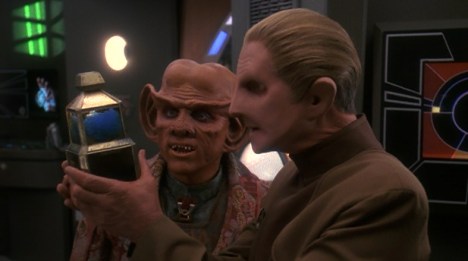
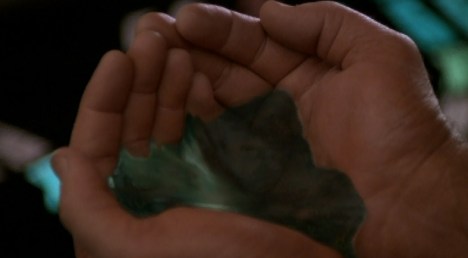
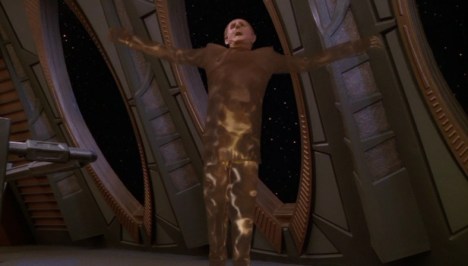
From a mechanical perspective, The Begotten is very much about clearing up the leftover pieces from the first half of the season before the second half can really begin.

Watching the fifth season of Star Trek: Deep Space Nine with the benefit of hindsight demonstrates just how carefully the production team have paced the season. The fifth season clearly turns on a number of different points, pivoting over In Purgatory’s Shadow and By Inferno’s Light in the middle of the year. However, a lot of the first half of the season can be seen as a build to that two-parter. The production team are very consciously lining up the remaining dominoes for that big plot development.

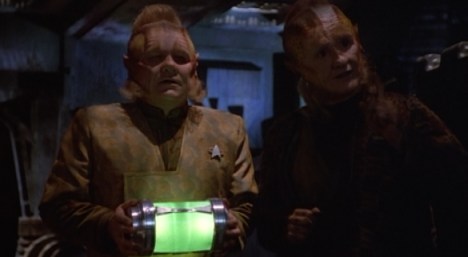
A life in his hands.

A life in his hands.

The most obvious example is the prophecy of Rapture, which foreshadows the events of both By Inferno’s Light and Call to Arms while keeping Bajor neutral for what is to come. But there are others. Apocalypse Rising folds the Klingon War into the looming battle with the Dominion. The Ship and … Nor the Battle to the Strong are proofs of concept for a Star Trek series about war. Things Past and The Darkness and the Light keep the Cardassian Occupation fresh in the viewers’ mind. The Ascent is a story that could only work while Odo is humanoid.

There is a clear purpose to most of the storytelling decisions made during this stretch of the season, designed to streamline what is to come. The Begotten takes care of two rather major plot points that need to be addressed; Odo’s status as a humanoid following Broken Link and Kira’s surrogate pregnancy from Body Parts. Sure, For the Uniform sits between this episode and the big mid-season twist, providing the opportunity to do one last Maquis story before the political board is reset. But that feels almost like an afterthought.

Soaking it in.

Soaking it in.

The Begotten dedicates itself to wrapping up the two biggest plot elements hanging over from the end of the fourth season, closing that chapter of the show before a new one is opened. There is a certain functional quality to The Begotten, a utilitarian approach to plotting. It would be very easy for The Begotten to feel stale or trite, contrived or obligatory. It is to the credit of writer René Echevarria that The Begotten never feels forced. The subplot focusing on Kira’s birth has a number of very serious issues, but the primary plot driven by Odo is genuinely affecting.

It is a testament to the writers working on Deep Space Nine that even the act of decluttering the long-form narrative can lead to affecting television.

Free as a bird.

Free as a bird.

Continue reading

Star Trek: Voyager – Alter Ego (Review)

Following on from the aborted promise of a new beginning in Fair Trade, things get back to normal.

Alter Ego is another episode of Star Trek: Voyager that feels like it might have been wholly repurposed from an earlier Star Trek show. On the surface, it is a fairly standard “holodeck run amok” story in the style of earlier episodes like Heroes and Demons or Projections. However the contours of the plot recall a very specific (and very good) episode of Star Trek: The Next Generation. As Alter Ego seems to suggest that a holographic character has achieved sentience and threatens to destroy the ship, it recalls the far superior Ship in a Bottle.

Forced attraction.

Forced attraction.

There are differences, of course. Ship in a Bottle is a far stronger episode, one of the best holodeck stories ever produced. More than that, the climax of Alter Ego reveals that the holodeck programme has not become sentient but is instead being used as the avatar of an outside force. Still, this twist is confined to the last act of the episode, and so it feels more like an embellishment than a revision. For the bulk of its runtime, Alter Ego plays as a pale imitation of a much stronger piece of television.

It does not help matter that Alter Ego‘s novel twist on that central premise is to paint its central guest star as a psychotic stalker with a crush.

A whole ball of crazy.

A whole ball of crazy.

Continue reading

Star Trek: Voyager – Fair Trade (Review)

In theory, Fair Trade is precisely the episode that Star Trek: Voyager needs right now.

From the outset, the show has struggled with several major problems. Superficially, Voyager has struggled to distinguish the Delta Quadrant from the Alpha Quadrant, to the point that the Kazon felt like low-rent Klingons and the various aliens-of-the-week seemed largely indistinguishable from the aliens-of-the-week featured on the sibling shows. More fundamentally, the show failed to conjure an air of mystery and intrigue about the region. Everything about the show felt too safe, right down to the characters. This was a show where terrorists became model officers.

Venting plasma...

Venting plasma…

Fair Trade feels like it should offer the perfect remedy to all of this. The opening scenes find Voyager brushing up against “the Nekrit Expanse.” It is a region of space that is pointedly different and alien. Neelix has no idea what lies beyond. The sensors cannot penetrate it. Voyager is forced to dock at a local space station to take supplies, one crowded with aliens of multiple species engaged in shady dealings. More than that, the episode hinges on the neglected character of Neelix. It returns to early undeveloped suggestions the Neelix is not all he claims to be.

However, in practice, Fair Trade is disappointing. The episode lacks the courage of its convictions, both as a script of itself and as clear demarcation within the third season. It is a show rich with promise that offers up any number of intriguing ideas, but lacks the courage necessary to follow through on them.

In a bit of a Wix.

In a bit of a Wix.

Continue reading

Star Trek: Deep Space Nine – The Darkness and the Light (Review)

The Darkness and the Light is the first television credit for writer Bryan Fuller.

There is no way around that. It puts a lot of emphasis on this fifth season episode, drawing a lot attention to the story. Fuller didn’t even write the script, instead pitching a story that would be developed by Ronald D. Moore. However, later in the fifth season, Fuller would pitch the story for Empok Nor. After that, he would be recruited on to the writing staff on Star Trek: Voyager. Then Fuller would begin developing his own shows. Dead Like Me. Wonderfalls. Pushing Daisies. Hannibal. American Gods. Star Trek: Discovery.

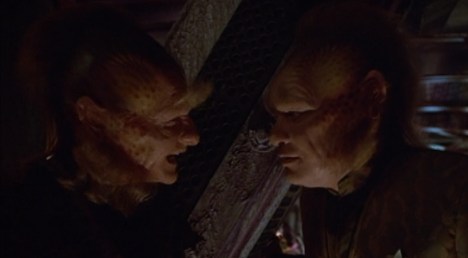
Face-off.

Face-off.

That naturally casts a shadow over his first television pitch, the premise sold to the writing staff of Star Trek: Deep Space Nine. Even watching Fuller’s idea filtered through the lens of Ronald D. Moore, there is a strong urge to read too much into this forty-five-minute piece of television. How much of it represents Bryan Fuller’s vision of Star Trek? How have its themes and ideas resonated across the rest of the writer’s work? What insight might it offer into the producer’s vision for the future of the franchise?

A lesser episode would crumple under that weight. It helps that The Darkness and the Light is an ambitious and exciting piece of television, a triumph of concept and execution that stands as one of the most distinctive and memorable episodes in the fifty-year history of the franchise.

A time to heal.

A time to heal.

Continue reading

Star Trek: Deep Space Nine – Rapture (Review)

Faith can be a tricky issue.

At one point in Rapture, the primary cast take a moment to reflect upon it. Kira tries to explain her belief in Sisko and the Prophets to Dax and O’Brien. She struggles. They have difficulty understanding how Kira can invest so much certainty in something so intangible. Eventually, Worf interjects. “Do not attempt to convince them, Major,” he urges her. “They cannot understand.” Dax is a little surprised by Worf’s interest in the topic. “Since when did you believe in the Prophets?” she asks. Worf responds, “What I believe in is faith.”

Gotta have faith.

Gotta have faith.

It is a short conversation, but one that reveals a lot about Star Trek: Deep Space Nine. As a rule, the Star Trek franchise tends towards a strong atheism, rejecting notions of religion and spirituality as the hallmarks of an underdeveloped civilisation; Return of the Archons, The Apple, For the World is Hollow and I have Touched the Sky, Who Watches the Watchers?, Devil’s Due, False Profits, Chosen Realm. This makes a certain amount of sense, given that the franchise prides itself on its rationalism. However, it also feels a little narrow-minded.

Rapture might just be the franchise’s most compelling exploration of unquestioning faith, a harrowing portrayal of devotion and inspiration that captures at once the ecstasy of unwavering belief and the discomforting aspects of watching someone embrace something outside a rational frame of reference. Rapture is a mesmerising piece of television.

"I, for one, welcome our new Klingon overlords."

“I, for one, welcome our new Klingon overlords.”

Continue reading