• Following Us

  • Categories

  • Check out the Archives


  • Awards & Nominations

The X-Files (Topps) #40 – Devil’s Advocate (Review)

This May and June, we’re taking a trip back in time to review the fifth season of The X-Files and the second season of Millennium.

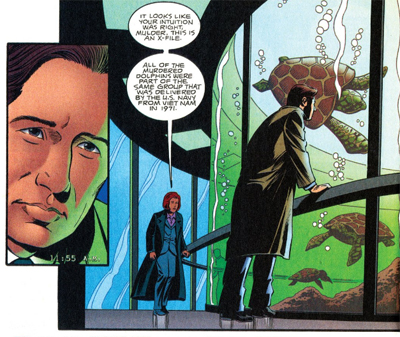
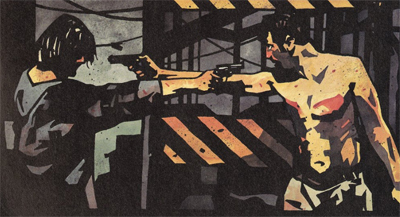
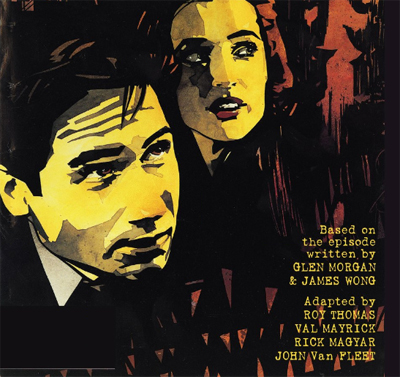
Devil’s Advocate is a perfectly serviceable comic.

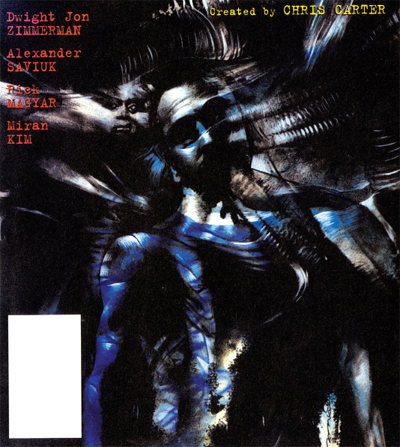
Its most distinguishing feature is the fact that it was not written by John Rozum, even though the art is provided by Alex Saviuk. This is not the first time that Rozum had taken a break from the monthly title. Writer Kevin J. Anderson had substituted in for Family Portrait, providing a quick two-issue fill-in rather early in the run. Here, executive editor Dwight Jon Zimmerman steps in to script the issue, possibly freeing up Rozum to finish work on the adaptation of The X-Files: Fight the Future that Topps planned to publish to mark the release of the film.
Ghosts in the machine...

Ghosts in the machine…

Dwight Jon Zimmerman was an industry veteran. He had worked at Marvel during the late eighties, writing for characters like Spider-Man and Wolverine. He joined Topps when they announced their plan to expand into the world of comic book publishing. Zimmerman worked as both an executive editor and as a writer. He worked on the company’s Mars Attacks! line. He also wrote Once Upon a Time…, the illustrated biography of Princess Diana that was published by the company in 1997.

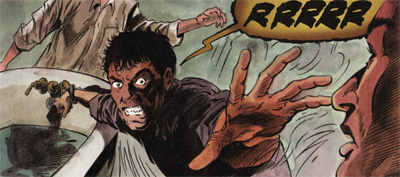
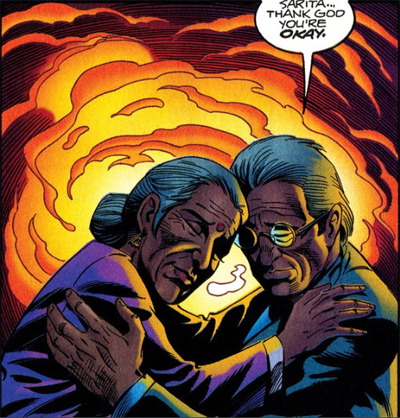
Zimmerman’s interests tend towards the military. He has written articles on American military history for American Heritage, the Naval Institute Press, and Vietnam Magazine. He served as President of the Military Writers’ Society of America. As such, it is no surprise that Devil’s Advocate plays to those strengths. It is an old-fashioned “military cover-up” story, with little to distinguish or define it from dozens of similar stories told using these characters over years and years.

"This is why we should go rafting in the daytime, Scully."

“This is why we should go rafting in the daytime, Scully.”

Continue reading

The X-Files (Topps) #39 – Scum of the Earth (Review)

This May and June, we’re taking a trip back in time to review the fifth season of The X-Files and the second season of Millennium.

Scum of the Earth taps right into the sweet spot for John Rozum’s sensibilities.

Rozum’s work on Topps’ monthly X-Files comic book might not have been quite as ambitious as that of his predecessor, but he had his own areas of interest and recurring themes. Scum of the Earth provides the perfect intersection between the classic horror comic aesthetic of stories like The Kanashibari and Donor and the more environmentally-conscious storytelling of scripts like Skybuster or Cam Rahn Bay. It is essentially a retelling of The Blob starring Mulder and Scully, in which the blob is created by toxic waste and bio-terrorism.

The green death...

The green death…

Scum of the Earth is not particularly elegant in its storytelling. Rozum’s script covers a lot of ground in the space of a single issue, presenting Mulder and Scully with a crisis that could easily threaten the entirety of the United States. it genuinely feels like Mulder and Scully have wandered into some lost fifties b-movie, capturing a lot of the atmosphere to which Ivan Reitman seemed to aspire by casting David Duchovny in Evolution a few years later. Scum of the Earth is an exceedingly silly comic book, and unashamedly so.

It is also great fun, which is something that really can’t be undersold when you are talking about an X-Files tie-in comic book.

Swamp Thing!

Swamp Thing!

Continue reading

The X-Files (Topps) #38 – Cam Rahn Bay (Review)

This May and June, we’re taking a trip back in time to review the fifth season of The X-Files and the second season of Millennium.

Cam Rahn Bay returns to one of the recurring themes of John Rozum’s run on Topps’ X-Files tie-in comic book.

It is essentially a cautionary tale amount mankind tampering with nature and the unforeseeable repercussions of such meddling. As such, it feels very much in keeping with scripts like Skybuster or Scum of the Earth. This idea of human hubris is a theme that is very much in keeping with The X-Files as a franchise, perhaps most keenly reflected in Chris Carter’s deep affection for Mary Shelley’s Frankenstein and for environmental causes. Cam Rahn Bay is very much in keeping with that aesthetic.

All at sea...

All at sea…

However, there are problems with the story. Most obviously, Rozum’s prose seems a little clunky and awkward. Cam Rahn Bay is a heavy-handed and clumsy meditation on mankind’s fixation with imposing its will over the natural world. However, there is also something slightly hypocritical about the story. As much as Cam Rahn Bay criticises the use of animals in a military capacity, it never seems to question the use of animals in captivity. While the training of dolphins to do military work is treated as deplorable, training them to do tricks for entertainment is lauded.

Cam Rahn Bay feels a little tonally ill-judged, with this fairly significant blindspot undermining a lot of Mulder’s impassioned rhetoric about how mankind treats the natural world.

"Sorry, I was just thinking abotu Deep Throat..."

“Sorry, I was just thinking abotu Deep Throat…”

Continue reading

The X-Files: Season One (Topps) #6 – Space (Review)

This May and June, we’re taking a trip back in time to review the fifth season of The X-Files and the second season of Millennium.

If the jump to Ice suggested that the Season One line would only be covering the “highlights” of the first season of The X-Files, then the decision to immediately follow with an adaptation of Space puts paid to that theory.

Ice is generally regarded as one of the strongest stories of the first season. It is moody and atmospheric, tense and claustrophobic. It shines a light on the characterisation of Mulder and Scully, while also offering a particularly memorable (and unsettling) monster of the week. In contrast, Space is generally regarded as one of the weakest stories of the first season. It is clumsy and muddled, slow and dreary. The episode’s direction is bland and the special effects are woeful. On paper, it is probably the least likely choice for a Season One adaptation.

Face the future...

Face the future…

However, Space ultimately lends itself to a comic book adaptation. The story finds itself well-suited by the transition from live action footage to comic book page. there are a number of different reasons for this, but the truth is that the story is simply better suited to this format. That applies to the technical limitations imposed on film, but also to the storytelling conventions associated with comic books as opposed to live action television. It is a startling result, and arguably the biggest success of the entire Season One line.

Although it is a qualified accomplishment at best, Space is the first Season One comic that manages to surpass its source material.

Is there life on Mars?

Is there life on Mars?

Continue reading

The X-Files (Topps) – Ground Zero #1-4 (Review)

This May and June, we’re taking a trip back in time to review the fifth season of The X-Files and the second season of Millennium.

Ground Zero offers an indication of just how much success Topps was enjoying with their line of licensed X-Files comic books.

The monthly series was still being published, and Season One was on a bimonthly schedule. Both books had stable creative teams, and there was no indication that they were likely to wrap up any time soon. Of course, Topps would pull of the comic book market in late 1998, but there was no indication that they considered their X-Files line to be anything other than a complete success. As such, it made sense to expand the line. After all, the company had already used the brand to sell annuals and digests.

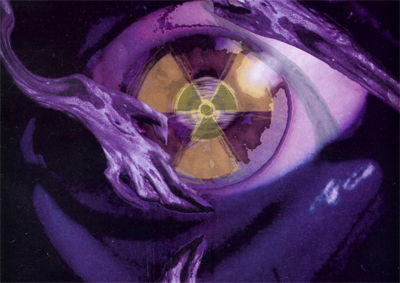
Eye see all...

Eye see all…

However, there was reportedly a considerable amount of friction between Topps and Ten Thirteen over the comic book line. Ten Thirteen was reportedly quite firm in what they would and would not allow to be published. Writers John Rozum and Stefan Petrucha have talked about how difficult it was to get their scripts published for the monthly series. It seems that Topps was eager to work around these restrictions. It is telling that neither Season One nor Ground Zero were original concepts; they were adaptations of ideas and stories Ten Thirteen had already approved.

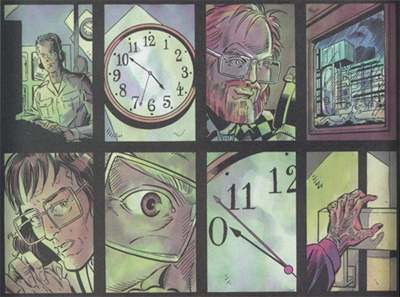
Ground Zero is written by veteran tie-in author Kevin J. Anderson. Anderson had already written a number of popular X-Files tie-in books and had provided a fill-in arc on the monthly comic book with Family Portrait. The artwork for Ground Zero is provided by Gordon Purcell, one of the best likeness artists in the business. Publishing a four-issue adaptation of a tie-in novel is the very definition of a “safe” choice to expand the line, and only illustrates some of the wasted opportunities towards the end of Topps’ stewardship of the license.

Doomsday clock...

Doomsday clock…

Continue reading

The X-Files: Season One (Topps) #5 – Ice (Review)

This May and June, we’re taking a trip back in time to review the fifth season of The X-Files and the second season of Millennium.

With Ice, Season One jumps ahead a bit.

It is hard to blame them. The first four episodes of the first season are relatively solid, outlining the heart of The X-Files and conveying everything the audience really needed to know at this point. However, the first season gets a little bit rocky after Conduit. Episodes like The Jersey Devil and Shadows are unlikely to top anybody’s list of favourite X-Files episodes. Ghost in the Machine is somewhat underrated, but it is hardly a world-beater either. So it makes sense to skip ahead to probably the most highly-regarded episode in the first half of the first season.

Worming its way into your heart...

Worming its way into your heart…

Ice is a classic installment of The X-Files. Like Squeeze, it is an episode that tends to lodge itself in the popular memory. It is hard to verify such things in any objective fashion, but it is an episode that many casual fans reference or point to whenever the show is mentioned. It has just the right balance of memorable imagery and distinctive hooks, brought to life in a haunting and atmospheric fashion. It would have been crazy for Roy Thomas’ adaptations of the Season One episodes to skip over this particular episode, and it makes sense to jump right to it.

Then again, there is also a pretty clear precedent for this.

This is not who we are...

This is not who we are…

Continue reading

The X-Files (Topps) #37 – The Face of Extinction (Review)

This May and June, we’re taking a trip back in time to review the fifth season of The X-Files and the second season of Millennium.

Suspension of disbelief is a curiously fickle thing.

It is a concept that generates considerable debate in its function and application. After all, the normal mode of fiction generally accepts that fiction is… well, fictional. There is no real belief to shatter, because there is an innate understanding between artist and audience that a work of art should be interpreted as a representation of reality rather than a piece of reality. Even in the case of “true stories”, audiences will willingly and readily accept alterations and adjustments designed to streamline the story in question.

Ramming speed...

Ramming speed…

After all, the concept of “suspension of disbelief” is quite firmly disengaged from the concept of reality. The old cliché about “truth being stranger than fiction” illustrates the distinction. The real world (and the stories of the people who inhabit it) are full of coincidences and contrivances that audiences would consider to be lazy writing or poor construction if they appeared in a work of fiction. Nevertheless, while “suspension of disbelief” might be more complex than its three-word nature would suggest, it is a useful philosophy.

What “breaks” a work of fiction? At what point does the artist – whether intentionally or otherwise – push the audience out of the story? What causes a double take to occur or a quizzical eyebrow to raise? What story developments prompt angry sighs or bitter grumbling? There is no hard and fast answer. The line will always be arbitrary, varying from audience member to audience member. Everybody has different expectations when it comes to art, and so that threshold is distinct for every person.

"Don't worry, Scully! Stay right there... I'm going to get my camera."

“Don’t worry, Scully! Stay right there… I’m going to get my camera.”

Sometimes people can agree on where the line falls on a certain work, but everybody has their limits. There are some people who embrace perceived absurdities or inconsistencies or incongruities in their stories; there are some people who simple do not consider those absurdities or inconsistencies or incongruities to exist at all. One of the great things about The X-Files as a television show is the sense of adventure and excitement that the premise generates. It is highly flexible, allowing for almost anything.

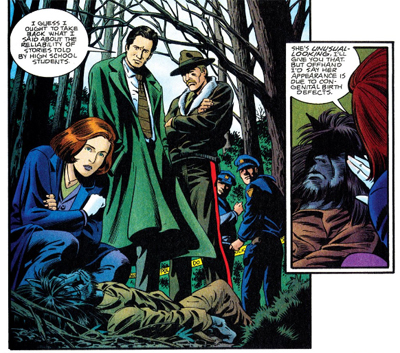
At the same time, it seems quite clear that writer John Rozum and artist Alex Saviuk find themselves charging head-first towards that highly arbitrary and high flexible boundary with The Face of Extinction, a story about a secret race of intelligent goat people who have lived alongside human civilisation for millennia and who also (conveniently) speak perfect English. It is a rather absurd concept, and one that seems at odds with the relatively grounded style of the first five seasons of The X-Files.

Beastly.

Beastly.

Continue reading

The X-Files: Season One (Topps) #4 – Conduit (Review)

This May and June, we’re taking a trip back in time to review the fifth season of The X-Files and the second season of Millennium.

Conduit is an interesting choice for a Season One comic.

It is the last of the first season mythology episodes to be adapted by Roy Thomas as part of the Season One brand. The Pilot and Deep Throat had launched both The X-Files and the mythology, but Conduit was really the show that emphasised that The X-Files would be returning to the idea of alien abduction quite frequently in the months and years ahead. Conduit paved the way for later first season episodes like Fallen Angel or E.B.E. Neither Fallen Angel nor E.B.E. were ever adapted for the Topps Season One range. Neither was solicited when the line was cancelled.

Myth-making...

Myth-making…

At the same time, Conduit is an episode that has not dated particularly well. As the fourth episode of the first season, it was quite effective at spelling out who Mulder was and how the abduction of Samantha motivated him to do what it was that he was doing. It was not subtle or nuanced character development, but there was a certain blunt appeal to it. Viewers had only just been introduced to Fox Mulder, so it was perfectly reasonable to bludgeon them over the head with his motivation and his back story.

However, the show has marched on. Mulder has developed and grown into a multifaceted character. Samantha will always be an essential part of his character arc, but she is no longer the only motivating factor. Indeed, David Duchovny even improvised a line into Oubliette that criticised Scully for behaving like Samantha was the only motivating factor in Mulder’s life. As such, it feels strange to go back to Conduit after all this time, and to see a very basic and early take on Mulder’s character. It underscores how far the show has come.

Far afield...

Far afield…

Continue reading

The X-Files: Season One (Topps) #3 – Squeeze (Review)

This May and June, we’re taking a trip back in time to review the fifth season of The X-Files and the second season of Millennium.

There is an argument to be made that this is the perfect time to feel all nostalgic. The X-Files is one of the biggest shows on television, sitting just outside the top ten as it entered its fifth season. The climax of the fourth season generated a national conversation, something that very few season-ending cliffhangers can do. The X-Files: Fight the Future was filmed in the summer of 1997 and primed for release in the summer of 1998. If there was ever a time to look backwards and dig into the show’s history, this is it. However, Season One feels like a flawed exercise.

There are a lot of problems here that contribute to the sense that Season One is not everything that it could be; the price is a little too high, there’s no new content to justify the nostalgia, and the show was becoming more easily available on home media as Season One was being released. The relaxed release schedule meant that Season One (and, presumably, any follow-ups) would never keep pace with the show, let alone catch up. At nine issues a year, the comic would fall further behind the show, even allowing for the decision to cherry-pick episodes.

In a tight spot...

In a tight spot…

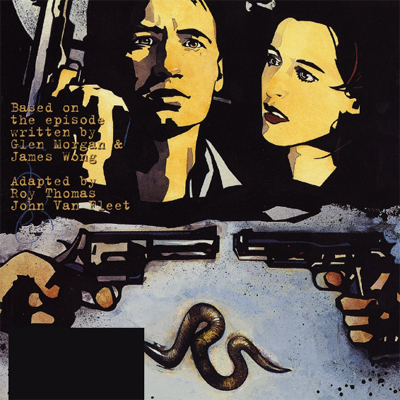
However, the adaptation of Squeeze demonstrates perhaps the biggest problem with the Season One line. While writer Roy Thomas was working from Glen Morgan and James Wong’s original script for Squeeze, and artist Val Mayerick can reference the finished episode, there is undeniably something missing from this adaptation. There is some part of Squeeze that is not replicable in the classic four-colour design, a vital part of The X-Files that seems lost in translation and seems to identify Season One as an inferior imitation.

Quite simply, Season One does not have access to David Duchovny and Gillian Anderson.

Closing in to seal your Tooms...

Closing in to seal your Tooms…

Continue reading

The X-Files (Topps) #33 – Soma (Review)

This May and June, we’re taking a trip back in time to review the fifth season of The X-Files and the second season of Millennium.

Soma is a done-in-one story that fits quite comfortably with the rest of John Rozum’s work on The X-Files.

Indeed, like a lot of Rozum’s output, Soma feels like a story recovered from a fifties horror comic. It is a very traditional ghost story hinging on a number of absurd contrivances and building to a suitably impressive climax. This is not a low-key supernatural thriller – it features vengeful smoke demons who materialise in front of countless witness and almost murder Mulder and Scully at the climax. Despite the insistence on the final page that it was too smoky to see anything, Soma feels a little too loud and campy for the world of The X-Files.

Burnt out...

Burnt out…

The script is very familiar. In many ways, Soma plays like an update of the script to Donor. It is another supernatural “beyond the grave” revenge story, similar in tone to first season episodes like Young at Heart or Lazarus or Born Again. As with Donor, the malicious spirit is a husband who plots a horrific revenge on a wife who disregarded his dying wishes. However, while Donor had an enjoyable pulpy charm to sustain it as an unwilling organ donor attempted to reclaim his harvested organs, Soma feels just a little bit too mean-spirited and malicious in tone.

Soma is a functional and efficient X-Files comic, but one that feels just a little bit too rote and familiar for its own good.

Burning love...

Burning love…

Continue reading