• Following Us

  • Categories

  • Check out the Archives


  • Awards & Nominations

Batman: Shadow of the Bat – The Last Arkham (Review)

23rd July is Batman Day, celebrating the character’s 75th anniversary. To celebrate, this July we’re taking a look at some new and classic Batman (and Batman related) stories. Check back daily for the latest review.

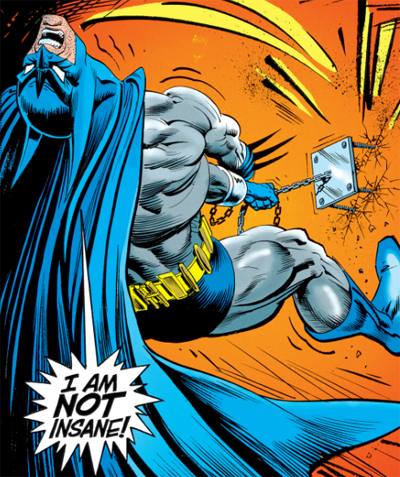
In 1992, DC comics launched Shadow of the Bat. It ran for eight years and ninety-two issues. Alan Grant wrote most of those issues, before his creative relationship with the publisher eventually broke down. (Grant is still upset about the manner of his dismissal.) As the driving force behind the book, Grant was able to give Shadow of the Bat its own unique flavour, focusing on the madness of Gotham, and the strangeness of its inhabitants.

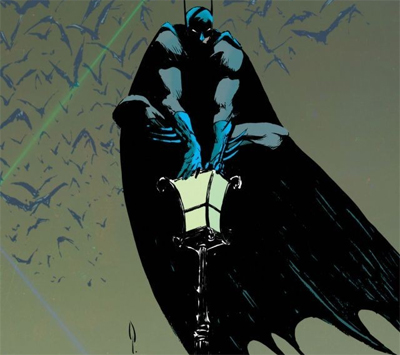
The opening four-part story, The Last Arkham, remains perhaps the most definitive of Grant’s contributions to the Batman mythos, teaming up with artist Norm Breyfogle to offer a rather creepy and unnerving exploration of the city’s ever-slipping sanity.

Me thinks the Batman doth protest too much...

Me thinks the Batman doth protest too much…

Continue reading

Dan Slott, Ty Templeton and Rick Burchett’s Run on The Batman Adventures (Review/Retrospective)

23rd July is Batman Day, celebrating the character’s 75th anniversary. To celebrate, this July we’re taking a look at some new and classic Batman (and Batman related) stories. Check back daily for the latest review.

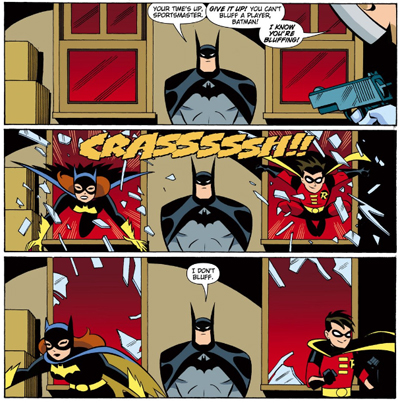
More than two decades after its original broadcast, Batman: The Animated Series remains one of the most insightful and most elegant distillations of the Batman mythos. While the show was on the air, DC published a variety of tie-in comic books featuring a variety of talent. Some of these count among the best Batman stories of the nineties, and it is a shame that DC has not done more work to keep these in print.

Indeed, it is a surprise that DC has never thought to produce a suitably deluxe or high-profile collected edition of the work that Mark Miller did on the tie-in to Superman: The Animated Series. However, it is worth noting that DC did make a nice gesture by offering the first issue of The Batman Adventures as their free comic book day issue in 2003. It is much more appealing free comic book day than a collection of promotions or previews.

Batman. In a nutshell.

Batman. In a nutshell.

The Batman Adventures was a tie-in comic published within the animated continuity while the animated Justice League was still on the air. However, it was written after the end of The New Batman Adventures. As a result, it had a lot more freedom than the comic books that had been published in tandem with the animated series. The Batman Adventures was no longer a supplement to a television show set in Gotham, it was the only continuing glimpse at this version of Gotham.

The Batman Adventures was a wonderful inclusive comic book – it was appropriate for children, it was accessible to people with only a casual familiarity with the world of Batman. In many respects, it was the perfect “free comic book day” comic. A light, fun read with a clever take on Batman and his world. The Batman Adventures is a fantastic little book that ended far too soon – a demonstration that comics don’t need to be “adult” or “mature” in order to be smart or fun.

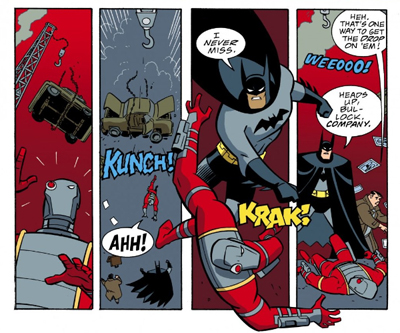
Deadshot is dead to the world...

Deadshot is dead to the world…

Continue reading

Peter Milligan’s Run on Detective Comics (Review/Retrospective)

23rd July is Batman Day, celebrating the character’s 75th anniversary. To celebrate, this July we’re taking a look at some new and classic Batman (and Batman related) stories. Check back daily for the latest review.

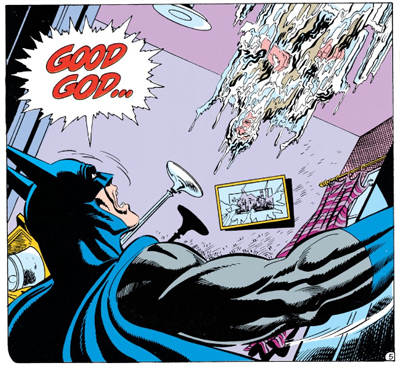
Peter Milligan’s run on Detective Comics was cut unfortunately short. After writing six issues of Detective Comics, the writer felt a little over-stretched, and so decided to concentrate on more personal projects. While that’s entirely understandable, it’s also a little unfortunate. Milligan’s work on Batman is rather underrated and often overlooked. Grant Morrison’s decision to build some of his extended Batman run off Milligan’s Dark Knight, Dark City helped bring some exposure to Milligan’s work on the character.

Despite the brevity of his run, Milligan is incredibly influential when it comes to the character of Batman. His work prefigures a great deal of the nineties. The way that Milligan seems to play Detective Comics as an existential horror story feels like it sets the stage for the extended collaboration between Doug Moench and Kelley Jones on the main Batman book during the mid-nineties. Although he didn’t stay to see the idea through, Milligan did play a (very) small part in the development of Knightfall.

Hanging on in there...

Hanging on in there…

Even outside of the general mood of Milligan’s work on the title, and demonstrating that a Batman comic could work as a horror story, even Milligan’s individual stories are influential. Dark Knight, Dark City is major influence on Grant Morrison’s work on the character. Perchance to Dream on Batman: The Animated Series seems to owe a debt to Milligan’s Identity Crisis, imagining a version of Bruce Wayne who is not Batman. (Something Morrison revisited during Final Crisis.)

However, perhaps Milligan is most influential in his portrayal of Gotham itself, offering us a damaged Batman protecting a haunted Gotham.

Knight clubbing...

Knight clubbing…

Continue reading

Scott Snyder & Greg Capullo’s Run on Batman – The Court of Owls, Night of the Owls & The City of Owls (Review/Retrospective)

23rd July is Batman Day, celebrating the character’s 75th anniversary. To celebrate, this July we’re taking a look at some new and classic Batman (and Batman related) stories. Check back daily for the latest review.

The “new 52” was a rather polarising experiment.

Claiming to restart their entire universe from scratch after the events of Flashpoint, DC comics claimed the initiative would make comic books more accessible to the masses. Without decades of continuity to block access, new readers would be more likely to try to get into these sorts of comics. The decision to effectively start from scratch has been controversial – arguably compounded by the fact that writers like Geoff Johns or Grant Morrison were allowed to carry their work across the continuity reboot.

Swinging into action...

Swinging into action…

The team of Scott Snyder and Greg Capullo are among the longest serving of the “new 52” creators. The pair have remained on the flagship Batman book for three years, longer than the vast majority of creators recruited to help relaunch the DC universe back in September 2011. There’s a wonderful consistency and enthusiasm to their work, and it seems like the two have a very clear vision of where they want to take Batman, one of the characters with the most complex relationship to the re-launch.

In many ways, The Court of Owls can be read as a meta-commentary on Batman’s position in the wake of Flashpoint, reflecting on the awkward relationship between the potential for novelty and the demand for familiarity.

Everything burns...

Everything burns…

Continue reading

Star Trek – Debt of Honour (Review)

This June, we’re taking a look at some classic Star Trek movie tie-ins and other interesting objects. Check back daily for the latest reviews and retrospectives.

By all accounts, Debt of Honour should be an unqualified success.

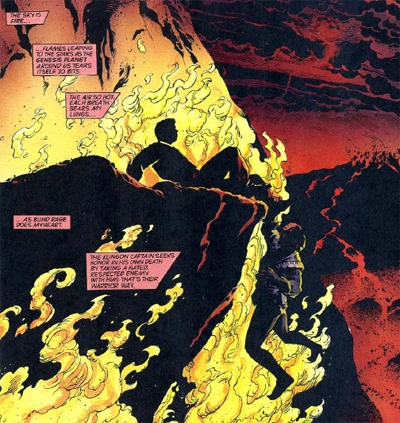
It’s a prestige graphic novel from DC comics, produced around the twenty-fifth anniversary of Star Trek and the release of Star Trek VI: The Undiscovered Country. It is written by celebrated comic book scribe Chris Claremont, fresh off his career-defining stint on Uncanny X-Men. An avowed Star Trek fan and comic book veteran, this should be in his wheel house. The art is provided by Adam Hughes, one of the most celebrated and respected artists of his time.

Talk about kicking off a comic...

Talk about kicking off a comic…

By any measure, Debt of Honour should count as some sort of hallmark for DC Comics’ Star Trek tie-ins. Unfortunately, that isn’t quite the case. A rather muddled storyline that is hopelessly devoted to Star Trek continuity while awkward interfacing with it,  Debt of Honour is just packed a little too tight. Charting a story from the earliest days of Kirk’s career to the aftermath of Star Trek IV: The Voyage Home, Claremont bites off more than he can chew.

Over the course of Debt of Honour, Claremont introduces a vague alien threat that has apparently been haunting Kirk for his entire career, a new arch-foe or love interest for Kirk, and even a supporting role for Kor. Along the way, he packs in cameos and shout-outs to various parts of Star Trek lore. He even explains why Klingons suddenly had ridges around the time of Star Trek: The Motion Picture. Ultimately, Debt of Honour is ambitious, but a little over-stuffed and quite over-cooked.

Warp speed ahead!

Warp speed ahead!

Continue reading

Star Trek (DC Comics, 1989) #35-40 – Tests of Courage/The Tabukan Syndrome (Review)

This June, we’re taking a look at some classic Star Trek movie tie-ins and other interesting objects. Check back daily for the latest reviews and retrospectives.

Captain Hikaru Sulu occupies a very special place in Star Trek lore. Given the amount of spin-off material that Sulu’s command of the Excelsior has generated, Sulu often seems like the Star Trek spin-off that never quite materialised. The idea of Sulu commanding the Excelsior has inspired novels and comics and audio books, and was even featured in Flashback, one of the episodes produced to celebrate the thirtieth anniversary of the franchise.

While Sulu’s command of the Excelsior is open-ended, it is interesting to consider the various origin stories that might apply. As with Khan Noonien Singh, there are multiple tie-in stories that cover the same ground. Published in late 2007, the novel Forged in Fire, for example, offers one account of Sulu taking command of the Excelsior – assuming command from Captain Styles during a high-pressure diplomatic crisis. However, this was not the first time that the story had been told.

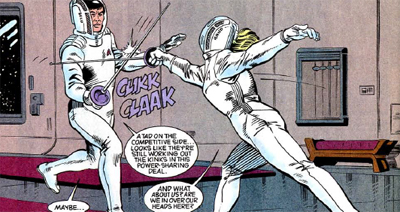
Crossing swords...

Crossing swords…

A year following the release of Star Trek VI: The Undiscovered Country, author Howard Weinstein wrote Tests of Courage. A six-issue arc set during the earliest days of Sulu’s command, Weinstein had originally hoped to collaborate with George Takei on the comic. Unfortunately, the two could not work out their schedules, forcing Weinstein to write the comic without Takei’s input. However, Takei did provide a glowing and enthusiastic foreword for the collected edition of the comic published two years later.

Tests of Courage is a fantastic piece of work, a suitably epic Star Trek comic that tells a suitably epic story – one with breadth and scope and drama and conflict that demonstrates just what a wonderful storyteller Howard Weinstein is.

Ships of the line...

Ships of the line…

Continue reading

Star Trek VI: The Undiscovered Country (DC Comics, 1992) (Review)

This June, we’re taking a look at some classic Star Trek movie tie-ins and other interesting objects. Check back daily for the latest reviews and retrospectives.

In many respects, adapting a Star Trek feature film into comic book form is very much an editorial function. With so little space available, particularly as compared to a feature film or novel, the assignment is more about whittling the script down to something that can be covered in fifty-five pages of a comic book. While those adapting the features films into novels frequently have to expand and flesh out the material to make it fit within the allocated page count and account for plot hole and logic error, the comic book adaptations just have to keep everything ticking over.

So Peter David and Gorden Purcell’s adaptation of Star Trek VI: The Undiscovered Country plays quite well as a condensed version of the narrative, covering the requisite story beats in the available space.

In space, everybody can hear you scream...

In space, everybody can hear you scream…

Continue reading

Star Trek (DC Comics, 1989) #1-12 – The Trial of James T. Kirk! (Review)

This June, we’re taking a look at some classic Star Trek movie tie-ins and other interesting objects. Check back daily for the latest reviews and retrospectives.

The late eighties and early nineties saw a change in the world of Star Trek tie-ins. During the eighties, tie-in writers had typically been afforded a great deal of freedom in telling their stories – allowed to explore the fringes of the Star Trek universe with little regard to how things matched up. The period saw a number of truly spectacular Star Trek tie-ins that count among the best work ever released with the Star Trek brand on it – John Ford’s The Final Reflection or Diane Duane’s My Enemy, My Ally.

However, with the release of Star Trek V: The Final Frontier and the broadcast of the third season of Star Trek: The Next Generation, there was a shift in how the franchise approached tie-in novels and comic books. Gene Roddenberry had arguably lost control of his creation, with the Harve Bennett and Nicholas Meyer taking control of the feature films while Rick Berman and Michael Piller were the driving creative forces on the television show.

Crossing swords...

Crossing swords…

As such, the tie-ins became a place where Roddenberry and his “people” – including Richard Arnold and Susan Sackett – could make their influence most heavily felt. So, in the late eighties and early nineties, a conscious effort was made to re-tool the novels and the comic book tie-ins, with Richard Arnold maintaining a much tighter grip on the reigns. DC’s first volume of Star Trek comics was cancelled after fifty-six issues, and another volume was launched to coincide with the launch of the Next Generation comic.

Writer Peter David had closed out the first volume of the Star Trek comic, and was drafted in as the writer of the new on-going series. However, he almost immediately came into conflict with Richard Arnold. Pages of the first issue had to be hastily re-drawn when Richard Arnold vetoed the use of a supporting character from Star Trek: The Animated Seriesafter the comic had been drawn. In many respects, this set the tone for the comic, which was victim to all sorts of weird editorial mandates.
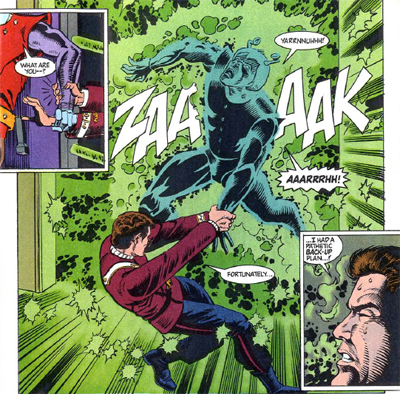
The Andorian Incident...

The Andorian Incident…

While writer Michael Jan Friedman remained the writer on the on-going Next Generation comic for most of its run – only occasionally getting another writer to fill in – Peter David departed the Star Trek comic before the end of the book’s second year on the stand. This is especially frustrating when one considers the pedigree of Peter David. An accomplished novelist and comic book writer, David had a wealth of experience in the medium that was being maliciously squandered by Arnold.

It’s a shame, because the opening twelve issues of DC’s second volume of Star Trek make for a delightful read and a fitting substitute for a live-action Star Trek television show unfolding between the movies.
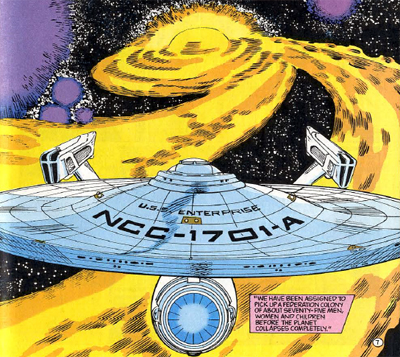
Warp speed ahead...

Warp speed ahead…

Continue reading

Star Trek V: The Final Frontier (DC Comics, 1989) (Review)

This June, we’re taking a look at some classic Star Trek movie tie-ins and other interesting objects. Check back daily for the latest reviews and retrospectives.

In many respects, the late eighties represented a changing of the guard when it came to Star Trek. The feature films had been relatively serialised. The events of Star Trek II: The Wrath of Khan led into the events of Star Trek III: The Search for Spock, which itself led directly into the events of Star Trek IV: The Voyage Home. At the same time, the expanded universe was generally left free to its own devices. Novelists and writers were given the freedom to do whatever they wanted.

In the late eighties, things changed. Directed by William Shatner, Star Trek V: The Final Frontier stood quite clearly apart from the events of the last three Star Trek films. At the same time, the franchise had found its way back to weekly television in the form of Star Trek: The Next Generation. Whereas comic books and novels had served to fill a gap when there was a scarcity of “official” Star Trek material, they were now very clearly of secondary importance to the “real” (or simply “live action”) versions of Star Trek.

Oh your God...

Oh your God…

There was a rather seismic shift in the nature and tone of tie-ins and adaptations. Rather notably, the creators who had adapted the last couple of films into prose and comic book form did not return to translate The Final Frontier across different media. Vonda McIntyre had written the novelisations of the last three Star Trek films, but was replaced by J.M. Dillard. Mike W. Barr and Tom Sutton had produced the comic book adaptations of the last two Star Trek films, but were replaced by Peter David and James W. Fry. Both Dillard and David would find themselves tasked with adaptation of Star Trek VI: The Undiscovered Country.

Peter David and James W. Fry’s adaptation of The Final Frontier is clearly intended as a launchpad for their new on-going Star Trek series that would debut only a few months later. Indeed, the final page of The Final Frontier includes an advertisement for that new series. In many respects, this adaptation of The Final Frontier seems to serve as a pilot for a new comic book series, a starting point for a bold new beginning to DC’s Star Trek line. Opening with the The Final Frontier, you might be forgiven for assuming it was doomed from the outset.

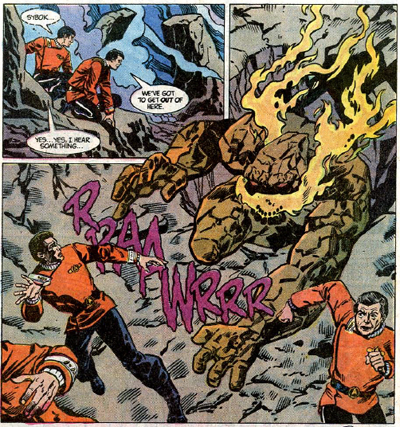
Here there be rock monsters...

Here there be rock monsters…

Continue reading

Star Trek IV: The Voyage Home (DC Comics, 1986) (Review)

This June, we’re taking a look at some classic Star Trek movie tie-ins and other interesting objects. Check back daily for the latest reviews and retrospectives.

The comic book adaptation of Star Trek IV: The Voyage Home does a surprisingly good job of translating the comedy adventure into comic book form. Relying the creative team of Mike W. Barr and artist Tom Sutton to produce a one-shot comic book adaptation of the feature film, DC Comics have reached a point where they are able to consistently and reliably churn out comic books based around the Star Trek franchise.

Indeed, one might imagine that the somewhat lighter tone of The Voyage Home would pose a challenge for the duo, eschewing the grand space opera of Star Trek III: The Search for Spock in favour of something more firmly rooted in modern sensibilities. However, Barr and Sutton do a wonderful job adapting the screenplay into a charming comic, even if it does seem to be aimed more squarely at hardcore Star Trek fans than casual viewers.

Standing tall...

Standing tall…

Continue reading