• Following Us

  • Categories

  • Check out the Archives


  • Awards & Nominations

The X-Files (Topps) #4-6 – Firebird (Review)

This August (and a little of September), we’re taking a trip back in time to review the second season of The X-Files. In November, we’ll be looking at the third season. And maybe more.

Firebird is the first multi-part story told in the pages of The X-Files. Writer Stefan Petrucha and artist Charles Adlard don’t transition from done-in-one stories to two-part adventures, instead skipping the middle step and producing a three-issue epic. While A Little Dream of Me exposed the limitations facing a creative team working on a tie-in, Firebird demonstrates the strengths of the format. Spanning from Siberia to New Mexico, Firebird has an epic scale that would not be possible on the second season of The X-Files.

(Rather interestingly – and perhaps tellingly – Petrucha takes the comics to places that the show wants to go. The American South-West would be very difficult to replicate in Vancouver, prompting the creative team to make an ambitious effort to bring Mulder and Scully to New Mexico in Anasazi, infamously painting a quarry red to achieve the desired result. The show would wait until the fourth season before it was confident enough to take Mulder to Siberia in Tunguska and Terma.)
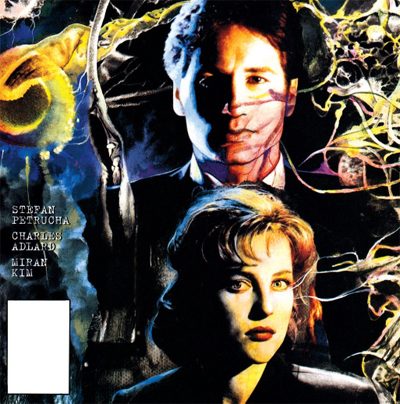
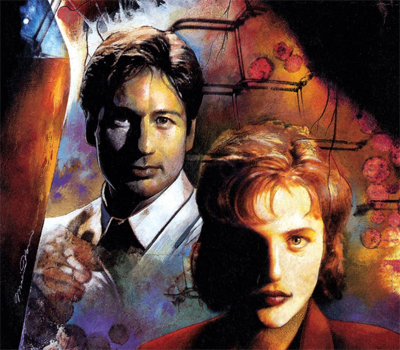
Something out of this world?

Something out of this world?

As with Not To Be Opened Until X-Mas, Firebird is very much a comic book story. While the show was reluctant have Mulder and Scully directly encounter aliens, the story features a monster that looks like something from the Lovecraft mythos. While the stakes on the show were generally rather personal to this point, Firebird puts the entire population of New Mexico (if not the world) at stake. While the series took its time revealing its evil conspiracy, Firebird gives us a cabal headed by a monologuing skull-holding would-be supervillain.

Perhaps surprisingly, this works. It’s clear that Petrucha and Adlard are aware that they are working in a different medium with different expectations and conventions. Firebird is very much an X-Files comic book epic, a story that couldn’t be realised on film. And there’s something very endearing about that.
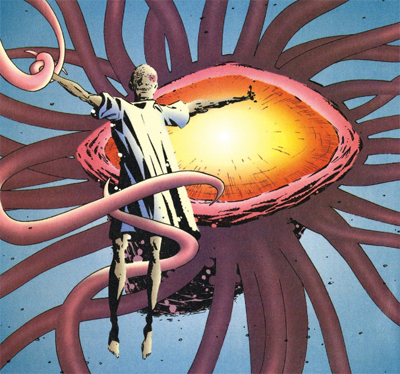
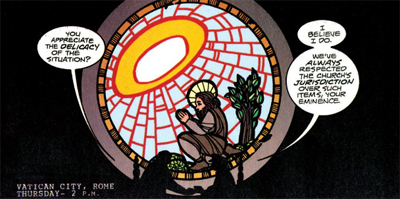
Alien affairs...

Alien affairs…

Continue reading

Mike W. Barr and Gordon Purcell’s Run on Star Trek: Deep Space Nine (Malibu Comics) (Review/Retrospective)

The September and October, we’re taking a look at the jam-packed 1994 to 1995 season of Star Trek, including Star Trek: Deep Space Nine and Star Trek: Voyager. Check back daily for the latest review.

The nineties comic book market was an interesting place. It enjoyed a huge boost due to the rise of speculation and collectors. The industry was massively successful in the early years of the decade, fuelled by high-profile artists, hype, and events. The industry imploded in on itself in the middle and towards the end of the decade, but it looked surprisingly profitable in the early years. Against that backdrop, Malibu Comics emerged.

Malibu had become the publisher of record for Image Comics in 1992. Image had been founded by a number of popular artists who had departed Marvel to set up their own shop and found their own company. Malibu distributed their comics for about a year, which gave Malibu access to a larger distribution platform. Although Image soon grew strong enough to publish its own comics, there was a point where Malibu had surpassed industry veteran DC Comics in the market place.

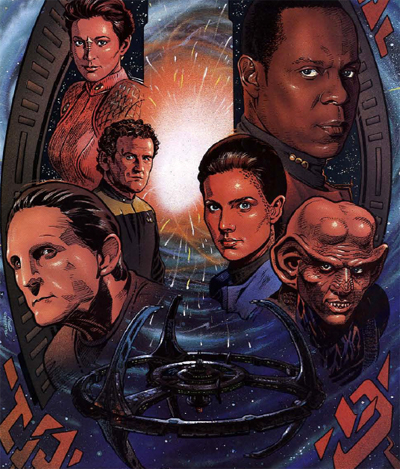
"Think of it—five months ago no one had ever heard of Bajor or Deep Space Nine. Now all our hopes rest here."

“Think of it—five months ago no one had ever heard of Bajor or Deep Space Nine. Now all our hopes rest here.”

Against this backdrop, Malibu secured the rights to publish comic books based on Star Trek: Deep Space Nine. Up until this point, DC comics had been publishing comics based on the original Star Trek and Star Trek: The Next Generation. Paramount’s decision to award the Deep Space Nine license to Malibu effectively split the comic book license up. DC Comics continued to publish comics based around the first two Star Trek shows, while Malibu had exclusive rights to the characters and world of Deep Space Nine.

As such, the decision to recruit writer Mike W. Barr and artist Gordon Purcell to write the first six issues of the comic was a pretty big deal. Barr and Purcell were incredibly associated with Star Trek comic books. The duo had done popular work on the movie-era comics, and had demonstrated an obvious and abiding affection for the franchise. Assigning these two creators to work on Deep Space Nine was a very clear message. Malibu were taking this license very seriously, indeed.

Triptych...

Triptych…

Continue reading

The X-Files (Topps) – Trick of the Light (Review)

This August (and a little of September), we’re taking a trip back in time to review the second season of The X-Files. In November, we’ll be looking at the third season. And maybe more.

The X-Files tie-in comic book was a massive success for Topps. It’s interesting to note the amount of cross-promotion that went into the comic. Factoring in short stories and tie-ins and annuals and other obligations, the output from writer Stefan Petrucha and Charles Adlard was nothing short of astounding. Topps worked very hard to promote the book, an approach that paid off – the comic would frequently appear in Diamond’s top 100 and was the publisher’s most successful monthly book.

Trick of the Light was a short twelve-page comic that was published as part of the The X-Files/Hero Illustrated Special, featuring an interview with Petrucha and packaged with Hero Illustrated #22 in March 1995. It was something of a glorified advertising gimmick, but one that demonstrates the popularity of the comic in question.

Don't go into the light!

Don’t go into the light!

Continue reading

The X-Files (Topps) #3 – A Little Dream of Me/The Return (Review)

This August (and a little of September), we’re taking a trip back in time to review the second season of The X-Files. In November, we’ll be looking at the third season. And maybe more.

There are inevitable challenges in working on a licensed property. You are effectively playing with somebody else’s toys. Since these tie-ins cannot drive a narrative currently unfolding in another medium, it’s often a challenge to maintain the illusion of forward momentum while existing at the behest of a story that can change from week-to-week. While The X-Files was a massive coup for Topps comics, and while Stefan Petrucha and Charles Adlard did a wonderful job, the comic had to face these constraints.

A Dismembrance of Things Past had brushed up against those limitations in trying to tell a U.F.O. story without meddling in the television show’s continuity. Petrucha used some fiendishly clever sleight of hand there, suggesting that the story would be about an alien visitation and possible cover-up, only to reveal that the story was actually an intimate meditation on the ideas of truth and memory. It was a rather ingenious bait-and-switch, resulting in a wonderful little story.

Pictures in his head...

Pictures in his head…

A Little Dream of Me is not quite as efficient in dealing with the external limitations imposed on a tie-in comic book. The unfortunate realities of comic book scheduling meant that A Little Dream of Me had the misfortune to hit the stands very shortly after the broadcast of Colony and End Game. Of course, the script for A Little Dream of Me would have been written long before the episodes aired (about six months), but the scheduling causes the comic to suffer.

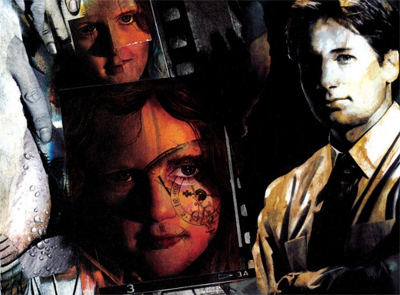
After all, Colony and End Game had made it abundantly clear that Samantha Mulder was unlikely to be returning to her family any time soon. And that was in the television show. The third issue of the comic book teasing the return of Samantha Mulder seems like a rather cynical cheat.

The "X" file...

The “X” file…

Continue reading

The X-Files (Topps) #2 – A Dismembrance of Things Past (Review)

This August (and a little of September), we’re taking a trip back in time to review the second season of The X-Files. In November, we’ll be looking at the third season. And maybe more.

A Dismembrance of Things Past is an absolute delight, and a nice demonstration of how well writer Stefan Petrucha and Charles Adlard could tell stories set within The X-Files universe.

There are many interesting things about A Dismembrance of Things Past. It’s a fine piece of work, deftly balancing the demands on a new comic book set within the world of The X-Files with an urge to tell a story that fits very clearly and very comfortably within the show’s basic structure. It is easy to imagine A Dismembrance of Things Past receiving a live-action adaptation. Indeed, Petrucha’s script feels like something of a tribute to writer Darin Morgan before Darin Morgan had even written for the show, half-way between Blood and Jose Chung’s “From Outer Space.”

Something to remember them by...

Something to remember them by…

A Dismembrance of Things Past confronts the difficulties of writing a tie-in comic book to The X-Files, while using those constraints to tell an interesting story in its own right. After all, the comic book would have to tell an alien or U.F.O. story eventually. The words “The X-Files” are written on the cover, and that comes with the territory. At the same time, Petrucha and Adlard have to acknowledge the fact that the tie-in comic book cannot advance the on-screen mythology arc. Indeed, it seems unlikely Carter had shared too much of that arc with Petrucha or Adlard.

It takes a lot of skill to balance these competing demands of a tie-in comic book – to remain connected to the source material, but never pulling too far away or ahead, while remaining interesting. A Dismembrance of Things Past manages to satisfy all of its obligations and then some.

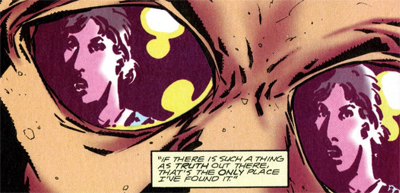
Through alien eyes...

Through alien eyes…

Continue reading

The X-Files (Topps) #1 – Not To Be Opened Until X-Mas (Review)

This August (and a little of September), we’re taking a trip back in time to review the second season of The X-Files. In November, we’ll be looking at the third season. And maybe more.

If you needed proof that The X-Files had made it, then the forty-issue Topps comic book series from the mid-nineties seems a place to start. Of course, this has less to do with the stories published in the comics themselves – though some are very interesting – and more to do with the comic book market in the nineties and the business model employed by Topps. The comic book industry was perhaps at its peak in the nineties – at least when it came to exposure and public profile.

Chris Claremont and Jim Lee’s X-Men #1 became the biggest-selling comic book of all time in 1991, selling over eight million copies. A year later, DC Comics published The Death of Superman, a sprawling highly-publicised comic book event that killed off (and then revived) the Man of Steel. The year after that, Batman got in on the action with the Knightfall trilogy, a suitably spectacular event that featured the crippling of Bruce Wayne, his replacement as Batman, and the eventual return of the Caped Crusader.

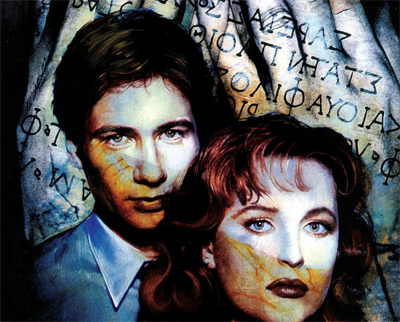
The truth is in here?

The truth is in here?

It is important to put those figures in perspective. While this was a financial peak for the comic book industry, it was still something of a fringe economy. In the mid-nineties, a television show attracting only eight million viewers would find itself on the bubble line when it came to renewal. However, that figure was the largest readership of any comic book ever. (Audience diversification means that both television audiences and comic book readers have dwindled in the years since, but the latter much more than the former.)

However, the business model for comic books in the nineties made them highly profitable, despite their smaller audience. Price gouging was not uncommon, with some retailers charging as much as $30 for Superman #75 in 1992. Poly bags, gimmick covers, variant artwork, celebrity authors – comics were largely driven by gimmicks in the nineties. More than that, the emphasis on comic books as an investment in the mainstream media helped to suggest the industry was more for collectors than for readers.

Holy conspiracy, Mulder!

Holy conspiracy, Mulder!

It is telling that the company to land the license for The X-Files was Topps, a company famous for producing sports memorabilia. The company had branched into comics in 1993, as the industry was growing and growing, hoping to license various characters and properties. The implication was that The X-Files comic had been designed more as an accessory than as a story. The cover to Not To Be Opened Until X-Mas ever features a handy “first collectors item issue” tag below the “1” at the top left-hand corner.

Licensed comic books have something of a chequered history. In the context of the mid-nineties, it would be easy to write off the forty-one issues (and change) of The X-Files as a cynical cash-in. However, the series has moments of brilliance and insight that mark it as a worth extension of the brand name.

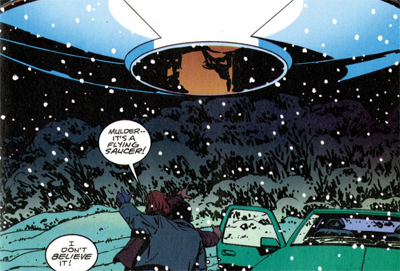
Up in the sky!

Up in the sky!

Continue reading

Robin: Year One (Review/Retrospective)

23rd July is Batman Day, celebrating the character’s 75th anniversary. To celebrate, this July we’re taking a look at some new and classic Batman (and Batman related) stories. Check back daily for the latest review.

Chuck Dixon is one of the definitive Batman writers, particularly in the context of the nineties. Dixon enjoyed a long and well-regarded run on Detective Comics in the nineties, serving as one of the three writers driving the Batman franchise – along with Doug Moench and Kelley Jones on Batman and Alan Grant on Shadow of the Bat. Dixon even got to stay involved with the Bat titles for a little while after No Man’s Land in 1999, when the entire line had a massive turnover in talent.

However, while Dixon is an incredibly influential writer on Batman, he had as much of an influence on Dick Grayson. Dixon was the writer who handled Dick Grayson’s first on-going Nightwing series, building off a miniseries written by Denny O’Neil. Dixon worked on Nightwing for seventy issues between 1996 and 2002. He even returned to the title with collaborator Scotty Beatty after its one hundredth issue to write Nightwing: Year One, an origin story covering the former Robin’s transition into his new superhero persona.

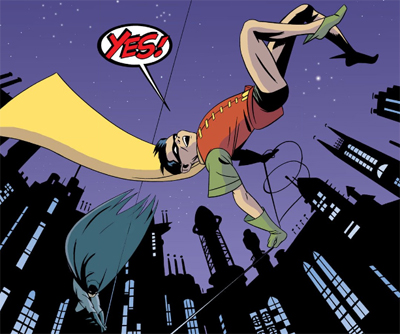
Swinging into action...

Swinging into action…

As such, it makes a great deal of sense for Dixon to collaborate with writer Scott Beatty on Robin: Year One, a prestigious miniseries spanning four extended issues and featuring wonderful artwork from Javier Pulido. Pulido’s distinctive artwork lends itself to vibrant colours and dynamic expression, as demonstrated during his wonderful stint as part of the rotating art team on The Amazing Spider-Man. If ever a comic book lent itself to Pulido’s style, Robin: Year One is it.

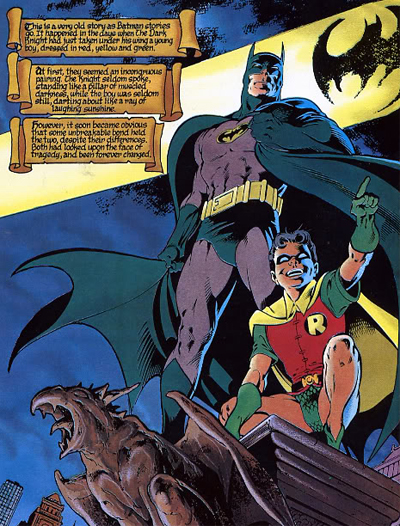
Dixon does some nice work trying to explain the dynamic between Batman and Robin, and even to argue why Robin is an essential part of the mythos. Most interestingly, he, Beatty and Pulido try to integrate the arrival of Robin with the atmosphere and mood established by Frank Miller and David Mazzucchelli in Batman: Year One.

Suit up!

Suit up!

Continue reading

Ed Brubaker’s Run on Detective Comics – Dead Reckoning (Review/Retrospective)

23rd July is Batman Day, celebrating the character’s 75th anniversary. To celebrate, this July we’re taking a look at some new and classic Batman (and Batman related) stories. Check back daily for the latest review.

It remains quite surprising that DC have never capitalised on the work that Ed Brubaker and Greg Rucka did on their Batman line during the early years of the twenty-first century. Given the popularity of Batman as a character, and considering the success that has been enjoyed by Brubaker and Rucka in the years since, it seems strange that DC has never made a consistent or concerted effort to package and release high-profile collections of their work on the character.

It is a shame, because the work is very good – both as solo writers on various titles and in collaboration with one another. Ed Brubaker enjoyed a solo run on Batman with artist Scott McDaniel shortly after No Man’s Land and through the end of Bruce Wayne: Fugitive. A few years later, while collaborating with Greg Rucka on the underrated and sorely missed Gotham Central, Brubaker also had a short run on Detective Comics.

Putting on his game face...

Putting on his game face…

He wrote a team-up between Bruce Wayne and Alan Scott in Made of Wood. However, Brubaker also wrote the epic six-part story, Dead Reckoning. On the surface, Dead Reckoning appears quite familiar. It follows a fairly standard set-up. It’s an adventure that features the width and breadth of Batman’s iconic rogues’ gallery, and unearths a terrible secret about the history of Gotham that – in Brubaker’s style – is a clever updating of a classic piece of continuity.

However, underneath the surface, Dead Reckoning is something much more harrowing and unsettling. It’s the story of lives destroyed by calamities and forces outside the normal human experience – it’s about wounds inflicted on ordinary people by monsters playing a very strange game. It feels like a post-9/11 superhero story, treating Batman’s world as something hostile and horrifying.

Snow escape...

Snow escape…

Continue reading

Batman – Full Circle (Review/Retrospective)

23rd July is Batman Day, celebrating the character’s 75th anniversary. To celebrate, this July we’re taking a look at some new and classic Batman (and Batman related) stories. Check back daily for the latest review.

In a way, Mike W. Barr and Alan Davies’ Full Circle feels a bit like Steve Englehart and Marshall Roger’s Dark Detective. It’s a cap to a run on the character, something of a forerunner to DC’s recent “Retroactive” initiative, reteaming classic creators on a particular character in an attempt to recapture past glories. Like Dark Detective, Full Circle doesn’t quite work. It’s a direct sequel to Barr’s Year Two – albeit with recurring gags and characters thrown in from the rest of his Detective Comics run – and it seems to exist solely to make sure the reader understood what Barr was doing with Year Two.

Given that Year Two was hardly the most subtle of comics, Full Circle occasionally runs the risk of bludgeoning the reader into submission.

It's a Boy Wonder he doesn't get killed...

It’s a Boy Wonder he doesn’t get killed…

Continue reading

Scott Snyder and Greg Capullo’s Run on Batman – Zero Year: Secret City & Dark City (Review/Retrospective)

23rd July is Batman Day, celebrating the character’s 75th anniversary. To celebrate, this July we’re taking a look at some new and classic Batman (and Batman related) stories. Check back daily for the latest review.

It takes considerable bravery to craft an origin story for Batman in the wake of Frank Miller and David Mazzucchelli’s Year One.

Superhero origins are constantly being tweaked and re-written and re-worked. Superman has had a half-dozen comic book origins (in- and out-of-continuity) since Crisis on Infinite Earths rebooted the DC universe. There’s John Byrne’s Man of Steel, Kurt Busiek’s Secret Identity, Mark Waid’s Birthright, Geoff Johns’ Secret Origin, J. Michael Straczynski’s Superman: Earth One and even Grant Morrison’s Action Comics run.

It's only a pale moon...

It’s only a pale moon…

In contrast, Batman has been relatively undisturbed, with only Geoff Johns’ Batman: Earth One positing an alternate origin story for the Caped Crusader. A large part of that is down to how sacred Year One is. Written by Frank Miller and David Mazzucchelli, Year One is considered to be one of the best Batman comics ever published. It recently topped Comic Book Resources’ high-profile fan poll for the character’s seventy-fifth anniversary.

In many cases, an “if it ain’t broke…” mentality applies. Having a universally-beloved comic book story that is easily accessible as the origin story for a particular character is not a bad thing at all. You can hand Year One to anybody and they can read and enjoy it. Although undoubtedly a product of the late eighties, the comic remains relevant and compelling to this day. Indeed, we have not moved so far from the eighties that it’s hard to reconcile a Batman origin grounded in that social context.

Talk about falling so far...

Talk about falling so far…

However, Scott Snyder and Greg Capullo are the creative team working on the Batman book for the character’s seventy-fifth anniversary. The duo have enjoyed a tremendous run – managing that rare intersection of critical and commercial success in mainstream comics. There are legitimate criticisms to be made, but Snyder and Capullo’s Batman work does hold up as some of the best Batman comics produced in quite some time, and one of true success stories of DC’s “new 52.”

So, if there was ever a time to go back to Batman’s origin, this was it. A well-loved creative team, a significant anniversary, a clear distance between this time and Year One. The risk associated with Zero Year is phenomenal. It is an incredible gambit. Even though the story is not in competition with Year One, comparisons are inevitable. The result is a very satisfying and exciting tribute to an iconic comic book character that doesn’t quite surpass Year One, but is clever enough to be clear that it isn’t trying to.

Getting into the swing of things...

Getting into the swing of things…

Continue reading