• Following Us

  • Categories

  • Check out the Archives


  • Awards & Nominations

5. Lawnmower Man 2: Beyond Cyberspace (-#61)

Hosted by Andrew Quinn and Darren Mooney, The Bottom 100 is a subset of the fortnightly The 250 podcast, a trip through some of the worst movies ever made, as voted for by Internet Movie Database Users.

This time, Lawnmower Man 2: Beyond Cyberspace.

podcast-lawnmowerman2

Continue reading

4. Aliens (#64)

Hosted by Andrew Quinn and Darren Mooney, The 250 is a fortnightly trip through some of the best (and worst) movies ever made, as voted for by Internet Movie Database Users.

This time, James Cameron’s Aliens.

podcast-aliens

Continue reading

3. Jaws (#226)

Hosted by Andrew Quinn and Darren Mooney, The 250 is a fortnightly trip through some of the best (and worst) movies ever made, as voted for by Internet Movie Database Users.

This time, Steven Spielberg’s Jaws.

podcast-jaws

Continue reading

2. In the Name of the Father (#186)

Hosted by Andrew Quinn and Darren Mooney, The 250 is a fortnightly trip through some of the best (and worst) movies ever made, as voted for by Internet Movie Database Users.

This time, Jim Sheridan’s In the Name the Father.

podcast-inthenameofthefather

Continue reading

1. Prisoners (#226)

Announcing The 250!

Hosted by Andrew Quinn and Darren Mooney, The 250 is a fortnightly trip through some of the best (and worst) movies ever made, as voted for by Internet Movie Database Users.

First up, Denis Villeneuve’s Prisoners.

podcast-prisoners

Continue reading

Star Trek: Voyager – Alter Ego (Review)

Following on from the aborted promise of a new beginning in Fair Trade, things get back to normal.

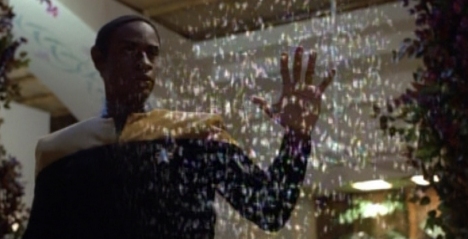
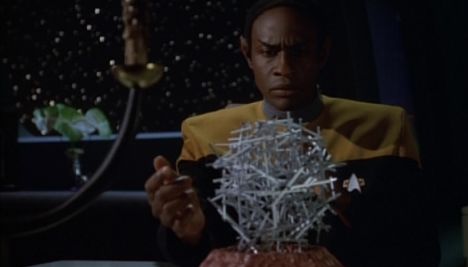
Alter Ego is another episode of Star Trek: Voyager that feels like it might have been wholly repurposed from an earlier Star Trek show. On the surface, it is a fairly standard “holodeck run amok” story in the style of earlier episodes like Heroes and Demons or Projections. However the contours of the plot recall a very specific (and very good) episode of Star Trek: The Next Generation. As Alter Ego seems to suggest that a holographic character has achieved sentience and threatens to destroy the ship, it recalls the far superior Ship in a Bottle.

Forced attraction.

Forced attraction.

There are differences, of course. Ship in a Bottle is a far stronger episode, one of the best holodeck stories ever produced. More than that, the climax of Alter Ego reveals that the holodeck programme has not become sentient but is instead being used as the avatar of an outside force. Still, this twist is confined to the last act of the episode, and so it feels more like an embellishment than a revision. For the bulk of its runtime, Alter Ego plays as a pale imitation of a much stronger piece of television.

It does not help matter that Alter Ego‘s novel twist on that central premise is to paint its central guest star as a psychotic stalker with a crush.

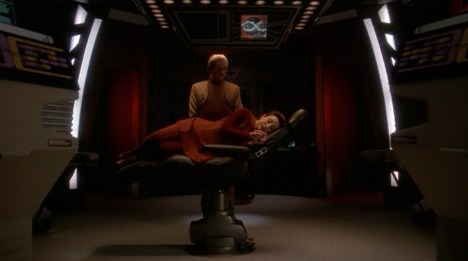
A whole ball of crazy.

A whole ball of crazy.

Continue reading

Star Trek: Voyager – Fair Trade (Review)

In theory, Fair Trade is precisely the episode that Star Trek: Voyager needs right now.

From the outset, the show has struggled with several major problems. Superficially, Voyager has struggled to distinguish the Delta Quadrant from the Alpha Quadrant, to the point that the Kazon felt like low-rent Klingons and the various aliens-of-the-week seemed largely indistinguishable from the aliens-of-the-week featured on the sibling shows. More fundamentally, the show failed to conjure an air of mystery and intrigue about the region. Everything about the show felt too safe, right down to the characters. This was a show where terrorists became model officers.

Venting plasma...

Venting plasma…

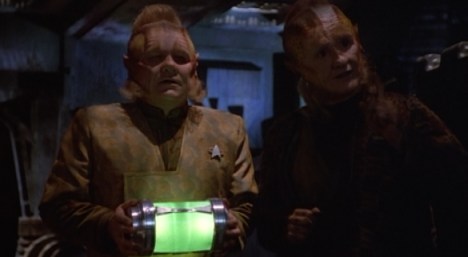
Fair Trade feels like it should offer the perfect remedy to all of this. The opening scenes find Voyager brushing up against “the Nekrit Expanse.” It is a region of space that is pointedly different and alien. Neelix has no idea what lies beyond. The sensors cannot penetrate it. Voyager is forced to dock at a local space station to take supplies, one crowded with aliens of multiple species engaged in shady dealings. More than that, the episode hinges on the neglected character of Neelix. It returns to early undeveloped suggestions the Neelix is not all he claims to be.

However, in practice, Fair Trade is disappointing. The episode lacks the courage of its convictions, both as a script of itself and as clear demarcation within the third season. It is a show rich with promise that offers up any number of intriguing ideas, but lacks the courage necessary to follow through on them.

In a bit of a Wix.

In a bit of a Wix.

Continue reading

Star Trek: Deep Space Nine – The Darkness and the Light (Review)

The Darkness and the Light is the first television credit for writer Bryan Fuller.

There is no way around that. It puts a lot of emphasis on this fifth season episode, drawing a lot attention to the story. Fuller didn’t even write the script, instead pitching a story that would be developed by Ronald D. Moore. However, later in the fifth season, Fuller would pitch the story for Empok Nor. After that, he would be recruited on to the writing staff on Star Trek: Voyager. Then Fuller would begin developing his own shows. Dead Like Me. Wonderfalls. Pushing Daisies. Hannibal. American Gods. Star Trek: Discovery.

Face-off.

Face-off.

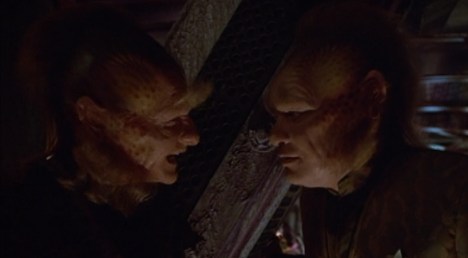
That naturally casts a shadow over his first television pitch, the premise sold to the writing staff of Star Trek: Deep Space Nine. Even watching Fuller’s idea filtered through the lens of Ronald D. Moore, there is a strong urge to read too much into this forty-five-minute piece of television. How much of it represents Bryan Fuller’s vision of Star Trek? How have its themes and ideas resonated across the rest of the writer’s work? What insight might it offer into the producer’s vision for the future of the franchise?

A lesser episode would crumple under that weight. It helps that The Darkness and the Light is an ambitious and exciting piece of television, a triumph of concept and execution that stands as one of the most distinctive and memorable episodes in the fifty-year history of the franchise.

A time to heal.

A time to heal.

Continue reading

Star Trek: Deep Space Nine – Rapture (Review)

Faith can be a tricky issue.

At one point in Rapture, the primary cast take a moment to reflect upon it. Kira tries to explain her belief in Sisko and the Prophets to Dax and O’Brien. She struggles. They have difficulty understanding how Kira can invest so much certainty in something so intangible. Eventually, Worf interjects. “Do not attempt to convince them, Major,” he urges her. “They cannot understand.” Dax is a little surprised by Worf’s interest in the topic. “Since when did you believe in the Prophets?” she asks. Worf responds, “What I believe in is faith.”

Gotta have faith.

Gotta have faith.

It is a short conversation, but one that reveals a lot about Star Trek: Deep Space Nine. As a rule, the Star Trek franchise tends towards a strong atheism, rejecting notions of religion and spirituality as the hallmarks of an underdeveloped civilisation; Return of the Archons, The Apple, For the World is Hollow and I have Touched the Sky, Who Watches the Watchers?, Devil’s Due, False Profits, Chosen Realm. This makes a certain amount of sense, given that the franchise prides itself on its rationalism. However, it also feels a little narrow-minded.

Rapture might just be the franchise’s most compelling exploration of unquestioning faith, a harrowing portrayal of devotion and inspiration that captures at once the ecstasy of unwavering belief and the discomforting aspects of watching someone embrace something outside a rational frame of reference. Rapture is a mesmerising piece of television.

"I, for one, welcome our new Klingon overlords."

“I, for one, welcome our new Klingon overlords.”

Continue reading

Non-Review Review: Doctor Strange

Some Marvel films succeed by pushing against the house style to provide a clear and unique artistic sensibility, like Iron Man III and Guardians of the Galaxy, films that are undeniably informed by the stylistic sensibilities of their directors as much (if not more than) the concerns of the shared universe. Those films are never distinctive enough to compare to the work done by Tim Burton or Christopher Nolan, but they stand out from the rest of the Marvel production slate for their willingness to tell a different story in a different style.

Some Marvel films suffer from their adherence to the production company’s house style. Just about anything interesting was smothered out of Thor: The Dark World, which frequently seemed to have been written and edited by a computer algorithm designed to amplify the well-received elements of the first film and graft them on to a familiar structure. Even some of the relatively strong films on the slate are not immune, with Captain America: The Winter Soldier and Captain America: Civil War unable to follow their bolder ideas to conclusion.
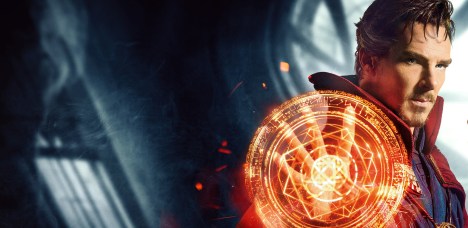
It's a kind of magic...

It’s a kind of magic…

However, there are also films that succeed through their understanding of the studio’s house style and sensibilities, working firmly within the structures and boundaries of what might be termed “the Marvel Cinematic Method.” These films do not just acknowledge the expectations imposed upon these blockbusters, they play towards them. In doing so, they embrace the stability and consistency that such a tried-and-tested approach affords, affording the production team the opportunity to craft enjoyable adventures starring likable actors doing fun things.

The original Thor is perhaps the best example of this approach. Often underrated and overlooked in assessments of Marvel’s cinematic output, Thor ranks among the very best of the company’s feature film slate by virtue of its willingness to embrace the stock superhero story at the heart of the script and focus upon making its cast likeable and its plot moving. There is a solid argument to be made that Thor is the purest solo superhero movie produced in quite some time, dating back to Richard Donner’s Superman. No irony or deconstruction in sight. Just simplicity.

Hair today...

Hair today…

Doctor Strange wisely opts for a similar approach. There are very few surprises to be found in the plotting and structuring of the film. The movie unfolds almost exactly as the audience expects. All the pieces are there, and they are assembled with the reliability of the very expensive watch that the title character chooses to carry around as a memento. The arrogant lead character humbled by tragedy. The nihilistic opponent who embraces the end of all things. The romantic co-lead. The stoic supporting character immune to our hero’s charm. The fallen mentor.

Doctor Strange is not particularly interested in subverting or twisting these stock elements. Instead, it focuses on honing them to a fine point, executing them with the help of a spectacular cast and a knowing grin. More than that, the relative simplicity of the plot framework allows director Scott Derrickson to hang some really impressive choreography and set pieces. The Marvel films have been (fairly) criticised for a certain textural “sameness”, and so the visual and aural stylings of Doctor Strange come as a breath of fresh air.
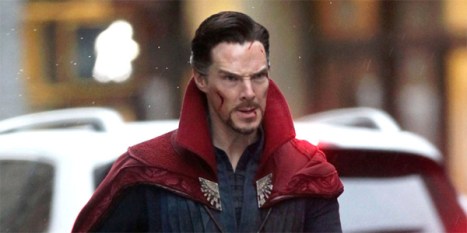
Strange fascination.

Strange fascination.

Continue reading