












“A beating heart inside a brain?”
“Brilliant. What else is a story?”
The Story and the Engine marks a clear return to form for the season around it.
Once again, it is interesting that Davies’ return to Doctor Who has adopted its own structures and rhythms, so that these two eight-episode seasons are more obviously paired with one another than with the thirteen-episode seasons of his first tenure. The Robot Revolution and Space Babies were retrofuturist pastiches, Lux and The Devil’s Chord were formally ambitious attempts to do something new with the format, The Well and Boom were militaristic high-concept science-fiction, Lucky Day and 73 Yards were Ruby-centric stories about encroaching fascism.

Tree’s company.
The Story and the Engine is an interesting companion piece to Dot and Bubble, in that both episodes are – at their core – stories about what it means for the Doctor to be a person of colour. Within their respective seasons, The Story and the Engine and Dot and Bubble are both constructed as stories that simply could not work if the Doctor still looked like David Tennant, Jodie Whittaker or Peter Capaldi. While Dot and Bubble cleverly built to this concept as a twist, The Story and the Engine makes it clear from the opening scenes.
The Story and the Engine is a clever, thoughtful meditation on what it means that the Doctor now looks like Ncuti Gatwa. It’s well-observed, well-structured and well-written, a classic Doctor Who story told from a fresh angle.
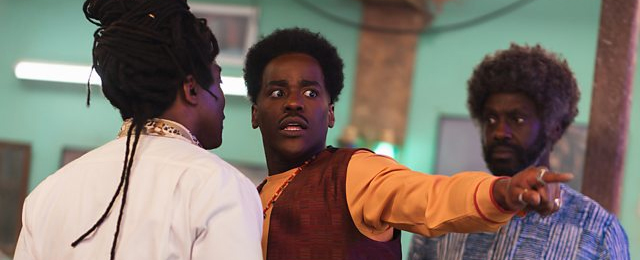
A cut above?
One of the strangest aspects of the Chibnall era was that the show featured the first regular incarnation of the Doctor to present as a woman, played by Jodie Whittaker, but there was never any real exploration of what that meant to the character. There were faint nods to the idea in stories like The Witchfinders, but every episode of the Chibnall era could handily have been rewritten to feature David Tennant or Matt Smith, without having to change more than a line or two of dialogue.
This was strange, given the (deserved) attention that the promotion of Whittaker’s casting drew to the idea of a female Time Lord. There was an incredible opportunity there to explore questions about the character and the history that they navigate. Across the fifty-plus years of the show to that point, the Doctor had enjoyed a certain white male privilege. “Just walk about like you own the place,” the Tenth Doctor boasted to Martha on visiting Elizabethan England in The Shakespeare Code. “Works for me.”
There had some effort to interrogate that idea towards the end of the Moffat era, most notably in Thin Ice, an episode in which the Twelfth Doctor gives Bill a stern lecture about how she shouldn’t be provoked by the racist attitudes of the time, only for the Doctor to let himself be provoked, because he doesn’t see those rules as applying to himself. However, the Chibnall era never really grappled with this. For the Thirteenth Doctor to continue to walk around like she owns the place feels like a massive missed opportunity.
Indeed, Davies has arguably spent a significant portion of his run trying to subtly rehabilitate some of the bigger swings and misses of the Chibnall era. “The Timeless Child” was reworked to focus less on mythology and more on adoption, serving as a thematic tether between the Doctor and Ruby rather than as some grand mystery to be resolved.

In the cut.
There is a certain magnanimity to how Davies has dealt with the baggage that he inherited from the Chibnall era. It is, for example, a lovely choice to briefly include Jo Martin as the Fugitive Doctor in The Story and the Engine, making the episode a rare multi-Doctor story as a way of acknowledging that Martin is technically the first person of colour to play the Doctor.
The Fugitive Doctor is perhaps Chibnall’s most interesting and compelling addition to the Doctor Who mythos, in large part because of Martin’s performance and because the Fugitive Doctor’s dynamism provided an unflattering contrast with the Thirteenth Doctor’s passivity. However, the Fugitive Doctor also felt like a missed opportunity, less a fully-formed character than a feint towards compelling ideas that that era of the show was unwilling to explore.
As such, it is wonderful to see Jo Martin make even a small cameo in The Story and the Engine, particularly one built around acknowledging how the character and the actor were shortchanged. Explaining why she abandoned Abena, the Fugitive Doctor confesses, “I was busy in a different story that might be finished one day.” It also retroactively seems to queer the character as well. The Story and the Engine makes a big, important gesture towards including the Fugitive Doctor in any understanding of what it means for the Doctor to be a person of colour.
Specifically in the context of the Fifteenth Doctor, it is commendable that Davies has taken the time in his return to Doctor Who to draw the audience’s attention to the fact that the Doctor no longer enjoys that white male privilege. It is a big deal that the Doctor is now played by a person of colour and presents to the audience as a person of colour. While that is not the only thing that defines the Fifteenth Doctor – he has had his share of classic run-around Doctor Who adventures from Rogue to The Well – it is one thing that does inform his characterisation and the stories in which he exists.
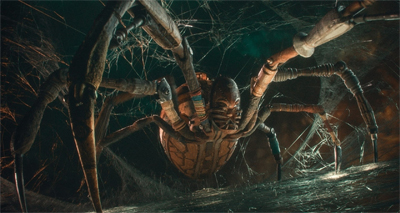
Spider-god, spider-gog, does whatever a spider-god can…
Indeed, there is a clear sense of growth. At the end of Dot and Bubble, the Fifteenth Doctor seemed as surprised as the audience at the unspoken racism that underpinned Finetime, and in particular that such racism could be applied directly to him. However, at the start of The Story and the Engine, the Fifteenth Doctor is very acutely aware of the fact that while who he is has not changed, how he is perceived has changed.
“I am not human, I am an evolved lifeform,” the Doctor tells Belinda at the start of the episode. “And… eh… my body changes a lot. It’s the first time I’ve had this Black body.” There is a sense that the Doctor has embraced the fact that the lived experience of somebody in a body like that is different than the lived experience of somebody who presents as white. As somebody who lives on Earth, his cultural frame of reference is shifted, and he is aware of that.
As a Black man, the barbershop takes on a huge significance. “I don’t go there for cuts,” he tells Belinda. “It’s hard to explain.” This makes sense. The barbershop has long occupied a unique space within that community. Indeed, The Story and the Engine was written by Inua Ellams, whose most notable theatrical work is Barber Shop Chronicles, a play set in multiple Black barbershops across the United Kingdom. The use of the barbershop is is a nice piece of cultural specificity. The barbershop is a safe space. As the Doctor tells Belinda, “I’m able to forget.”
It is very well-observed that Belinda herself intuitively understands what this means for the Doctor, a bond shared between two people of colour existing in a world largely defined by the white gaze – the subtext of stories like The Robot Revolution, Lux and The Well. “They…,” the Doctor begins. “Treat you like one of their own?” Belinda suggests. Belinda recalls of the importance of the trips that she would take to India with her grandmother so that she could be in a place where it felt like she belonged. “Take as long as you need,” she tells him, delaying her own trip home.

Barbershop quartet.
It is a nice character beat. Belinda has been intensely sceptical of the Doctor and the TARDIS. In both Lux and The Well, her first reaction to landing in a Doctor Who story was to suggest immediately returning to the TARDIS so she can get home. As such, it is very clever that Belinda responds with empathy and compassion to the Doctor’s desire to visit the barbershop, because she understands what that space means to him. It’s a choice that does a lot to underscore Belinda’s empathy for people, even as she remains skeptical of Doctor Who.
Indeed, The Story and the Engine is in some ways built around Belinda’s skepticism of the Doctor. She clearly respects him and cares for him, but she is also wise enough and experienced enough not to be enthralled by him. It is interesting that this season has paralleled the Doctor with abusive boyfriends, whether serving as a contrast to Belinda’s earlier relationship with Alan in The Robot Revolution or setting up Ruby to fall for Conrad in Lucky Day.
The Story and the Engine very pointedly parallels Belinda and the Doctor with the Barber and Abena. As with Sasha-55 in The Robot Revolution, Belinda is confronted with another almost-companion, a woman who the Doctor almost took with them, but who was left behind. What is interesting in the parallel between the Doctor and Belinda and the Barber and Abena is that Abena is the one who actually holds the power in that dynamic, even if the agenda is being set by the Barber. It feels like an interesting wrinkle in the mirroring of the dynamic.
Ultimately, though, it is very telling that Belinda unlocks the relationship between the Barber and Abena with a warning. “Abena, hurt people hurt people,” Belinda cautions the goddess. Belinda is the character with the clearest and strongest read on the dynamic within this relationship. “Imagine,” Abena sighs at the end of the episode. “A mortal teaching a god life lessons.” It is an obvious reference to the idea that Belinda has more to off the Doctor than even he might know.
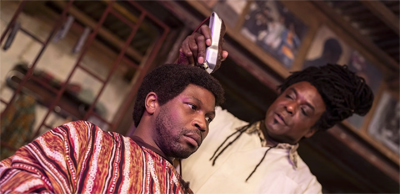
A close shave.
However, it also draws another clear line between Alan and the Doctor. When Belinda observes that “hurt people hurt people”, she is obviously talking from experience with Alan. However, it also seems like her efforts to impose clear boundaries with the Doctor and her reluctance to be seduced by his usual routine comes from a place of recognition. Belinda understands the Doctor better than he might think, and perhaps even better than he knows himself. It’s a really interesting dynamic, and a reasonably fresh take on the relationship between the Doctor and the companion.
To get back to the cultural specificity of The Story and the Engine, it is clever how the episode compares the barbershop to the TARDIS. These are both seemingly mundane spaces that serve as transportation into the unknown. They are alternately accessible from and completely cut off from the outside world. The episode reinforces this comparison by cutting between the Doctor in the barbershop and Belinda in the TARDIS. These are spaces that are at once part of the world, but also protected from it.
The Story and the Engine is a really remarkable balancing act, feeling at once specific to its cultural milieu but also firmly tied to the larger thematic interests of this era of Doctor Who. It is an episode about stories, in which stories have so much power that they can literally drive a ship forward through space and time. This is perhaps the most romantic expression of what storytelling is, and what Doctor Who is.
The Story and the Engine is very firmly rooted in African culture. It is more than just the references to Anansi. Rashid’s story, adapted from a poem that Ellams published in Poetry in May 2020, based on a story that Bobby McFerrin told about Yo-Yo Ma’s visited to Botswana, is a clever thematic hook for the story, as Rashid explains that while the push of contemporary capitalism works to flatten and standardise art, the context of a work inevitably changes based on factors beyond the work itself.
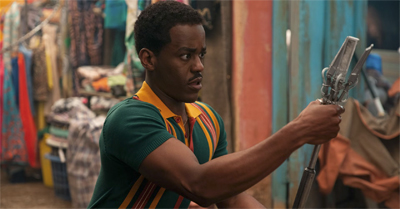
Doesn’t scan.
Recalling how Yo-Yo Ma asked a local musician to play the same piece of music again only to hear “a completely different song”, Rashid has the composer explain to the visiting musician, “The first time, an antelope was in the distance, clouds covered the sun. The second time, clouds had gone, antelope had disappeared, so the song changed.” As Rashid summarises the point, “You see, in the old days, music was a live thing. But after industrial revolution, people became obsessed with producing identical things – to package time.”
It is a beautiful observation, making a strong argument for the virtues of diversity and inclusivity in pragmatic terms. “We’re running out of stories!” Tunde shouts early in the episode, and this is perhaps in some senses true. By this point, the audience is long past the point of “peak television“ or perhaps even “peak content.” Doctor Who has been running for over sixty years by this point. Perhaps every story that can be told has been told. This might explain why audiences feel a clear “fatigue“ at the same old recycled narratives, packaged through industrial systems designed to strip out any humanity.
After all, there are plenty of Doctor Who stories about engines that use human beings as fuel, in stories like The Pirate Planet or The Girl in the Fireplace or The Crimson Horror. There are only so many basic plots that can be done within an established framework, and it’s inevitable that those plots would eventually start to feel repetitive. The engine would break down. In this context, changing some of the variables, adding specificity and perspective, serves to refresh these tired and familiar beats.
The highest-level most-abstract plot of The Story and the Engine could have been told in any number of locations with any number of characters. It could have been set on an alien world. It could have unfolded in an old pub. The Barber runs through a variety of permutations, that tellingly allude to both Lux and The Robot Revolution with descriptions of “an electric cinema” and “a space opera.” Once again, Doctor Who is a show about stories and about storytelling, about the importance of what ideas are communicated and how.

Hair today, gone tomorrow.
It’s very telling that the first story heard in The Story and the Engine – narrated by Omu – is the story of Doctor Who itself. And that, as Omu finishes that story, the Doctor Who opening credits manifest themselves in the window. The Doctor describes the images in the window as “a visual interpolation of his story”, suggesting that the window is television.
However, while the concept of The Story and the Engine could unfold in any setting, the choice to place it specifically within a Nigerian barbershop is what makes the episode distinct and interesting. It makes Doctor Who, in Rashid’s words, “a live thing.” It demonstrates that there is still the potential for new and exciting stories, even using existing templates, if these reliable storytelling engines are willing to embrace new perspectives rather than to run from them.
This specificity of setting gives The Story and the Engine a remarkably strong emotional core. The Barber is obviously a mirror to the Doctor, an ordinary man who gives stirring speeches about how he is really a god, only to contrast that self-appointed divinity with some deep-seated humanity. “It does not matter what I am called,” the Barber boasts at one point, as if fresh from a rewatch of The Name of the Doctor. “It matters who I am, what I do.” The Barber is a man tied to gods, but not a god himself, whose power came from his ability to talk. He is an obvious mirror to the Doctor.
However, the setting of The Story and the Engine affords the character a deeper tragedy. The Barber was once a master storyteller, who created this immense work of art, only to lose control of the very narrative that he spun. “I worked for centuries and all I wanted was to be recognised,” the Barber confesses. “They told me that I should know my place.” He laments, “So they threw me out, out of my life’s work.” In the episode’s closing scenes, he admits, “All I wanted to do was to be creditted for my work.”
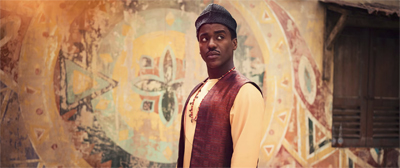
Barber shopping trip.
There are all sorts of cultural neutral ways of framing this central tension. After all, the second Davies era has a strong recurring fascination with the idea of large language models that devour huge volumes of media and spit out uncanny imitations with no real authorship. This fear permeated both the uncanny doubles of Wild Blue Yonder and the initial set-up of The Robot Revolution. The Barber is a writer who put all his work on “the world wide web”, and then had it stolen from him. It’s a very universal metaphor, and it fits with the thematic concerns of the show around it.
However, while that reading is undoubtedly there, the setting and the framing of The Story and the Engine allows for an even more interesting and compelling interpretation of the central metaphor. It reframes this idea of stolen credit through the lens of colonialism. After all, machines aren’t the only objects capable of stealing stories. Around the time that Davies would have been developing this season, Beatrix Potter was accused of stealing and repurposing slave narratives. This is a common issue with indigenous stories in places like Australia.
There are smaller charged moments. The Doctor is horrified at Omu’s betrayal, summoning him into this dangerous situation. Omu argues that this is justified, because his patron have to get home. “And because I have no home, I am – what? – I’m expendable?” the Doctor counters. Omo insists, “Their families need them.” The Doctor retorts, “And I have none, so I don’t matter?”
This framing of the Doctor as “expendable” is interesting. Often the Doctor’s isolation and loneliness is used to mark him as “above” the people that he encounters and “apart” from them. It is rare that his isolation is used to brand him as “disposable.” It is a novel way of looking at the Doctor, but one that feels very charged in the context of the episode. Gatwa arrived in Scotland as a refugee, and this positioning as a traveler without a home or a family as “expendable“ plays as a commentary on how refugees and immigrants are often treated in contemporary political discourse.
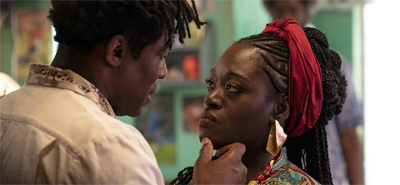
Storytime.
It is another subtle reminder of how the dynamic of the show has shifted through the simple act of casting the lead role. The Doctor has traditionally been seen as a bohemian wandering aristocrat, but sudden he becomes a disposable drifter who nobody will miss because he doesn’t have a home or a family. The Story and the Engine does not dwell on the point for too long, but it is a very deliberate choice. It is a far cry from “walk around like you own the place.”
It is a very powerful central idea, and it something that a show like Doctor Who would struggle to explore without the context of the Fifteenth Doctor as a Black man visiting a barbershop in Nigeria. This is not a framing of the story that could work as eloquently with the Fourteenth, the Thirteenth or the Twelfth Doctor. It is an illustration of how these stories can be enriched and deepened simply by expanding who gets to tell them and who they get to be told about.
However, The Story and the Engine is unashamedly and enthusiastically a Doctor Who story. Ellams clearly has a great deal of affection for the series and for its central premises. As a story about stories, The Story and the Engine understands that the power of these sorts of tales is that they resonate on multiple levels and from multiple perspectives simultaneously. The Story and the Engine can be a tale about artificial intelligence at the same time as being a narrative about colonial exploitation of indigenous narratives at the same time as being a story about Doctor Who.
In some ways, The Story and the Engine is about the power of a framework like Doctor Who to use its storytelling to “expand and make connections between ideas” in a way that is “cross-connecting concepts, cultures and ideas.” It is not just about one thing, it is about many things. Sometimes those things are at odds with one another – as in Lucky Day – and sometimes they cohere and push in a single unified direction – as in The Story and the Engine.
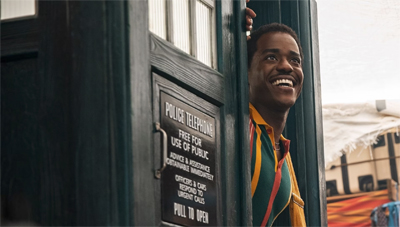
The land of fictions.
The Story and the Engine is a narrative about the power of Doctor Who as a storytelling engine. Omu describes the Doctor as “the greatest story I know” and the Barber boasts that “his stories alone can superpower the engine.” The climax of the episode finds the Doctor pouring himself into he engine. “You told a never-ending story?” the Barber asks. “And gave me never-ending power?”
There is a sense that Doctor Who can run forever. That it is a story without an ending, that can change form and shift identity. This fits with the recurring thematic concern within the second Davies era concerning the point and the effectiveness of Doctor Who. It also feels somewhat charged given the ongoing discourse around the long-term viability of Doctor Who, which this week boiled over again when Davies refused to confirm whether the show would have a Christmas special.
As such, this emphasis within The Story and the Engine feels somewhat justified. While this season was written two years before all this discourse, there is something self-aware in Davies’ willingness to play with the question of the show’s longevity. After all, Lux closed with Misses Flood boasting that the series had “a limited run only.” To a certain extent, it feels a little bit like this run of episodes is designed to head into a cancellation crisis. Given how self-aware the show has been, and the ambiguity over the show’s future, the Doctor’s greatest threat this season may be the possibility of being cancelled.
The Story and the Engine is a wonderful, clever, playful piece of work. It is a reminder of what Doctor Who is capable of, and the raw potential that comes from embracing outside perspectives.
Filed under: Television | Tagged: barber, barbership, doctor who, fugitive doctor, Inua Ellamsrussell t. davies, jo martin, ncuti gatwa, the barber |



 the m0vie blog
This was a wonderfully written review with much nuance and perceptive insight. It’s truly fantastic to see such a well developed opinion of the new doctor who series when there are so many polarizing opinions about it. I read a few other of your reviews after this and must say you write like a professional, you’ve earnt yourself a fan.