












One of the great things about long-running pop art, whether television shows, film franchises or comic books, is the sense in which they can serve as a reflection of shifting cultural concerns.
The Marvel Universe spans more than six decades of continuity. It is perhaps too much to call it a single story, even if comic book continuity is held together by that fiction. It is the work of countless writers and artists, working under different editorial regimes with different creative and commercial constraints. The visual language of the medium has shifted over decades, along with its target audience, not to mention its relationship with the mainstream culture.
Still, while monthly superhero comics are rarely considered high or important art, they are an interesting window into their particular cultural moment. These characters and archetypes are constantly changing and evolving, being reworked and recontextualised to fit the perpetual present. Rereading old comic books can feel like stepping inside a time machine, taking the reader back to not just a particular moment in comics continuity, but a funhouse mirror of the larger culture.

Brian Michael Bendis stewarded the Avengers titles for eight years, from 2004 to 2012. He managed the brand across multiple titles starting with Avengers Disassembled into New Avengers and Mighty Avengers, and through a host of epic status quo-altering events. Some of those events, like House of M, Secret Invasion and Siege, Bendis wrote himself. Other events, like Civil War, he simply tied into from the sidelines.
Still, that initial run of comics from Avengers Disassembled to Siege remains hugely important. Bendis restructured the Marvel Universe to place the Avengers franchise at its core, displacing the X-Men as the company’s flagship brand. Coinciding with the launch of Marvel Studios, that run is an obvious and ongoing touchstone for the Marvel Cinematic Universe, which has directly adapted segments of this run into films like Captain America: Civil War and shows like Secret Invasion.
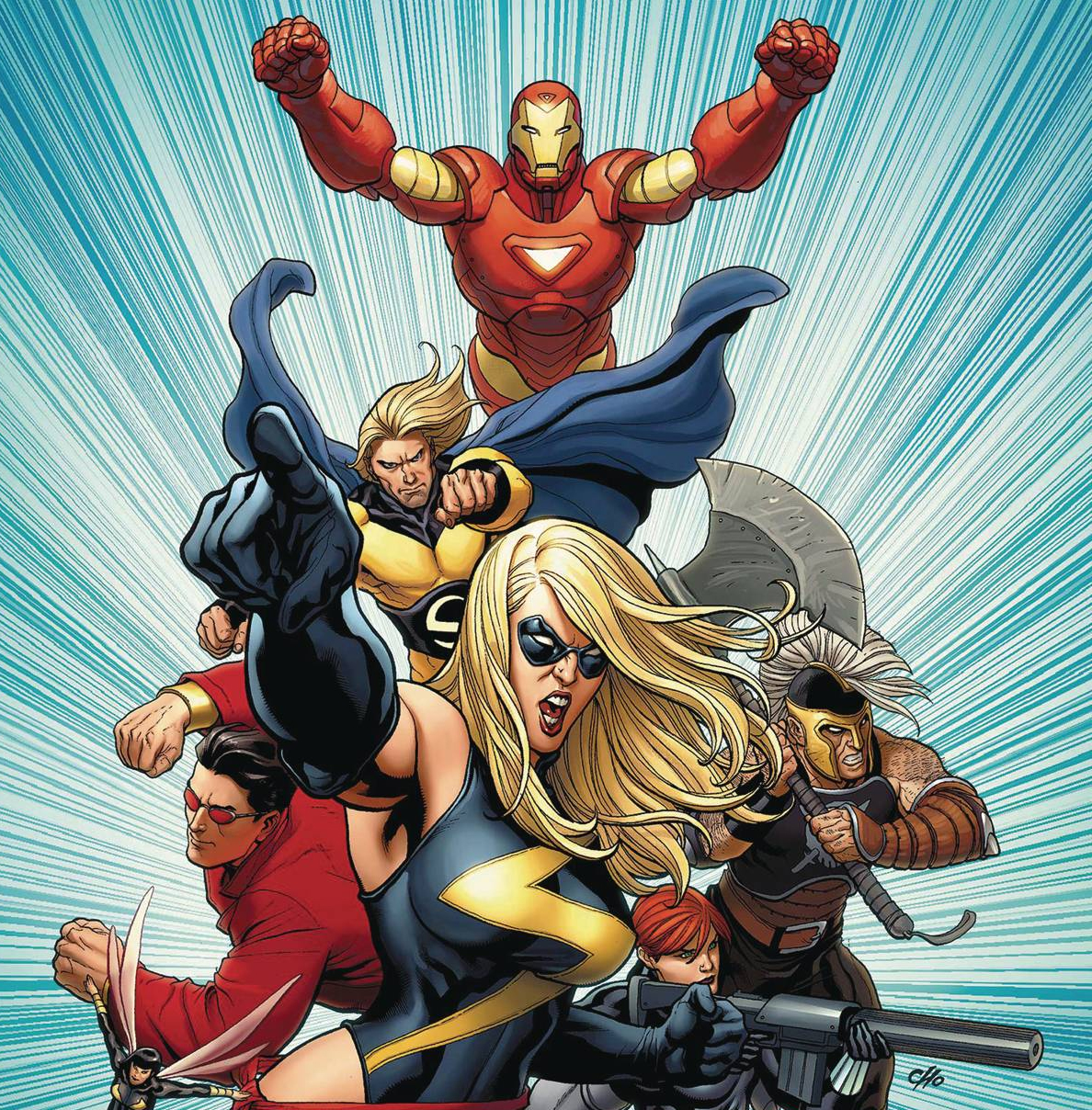
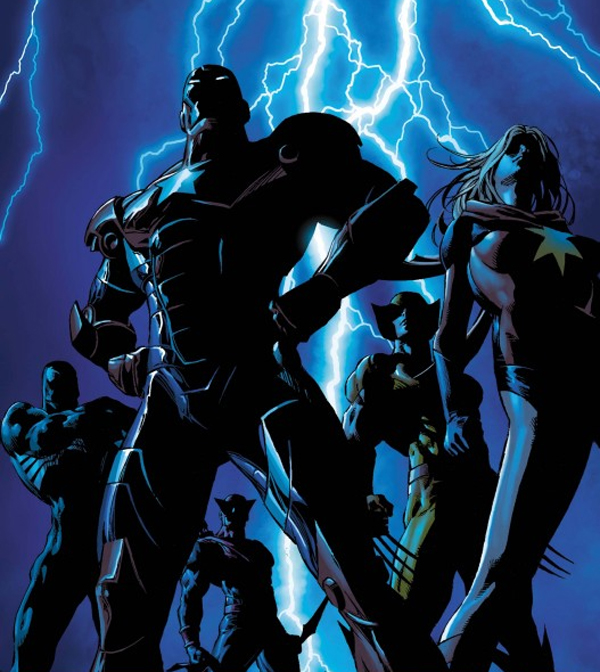
Even as the big crossover events like Avengers: Infinity War or Avengers: Secret Wars draw more heavily from the work of Bendis’ successor on the Avengers titles, Jonathan Hickman, Bendis’ Avengers remains a key influence. Thunderbolts*, for example, feels heavily indebted conceptually to Bendis’ Dark Avengers and even leans heavily on the character of Sentry, a continuity curiosity who became central to Bendis’ larger arcs.
However, even outside of its obvious cultural footprint, the remains one of the definitive explorations of the War on Terror in popular American culture, elevating the emotional and symbolic response to the 9/11 terrorist attacks into a sort of pop mythology, playing out the country’s psychodrama in costumes and capes. Bendis’ Avengers run is messy and uneven, occasionally downright clumsy in its execution. It is also a snapshot of a moment.
Bendis emerged from the independent comic book scene, and a lot of his early work at Marvel reflects that sensibility, operating in a very different context from the publisher’s more meat-and-potato superhero offerings. Bendis’ work with Alex Maleev on Daredevil and Michael Gaydos on Alias felt very different from the big blockbuster comics of the era. Even Bendis’ reimagining of Peter Parker on Ultimate Spider-Man with Mark Bagley felt very “hip” in a way comics of the era weren’t.
Bendis was an odd choice to write The Avengers. By Bendis’ account, he almost ended up writing the book by accident after getting drawn into a discussion about the title with Mark Millar at a company retreat. “By the end of the conversation, I was shocked to find myself as the writer of The Avengers, which I was not pitching for,” he acknowledged. “I had my gigs; I was thrilled I had them. Team books were still a frustration for me—like, I hadn’t nailed them.”
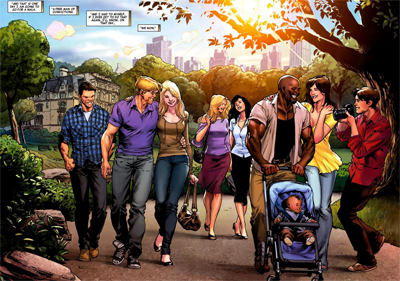
It was reportedly Mark Millar who came up with the idea of stacking the Avengers roster with A-listers, citing DC’s use of major characters in Justice League of America. According to to Tom Breevort, Millar argued that “if you had all the headliners in one book and all the biggest guys that’d be the best book ever.” Bendis has acknowledged that the decision to put hugely popular characters like Wolverine and Spider-Man on the Avengers roster was controversial to Marvel editorial.
Although this has never been officially confirmed, it seems obvious to anybody looking in from the outside that this realignment of the Marvel brand made good business sense. For decades, Spider-Man and X-Men had been Marvel’s two biggest brands, to the point that they were also the company’s two best-selling comic books ever. However, the publisher had had to license those brands to film studios to stave off debt; Spider-Man went to Sony, X-Men to Fox.
Coinciding with Bendis’ arrival on the Avengers brand, Marvel hired producer David Maisel to manage Marvel Studios in 2003, with an eye to developing their own in-house blockbusters from the properties they hadn’t sold off to other studios. Marvel rebranded itself as Marvel Entertainment in September 2005, and took out a $525m loan from Merrill Lynch in the hopes of breaking into filmmaking. This was the backdrop against which Bendis was reinventing the Avengers.
While Stan Lee and Jack Kirby launched The Avengers with an all-star line-up, for decades the book had served as a sort of clearing house of comic book continuity. The comic became a home for characters who struggled to hold down their own ongoing series, like Clint Barton or Hawkeye. The line-up often featured superheroes that remain obscure even in this era of superhero blockbuster dominance, like Tigra or Jack of Hearts or (allowing for Eternals) Black Knight.

To get a sense of how little the Avengers brand actually meant outside of comic book circles, Sony Pictures declined to by the rights to the company’s back catalogue for $25m in 1998. According to Sony executive Yair Landau, the studio responded to that offer by bluntly stating, “Nobody gives a shit about any of the other Marvel characters. Go back and do a deal for only Spider-Man.” To launch a film studio, Marvel needed to make audiences give a shit about these characters.
Structurally, Bendis’ run on Avengers is interesting. When discussing Bendis’ form, there is a tendency to focus on the writer’s distinctive dialogue, which is heavily influenced by the work of playwright and director David Mamet. Paired with his heavy use of that Mamet-esque dialogue, Bendis is often criticised for his “decompressed” pacing, his tendency to stretch out stories over five or six issues and construct narratives that unwind over the course of years.
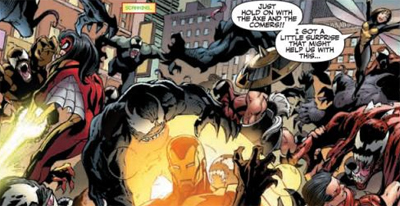
At the same time, when reading Bendis’ gigantic sprawling Avengers epic, spread over eight years and across multiple books, there is something interesting that emerges. As much as Bendis is often framed as a “street level” writer, as demonstrated by his fondness for characters like Spider-Man, Daredevil, Luke Cage and Jessica Jones, it is clear that the writer is doing something just a little bit grander across these hundreds of issues.
This transition in scale is deliberate. New Avengers doesn’t open with Captain America or Iron Man, it opens with three “street level” heroes tied to Bendis’ earlier work: Matt Murdock, Luke Cage, and Jessica Drew, who was originally meant to be the star of Alias. That opening arc is structured in such a way as to begin with these “street level” heroes in New York City and then expand its scope to become a globe-trotting adventure starring some of comics’ biggest hitters.
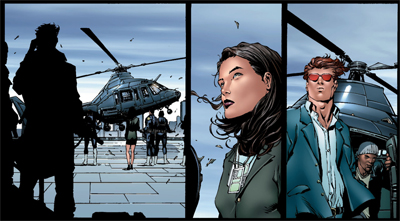
Bendis’ Avengers saga is full of repeated and recycled beats. There is an emphasis on recurrence and repetition within the work, often in a manner that feels quite deliberate. Throughout Bendis’ run, there is a recurring emphasis on international intervention in the sovereign nation state of Latveria, often controlled by the supervillain Victor Von Doom. Bendis doesn’t just return time and again to Latveria, he returns at very specific points.
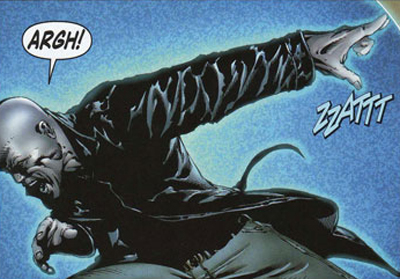
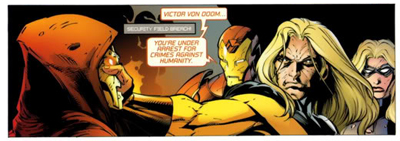
The miniseries Secret Wars, which serves as a prologue to New Avengers, finds Nick Fury sending a line-up very similar to the New Avengers line-up into Latveria, with disastrous consequences. The second arc of The Mighty Avengers finds Iron Man leading the Mighty Avengers to Latveria in response to a terrorist attack on New York City. Then the first arc of Dark Avengers has Norman Osborn help to reinstall Victor Von Doom as the leader of Latveria.
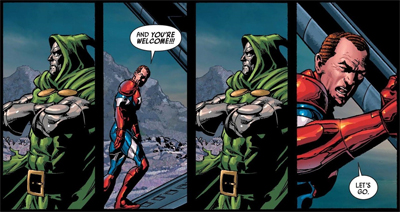
Allowing for Secret Wars as a set-up book for New Avengers, each of the three distinct chapters of Bendis’ Avengers saga open with American superheroes meddling in the internal politics of a very specific foreign power. Indeed, this foreign intervention becomes a recurring trope of itself. The first arc of New Avengers hinges on a secret S.H.I.E.L.D. operation in the Savage Land. A few stories later, the team leads an intervention into Japan to confront the Hand.
Similarly, these teams often find themselves facing opponents with the ability to rewrite reality itself. Early on, House of M finds the New Avengers team thrown into an alternate reality created by Wanda Maximoff. The second arc of Dark Avengers finds Norman Osborn and his subordinates dealing with Molecule Man’s ability to alter their perceived reality. In this context, it feels appropriate that Sentry is a central figure to Bendis’ larger run, a living continuity snarl who alters reality around himself.
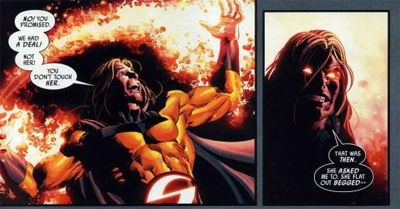
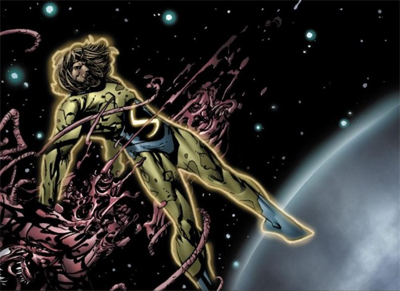
Bendis’ Avengers was occasionally even playful about this repetition. Sentry had a habit of being involved in visceral midair explosions, tearing Carnage apart in New Avengers and Ares to pieces in Siege, while being exploded himself by Molecule Man in Dark Avengers. Sentry repeated threatens to throw characters into the sun – and other characters threaten to have Sentry throw things into the sun – prompting the character to opine at one point that he doesn’t “throw everything in the sun.”
Images and ideas recur throughout the run, less directly tied to one another. Avengers Disassembled begins with the destruction of the Avengers Mansion by the superhero Wanda Maximoff. Siege closes out the chapter with the destruction of Asgard by the superhero Sentry. Civil War begins with a horrific disaster involving a team of untrained superheroes steering public opinion. Siege opens with a similar disaster caused by an Asgardian used to galvanise public sentiment.
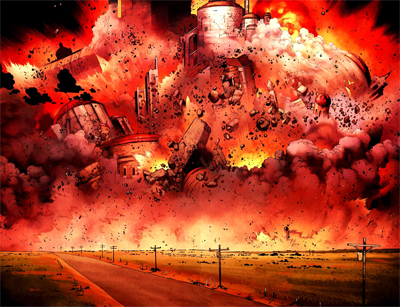
At various points in the run, different characters adopt the superhero codename “Ronin”, first Maya Lopez and then Clint Barton. Events in different books are designed to mirror one another. Norman Osborn gives a public interview in Dark Avengers, directly appealing to the American people, which prompts Clint Barton to make a similar televised response to Osborn in New Avengers. There is a clear rhythm to Bendis’ plotting of these books.
The characters in Bendis’ Avengers often seem aware of the mythological importance of what they are doing. Tony and Osborn both select team members based largely upon pre-existing archetypes, arguing that an Avengers team needs a certain set of archetypes. Tony argues that Ares, for example, can occupy the space on the roster that might otherwise go to Thor or Wolverine. Osborn takes that idea even further, straight up rebranding his own versions of Wolverine, Hawkeye and Ms. Marvel.
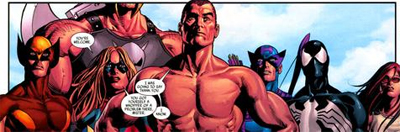
This emphasis on repetition is in some ways an extrapolation of Bendis’ approach to dialogue, having characters hit the same beats over and over again as a way of making a point about how these characters perceive – and interact with – the larger world. However, it also lends Bendis’ Avengers a larger mythological framework. Repetition is a key part of epic storytelling, in that “it creates a sense of rhythm, increases listener attention and highlights an author’s emphasis.”
Indeed, superhero comics and stories are – by their nature – repetitive. These stories are stuck in perpetual second acts, denied meaningful resolution. Over decades of continuity, it was inevitable that certain beats and cycles would repeat, again and again. Characters rarely remain dead. The status quo rarely meaningfully changes. Heroes inevitably end up fighting the same villains over and over again.
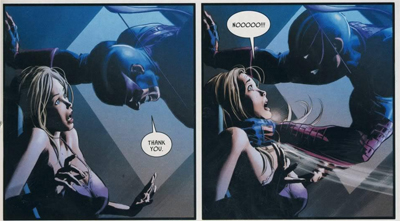
Bendis just concentrates that repetition within his own larger epic. These beats and images are not repeating across decades of continuity. They are repeating within a concentrated eight-year space, across multiple books, often by the same author and largely involving the same characters. There is a sense in which Bendis is clearly positioning his Avengers run as something more abstract and grander than the “street level” books on which he established his credentials.
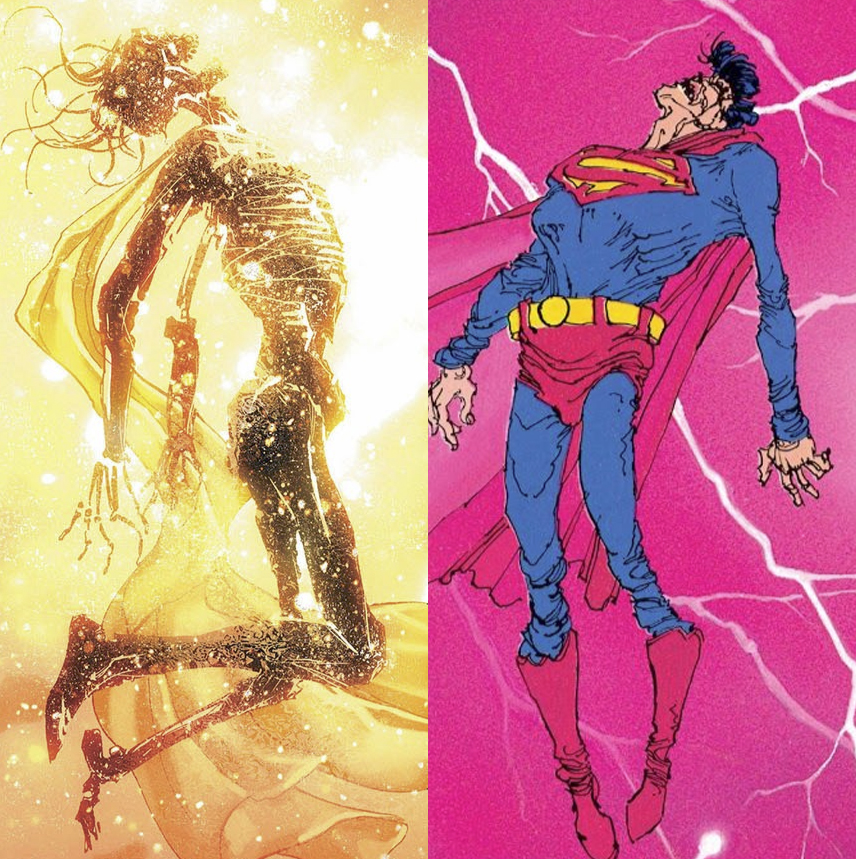
Even the emphasis on Sentry – a very obvious stand-in for Superman, the codifier for the modern superhero archetype – suggests that Bendis’ Avengers is engaged in an existential exploration of the larger superhero genre. With artist Mike Deodato, Bendis even draws from The Dark Knight Returns in how he frames Sentry at the climax of Dark Avengers. Sentry is a recurring threat across these titles, and the implicit subtext is that Superman is a threat to the Marvel Universe.
Under Bendis, the Avengers becomes a meditation on American identity in the immediate aftermath of 9/11 and the War in Iraq. This is not a surprise. Comic books have often engaged with contemporary American issues. Captain America famously explored the impact of Watergate on the American psyche through the lens of Steve Englehart and Sal Buscema’s Secret Empire. Denny O’Neil and Neal Adams’ Green Arrow/Green Lantern shone a light on 1970s America.
Breevort acknowledges that so much of this era was defined by the reaction to 9/11 and that “comics were among the first entertainment media (due to our speed of production) to be able to effectively and emotionally deal with the aftermath of those attacks and the psychic scars that everybody was feeling.” Bendis’ Avengers is not literally about 9/11, but it is emotionally and thematically a response to what that tragedy did to American self-image.
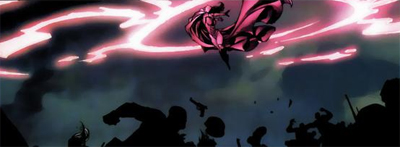
Bendis would even occasionally acknowledge as much in interviews. He openly conceded that Norman Osborn’s attack upon Asgard was informed by the American invasion of Iraq. “That’s what many people feel what happened with the Iraq situation,” Bendis explained. “They wanted to go out there and looked for any reason to go. They were looking for something – anything – and that’s what Norman did – the superhero version of that.”
Superheroes have long been an expression of American self-image. Captain America literally cloaks himself in the American flag, while Superman fights for “truth, justice and the American Way.” While there have been various clumsy attempts to disconnect superheroes from their American origins to better integrate into the current globalised marketplace, the superhero is as American an archetype as the cowboy or the gangster.
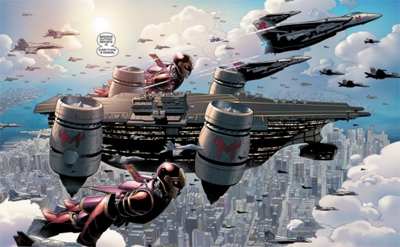
American self-image was undeniable affected by the World Trade Centre attacks, which represented an end of what Charles Krauthammer had called “the unipolar moment” and what Francis Fukuyama described as “the end of history.” It is hard to articulate how much of a shock the terrorist attacks presented to Americans. For many Americans who had not been paying attention to the country’s foreign policy, questions like “why do they hate us?” captured the surprise of the attacks.
Throughout Bendis’ Avengers, the heroes are constantly on the back-foot, reacting to horrific atrocities for which they were completely unprepared. Bendis even retcons this reactionary attitude into early Marvel history. The Illuminati reveals that Tony Stark was motivated by the Kree-Skrull War to create an elite group of superheroes who could operate in secret to protect the planet from other potential threats.
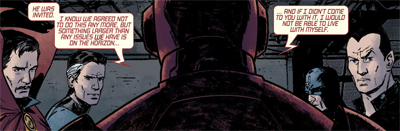
“I wonder – if we has a more unified structure amongst ourselves – I wonder if they would have thought twice about attacking this planet like they did,” Tony explains to the assembled heroes. “To the rest of the universe, we’re the law enforcement of this planet. I’m saying – maybe we should gather together and do just that.” It is a none-too-subtle metaphor for the expansion of the surveillance state and the defense infrastructure in the wakes of the attacks: “Never again.”
Stark, a weapon’s manufacturer, constantly appeals to others’ sense of guilt or responsibility to justify the expansion of the team, both in terms of membership and remit. One early argument between Steve Rogers and Tony Stark concerns welcoming Wolverine on to the team, with Steve objecting to the inclusion of a stone-cold killer into the group. Wolverine represents a sort of moral compromise for Steve, a threat to the moral purity of the team as a whole.
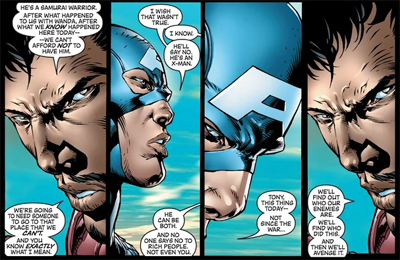
“Tony, he’s a murderer,” Steve objects. Tony counters, “We can’t afford not to have him. We’re going to need someone to go to that place we can’t.” Then Steve acknowledges that the opening arc of New Avengers is framed as a war story. He admits, “Tony, this thing today… not since the War…” Tony explicitly positions the team’s mandate as one of retribution and retaliation. “We’ll find out who are enemies are. We’ll find out who did this. And then we’ll avenge it.”
Tony repeatedly argues that the team needs to evolve and adapt to meet the new threats in the new world. He admits to Wolverine that a large part of this thinking is informed by the destruction of Avengers’ Mansion at the hands of Wanda Maximoff. “I just can’t help but think that… if we were a different type of team then… a little more realistic in the ways of the world, a little less naïve… things could have gone a different way,” he contends.
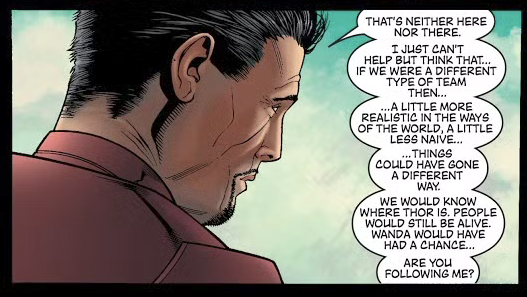
This rhetoric will be familiar to anybody who had been paying attention to American politics during the War on Terror. Similar justifications were employed to excuse “enhanced interrogation” or “extraordinary rendition.” New Avengers positions this reforming and reformatting of the team as a metaphor for the “loss of American innocence or impregnability” in response to the terrorist attacks. It recalls George Bush’s vow to take down bin Laden “dead or alive”, evoking another pulp archetype.
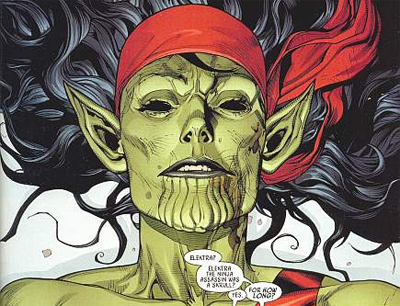
The heroes of Bendis’ Avengers seems to find themselves caught in an existential quagmire. There is a recurring ambiguity over whether these are heroes or soldiers. Elektra describes Maya Lopez as “a great warrior with no focus or purpose.” Jessica Drew is a former superhero who lost her powers and become a S.H.I.E.L.D. operative, before becoming a double-agent for the terrorist organization HYDRA, and who is eventually revealed to be the shape-shifting Skrull Queen.
The destruction of Avengers Mansion is indicative of a larger restructuring of the world in which these characters operate. Throughout Bendis’ run, veteran Avenger Clint Barton struggles to adapt to the new reality. As Spider-man warns him, “You’re so used to your old Avengers Mansion and your butler and Tony Stark paying for your spa days that now you have to live like the rest of us… now that you have to feel what it’s like to be, you know, me every single day… you’re cracking up.”
While there have always been comic book stories with “war” in the title – The Kree-Skrull War, Secret Wars, Armour Wars, and so on – it does feel notable that many of the events that occurred during Bendis’ stewardship of the Avengers franchise were framed as “wars”: Secret War, Civil War, World War Hulk. Even those events that didn’t include the word “war” were quick explicitly militaristic, like Secret Invasion and Siege. The villains of this run aren’t monologuing supervillains, but enemy armies. In the lead up to Secret Invasion, Wolverine notes that the Skrulls have “a wartime plan. An invasion plan.”
While “hero versus hero” has long been a staple of superhero comic book storytelling, it is notable that so many of the big conflicts within Bendis’ tenure find the superhero community fighting among itself rather than fighting an external adversary. Wanda Maximoff is the villain of Avengers Disassembled. House of M finds the team escaping a world created by Wanda and her brother Pietro. Civil War turns Steve against Tony. World War Hulk pits the planet’s heroes against the Hulk.
Before Civil War, there is a clear and recurring tension between the New Avengers and the bureaucratic organization known as S.H.I.E.L.D., overseen by Maria Hill following Nick Fury’s fall from grace. Hill believes that the superheroes should exist under her jurisdiction, while they insist on operating autonomously. This throws the two organizations into conflict with one another, fueled by Skrull infiltration of S.H.I.E.L.D.
The entire plot of Secret Invasion hinges on the idea of the Skrulls turning the heroes against each other – often by adopting the identity of heroes. In the aftermath of Civil War and Secret Invasion, Bendis would devote entire arcs to conflicts between rival branded teams of Avengers: Steve’s team against Tony’s, the New Avengers fighting the Dark Avengers. In this sense, Bendis is exploring the idea of the superhero community as a metaphor for American global hegemony.
America emerged from the end of the Cold War as the single remaining global superpower, imposing its will on the world as “a global policeman.” With the collapse of the Soviet Union, there was no equivalent power bloc. Even during the War on Terror, the militaries of countries like Afghanistan and Iraq offered no real challenge to American military might. Bendis imagines a version of the Marvel Universe that adheres to that logic. In this context, the greatest threat to these heroes is each other.
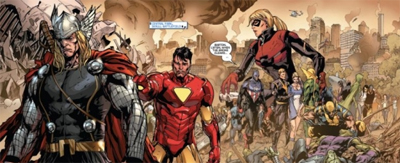
Following the events of Civil War, Tony Stark imposes a more militaristic structure on the superhero community. Stark operates as both head of The Mighty Avengers and director of S.H.I.E.L.D. He appoints Carol Danvers, a veteran of the U.S. Air Force, as field leader for the team. “This is a military operation, Carol,” Tony tells her at one point. Later, the superhero Janet van Dyne considers “matching uniforms” for the group, suggesting that they should be seen as a tactical unit.
However, one of the interesting recurring motifs of Bendis’ Avengers is the sense that this is a war without either a clearly defined opponent or an obvious win condition. The enemy is often other superheroes, with Steve and Tony coming to blows in Civil War. It is also occasionally a war against one’s self, with the Sentry and the Void being the same person. As Wolverine explains in Secret Invasion, the characters are “fighting a war when we can’t trust the soldier next to us.”
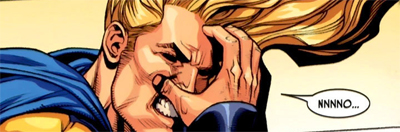
This captures the existential ambiguity of the War on Terror. This was not the Second World War, the Vietnam War or the Gulf War. It was not a war against a single clearly defined enemy. Instead, it was a state of perpetual and unending war, in which the norms of civilised society seemed to be up for debate, but the nature and the theatre of combat were hazily defined at best. There is a perpetual fog of war, but the actual material objectives seem undefined.
Indeed, there were moments when Bendis seemed to get swept in the occasionally xenophobic jingoism that informed so much of the War on Terror. The crossover event Secret Invasion feels particularly reactionary, telling a story about how Earth’s superhuman community has been infiltrated by the classic shapeshifters. It is a none-too-subtle metaphor for the paranoid right-wing fear that outside infiltrators are subverting America from within.
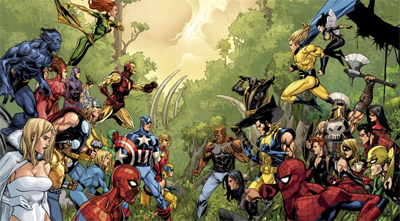
Bendis openly acknowledged as much, explaining to Entertainment Weekly, “The subtext of this story is not knowing if you can trust your friends or family. Years after 9/11, we go on a plane and start scanning the crowd… we can’t help it.” The problem is that the story itself winds up feeling knee-jerk reactionary and Islamophobic, with its villains “secretly religious extremists that are fully willing to suicide-bomb themselves as they utter a phrase of devotion to their God.”
Secret Invasion is such a big part of Bendis’ run, threaded from the very beginning of New Avengers, that it taints a lot of the more interesting social commentary. The opening arcs of New Avengers return repeatedly to the question of S.H.I.E.L.D.’s authority, with Drew repeatedly insisting that the organization is “a peace-keeping task force” even as it engages in clandestine operations to exploit the natural resources of the Savage Land.
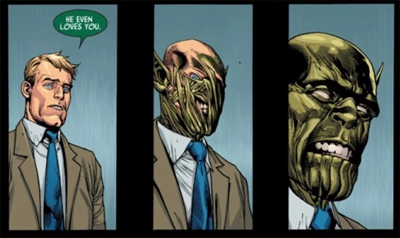
Indeed, the narrative engine that drives New Avengers is the discovery that S.H.I.E.L.D. has been detaining individuals illegally, recalling the legal and moral debates over Guantanamo Bay. “Why was I put in American custody without trial?” Keniuchio Harada demands of the heroes at one point. “A month ago, I went to sleep in my private plane and woke up in a dark cell in that Raft prison.” This challenge to the moral authority of the heroes idea is undercut by the reveal that it’s all a Skrull plot.
Still, there is a sense in Bendis’ run that this erosion in the heroes’ moral authority is largely their own fault – that this existential crisis eating away at their moral certainty and their political capital is a result of choices that they have made. There is a strong repeated idea that this much power should not be concentrated in these few individuals, which feels like a pointed meditation on American global power at a time when the country was restructuring the international order.
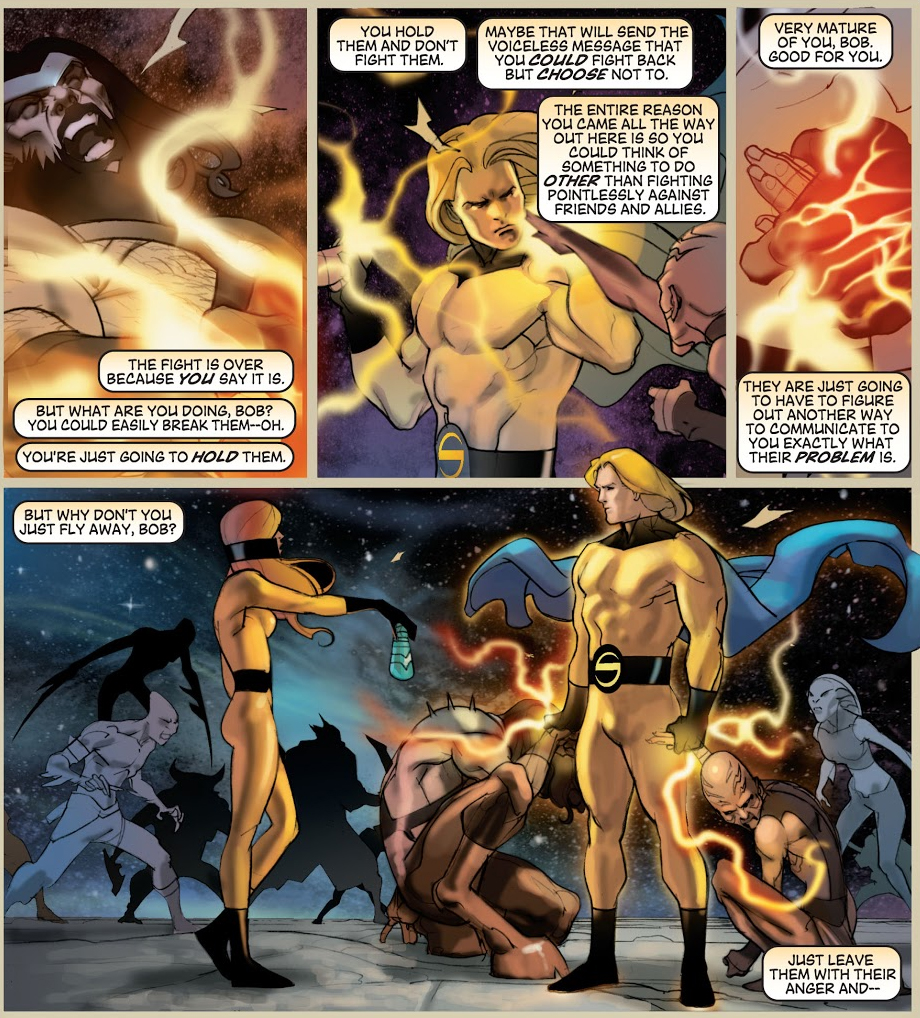
During Civil War, Sentry retreats to join the Inhumans on the moon. “You tell them of how the building paranoia from Nick Fury’s Secret War led to the unspeakable damage to the mutant population because of Wanda Maximoff’s tantrum that caused the House of M,” the narration explains. “And how that brought on even more fear and even more paranoia… forcing the American government to pacify the populace by passing the Superhero Registration Act.” It is presented as a linear chain of cause and effect.
At one point in the Illuminati miniseries, the Watcher praises Reed Richards for surrendering the Infinity Gauntlet. “Man was not meant to wield this kind of power,” the Watcher advises. “It’s beyond your understanding. You will destroy everything.” The superhero story is a power fantasy, but Bendis’ Avengers run suggest that unchecked power will only lead to terrible outcomes for both the larger population and for the people who are wielding that power.

Throughout Bendis’ tenure, the use of this power takes an existential toll on those who would wield it. It shreds and tears at the fabric of reality itself. It all adds up, and it all comes at a price. “Man, look around you… This is the end of days,” the demonic Daimon Hellstrom warns the team. “All that madness you guys are involved in every single second of every single day. It weakens the barriers between this dimension and the ones that would keep an a-hole like Dormammu away from us.”
Stephen Strange loses the mantle of Sorcerer Supreme because of his moral compromises. “And with the modern world changing so quickly so often, it may have been inevitable that Stephen would be forced to make choices that he would not be able to live with for long,” the Ancient One explains. “Choices that at the time saved lives and helped friendships. But choices that nonetheless had powerful repercussions on himself and his mastery.”
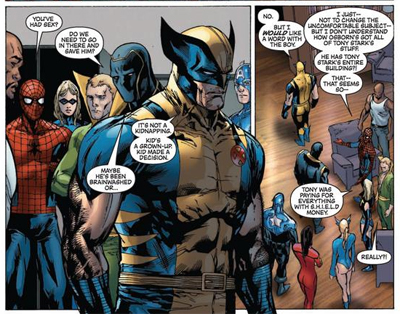
Throughout Bendis’ Avengers run, there is a strong recurring emphasis on the idea of sanity as something that is incompatible with such power. In a world without checks and balances to properly regulate power – where the established order can be upended by a single actor – madness becomes inevitable. Wanda goes insane with power. Sentry completely loses his grip on power. Even Norman Osborn slips into madness as he solidifies his control over the superhero community.
In this sense, the superhero becomes an expression of both the American superego and the id. This is rendered literal with Sentry, who manifests as the world-eating monster known as the Void. “When I use my powers of a million exploding suns – I unleash a blackness across the world,” he admits. Central to Bendis’ run is the idea that the superhero is both compelling and terrifying. The superhero is an expression of both an American ideal and an American nightmare.

Of course, Sentry’s “powers of a million exploding suns” evokes the atomic bomb, the cornerstone of American political dominance in the postwar era and its own deeply morally complicated object. It’s hard not to read the “blackness across the world” as either the silhouette of the mushroom cloud or nuclear winter. The superhero was itself largely shaped by the atomic age, as demonstrated by arms merchants like Tony Stark or radiation scientists like Bruce Banner.
There is an interesting ambivalence in Bendis’ Avengers to the very idea of the superhero, suggesting that such an American mythology will inevitably be drawn into cycles of escalation. This is where Bendis’ repetition feels pointed. Tony Stark’s stewardship of S.H.I.E.L.D. and the Avengers brand is morally complicated in the wake of Civil War, but it inevitable gives way to the truly monstrous and nightmarish Norman Osborn tenure over H.A.M.M.E.R. and his own Avengers.
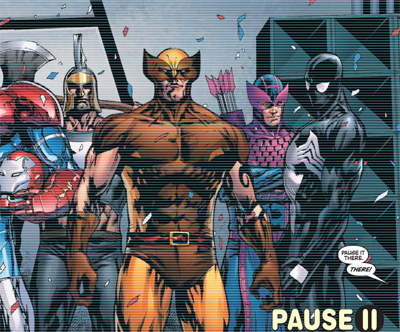
However, even these transitions are not cleanly delineated. The original New Avengers roster splits between Tony and Steve during Civil War. When Norman Osborn takes over after the events of Secret Invasion, he is able to convince Ares and Sentry to carry over from The Mighty Avengers to Dark Avengers. These are not separate institutions or organisations. They are simply escalations and evolutions, often following a clear and linear path.
Bendis’ Avengers has aged remarkably well in its understanding of the response to the horrors of the attack on the World Trade Centre as a sort of spiraling collective insanity. Perhaps inspired by Frank Miller’s work on The Dark Knight Returns, it is interesting how much of Bendis’ Avengers is framed by the media, with various characters reading statements, doing interviews and even appearing on late night talk shows to set the narrative of events.
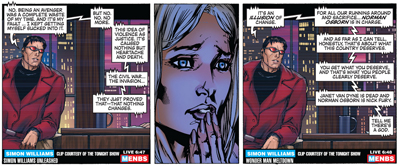
Clint is shocked at how the media makes itself complicit in Norman Osborn’s takeover of homeland security. “I thought the media would go after him,” he gasps, naïvely. “But they didn’t…” Simon Williams uses his guest appearance on a late night chat show to implicate the audience. “As far as I can tell, honestly, that’s about what this country deserves. You get what you deserve, and that’s what you people clearly deserve.” There is an awareness of the media’s building of consent and reality.
More broadly, the comics’ recurring emphasis on characters who manufacture and construct their own realities – and the inevitable chaos that results when those realities collide with the outside world – resonates even more in the “post-truth era” of “alternative facts.” Revisiting Bendis’ Avengers more than a decade removed from its original publication, there is a fascinating understanding that giving individuals that much unchecked power must bend reality itself.
In this context, it’s worth acknowledging the nostalgia of Tony Stark’s Mighty Avengers, the team that he builds in the wake of Civil War as a direct contrast to Steve Rogers’ New Avengers. The Mighty Avengers is an overtly nostalgic comic, in contrast to the novelty of the roster and themes of New Avengers. Bendis stacks The Mighty Avengers with familiar heroes like Wonder Man, the Wasp and Ms. Marvel, while pitting them against classic foes like Ultron and Doctor Doom.
Even the visual language of The Mighty Avengers is designed to be retrograde, with characters using thought balloons. At one point, the team is literally thrown back in time, with the comic drawn and lettered as if it were published sometime between October 1974 and January 1975. This use of nostalgia is interesting, particularly with Stark trying to assert control of the Avengers brand. It is not simply that reality is unravelling, that unravelling is tied to the conjuring of some lost imagined past.

This is not a new argument. Much as been written about how Norman Osborn’s arc seemed to eerily predict the rise of Donald Trump, another failed New York businessman (and possible malignant narcissist) who manages to manipulate public opinion to rise to the top of the social order. Douglas Wolk contended that Osborn’s arc was “unnervingly prescient” in its depiction of “what a totalitarian monster rising to power in the US might look like.”
Bendis deserves credit for this, but it is worth acknowledging that his Avengers was largely an extrapolation of contemporary American politics, an elevate a crisis in American self-image to the status of a grand and epic saga. Osborn was clearly a commentary on neoconservatives, like Bush, Cheney or Rumsfeld, just more obviously and cartoonishly evil. This prescience is arguably just a reflection of how heightened and absurd reality has become over the past decade.

This emphasis on the superhero as an avatar for the complicated and eroding American self-image during the War on Terror is perhaps Bendis’ largest influence on the cinematic superhero genre. Whether intentionally or not, Bendis’ reconfiguration of the shared universe served as a model for the theatrical franchises that would follow, and those movies are just as haunted by the ghosts and the legacy of the War on Terror as Bendis’ comics, replaying fantasy versions of 9/11 over and over.
Still, Bendis’ Avengers is a much more nuanced and complicated interrogation of that strange – and perhaps ongoing – moment in American popular consciousness. The movies were rarely willing to get as introspective and reflective as Bendis’ Avengers, less willing to interrogate the very idea of these superheroes, particularly in the aftermath of Avengers: Age of Ultron. Bendis’ Avengers epic is a messy, sprawling, uneven work. However, it’s also a snapshot of a moment.
Filed under: Comics | Tagged: 9/11, avengers, brian michael bendis, Civil War, Comics, dark avengers, george w. bush, marvel, marvel comics, norman osborn, secret invasion, Siege, superheroes, tony stark, war on terror |



 the m0vie blog
Nice to get some further thoughts on comic book runs again Darren.
Are you going to be doing some more columns on comic book runs in the future?
I’d be interested to hear your thoughts on Grant Morrison’s Multiversity or the Batman 89 miniseries DC have been publishing. As well as Jonathan Hickman’s new Ultimate Spider-Man storyline.
yes
It’s interesting that I’ve found your article just as I’ve been considering diving into Bendis’s Avengers work when I had previously avoided it, mainly due to the continuity errors and character assassination (towards Wanda and Wonder Man) that I’ve read about. I’ve also gotten interested in multi-year, and even decade-long, runs on titles by certain writers (i.e. Johns on Green Lantern) that seem “epic” and Bendis’s Avengers run does seem epic! I believed in the 2010s that putting him on every possible Marvel title was a mistake (i.e. on GOTG, Iron Man, etc) and while I still feel that way, I want to give his Avengers stuff a chance.