












“There’s no such thing as monsters. Just creatures you haven’t met yet.”
Space Babies is an interesting season premiere, in large part because it feels like a test case for Russell T. Davies’ return to Doctor Who.
Of course, the three sixtieth anniversary specials were in effect a miniature season. The Star Beast was structured like a classic Davies premiere and The Giggle delivered a lot of the spectacle that one might expect from a Davies era finale. Still, Space Babies represents the start of Davies’ first full season as returning showrunner. It is also the first episode to premiere on Disney+. As such, it is a mission statement. Space Babies is an interesting demonstration of how Davies has changed and how he remains consistent.
Space Babies is recognisable as a Davies era premiere, evoking stories like Rose, New Earth, Smith and Jones and Partners in Crime. It is a decidedly low-stakes adventure featuring a couple of appealingly goofy elements and a fairly generic plot, which allows Davies to foreground character and theme while also outlining his vision of the show in a way that is designed to be welcoming to new viewers. It’s a solid example of what Doctor Who is, particularly under Davies. Davies has been away from Doctor Who for nearly fifteen years, but some things remain consistent.
At the same time, it’s also very obviously written with the understanding that Davies is pitching the show to a slightly different audience than he used to. This changes are subtle, but they are instructive. While the plot and rhythms of Space Babies suggest that Davies himself hasn’t changed, there are shifts that demonstrate an understanding of how the show itself has changed.

“It’s Space, Babes.”
It’s probably illustrative to start with the familiar. Space Babies is endearingly silly. It is a very goofy concept for an episode, one that seems actively hostile to the idea that Doctor Who is “serious business.” This is Davies writing in the mode of the farting invaders from Aliens of London or the Master’s introductory dance sequence in The Last of the Time Lords. Davies is not framing Doctor Who as an august and prestige piece of television. This isn’t competing in the same space as something like Foundation or Silo. Davies gave Doctor Who farting aliens, now he gives it a farting space station.
Davies, like his successor, was always acutely aware that the goofiness of Doctor Who was part of the appeal. Doctor Who is a fundamentally silly show. In some ways, this feels like a direct response to the excesses of the Chibnall era, which seemed to aggressive push Doctor Who in the direction of prestige television. The Chibnall era took itself unrelentingly seriously, with episodes like Ascension of the Cybermen or Once, Upon Time suggesting that the real objective of Doctor Who was to render massive computer-generated armies of invasive alien species.
To be fair, there is some sensitivity in fandom over comparisons to the Chibnall era. This is perhaps understandable. The Chibnall era didn’t make a particularly strong impression. Contestents on the game show Pointless couldn’t even name a single episode from it, and the production team working on The Power of the Doctor didn’t even know if the show would continue. Still, the Chibnall era had a very distinct creative vision, and it makes to contextualise what came after in relation to that approach to Doctor Who.
The Chibnall era embraced a sort of understated minimalism and even naturalism when it came to Doctor Who. This was reflected in the more restrained soundscape from composer Segun Akinola and the embrace of a cinematic style that embraces lens flares and landscapes. It was an approach that informed stories like The Ghost Monument and The Tsuranga Conundrum, shows that were largely about demonstrating how beautiful the series could look while also attempting to minimise any potential embarrassment.

Not ready for pram-time players.
While the Chibnall era included moments of surrealism, most obviously the talking toad in It Takes You Away, the show was on the whole more grounded and restrained than it had been in previous years. There was a clear sense that Chibnall intended for Doctor Who to be taken relatively seriously as a mainstream science-fiction franchise, perhaps comparable to Star Trek or Star Wars. It might have been a misguided impulse, forsaking what made Doctor Who unique to chase larger trends, but it was understandable.
In contrast, Space Babies is under no illusions that anybody is going to take it seriously. Indeed, it occasionally seems like Davies is affectionately spoofing the idea of earnest and serious franchise science-fiction, dressing the station’s adult staff like cast members on Star Trek: Deep Space Nine and Star Trek: Voyager right after having Ruby invite the audience to consider the relationship between Doctor Who and Star Trek. In fact, it’s entirely possible to imagine the episode’s concept evolving from the observation that the overalls from the Star Trek franchise look just a little bit like “onesies.”
There is something inherently mischievious in all of this, very similar to Steven Moffat’s gentle mockery of Star Trek in episodes like A Christmas Carol or Let’s Kill Hitler. To be clear, there is no malice here. Davies has talked about wanting to cross Doctor Who with Star Trek and even considered a pastiche for the episode that would become Planet of the Dead. He had been vocal in his praise of Star Trek: Picard. Still, there is something very deliberate in how – from its basic concept – Space Babies is designed to distinguish Doctor Who from most of its competitors.
Space Babies is extremely light on plot. This is par for the course with Davies era premieres. It’s more just about jumbling enough ideas together that Davies can fashion them into a fun run-around into which he can weave his character dynamics and themes. As such, it is deliberate that Space Babies is an episode that embraces childishness. The show repeats the phrase “space babies.” It features a supporting cast of talking super-intelligent babies. There is a monster literally made out of snot, as if trying to out-gross Sleep No More. This is very aggressively Doctor Who for seven-year-olds.
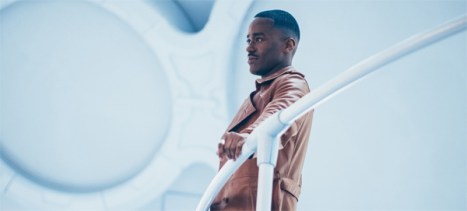
The Doctor is in.
Indeed, Space Babies all but explicitly acknowledges as much. The central drama of the episode is framed as a fairytale for children, a story with a monster in it to terrify children. As Ruby explains, “It’s a children’s story come to life.” At one point, the Doctor broadcasts an image of the creature on a screen, to shock the young children. “Why is it so scary?” they ask, as if watching an episode of Doctor Who. Space Babies is a deliberately “childish” piece of Doctor Who, one that eschews the weird and clumsy gestures toward self-serious maturity that led to episodes like The Battle of Ranskoor Av Kolos.
It’s not hard to imagine certain fans being outraged or offended by the inherent childishness of Space Babies, convinced that Davies has “ruined” the show by using imagery designed to appeal to children rather than adults. However, this is very conscious. Space Babies is the first episode of Doctor Who to premiere on Disney+, and so it will be the first episode of Doctor Who for an entirely new audience. Davies has made the calculated (and perfectly reasonable) decision that the show is for children rather than for a dwindling audience of adult fans.
To be fair, there are other indications that Davies knows he is writing for a different audience. The structure of Space Babies is interesting. This is not an episode introducing (or re-introducing) a new Doctor and/or a new companion. The ensemble carries over from the Christmas special, The Church on Ruby Road. As such, Space Babies is closer to New Earth than to any of Davies’ other season premieres. However, the show starts in a very strange place.
Traditionally, Davies’ season premieres are built as run-around adventures that culminate in a scene in the TARDIS, in which the Doctor convinces the companion to stick around and outlines the basic concept and mechanics of the show. The adventure is foregrounded, and the idea is that everything will flow organically from that. The Doctor meets Rose while fighting the Autons in Rose, and she only really considers the TARDIS at the end of the episode. The Doctor encounters Martha while facing “a Judoon platoon upon the moon” in Smith and Jones, and she only steps inside the TARDIS at the end of the episode.
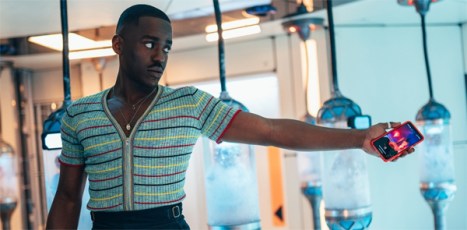
Dial it back.
In contrast, Space Babies begins with the TARDIS. Picking up from the end of The Church on Ruby Road, the episode opens with Ruby’s first real glimpse of the TARDIS and a conversation with the Doctor about the nature of their relationship that also serves as a quick guide to the mechanics of Doctor Who. This approach is interesting, because it marks a clear departure from how Davies approached the show’s mythology during his initial tenor as showrunner.
Ruby asks a series of questions and gets a set of very direct and relatively detailed answers. “I can’t call you Doctor,” she protests. “I want to know your name.” The Doctor responds with a lore dump, “That’s tricky, because I was adopted and the planet that took me in, well they were… they were kinda posh.” He tells her bluntly, “My world is called Gallifrey.” When she asks where that is, he answers, “It’s gone.” He elaborates, “They died. There was a genocide and they died. So the one who was adopted was the only one left. I am the Last of the Time Lords.”
Although a lot of this exposition is frontloaded within the episode, Space Babies devotes considerable runtime to explaining the lore of Doctor Who. “Listen to my hearts – it’s two hearts, plural,” the Doctor states, during a tense moment. On their first trip together, with no prompting, the Doctor explains, “The TARDIS stands for Time and Relative Dimension in Space.” There is a real sense that Space Babies is intended to come with a spot-quiz at the end to test the audience’s memory.
There are two notable facets of this approach to exposition. The first is that it is very much at odds with how slowly and carefully Davies built up the show’s mythology during his initial tenure. Famously, the Tenth Doctor didn’t even mention “Gallifrey” by name until The Runaway Bride, in his second season. Davies avoided burdening the show with unnecessary lore, trusting that new viewers could pick it up as they went along and that he could explain as needed when introducing new elements. In contrast, Space Babies grinds to a halt to effectively read a Wikipedia article to the audience.
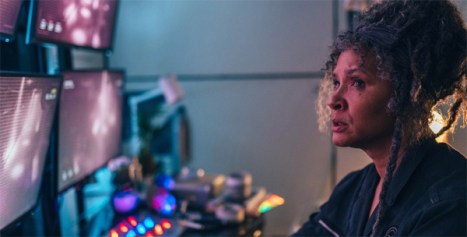
Nanny cams.
The other interesting side of this is that Davies spends a lot of time explaining the basic concepts in great detail. The Doctor notes that the TARDIS is “like a Chameleon.” He also explains that the circuit got stuck. Later on, he explains the concept of the TARDIS’ translation circuit. However, it isn’t enough to just state that it exists, the Doctor waves his hand in demonstration so that the text Ruby is reading can flash back to its original format. It’s very detailed and very attentive, in a way that feels like it is very aggressively explaining itself to the audience.
It is interesting to wonder why Davie shas adopted such a different approach this time around, even if it’s clear that Space Babies is also intended as a jumping-on point. It might reflect an understanding that this is just how fandoms work now, fans love lore dumps and exposition is often as appealing to a particular sort of fan as narrative. It might also reflect the fact that placing Doctor Who on an American streaming service alters the kind of show that it is, making it more of a “cult” series than it would be on the British national broadcaster.
It’s also possible that Davies is writing with the understanding that even audiences who have never watched Doctor Who will have some casual familiarity with it by virtue of the show’s nearly two decades on the air, which was definitely not the case with the premiere of Rose. Doctor Who is certainly a more mainstream property than it was when it initially relaunched, thanks to Davies and Moffat. As such, there is perhaps little point playing coy with the lore. Davies may also understand that new viewers who want to know these things aren’t going to wait for explanations, and will just do Google searches on their phones.
There is also the possibility of compressed space. When the revival premiered, Davies had thirteen episodes in which to build up the mythology and the lore. He could illustrate how the show worked rather than needing to bluntly explaining it at length. After all, Space Babies isn’t just covering the same ground as Rose, it’s also burning through a lot of the same beats that played out in The End of the World. There is the same shot of the companion looking out over a planet, the same gimmick with the mobile phone, the same contemplation of what it means for the Doctor to be the last of his kind.
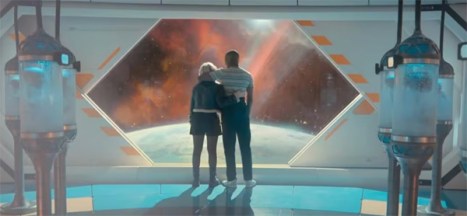
I feel fine.
Indeed, there are even similar thematic concerns, elements that feel somewhat recycled from the first season of the revival. Towards the end of the episode, the Doctor tells his new companion, “There’s one thing that I can never do, Ruby. And that’s take you to that church on Ruby Road, that Christmas. Absolutely never.” It’s interesting, because this recalls the drama of Father’s Day, in which the Doctor took Rose to a church to meet her father, leading to a series of events that caused reality itself to unravel.
However, this time around, Davies doesn’t have thirteen episodes in which to hit all of the requisite beats. This season will only run eight episodes. For point of comparison, Davies was credited on writer on eight of that first season’s thirteen episode. So there’s less room to just enjoy being Doctor Who. This was also an issue with the sixtieth anniversary specials, which effectively crammed a celebrity historical into the teaser to Wild Blue Yonder because there was nowhere else to put it.
This condensed space perhaps explains the breakneck pace of the episode’s opening, which spends a solid five minutes just outlining how Doctor Who works before actually getting to the story. There’s even a completely superfluous tangent involving “the butterfly effect” to help illustrate that the TARDIS can go back in time. In the past, Davies had a classic three-act structure to open the season: past, present and future. While The Devil’s Chord is kinda a celebrity historical, it’s also its own thing, which means that Davies has to cover three episodes worth of “this is Doctor Who” in the space of forty-odd minutes.
This is a problem with the episode, and it holds it back as a Davies era premiere. There’s a sort of clumsiness to the structure and the bluntness of the exposition that really feels less elegant than the show used to be at delivering this information. It’s not quite as uncomfortable as the extended monologued exposition of something like The Timeless Children, but it gives the episode a very strange and distracting shape. Indeed, this – more than anything – suggests the price of writing Doctor Who for Disney. Doctor Who has to be written like a modern American science-fiction show, which means a lot of exposition upfront.
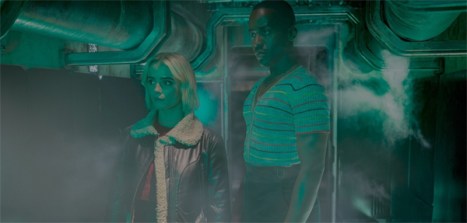
Underground movement.
It’s a shame, because there’s a lot of stuff in Space Babies that demonstrates Davies’ strengths as a writer, the sorts of choices that were sorely missing over the past few years. Most obviously, the goofy premise of Space Babies is an obvious framework for the season’s larger thematic concerns. The Doctor and Ruby are both abandoned orphans, which is Davies’ very clever way of reworking the whole “Timeless Child” concept from his predecessor, so it makes sense that their first adventure together would take them to a station full of abandoned children.
“We’ve gone from baby to baby,” the Doctor muses. “I’m not saying things are connect and – yet – things connect.” As Ruby explains, “I’m the one looking for my parents and you’d got a time and space machine.” It is not subtle, but its a logical extrapolation from the child-snatching goblins of The Church on Ruby Road and it’s much more interesting than anything that the Chibnall era did with the concept of the Timeless Child. In some ways, this illustrates the issues with that opening exposition dump; Davies has always understood that emotional logic is much more narratively compelling than just lore.
Space Babies touches on this. The episode’s resolution doesn’t necessarily make a great deal of plot sense. The snot monster might be “the only one of its kind”, but it is still hunting children and there’s still the potential of it getting lose to resume that practice. However, emotionally, it makes sense that the story’s revolution would tie together the Doctor’s competing impulses of isolation and empathy. If the eponymous space babies provide a mirror to the Doctor and Ruby’s abandonment issue, why shouldn’t the resolution build on that emotional hook. After all, as Davies likes to imply, the Doctor is a bit of a monster himself.
Like so many of Davies’ premieres, Space Babies is a jumble of ideas that operate under the assumption that the script can move fast enough to outrun any nitpicks, and that charm and wit will cover a lot of flaws. So the episode feels like a game of mad-libs; it’s got a “bogeyman [made] out of bogeys”, the classic Moffat era twist that the monster isn’t really a monster and the story is a story, and it builds to a climax shamelessly riffing on Aliens, another iconic property that can be found on Disney+. It doesn’t entirely work, but it has commendable energy.
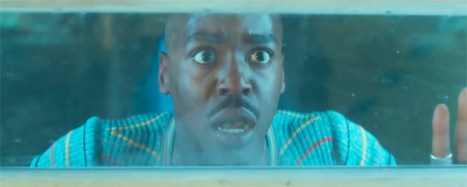
Airlockdown.
Interestingly, there is another way in which Davies seems to use Space Babies to reconfigure Doctor Who for a more American audience. The entire episode is a none-too-subtle abortion metaphor. The horror of the premise is that the government will force these children to come to term in a world that openly hates them. “So the planet down below refused to stop the babies being born, but once they’re born they refuse to look after them?” Ruby asks Jocelyn, effectively stating the theme of the episode and making a criticism of America’s abortion laws.
Abortion isn’t really much of a culture war issue in the United Kingdom, which is why Doctor Who doesn’t really have a long history of grappling with the concept. In contrast, abortion rights have been under sustained attack in the United States, which may explain why Davies decided to build his season premiere around the concept. After all, American audiences will get to see Space Babies before their British contemporaries. It’s a welcome reminder of Davies’ political conscience. Indeed, the episode’s emphasis on refugees feels more specifically British.
That said, there is a more universal metaphor simmering through the episode as well. Explaining how the adults could just abandon these children, Jocelyn states, “It’s the recession. The government closed the baby station to save money, but the law says it’s illegal to stop the birth machines.” At its core, Space Babies is a story about a younger generation being betrayed and abandoned by their elders. It’s a metaphor that resonates in an era where children are forced to do active shooter drills, march on climate change and protest war because their parents are refusing to take any active steps to remedy the situation.
Beneath the episode’s cartoon aesthetic, there is a real anger and frustration. “Most of the universe is knackered,” the Doctor tells Ruby. Indeed, one of the more interesting aspects of Space Babies is that the babies themselves are never the butt of the joke. Instead, the episode approaches these young children with a great deal of earnest empathy. When the children wonder why their parents abandoned them, the Doctor and Rudy reassure them. “Nobody grows up wrong,” the Doctor tells them. “You are what you are, and that is magnificent.”

If you order something from the future, do you have to worry about vat?
It’s surprisingly sweet. For all the issues with Space Babies, there’s something undeniably appealing in the earnestness with which it treats its absurd premise. This isn’t top-tier Davies, but it’s a reminder of the sort of steady hand and basic competence that has been missing from Doctor Who for quite some time.
Filed under: Television | Tagged: Abortion, disney, doctor who, refugees, russell t. davies, season premiere, snot, space babies |



 the m0vie blog
I could be wrong, but I think there was a suggestion that the monster wasn’t in fact a danger to the children, it just stalked about and roared because that’s what a monster is supposed to do. It did look like it would have got Eric if it was going to attack anyone. (Might have made for a solider plot point if it was e. g. created by the systems to scare the kids away from a dangerous part of the ship for their safety, although that would have taken away the “story” aspect.) Regardless, the whole business with the bogeyman monster does kind of hilariously underline how selective Who is (especially RTD-era Who, I’d say) about which deaths we’re supposed to feel bad about. Nobody felt bad for the Not-Things from “Wild Blue Yonder”, for instance, although they’d been corrupted by humanity experienced from a distance and presumably had the potential to be less malevolent if exposed to different stimuli (the plot denies them the possibility of truly becoming like the people they imitate like the “Fleshkind” do.) It’s not the most galling example because they just got returned to square one, the nothingness from which they came, but still.
Minor correction in that Ten actually first mentioned Gallifrey by name in The Runaway Bride, not Gridlock, but the general point still stands. He does do the whole “The leaves on the trees are a burnt silver” spiel in that episode, borrowed from Susan in something that feels a lot more pointed given the en vogue speculations at the moment, though he actually doesn’t mention Gallifrey in terms any more specific than “that old planet,” looking at the transcript.
Cheers, corrected.