












“Thinkthinkthinkthinkthink”
Of the three specials starring David Tennant and Catherine Tate for the sixtieth anniversary, Wild Blue Yonder was the one that generated the most feverish speculation.
It is easy to understand why this was the case. Wild Blue Yonder was the middle of the three installments, and so lacked both the burden and the import of being either the opener or the finale. It also, in contrast to The Star Beast and The Giggle, filmed largely on sets and greenscreens allowing for the teaser and the coda. The production team had been very secretive about the content of Wild Blue Yonder. While publicity for The Star Beast included the Meep and promotion for The Giggle included the Toymaker, very little of Wild Blue Yonder made it into promotional material.
The issue was compounded by the fact that there had been surprisingly little nostalgic fanservice in the other announcements around the specials. Sure, Tennant and Tate were returning, which was an obvious invocation of the revival’s fourth season. On top of that, both The Star Beast and The Giggle include villains that are recognisable to hardcore fans. However, there were precious few easter eggs tailored to other fans of the revival. There was no announcement of Billie Piper, Matt Smith, Peter Capaldi or anyone else. If the specials were going to include those cameos, Wild Blue Yonder was the place for them.
This makes Wild Blue Yonder all the more surprising. In the end, Wild Blue Yonder is not a collection of returning actors and familiar references. It is something more interesting. It is a solid high-concept episode of Doctor Who, in the tradition of Davies era episodes like The Impossible Planet, The Satan Pit, Midnight and The Waters of Mars. It is an episode that marks the sixtieth anniversary of Doctor Who with more than just allusions to things that audiences recognise. It celebrates the sixtieth anniversary of Doctor Who by simply being Doctor Who.

Corridors of powered.
On one hand, Wild Blue Yonder is a “big” episode. The special makes use of large sets, extended by computer-generated imagery. While the special effects aren’t necessarily going to compete with the Marvel Cinematic Universe, they certainly make use of the substantial investment from Disney. Wild Blue Wonder features elaborate props and production design, creating an entire space ship through which the Doctor and Donna might go exploring. It even includes an adorable robot sidekick, which the Doctor nicknames “Jimbo.”
There is something playful in all of this. Wild Blue Yonder is an episode built around the world’s longest corridor. The climax of the episode is built around the Doctor and the companion having to run through that extremely long corridor. Given how fundamental “running through corridors“ is to Doctor Who, it feels somewhat fitting that one of the sixtieth anniversary specials is built around the iconography. It helps that Wild Blue Yonder is technically a multi-Doctor story, even if it’s not necessarily what the vast majority of fans would have wanted.
As with The Star Beast, there is something inherently comforting in this in a very basic “meat-and-potatoes” sort of way. The Chibnall era embraced a sort of minimalist grim and gritty aesthetic when it came to science-fiction, as evident in episodes like The Ghost Monument, The Tsuranga Conundrum and The Battle of Ranskoor Av Kolos. With its anamorphic lenses and lens flare, the Chibnall era pushed Doctor Who towards a grounded version of science-fiction; junkyards, quarries and foundries. It’s nice to see Wild Blue Yonder embrace the more vibrant, cartoonish and colourful aesthetic of the Davies and Moffat eras.
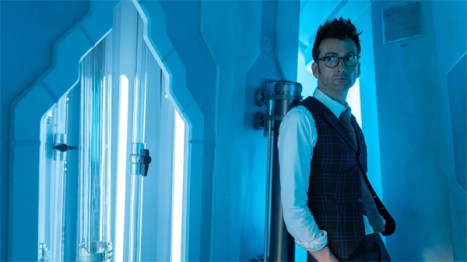
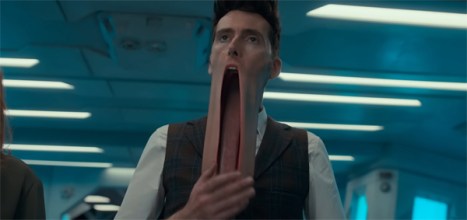
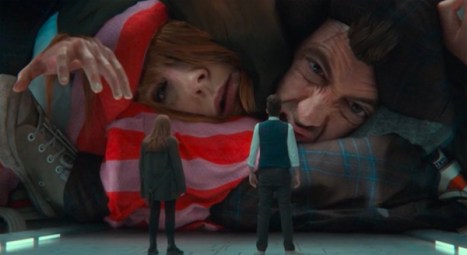
Director Tom Kingsley does some truly impressive work with Wild Blue Yonder. The special contains a number of memorable images, such as the enlongated arms 0r Donna-as-a-puddle. More generally, the episode is beautifully lit. The sets are sparse and minimalist, all metal panels and sliding doors. However, Wild Blue Yonder is beautifully lit in vibrant shades of blue, orange and green. This gives the episode a texture quite distinct from the earthy greys, browns and golds that defined so much of the past five years. The story has a texture and vibrancy to it that makes it interesting to watch.
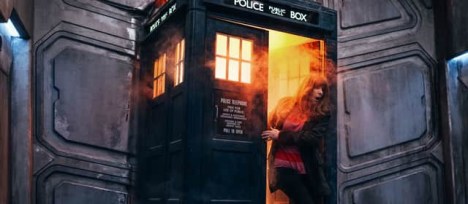
Lightening the moods.
However, on the other hand, Wild Blue Yonder is a “small” episode. The cast is incredibly contained. Allowing for the opening and closing sequences, there are no guest stars. The bulk of the episode is given over to Tennant and Tate. More than that, the monsters are also played by Tennant and Tate. There is a sense in which Wild Blue Yonder could be considered a “chamber piece.” Indeed, with its mysterious villainous mimics copying the lead characters, Wild Blue Yonder is much closer to something like Midnight than it is to something like The Stolen Earth and Journey’s End.
This is a bold choice for the second of three “specials” celebrating the show’s sixtieth anniversary. After all, these are meant to be crowdpleasing spectacles, intended to win back the audience in preparation for the arrival of Ncuti Gatwa. These are event episodes being broadcast in the run-up to Christmas, starring the most popular TARDIS team in living memory. The impulse with all three of these stories would be to go large, as Davies has acknowledged. Certainly, Davies is a writer who has never been afraid to lean into big, broad populism. So, there’s commendable restraint here from a writer who isn’t always restrained.
However, it also makes a great deal of sense. After all, what is the point of bringing back Tennant and Tate – particularly for three specials – if not take advantage of them? Any actors can headline big bombastic spectacles stuffed to the gill with nostalgia. Tennant and Tate are beloved for a reason. While part of that love is undoubtedly rooted in the gigantic scale of The Stolen Earth and Journey’s End, but it’s also rooted in the standard weekly adventures. Their season included episodes like Planet of the Ood, The Fires of Pompeii, The Unicorn and the Wasp, Silence in the Library and Forest of the Dead.
The Star Beast has to introduce the Fourteenth Doctor and reintroduce Donna, while also unpacking the baggage of Journey’s End. The Giggle will have to resolve that arc, and pass the torch from Tennant to Gatwa. These specials have a lot of “business” to get through, quite apart from telling their own stories. In contrast, Wild Blue Yonder exists independent of those obligations. It can just be whatever it wants to be. It is the most liberated of the three specials, and it’s reassuring to see Davies take advantage of it.
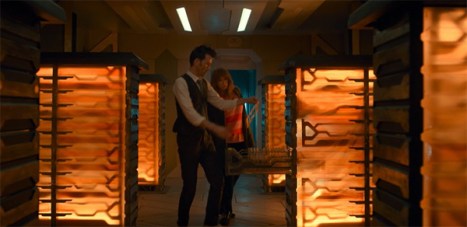
Mainframe of reference.
This is – and always has been – part of the appeal of Doctor Who. The show is not any single thing. It can be anything. It can reinvent itself from one week to the next. It can pivot from action to comedy to science-fiction to horror, and often switch within a single episode. Much more than including gratuitous cameos from pre-existing characters, Wild Blue Yonder demonstrates what Doctor Who can be. It demonstrates through action. Much more than The Star Beast, it is possible to imagine pointing a new viewer to Wild Blue Yonder as an example of what Doctor Who is and what Doctor Who can do.
This is woven into the narrative of the episode itself, with the TARDIS taking the Doctor and Donna to the very limits of reality. Instead of journeying into the franchise’s past or bringing the Fourteenth Doctor to confront familiar enemies, Wild Blue Yonder instead pushes its characters to “the edge of everything” and “the edge of creation.” It is, in a very real sense, further than the Doctor and Donna have ever gone before. “I’ve never been this far out,” the Doctor admits to Donna. “Unprotected, right on the edge.”
Ironically, this is familiar territory for Davies. The concept is not so far removed from the way that Utopia sent the Doctor past the end of the universe, for example. Similarly, the Doctor’s instinct to lean forward into the abyss is not too dissimiliar to his monologue in The Satan Pit, about the voice in the back of his head urging him “to jump.” That’s before getting into obvious comparisons between the mimicking monsters and the alien from Midnight. Still, it is an impressive statement of intent. It’s about reestablishing the idea that “business as usual” is an embrace of bold new frontiers.
That said, there is something interesting in how Wild Blue Yonder flings the Doctor and Donna into the void, surrounded by “nothing” – as the Doctor elaborates, “absolutely nothing.” It is so far beyond the boundaries of known existence that even light hasn’t penetrated that far. As the Doctor explains to Donna, there are not words in the human vocabulary to articulate where they are. It’s a wonderful idea. It’s a welcome departure from the technobabble of the Chibnall era, recalling Davies’ more lyrical framing of Time War concepts like the “army of meanwhiles and never-weres.”

A screw(driver) loose.
This nothingness seems to be the point. Davies seems to have inherited Doctor Who on the cusp of cancellation. The Power of the Doctor was written with the understanding that it could potentially have been the last episode of Doctor Who. Chris Chibnall wrote Jodie Whittaker’s regeneration with no idea what would follow – or if anything would follow. There’s no way to know what might have happened had Davies not reached out the BBC and volunteered to come back.
As such, Davies inherited Doctor Who contemplating the abyss and oblivion. Of course, the BBC had considered resting Doctor Who when Davies and Tennant left. Moffat stayed longer than he planned to avoid leaving it “in the lurch“ without a showrunner. However, this feels like the closest Doctor Who has truly come to oblivion since it came back. It wouldn’t be the first time that Davies wrote a metaphor for the threat of cancellation into Doctor Who. The Time War was a manifestation of the trauma of the wilderness years, a scar separating the classic series and the revival.
Even outside of its setting, Wild Blue Yonder is fascinated by the idea of endurance and permenance – the question of what happens to an object when it disappears from view or is removed from its context. At one point, Donna identifies the not!Doctor because his tie vanishes as soon as he removes it from his shirt. This is a moment of realisation for the doppelganger. “When something is gone, it keeps existing,” he gasps. There is something inherently optimistic in the implication that Doctor Who would keep existing, even if it were to be gone again. There is something that exists past the end of everything.
Indeed, there is also a sense that Davies has come a long way in the eighteen years since he relaunched Doctor Who, that he is somewhat more optimistic about the future of the show in its more precarious moments. In The Parting of the Ways, the Ninth Doctor ruminates on what might happen to the TARDIS in his absence. “Let the TARDIS die,” the Ninth Doctor urged Rose. “Just let this old box gather dust.” He implores his companion, “Let it become a strange little thing standing on a street corner. And over the years, the world’ll move on and the box will be buried.”

Edge of his seat.
When the Fourteenth Doctor contemplates the same possibility in Wild Blue Yonder, he imagines quite the opposite. The Fourteenth Doctor believes the TARDIS will endure. He imagines the locals worshipping and then trying to burn the TARDIS, but it survives. He imagines cities constructed around it, as a fixed point – “a tiny little dot, surrounded by skyscrapers and monorails.” In this fantasy, the TARDIS endures as the world around it crumbles. “Time passes and the city falls – or gets swept away – and there’s the TARDIS,” he explains. It’s a romantic idea: Doctor Who will survive in some form or another.
It’s easy to understand the root of that optimism. Wild Blue Yonder is overflowing with ideas. There is a sense of Davies trying to cram as much as he can into the episode, understanding that this is probably his last chance to write a “standard” adventure starring Tennant and Tate. This is most obvious with the teaser, which exists entirely disconnected from the episode itself. The opening scene could have been cut from Wild Blue Yonder and little would have been lost, allowing for a later winking reference to “mavity.” It is the kind of sequence that could easily have served as a “minisode” during the Moffat era.
However, its inclusion serves a purpose. After all, it is functionally a celebrity historical, one of the staples of the Davies era. Isaac Newton is not too far removed from Charles Dickens in The Unquiet Dead, Queen Victoria in Tooth and Claw and William Shakespeare in The Shakespeare Code. Indeed, if Davies were reuniting with Tennant and Tate for four serials instead of three, it’s possible to imagine that Isaac Newton would get an entire episode to himself, dealing with some sort of alien threat. However, the teaser serves as a way for Davies to include at least an acknowledgement of the subgenre.
There is a sense in which Davies has built these specials as a way to remind the audience what they love about Doctor Who, in the hopes of winning back the audience that drifted away over the past five years and attracting a new viewership. That is the whole point of bringing back Tennant and Tate. That approach relies on Davies reminding the audience of all the things that the show can do, and that brief introduction is an efficient – if somewhat inelegant – way of accomplishing the task.
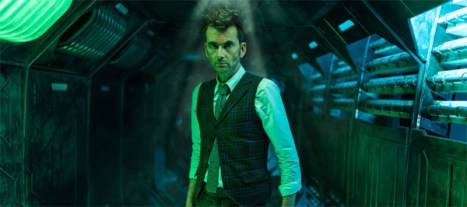
Wild Green Yonder.
There’s a sense in which that is reflected by the monster in the episode, essentially a mimic. The aliens in Wild Blue Yonder are effectively learning how to make a Doctor Who episode. They are studying and copying Doctor Who, trying to build a convincing imitation. There is something a little bit cheeky in this, as if Davies is affectionately mocking the entire wave of British television that tried to emulate what he did with Doctor Who – shows like Merlin, Atlantis, Robin Hood and The Musketeers. For the better part of a decade, British television has been trying to replicate Davies’ success with Doctor Who.
There is also, perhaps, a sense of Davies grappling with the changes to the industry in the years since The End of Time, Part II. In particular, Wild Blue Yonder feels very aware of the Marvel Cinematic Universe, with its use of vast greenscreens and soundstages. It’s telling that Donna’s frame of reference for the episode is a superhero film. “Shaun used to complain about that watching Venom movies,” Donna nitpicks of the episode’s monsters. “Where’d all that extra mass come from?” She cites Marvel-adjacent superhero franchise, but one not produced by Davies’ new distribution partners at Disney.
The entities in Wild Blue Yonder struggle with the idea of shape and definition. “The notion of shape is odd,” not!Doctor admits. The episode’s first big action set piece finds the Doctor and Donna fleeing their rapidly expanding doppelgangers, whose bodies warp and twist. If these are aliens learning the art of Doctor Who, it feels like aliens constructing an elastic and malformed streaming version of the show. These monsters are building the “content soup“ version of Doctor Who, without without the clearly-defined episodic structure that has defined the show.
This is obviously something on Davies’ mind. For international audiences, Doctor Who will stream on Disney+. Davies was approached to write for both Star Wars and Marvel, two other feathers in Disney’s intellectual property cap. He has cited the modern Star Trek streaming empire as a model for his vision of Doctor Who, and is already talking about plans for spin-off shows and franchise extensions. It makes sense that Davies would be thinking about the shape and form of Doctor Who in this new space, one that tends to devalue the classic episodic structure and lead to bloat.
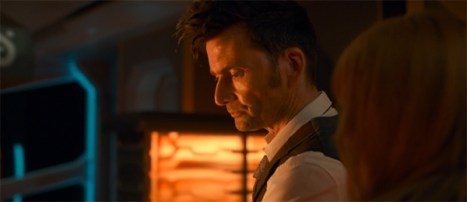
A glow up.
In this sense, Wild Blue Yonder also finds Davies engaging with Doctor Who: Flux, the sprawling six-part epic that saw Chris Chibnall embrace true longform serialization in the style of streaming. After all, there is a valid argument to be had over whether The Halloween Apocalypse, Once, Upon Time or Survivors of the Flux function as standalone episodes of television. Even an otherwise impressive episode like Village of the Angels is malformed by missing an ending. It’s the culmination of one of the defining attributes of the Chibnall era: its pursuit of polished streaming television in its aesthetics and narratives.
Wild Blue Yonder more directly engages with the legacy of the Chibnall era by acknowledging the era’s continuity. When the Doctor states that he is from Gallifrey, not!Donna corrects him. “You don’t know where you’re from,” she states, articulating the revisions to the show’s continuity in The Timeless Children. The Doctor more directly invokes “the Flux”, confessing his sense of guilt over it, “It destroyed half the universe, because of me.” The implication seems to be that the Doctor is running from that horror.
Outside of the reference itself, this sequence is notable for two reasons. The most obvious is that this is a large part of what Davies does, taking troubled ideas and rehabilitating them. His first season, for example, borrowed very heavily from the much-maligned Colin Baker era. The Long Game and Bad Wolf both owed a lot to Vengeance on Varos. The Dalek Emperor’s plan to create “an army of Daleks out the dead” in Bad Wolf and The Parting of the Ways is lifted directly from Revelation of the Daleks.
As such, the invocation of “the Timeless Child” and “the Flux” is part of this tradition. Notably, Davies largely avoids any of the continuity implications in those ideas. There’s no mention of Tecteun and no indication that the universe is any emptier than it was before. Instead, he focuses on the emotional crux. Davies treates these concepts as a source of drama and angst. The audience doesn’t need to know the particulars or the specifics to follow along. They understand that something bad happened and the Doctor has a mysterious past. It’s not too different from where Davies reintroduced the character in Rose.
Waters of (far from) Mars…
This gets at the second interesting aspect of this reference. Davies goes out of his way to write these scenes so that the Doctor is the only person who knows about any of this. When he asks Donna whether she knows, she doesn’t. “Where have you been since I last saw you?” Donna asks him at the climax of the episode, and he largely shrugs off the question. This is somewhat in keeping with Davies characterisation of the Doctor as an enigmatic and withholding figure.
It also allows Davies the neat trick of both directly acknowledging those events and being able to avoid ever having to deal with them ever again. It’s a clever piece of writing, avoiding anything as blunt as a continuity reset or potentially validating the worst sorts of internet people who want the Chibnall era erased from continuity, while also avoiding any potential future entanglement. It’s very clever and very effective, balancing two competing ideas. It allows the episode to effectively believe “two completely different things at exactly the same time.”
This choice allows Davies to have his cake and eat it. Wild Blue Yonder acknowledges these new additions to the franchise mythology in a way that is vague enough that it doesn’t lockout any potential viewer who hasn’t watched those episodes. “The Timeless Child” and “the Flux” definitely happened, but the way that they are framed suggests that they could just as easily have happened off-screen. It’s similar to the various references that the Doctor would make to events like “the Fall of Arcada” or “the Gates of Elysium”, a bit of flavour and colour.
That said, as with The Star Beast, there is a sense that Davies is writing a version of the Doctor informed by what happened in his absence. As not!Donna points out, “I had fifteen years without you, and I saw everything that’s happened to you since.” While Davies is still writing his version of the character, as evidenced by the implicit threat of genocide in The Star Beast, he is writing a version of that character who has grown and evolved over the intervening decade-and-a-half.
Holding it together.
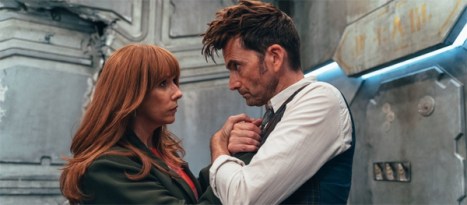
When the Doctor and Donna are stranded by the TARDIS, the Fourteenth Doctor is much more conscious of what that means for Donna than the Tenth Doctor was for Rose in The Impossible Planet or Martha in Blink. “I will get you home,” he promises and reassures her, gently kissing her hand. It’s a sequence that recalls the sorts of promises that the Eleventh Doctor would make to Amy or that the Twelfth Doctor would make to Clara, much more conscious of the “duty of care” that he owes to those who travel with him.
In terms of the metatextual reading of the episode, the mimics also evoke the looming threat of artificial intelligence, particularly as it applies to artists. The past few years have seen a lot of press around artificial intelligence that can mimic human interactions in a way that feels uncanny or uncomfortable. These bots can profess to experience love for their user. In many cases, they are simply mirroring or replicating existing material, although they can also “hallucinate“ and conjure concepts that are fundamentally unreal. Image generators can produce nightmarish abstract shapes that recall the monsters in Wild Blue Yonder.
In this context, it is notable that the first indication that something is wrong concerns the creatures’ hands. “My arms are too long,” the not!Doctor warns Donna. “I don’t know why, but the arms – they’re so very difficult.” This recalls the way that hands are often very difficult for image generators. An AI-generated image might initially appear convincing or even appealing, until the viewer notices that the hands are warped and deformed: too many fingers, insane proportions, a bend in the wrong place. These are unconvincing copies, and more unsettling for that.
More broadly, Davies is clearly just having fun writing Wild Blue Yonder. The episode might not be quite as intense as Midnight. Perhaps mindful of the fact that it is a “special”, Davies argued that Wild Blue Yonder was “not scary – it’s genuinely weird.“ The episode takes its cues from several gloriously kids-unfriendly movies. The abandoned ship with the gigantic command chair obviously evokes Alien, which famously had the original title of “the Star Beast.” Even the horse alien feels like a joke about “space jockeys.” The contorting monsters recall The Exorcist. The long neck of the ship suggests Event Horizon.
Jaw-dropping.
There’s also some of Davies’ trademark cynicism woven into the fabric of the episode, despite his optimism about the future of Doctor Who. After all, the monsters in Wild Blue Yonder are a reflection of the universe itself – not even of just humanity, but every living creature in existence. “If you existed here, no shape, no form, no purpose, then what’s made you… so bad?” the Doctor asks them, which is a reasonable question given that they have been conjured from the void.
“We could hear your lives of war,” the not!Doctor responds. “All blood and fury and hate.” When Donna insists that this is a very reductive impression of the entirety of existence, not!Donna elaborates, “Love letters don’t travel very far.” At its core, Wild Blue Yonder believes that hate reaches far futher than light, probing and penetrating into the endless dark. This outlook is consistent with Davies’ work on earlier episodes like Midnight, and it arguably bleeds over into the teaser scene at the end of the episode, as the world descends into contagious and apocalyptic madness that seem rooted in the breakdown of social order.
Indeed, there is a sense that the Doctor and Donna brought of their “lives of war” with them on to the alien ship. The TARDIS materializes, and starts playing Wild Blue Yonder. This is perhaps a small detail in the larger context of the story, but it’s notable that Davies chose to title the episode in reference to the song. Donna recalls that her choir used to sing it in school until Wilf objected. Donna remembers Wilf’s argument, “You shouldn’t be teaching children that. It sounds all jaunty and fun but it’s not. It’s the military going to war.”
Wild Blue Yonder that war is so deeply engrained in human culture – in its understanding of the universe on a primal level – that it permeates even the most seemingly innocuous spaces, like a school choir or the TARDIS. The Doctor himself pauses to acknowledge the incongruity of the TARDIS’ song choice. “The words are Wild Blue Yonder, which means the TARDIS played us a war song,” he confesses. Even the plot device that spurs the episode – the “Hostile Action Displacement System” – uses the language of war.
Cramming a lot in.
That is what human beings send out into the universe. Wild Blue Yonder was filmed as part of the production block between May and July 2022, in the months following Russia’s invasion of Ukraine. This was the largest military action in Europe since the end of the Second World War. There were concerns that the invasion could lead to a Third World War and potentially to a nuclear conflict. Obviously, Wild Blue Yonder is broadcast in the midst of another horrific internation conflict with potentially global repurcussions. Wild Blue Yonder taps into those simmering anxieties, albeit indirectly.
Of course, this may be reading too much into Wild Blue Yonder. As with The Star Beast, it is simply refreshing to watch an episode of Doctor Who that is enjoying itself this much.
Filed under: Television |



 the m0vie blog
Leave a comment