












I really liked The Dark Knight Rises. There were lots of things that I liked about it, and I covered a lot of them in my review of the film itself. (Which I still can’t believe ultimately ran to 11,000 words. Sorry.) However, one that I only fleetingly touched upon in the context of the film itself is the way that The Dark Knight Rises developed Ra’s Al Ghul as a character. Of course, developing a comic book villain as a character is hardly a new thing even in superhero cinema. It’s been the hallmark of a good film since Ian McKellen first referred to Charles Xavier as an “old friend”, and it’s continued to generally define the good films from the bad ones.
However, The Dark Knight Rises is notable because it actually takes a great deal of time and effort to develop a character who died two films earlier. And still manages to do it without slowing down the plot or seemingly like a tangent.

“Ice to meet you… oh, wait a Bat-villain already did that one, right?”
Note: This article contains spoilers for The Dark Knight Rises. If you haven’t seen it yet, and are somehow unspoiled, I recommend trying to stay that way. We’ll be here when you get back. It also contains spoilers for Batman Begins. If you haven’t seen that yet… well, I don’t know what to say to you.
The last third of Batman Begins generally attracts a fair bit of scorn, because some people argue that it undermines a lot of what came before. Nolan spends the first two-thirds of the film developing perhaps the most complex Bruce Wayne in any medium… and then launches this massive threat to the city for Bruce to resolve in the most conventional manner possible. There’s even the trademark smug and smarmy villain making dodgy one-liners about how evil he is. “Now if you’ll excuse me,” Ra’s states, “I have a city to destroy.”At least when Bruce points out he can defeat one of Ra’s anonymous goons, the villain has the good sense to send three more.
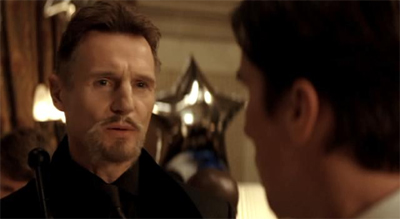
A Ghul-ish reappearance…
However, I like that climax precisely because it is so conventional, following something much more nuanced and complex. Nolan spends an hour-and-a-half introducing us to Bruce Wayne so that when he finally does something approaching conventional superheroics, we’re emotionally invested in him. If Nolan spends the first two-thirds of Batman Begins building a better batmobile, the climax is about seeing it in action. The fact that we know, understand and care about Bruce Wayne gives that third a lot more weight than a similar action sequence would in any other superhero films.
That said, I think it’s fair to argue that Liam Neeson’s Ra’s Al Ghul wasn’t exactly an especially well-developed villain. He worked very well as a corrupted mentor in the first third of the film, really subverting audience expectations. After all, this was before Liam Neeson really established “plays a mean scenery-chewing bad-ass” on his CV, and came shortly after he’d played the doomed mentor in Star Wars: The Phantom Menace. Casting Liam Neeson as a teacher to a young Bruce Wayne was a suave move. Turning him evil – gloriously, scenery-chewingly evil– was just icing on the cake.
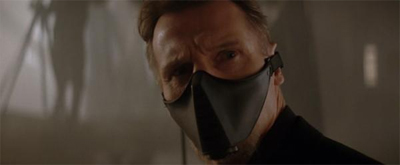
“Bruce isn’t the only one who gets to have a mask!”
Still, Ra’s Al Ghul wasn’t the most nuanced of characters. He hated criminals. He really hated criminals. He also seemed to relish the occasional bad-ass one-liner. He seemed, at best, like a fairly shallow reimagining of Ian McKellen’s Magneto, except instead of hating all humans, he seemed to just hate all humans living in Gotham. While he’d worked well as a father-figure to Bruce (particularly when quietly urging Bruce to kill the criminal), his return to Gotham saw him fairly eager to murder his protégé.
Neeson played the role rather well, and seemed to relish the character’s putdowns to Bruce, but his characterisation seemed a little all over the place. During the fight on the train, Ra’s seems at once extremely vindictive towards his former ward, but also strangely tender. “You are just an ordinary man in a cape!” he advises Bruce, moments before his work is complete. “That’s why you couldn’t fight injustice and that’s why you can’t stop this train!” It seems a bit of a petty comment, given how sincerely he advises Batman, “Don’t be afraid, Bruce.”(Mirroring the last words of Thomas Wayne.)

He rescued Bruce from a Ghul-ag…
It’s not an uneven or a nonsensical characterisation. Bruce betrayed Ra’s, and he seems to take it rather personally, as movie villains tend to. “You burned my house and left me for dead,” Ra’s comments after burning down Wayne Manor. “Consider us even.” However, it isn’t anywhere near as complex as the motivations that Nolan would give to the Joker or to Two-Face. Even within the same film, while Jonathan Crane is hardly the most developed character, he has a very clear and concise psychology and character arc. (Even though he is perhaps the most obviously “evil for the sake of evil” character in the trilogy – he doesn’t believe in anything except manipulating others to his own ends, without the philosophical underpinnings of any of the other villains.)
However, The Dark Knight Rises is remarkable because it retroactively develops Ra’s as a character in a logical and organic way. It reveals that Ra’s interest in Bruce Wayne might not solely have been to recruit an agent in Gotham – that his visit to Wayne in prison was not purely a calculated maneuver. As much as Batman Begins portrays Bruce as a character desperately searching for a replacement father figure, The Dark Knight Risesretroactively suggests that Ra’s was looking to redeem himself as a failed father.
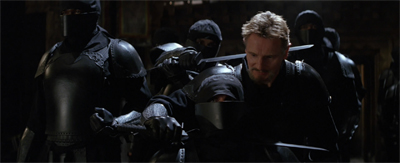
Surrogate father-son bonding…
The origin story for Bane and Talia portrays Ra’s as a secondary character – the father of Talia who never realised that his wife and his unborn child had been condemned to the Pit in his stead. He comes back to rescue them, but clearly years later. Not only does he learn that his wife is dead, he learns that his daughter grew up in a hell-hole while he never knew that she existed. He seems to try to connect with the two, but can’t. He exiles Bane from the League of Shadows, because he serves as a constant reminder of that failure, and Talia never forgives him – costing him any chance at a potential reconciliation.
It’s a very tragic story for Bane and Talia, to the point where you feel sorry for them – up until the point where they plan to vapourise a major American city. However, it also manages to cast Ra’s as a much more tragic figure than Batman Begins suggested. At best Batman Begins suggested that Ra’s found kinship with Wayne through a shared loss. For Bruce it was his parents, but Batman Begins suggests that it was Ra’s wife that he mourns. He explains around the campfire, “Once I had a wife, my great love. She was taken from me. Like you, I was forced to learn that there are those without decency that must be fought without hesitation, without pity.”
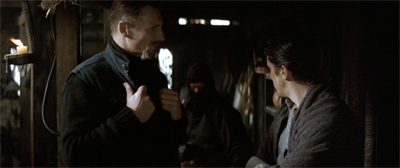
“You have learned to bury your guilt with anger. I will teach you to confront it, and to face the truth. You know how to fight six men. We can teach you how to engage six hundred. You know how to disappear. We can teach you to become truly invisible… We could also play ball and go to sporting events together.”
However, The Dark Knight Rises adds a great deal more pathos to that dynamic. It is interesting, for example, that Ra’s is introduced effectively saving Bruce Wayne from a prison. It seems that perhaps he is trying to redeem past mistakes. Like Talia, Wayne has a lot of anger and bitterness inside. Looking back at Batman Begins now, it seems like Ra’s is perhaps trying to do things properly. Wayne is looking for a replacement for his dead father. (Sadly, Martha Wayne barely features in Nolan’s films.) The Dark Knight Rises suggests that Ra’s is looking for a replacement child.
This explains, perhaps, why Ra’s seems so keen to recruit Bruce to his cause. When Bruce refuses to kill the criminal, stating in no uncertain terms that he will not be “an executioner”, Ra’s seems to beg him to reconsider – as if knowing that this is the last chance he might get. “Bruce, please! For your own sake. There is no turning back.” Perhaps that is why Ra’s takes the inevitable betrayal so personally. After all, Bruce makes a point to save Ra’s life when the mountain-top retreat explodes. One would imagine that Ra’s would at least look upon that with a hint of compassion. Instead, Ra’s seems to focus on destroying Bruce, with nothing tempering his anger.
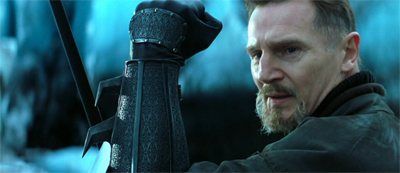
Throwing down the gauntlet…
He makes a point to visit Wayne Manor and to try to kill Bruce personally before embarking on his plan to destroy the city. Of course, he could just be tying up loose ends. (As Crane notes during Batman’s trip to the asylum, informing his goons to call the police. “At this point, they can’t stop us, but the Bat-man has a talent for disruption.”) The betrayal seems much more personal in light of Ra’s failure to protect Talia. Bruce’s decision to refuse Ra’s as a father figure seems to cut a lot more deeply, and it makes his response seem a lot more logical than it might have seemed. Instead of a supervillain wallowing in supervillainy, instead it becomes an attempt to pay back a decidedly personal wound.
It even explains the really strange change in tone once he has subdued Bruce on the train. “Don’t be afraid, Bruce,”doesn’t sound like a snide put-down, but seems like a genuinely sincere plea. It’s as if Ra’s is still desperately clinging to the idea that somehow things will be okay in the end. It also, perhaps, explains why he faces his inevitable death in such a calm manner, closing his eyes as if meditating. Finally, and thoroughly, defeated and abandoned by Bruce, Ra’s seems to have come to terms with everything.
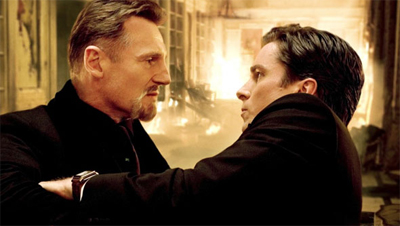
Taking another stab at parenthood…
Nothing in Batman Begins suggested that Ra’s was self-destructive or suicidal, but the final shot reads rather differently now that we know the depth of his personal loss, and can infer precisely what Bruce meant to him. (And, thus, what Bruce’s defeat of him would have meant to him, psychologically.) It adds a nice personal element to that scene – it isn’t just the fact that Bruce has defeated his insanely evil plan to destroy Gotham, but it also represents Bruce’s final rejection of Ra’s Al Ghul as a father.
It’s certainly interesting. I can’t really think of too many sequels or spin-offs that take the time to so radically redefine a character, especially one who barely appears in the film itself – with the characterisation developing and adding nuance to a performance given over half-a-decade earlier. The only really similar example I can think of is James McAvoy’s performance as Charles Xavier in X-Men: First Class, which actually does a great job adding a bit of nuance and depth to Patrick Stewart’s later performance.

Graduation day!
There are a lot of things that The Dark Knight Rises does exceptionally well, and I freely concede that recharacterising the villain from the first film in the trilogy is not the most important, but it’s still something that I think speaks volumes about the care and craft that Nolan put into making these films.
Filed under: Movies |



 the m0vie blog
Great article, very insightful. I hadn’t really thought about how TDKR transformed Ra’s motivations so much… I mean, there’s enough of the surrogate father relationship in Batman Begins that we can see a bit of Ra’s (how do you form the possessive of Ra’s anyway?) affection for Bruce, but you’re right that TDKR really fills in a lot of details.
Yep, I think the outline was there, but it really feels a lot deeper in hindsight. I thought Batman Begins really explained why Ra’s meant so much to Bruce – and why, I think, there was an element of spite in leaving him to die. And you could certainly pick up a “failed family man” vibe from Ra’s, even without the suggestion that he lost a child. But I still think that The Dark Knight Rises actually added some nice shading.
And I did think about using Ra’s’s or Ra’s’ but they both look kinda funky, right?
Yeah, just one reason to curse the comic book writer who came up with that name… 😀
All joking aside, I think Ra’s is certainly the most iconic “new” villain, arguably the best villain created since The Riddler in the forties. Since then, we’ve had several wonderful additions like Bane or Alan Grant’s wonderfully weird creations (Victor Zsasz, Scarface, Cornelius Stirk,etc), but Ra’s was really a perfect character who filled an absence that nobody really noticed. (Providing a wonderfully evil surrogate father for the orphan Batman.)
Don’t really have anything to add, other than I love the way Ra’s delivers the line “You burned my house and left me for dead… consider us even.” That delivery has the perfect mixture of anger, betrayal, sadness and regret. You can really tell how much he regrets what happened to his relationship with Bruce.
It’s a great example. But I do loe his, “Don’t be afraid, Bruce.” It’s kinda like “look, I know I messed up my second shot at being a father figure, but maybe everything will be okay once I destroy Gotham, okay?” Almost makes me wonder if, after he had destroyed Gotham, would he offer Bruce a second chance – sorta like, “Look, I know we had our disagreements, but it’s not like you can choose Gotham over me again, right?”
That was a great read, my man. Good job!
Oh, nice puns too
At least somebody likes them! Sometimes even I flinch. They often feel quite pun-ishing…
Okay, I’m done.
Thanks Andy, glad you liked it!