• Following Us

  • Categories

  • Check out the Archives


  • Awards & Nominations

The X-Files: Season One (Topps) #5 – Ice (Review)

This May and June, we’re taking a trip back in time to review the fifth season of The X-Files and the second season of Millennium.

With Ice, Season One jumps ahead a bit.

It is hard to blame them. The first four episodes of the first season are relatively solid, outlining the heart of The X-Files and conveying everything the audience really needed to know at this point. However, the first season gets a little bit rocky after Conduit. Episodes like The Jersey Devil and Shadows are unlikely to top anybody’s list of favourite X-Files episodes. Ghost in the Machine is somewhat underrated, but it is hardly a world-beater either. So it makes sense to skip ahead to probably the most highly-regarded episode in the first half of the first season.
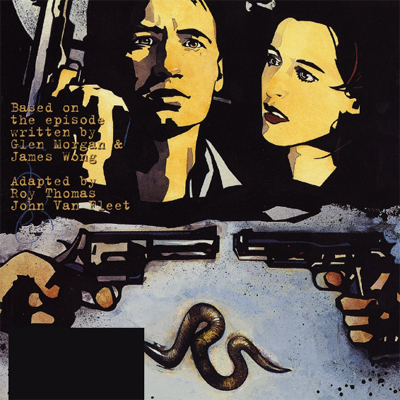
Worming its way into your heart...

Worming its way into your heart…

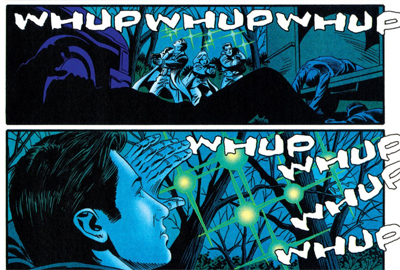
Ice is a classic installment of The X-Files. Like Squeeze, it is an episode that tends to lodge itself in the popular memory. It is hard to verify such things in any objective fashion, but it is an episode that many casual fans reference or point to whenever the show is mentioned. It has just the right balance of memorable imagery and distinctive hooks, brought to life in a haunting and atmospheric fashion. It would have been crazy for Roy Thomas’ adaptations of the Season One episodes to skip over this particular episode, and it makes sense to jump right to it.

Then again, there is also a pretty clear precedent for this.
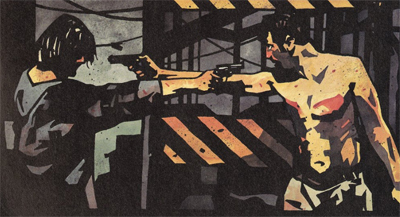
This is not who we are...

This is not who we are…

Continue reading

The X-Files (Topps) #35-36 – N.D.E. (Review)

This May and June, we’re taking a trip back in time to review the fifth season of The X-Files and the second season of Millennium.

N.D.E. is a nice clever character-driven story, one that perhaps suggests a direction that John Rozum might have taken the monthly tie-in comic.

Ten Thirteen had made it quite clear that they did not want long arcs or ambitious storytelling from their licensed comic books. They wanted reliable straight-down-the-middle storytelling, with none of the playful self-awareness and meta-narratives that drove Stefan Petrucha and Charles Adlard’s work on the title. As a result, the comic has been rather more conservative in approach since John Rozum took over. His time on the title has not produced anything as cynical or grim as One Player Only or Home of the Brave.

Healing palm...

Healing palm…

While Rozum is undoubtedly limited by constraints imposed by Ten Thirteen, there is something disappointing about his run on the comic. Rozum has tended to favour done-in-one stories, single issue adventures that wrap up everything quite neatly within twenty-four pages. Rozum has grown quite efficient at this, but there is little room for nuance in stories like The Kanishibari, Silver Lining, Crop Duster or Soma. Rozum’s stories tend to work better when stretched out a little, with Be Prepared and Remote Control allowing room for nice character moments.

N.D.E. is another two-part story that takes advantage of that additional space to tell a story about Scully. N.D.E. has a fascinating central idea, and a number of clever twists, but it also allows room to explore Scully’s character and philosophy in more depth than the comic has really afforded her. N.D.E. is perhaps a bit clunkier than Be Prepared or Remote Control, but it is the strongest story of Rozum’s final year on the title. Looking at how well this approach works in those stories, it is a shame that Rozum did not employ it more frequently.

You can play the theme to The X-Files in your head if it helps...

You can play the theme to The X-Files in your head if it helps…

Continue reading

The X-Files: Season One (Topps) #4 – Conduit (Review)

This May and June, we’re taking a trip back in time to review the fifth season of The X-Files and the second season of Millennium.

Conduit is an interesting choice for a Season One comic.

It is the last of the first season mythology episodes to be adapted by Roy Thomas as part of the Season One brand. The Pilot and Deep Throat had launched both The X-Files and the mythology, but Conduit was really the show that emphasised that The X-Files would be returning to the idea of alien abduction quite frequently in the months and years ahead. Conduit paved the way for later first season episodes like Fallen Angel or E.B.E. Neither Fallen Angel nor E.B.E. were ever adapted for the Topps Season One range. Neither was solicited when the line was cancelled.

Myth-making...

Myth-making…

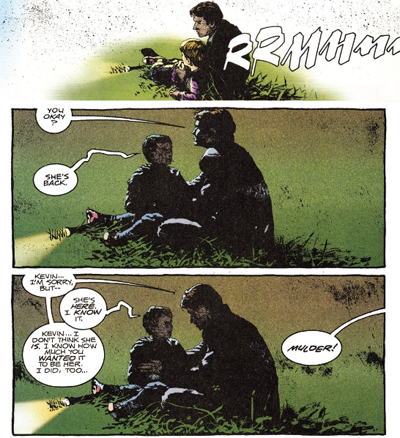
At the same time, Conduit is an episode that has not dated particularly well. As the fourth episode of the first season, it was quite effective at spelling out who Mulder was and how the abduction of Samantha motivated him to do what it was that he was doing. It was not subtle or nuanced character development, but there was a certain blunt appeal to it. Viewers had only just been introduced to Fox Mulder, so it was perfectly reasonable to bludgeon them over the head with his motivation and his back story.

However, the show has marched on. Mulder has developed and grown into a multifaceted character. Samantha will always be an essential part of his character arc, but she is no longer the only motivating factor. Indeed, David Duchovny even improvised a line into Oubliette that criticised Scully for behaving like Samantha was the only motivating factor in Mulder’s life. As such, it feels strange to go back to Conduit after all this time, and to see a very basic and early take on Mulder’s character. It underscores how far the show has come.

Far afield...

Far afield…

Continue reading

The X-Files (Topps) #34 – Skybuster (Review)

This May and June, we’re taking a trip back in time to review the fifth season of The X-Files and the second season of Millennium.

There is an interesting divide in John Rozum’s work on The X-Files.

Half the time, it seems like Rozum is writing classic EC horror stories that just happen to feature Mulder and Scully. There are stretches of his work on the title where it seems like the stories might easily have been found in the desk drawer of some classic editor, tweaked and altered slightly so as to update them forty years, and published with the addition of Mulder and Scully. Stories like Silver Lining, Donor and Soma comfortably fit this classic pulpy horror mould. There’s nothing wrong with this approach, although it is quite striking.

Death from above!

Death from above!

When Rozum does write a story that feels particular to The X-Files, it often feels a little disconnected from the season unfolding around it. Scripts like Be Prepared, Remote Control and N.D.E. feel like they hark back to the first season of the show. The characterisation is familiar, if simplistic; shades of the mythology is present, but underdeveloped; there is a very traditional approach to big paranormal ideas like the Wendigo or “remote viewing.” It feels like these comics make a solid companion piece to the Season One comics written by Roy Thomas.

Skybuster is a pretty perfect example of this style of storytelling, offering an environmental parable about the arrogance of mankind’s tampering with nature.

Quoth the raven...

Quoth the raven…

Continue reading

The X-Files (Topps) #33 – Soma (Review)

This May and June, we’re taking a trip back in time to review the fifth season of The X-Files and the second season of Millennium.

Soma is a done-in-one story that fits quite comfortably with the rest of John Rozum’s work on The X-Files.

Indeed, like a lot of Rozum’s output, Soma feels like a story recovered from a fifties horror comic. It is a very traditional ghost story hinging on a number of absurd contrivances and building to a suitably impressive climax. This is not a low-key supernatural thriller – it features vengeful smoke demons who materialise in front of countless witness and almost murder Mulder and Scully at the climax. Despite the insistence on the final page that it was too smoky to see anything, Soma feels a little too loud and campy for the world of The X-Files.

Burnt out...

Burnt out…

The script is very familiar. In many ways, Soma plays like an update of the script to Donor. It is another supernatural “beyond the grave” revenge story, similar in tone to first season episodes like Young at Heart or Lazarus or Born Again. As with Donor, the malicious spirit is a husband who plots a horrific revenge on a wife who disregarded his dying wishes. However, while Donor had an enjoyable pulpy charm to sustain it as an unwilling organ donor attempted to reclaim his harvested organs, Soma feels just a little bit too mean-spirited and malicious in tone.

Soma is a functional and efficient X-Files comic, but one that feels just a little bit too rote and familiar for its own good.

Burning love...

Burning love…

Continue reading

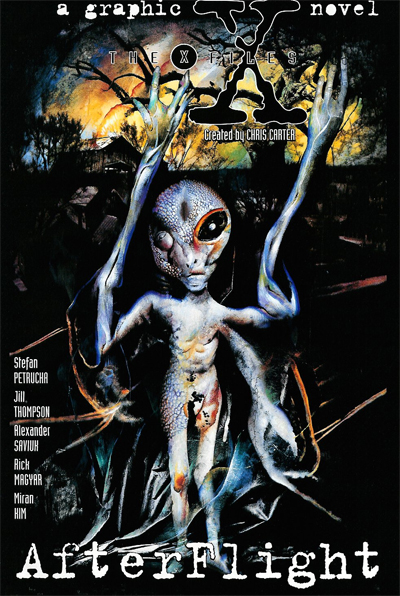
The X-Files (Topps) – Afterflight (Review)

This May and June, we’re taking a trip back in time to review the fifth season of The X-Files and the second season of Millennium.

And so we reach the end of Stefan Petrucha’s work on The X-Files.

It is quite a delayed end. Petrucha had originally written Afterflight three months before Home of the Brave, his last script for the monthly tie-in comic book. It was published fifteen months after the publication of Home of the Brave. That meant a year and a half had passed between Petrucha finished and Topps actually publishing it. The delay was rooted in disagreements with Ten Thirteen over the artwork. Still, Afterflight offers just a hint of closure to the sixteen-issue (and more) run that launched Topps’ licensed X-Files comic book line.

The truth is up there...

The truth is up there…

Afterflight is a mournful little comic, a story that takes a lot of the core themes of Petrucha’s X-Files work and distills them down to a single story. Interviewed about his work, Petrucha contended that his writing for The X-Files primarily meditated on themes of “memory, the self and what is reality.” All of these ideas are brought to the fore in Afterflight, a comic that offers a similar thematic resolution to Home of the Brave, suggesting the faintest hint of hope can be found beyond the world of men.

Afterflight is a beautiful piece of work, and a suitable conclusion to a fantastic run.

Aliens among us...

Aliens among us…

Continue reading

The X-Files: Season One (Topps) #2 – Deep Throat (Review)

This February and March, we’re taking a trip back in time to review the fourth season of The X-Files and the first season of Millennium.

Season One feels like a very odd way to franchise The X-Files.

Topps had enjoyed tremendous success with their licensed tie-in comic book, so it made a certain amount of sense to try to milk the franchise as much as possible. After all, they had already tried a number of other promotions, like releasing “digests” to supplement that monthly series and releasing tie-in comics to appear with magazines like Wizard. So offering another series that would publish on a regular basis starring Mulder and Scully made perfectly logical sense.

The truth is up there...

The truth is up there…

About a year after the release of their adaptation of The Pilot, Topps decided to push ahead with a series of regular adaptations of first season episodes of The X-Files. They reissued their adaptation of The Pilot as the first comic in the series, and then began publishing new adaptations of those early episodes written by Roy Thomas and illustrated by a rotating team of artists. The comics would be about twice as long as the issues of the monthly series, but would only publish once every two months. The monthly series was priced a $2.50, with Season One priced at $4.95.

It is hard not to feel quite cynical about Season One, particularly in an era where these classic episodes of The X-Files stream of Netflix and entire seasons are available to purchase at very low prices.

The shape of things to come...

The shape of things to come…

Continue reading

The X-Files (Topps) #32 – Crop Duster (Review)

This February and March, we’re taking a trip back in time to review the fourth season of The X-Files and the first season of Millennium.

Crop Duster feels rather generic.

That is a shame. After all, John Rozum’s script hits on all sorts of big themes related to The X-Files. It is a story about a small community that has its own secrets, haunted by the legacy of sins long past. The paranormal evil at work in the rural community of Kelly in Kentucky ultimately masks a more mundane story about human violence and betrayal. There is a sense that the basic ingredients of Crop Duster should add up to more than a disposable one-shot. Unfortunately, they don’t.

Alien bodies...

Alien bodies…

Continue reading

The X-Files (Topps) #30-31 – Surrounded (Review)

This February and March, we’re taking a trip back in time to review the fourth season of The X-Files and the first season of Millennium.

Surrounded marks the beginning of the end for Topps’ licensed X-Files tie-in comic book. There are only twelve issues remaining before Ten Thirteen would decided not to renew the contact, making this the last year for the comic. Of course, Topps would rather relentlessly milk the comic for whatever it was worth over the next year, publishing both a range of Season One adaptations and an adaptation of Kevin J. Anderson’s Ground Zero novel. They would also finally get around to releasing Stefan Petrucha and Jill Thompson’s AfterFlight graphic novel.

So there is a lot of content coming in the final year of Topps’ hold on that license. The X-Files was clearly a massive success for the newly-minted comic book wing of the company. Indeed, The X-Files was the last comic standing for Topps, and there is ample evidence that Topps was hoping to continue the line beyond The X-Files: Fight the Future, with several Season One adaptations solicited, but never published. Much like for the show itself, this was a boom time for Topps.

What's eating you?

What’s eating you?

However, the final year of the comic ultimately feels rather safe and generic. John Rozum is a competent comic writer; he understands the medium, and he knows how to play with other peoples’ toys. However, there is a sense that the comic book is really just marking time. There is very little that stands out about this last stretch of the comic; nothing which really demands to be read or to be added to the great X-Files canon. It is not bad, by any measure; it is just there.

Surrounded is a prime example of the comic book marking time. It feels like a retread of familiar ground – both for the comic book and for the parent show. When Stefan Petrucha and Charles Adlard set stories like Silent Cities of the Mind or Home of the Brave in militia compounds, they were very much ahead of the television. By the time that Surrounded was published at the end of the fourth season, the show itself had already told stories about this world in episodes like The Field Where I Died, Tunguska, Terma and Unrequited.

Shining some light on the matter...

Shining some light on the matter…

Continue reading

The X-Files (Topps) #27-29 – Remote Control (Review)

This February and March, we’re taking a trip back in time to review the fourth season of The X-Files and the first season of Millennium.

In many respects, Remote Control is a very “big” story.

It is the biggest story that writer John Rozum has told to date on the comic book, one that spans three issues and seems to brush against the edge of the mythology most associated with The X-Files. Not only does Remote Control feature secret CIA experiments into psychic phenomenon, it also involves a UFO that is being transported through the United States and is hijacked by a foreign power. To top it all off, there is a super-soldier who can render himself invisible and make himself immune to bullets.

Everything is under control...

Everything is under control…

There is a very clear sense of scale to Remote Control, one that suggests this is a blockbuster adventure. This is the comic book equivalent of those mythology episodes that air during sweeps. At the same time, however, Remote Control brushes up against the limitations imposed upon the comic book by Topps and Ten Thirteen. While Remote Control offers the highest stakes that the comic book has seen since Feelings of Unreality, the script is quite clear that this is a story separate and divorced from anything happening in the show.

There are points where it feels like Remote Control goes out of its way to remind readers that this is just a tie-in comic book, and is thus secondary to the television show.

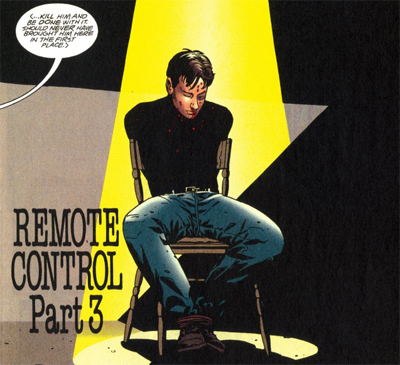
Mulder is a little tied up right now...

Mulder is a little tied up right now…

Continue reading