• Following Us

  • Categories

  • Check out the Archives


  • Awards & Nominations

Star Trek – The Devil in the Dark (Review)

To celebrate the release of Star Trek: Into Darkness this month, we’ll be running through the first season of the classic Star Trek all this month. Check back daily to get ready to boldly go. It’s only logical.

There are any number of ways to “get into” Star Trek, to jump on board the cult phenomenon. Despite decades of continuity, a lot of the franchise is accessible on its own terms, and it’s easy enough to come across a list of recommended classic episodes for a neophyte to sample. There are over seven hundred hours of Star Trek, so there’s something for everybody. And it’s perfectly possible to tailor a recommendation to the new viewer’s preferences.

Want proof that Star Trek can do credible drama? Stick on The City on the Edge of Forever. Fascinated by Spock? Try Amok Time. Want to watch William Shatner take on another leading character with a similar amount of gravitas? Give Space Seed a go. Want some high-concept sci-fi android stuff? Maybe What Are Little Girls Made Of? is right up your street. Want a contemporary commentary on the Vietnam War? Watch A Private Little War.

However, if you asked me to recommend an example of the franchise’s philosophy and its humanist values, executed with a superb level of craftsmanship, The Devil in the Dark is really the only choice. There’s a reason that Arthur C. Clarke considers it to be the most memorable episode of Star Trek ever produced.

Spock would have to have a heart of stone not be affected by this...

Spock would have to have a heart of stone not be affected by this…

Continue reading

Star Trek – Spock Must Die! by James Blish (Review)

To celebrate the release of Star Trek: Into Darkness this month, we’ll be running through the first season of the classic Star Trek all this month. Check back daily to get ready to boldly go. It’s only logical.

We’ll be supplementing our coverage of the episodes with some additional materials – mainly novels and comics and films. This is one such entry.

Spock Must Die! is notable for being one of the first Star Trek novels published. Indeed, it is the first original novel published by Bantham Books. (For trivia hounds, the young adult original novel Mission to Horatius was actually published during the show’s run.) It’s written by James Blish, the British author responsible for those Star Trek episode novelisations I have been sporadically quoting over the past month or so. Blish was a published science-fiction author before he worked with Star Trek. Reading Spock Must Die!, you can definitely sense the writer’s fondness for high concepts and metaphysical quandaries.

Indeed, one of the defining attributes of Spock Must Die! is that Blish seems more preoccupied with the logic and implications of the show’s pseudo-science (and his own elements building on that) than he is with the characters themselves. It’s not necessarily a fatal flaw, but Spock Must Die! is more interesting and intriguing as a curiosity than as an expansion or examination of the Star Trek franchise.

tos-spockmustdie1

Continue reading

Star Trek – This Side of Paradise (Review)

To celebrate the release of Star Trek: Into Darkness this month, we’ll be running through the first season of the classic Star Trek all this month. Check back daily to get ready to boldly go. It’s only logical.

Star Trek always had a curious relationship with the hippie movement in the late sixties. On a surface level, you’d assume that the series would have a great deal of empathy for the idealistic and pacifist movement. After all, the show embraced counter-culture in a fairly significant way, offering none-too-subtle criticisms of American foreign policy in episodes like A Taste of Armageddon, and harbouring some very serious concerns about authority in adventures like Dagger of the Mind. What was The Naked Time but an embrace of fin de siècle anxiety mere months before “the summer of love”? After all, the nineteenth century European fin de siècle period had produced Der Wandervogel, considered one of the predecessors to the hippie movement.

And yet the show never seemed entirely comfortable with the youth movement. This would be much more obvious third season’s dire The Way to Eden, but the show’s sense of unease is quite palpable here, as Kirk finds himself trying to deal with a crew that have sampled some mind-altering vegetation and are now embracing free love.

Flower power...

Flower power…

Continue reading

Star Trek – Space Seed (Review)

To celebrate the release of Star Trek: Into Darkness this month, we’ll be running through the first season of the classic Star Trek all this month. Check back daily to get ready to boldly go. It’s only logical.

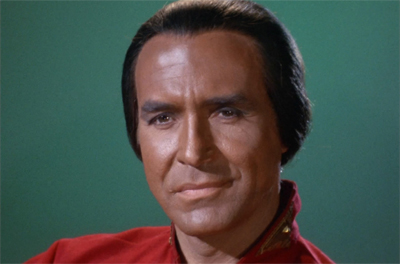
Following the commercial success (and lack of critical success) of Star Trek: The Motion Picture, Paramount made a conscious decision to side-line Gene Roddenberry. Given that his plans for the sequel involved Spock travelling through time to assassinate Kennedy, we can likely all agree that was probably a good thing. Harve Bennett was tasked with producing the sequel, and took to the task of researching what would become the second Star Trek film. Demonstrating considerable respect for the source material, Bennett locked himself away and screened all three seasons of the show, looking for inspiration.

Apparently he only needed to reach the tail end of the first season, because he had found the basis of his film by the closing credits of Space Seed.

You Khan do it...

You Khan do it…

Continue reading

Star Trek – A Taste of Armageddon (Review)

To celebrate the release of Star Trek: Into Darkness this month, we’ll be running through the first season of the classic Star Trek all this month. Check back daily to get ready to boldly go. It’s only logical.

It’s amazing to think that A Taste of Armageddon and The Return of the Archons were produced on consecutive weeks by the same television show. Both are politically-charged pieces of pop culture, heavily influenced by the realities of the Cold War, but they adopt two completely different philosophies towards the conflict. The Return of the Archons is a story about the need for freedom and individuality, and how the struggle for those inalienable rights is a battle that must be fought. While it’s debatable whether Landru is a representation of the forces of communism, the episode is unquestionably about the triumph of Western liberal values.

In contrast, A Taste of Armageddon can’t help but feel a little cynical about the whole damn thing.

A shooting war...

A shooting war…

Continue reading

Star Trek – The Return of the Archons (Review)

To celebrate the release of Star Trek: Into Darkness this month, we’ll be running through the first season of the classic Star Trek all this month. Check back daily to get ready to boldly go. It’s only logical.

It is really hard to believe that this is the first time we’ve really had one of these plots, with the Enterprise visiting an alien civilisation, meddling thoroughly and freeing the population from oppression. Of course, that’s probably because the universe seemed so vast an empty in the first few episodes. The only planets seemed to be either lifeless rocks or human colonies. From this point on, the galaxy is going to seem a whole lot busier.

Return of the Archons is a little bit like an expansion of the archetypal Star Trek plot established in What Are Little Girls Made Of? The Enterprise visits an alien world following up on the disappearance of Federation personnel. When they arrive, they discover sinister plans afoot involving evil artificial intelligences that plan on stomping out free will. Kirk promptly uses his humanity to talk the machines into destroying himself.

However, Return of the Archons deals with a whole civilisation trapped in the midst of this sinister robotic plot. Kirk and his crew aren’t strolling through an alien graveyard. This is a living, breathing society. And this is the first time that Kirk would save an entire civilisation.

Some men just want to watch the world burn...

Some men just want to watch the world burn…

Continue reading

Star Trek – Tomorrow is Yesterday (Review)

To celebrate the release of Star Trek: Into Darkness this month, we’ll be running through the first season of the classic Star Trek all this month. Check back daily to get ready to boldly go. It’s only logical.

It’s interesting how easily you can trace a line back from the original Star Trek films to the television show which inspired them. Each of the first four films has a very clear predecessor, an episode broadcast during the show’s run which seems to serve as something of a thematic forerunner. Star Trek: The Motion Picture is so similar to The Changeling that Star Trek: The Original Series 365 dubs it “Where Nomad Has Gone Before.” The Wrath of Khan is obviously rooted in Space Seed. Kirk’s decision to hijack the Enterprise and go against regulations to save his first officer in The Search for Spock feels like a full circle from Spock’s efforts to help Pike in The Menagerie.

And Tomorrow is Yesterday feels like a bit of a dry run for Star Trek IV: The Voyage Home. The crew might not have to save any whales, but it’s a comedic time-travel adventure that finds the Enterprise crew visiting the twentieth century and trying to avoid altering the time-line too much. Tomorrow is Yesterday feels a little simplistic when compared to some of the franchise’s later interactions with time-travel, but it is a fun and entertaining little episode. It’s easy to see why The Voyage Home might be tempted to revisit the set-up.

Flying the friendly skies...

Flying the friendly skies…

Continue reading

Star Trek – The Alternative Factor (Review)

To celebrate the release of Star Trek: Into Darkness this month, we’ll be running through the first season of the classic Star Trek all this month. Check back daily to get ready to boldly go. It’s only logical.

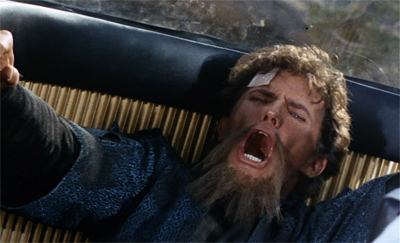
Well, here we are. The Alternative Factor. We’ve had weak episodes before. I’ll concede that shows like Court Martial and The Menagerie, Part II wouldn’t rank among my favourites of the season. However, there was always just enough there to make them interesting, if not compelling. There were good ideas, clumsily executed. There was something value to be found in watching these episodes. The Alternative Factor lacks those sorts of redemptive values, and it’s the first time on this re-watch I have actually wondered where my fifty minutes went, and lamented the fact that watching The Alternative Factor inched me ever-closer to death.

The Alternative Factor is – I’d argue – the weakest episode of a remarkably strong first season of Star Trek. While some would consider it one of the worst episodes the show ever produced, I’m reluctant to commit to that sort of certainty. After all, we still have the third season to come, and I’m hesitant to rank The Alternative Factor as that much worse than The Turnabout Intruder or The Way to Eden or And the Children Shall Lead or Spock’s Brain. Yep, there’s a lot to look forward to if I ever get around to finishing the third season of the show.

Still, the fact that The Alternative Factor might possibly not be the worst thing to happen to Star Trek in its nearly fifty years of existence is damning with faint praise. But I’m sure the episode will take whatever it can get.

It hurts!

It hurts!

Continue reading

Star Trek – Arena (Review)

To celebrate the release of Star Trek: Into Darkness this month, we’ll be running through the first season of the classic Star Trek all this month. Check back daily to get ready to boldly go. It’s only logical.

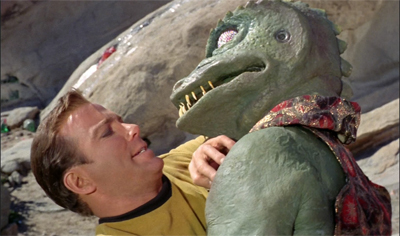
Arena is a fascinating piece of Star Trek, because it’s such an iconic and important piece of franchise history, despite the fact that it’s far from the best that the show has to offer. Indeed, the basic premise of the show is rather generic science-fiction B-movie stuff. Kirk is forced to compete against a lizard-like alien by some god-like beings to ensure the survival of his crew. The script, by producer Gene L. Coon, is credited to a story written by Fredric Brown. Despite its similarities to Brown’s short story of the same name, Arena also shares quite a few plot points with a 1964 episode of The Outer Limits, Fun & Games. None of this is to suggest that Coon was consciously channelling these sources when he wrote the teleplay, just to illustrate how generic the basic plot is.

However, despite (or perhaps because of) this rather straightforward and familiar set-up, Arena is a truly memorable episode of Star Trek. Like quite a few other episodes of the original Star Trek, the episode produced images and concepts that have resonated well outside Star Trek fandom, to the point where elements like the Gorn or Kirk’s highly dubious improvised weapon will be recognisable to people who have never actually seen the episode. However, the episode is also vitally important to the Star Trek franchise itself, as it offers a more thorough expansion and exploration of the back story that has been inconsistently hinted at throughout this first season. Arena is really the first episode to feature a fully-formed framework for the internal logic of the Star Trek universe, one that has informed half-a-century of the franchise.

Plus, you know, Kirk wrestles a lizard man.

Don't pretend you aren't loving every minute of this, Shatner!

Don’t pretend you aren’t loving every minute of this, Shatner!

Continue reading

Star Trek: The Next Generation – Requiem by Michael Jan Friedman & Kevin Ryan (Review)

To celebrate the release of Star Trek: Into Darkness this month, we’ll be running through the first season of the classic Star Trek all this month. Check back daily to get ready to boldly go. It’s only logical.

We’ll be supplementing our coverage of the episodes with some additional materials – mainly novels and comics and films. This is one such entry.

At the risk of stating the obvious, Star Trek is a franchise spanning almost half-a-century with six leading actors and five different television shows. Due to its nature, one of the more enjoyably fanboy-ish pastimes is attempting to reimagine various confrontations and encounters, swapping out the characters involved. How would Kirk have responded to the Borg? Would Sisko have been ideally suited to dealing with the Xindi threat? What if Janeway faced the Doomsday Machine? Different characters have different defining moments, and those moments often play to their particular strengths. It might be fun to watch Khan spar with Picard, but it probably wouldn’t work as well as it did with Kirk. Q and Kirk would probably have difficulty striking it off.

Still, Kirk’s confrontation with the Gorn in Arena stands as one of the most iconic moments in the whole of the franchise, to the point where the weird toga-wearing god-like being at the end barely gets a look-in. Indeed, based on Sisko’s fanboy gushing in Trials and Tribble-ations, it seems to be one of Kirk’s defining moments within the shared Star Trek universe. So it might be fun to take Captain Jean-Luc Picard, and put him through that same sort of confrontation.

tng-requiem

Continue reading