• Following Us

  • Categories

  • Check out the Archives


  • Awards & Nominations

Star Trek: Terok Nor – Day of the Vipers by James Swallow (Review)

Star Trek: Deep Space Nine is twenty years old this year. To celebrate, I’m taking a look at the first season. Check back daily for the latest review or retrospective.

We’ll be supplementing our coverage of the episodes with some additional materials – mainly novels and comics and films. This is one such entry.

Star Trek: Deep Space Nine comes with back story. A lot of back story. In fact, the opening scene of Emissary establishes the show in the context of The Best of Both Worlds, Part II, introducing a lead character whose tragic origin is rooted in an encounter that we had only fleetingly glimpse in Star Trek: The Next Generation. Due to the setting and nature of the show, history and continuity were major parts of Deep Space Nine‘s identity, and a large part of what set the show apart from its predecessors. (And successors, for that matter.)

Although the Klingons would dominate the show’s fourth season and remain a presence throughout the show’s run, and the Romulans might occasionally be glimpsed lurking in the back ground, the series largely focused on two alien races that had been introduced in The Next Generation. The Cardassians had been introduced in the show’s fourth season, in The Wounded, and the Bajorans first appeared during the fifth season in Ensign Ro.

Officially part of The Lost Era series of novels designed to flesh out the history of the shared Star Trek universe, the Terok Nor trilogy exists as a bridge into Emissary, something of an extended history lesson that contextualises the events of Deep Space Nine by providing an account of the Occupation of Bajor, an atrocity that only ended shortly before Emissary actually began.

teroknordayofthevipers1

Continue reading

Star Trek – Dwellers in the Crucible by Margaret Wander Bonanno (Review)

This August, to celebrate the upcoming release of Star Trek: Into Darkness on DVD and blu ray, we’re taking a look at the Star Trek movies featuring the original cast. Movie reviews are every Tuesday and Thursday.

We’ll be supplementing our coverage of the movies with tie-ins around (and related to) the films. We’ll be doing one of these every week day. This is one such article.

The state of Star Trek tie-ins in 1985 was radically different than it is today. While the film series was at height of its popularity, generating a great deal of attention for the franchise, authors working on the associated tie-in novels were granted a great deal of freedom. Books from this era tend to be a great deal looser, adapting a sort of “devil may care” attitude towards the type of restrictions one might impose on a Star Trek story. Novels could be dedicated to new characters or to existing aliens, or offer radical twists on the show’s rich mythology. It was almost free-style Star Trek, with authors afforded the freedom to tell the stories that they wanted to tell, no matter how difficult it might be to fit that within the confines of “Star Trek.”

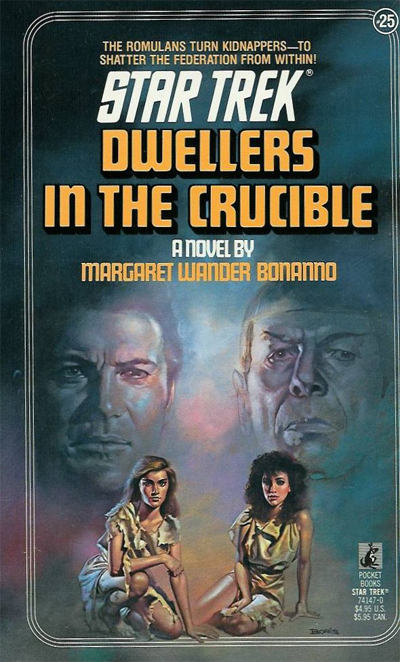
Dwellers in the Crucible captures a lot of the spirit of this era quite well. It’s Margaret Wander Bonanno’s first Star Trek tie-in book, but it’s also her strangest. It’s a rather high-concept piece of trashy “women in prison” fiction that dares to ask a question that nobody in their right mind had ever broached before: what if Kirk and Spock were lesbians?

st-dwellersinthecrucible

Continue reading

Star Trek – Music of the Spheres by Margaret Wander Bonanno (Review)

This August, to celebrate the upcoming release of Star Trek: Into Darkness on DVD and blu ray, we’re taking a look at the Star Trek movies featuring the original cast. Movie reviews are every Tuesday and Thursday.

We’ll be supplementing our coverage of the movies with tie-ins around (and related to) the films. We’ll be doing one of these every week day. This is one such article.

Music of the Spheres is something of a legend in Star Trek circles. It’s not quite a ghost story, spoken of in hushed whispers. Indeed, author Margaret Wander Bonanno has made the manuscript available to interested fans via her website, and has used it to raise money for a variety of worth causes. She’s documented the difficult story of how her original novel warped in Probe in a wonderfully wry and insightful essay, offering a glimpse at the inner workings of Pocket Book and Paramount towards the end of the eighties.

It’s a rare peek behind the curtain, with Music of the Spheres serving as a compelling vehicle to explore just what was going on inside Star Trek licensing in the late eighties and early nineties.

startrek-voyagehome8

Continue reading

Non-Review Review: Star Trek II – The Wrath of Khan

This August, to celebrate the upcoming release of Star Trek: Into Darkness on DVD and blu ray, we’re taking a look at the Star Trek movies featuring the original cast. Movie reviews are every Tuesday and Thursday.

In many respects, Star Trek II: The Wrath of Khan represents the franchise’s first true “reboot.”

There have been various points in the history of the franchise when the show has undergone a reinvention of some description, a radical shift from what it was into what it would be. The third season of Star Trek: The Next Generation represented such a dramatic update, a shift turn-around from the show’s first troubled two seasons. The third and fifth seasons of Star Trek: Deep Space Nine did something similar. Star Trek: Enterprise tried to affect some radical shift, but only managed to accomplish it in the third season. JJ Abrams’ recent summer blockbuster represented its own dramatic alteration to what Star Trek was or could be.

However, The Wrath of Khan represents the show’s first massive shift, the first point at which the franchise effectively evolved into something markedly different from what it had been before.

You Khan do it!

You Khan do it!

Continue reading

Star Trek – Ex Machina by Christopher L. Bennett (Review)

This August, to celebrate the upcoming release of Star Trek: Into Darkness on DVD and blu ray, we’re taking a look at the Star Trek movies featuring the original cast. Movie reviews are every Tuesday and Thursday.

We’ll be supplementing our coverage of the movies with tie-ins around (and related to) the films. We’ll be doing one of these every week day. This is one such article.

Ex Machina is really an astoundingly clever piece of work. On the surface, a lot of reads like a fan’s wishlist, a collection of “snags” made while watching the classic Star Trek films and making a conscious effort to fix them up a bit. There’s a lot of effort into explaining the changes between Star Trek: The Motion Picture and Star Trek II: The Wrath of Khan, with character-centric subplots focusing on Kirk’s ego or Chekov’s growing disenfranchisement.

Indeed, Bennett even provides an entirely unnecessary but quite-enjoyable-nonetheless set of annotations for Ex Machina, explaining where and how he’s tying his story into a rake of continuity. He describes Ex Machina as probing “an unexplored gap” in the franchise’s chronology. Ex Machina exists as both a sequel to a rather bland third-season episode of the show (For the World is Hollow and I Have Touched the Sky) and The Motion Picture. Neither is especially loved among fans.

However, what’s fascinating about Ex Machina is the way that none of this prevents Bennett from crafting a compelling and intriguing narrative. It’s clear that he’s enjoying attempts to fill in various gaps, but Ex Machina works incredibly well as a piece of Star Trek which stands on its own two feet.

st-exmachina

Continue reading

Star Trek – The Final Reflection by John M. Ford (Review)

To celebrate the release of Star Trek: Into Darkness this month, we’ll be running through the first season of the classic Star Trek all this month. Check back daily to get ready to boldly go. It’s only logical.

We’ll be supplementing our coverage of the episodes with some additional materials – mainly novels and comics and films. This is one such entry.

The Final Reflection was written in 1984. Development on Star Trek: The Next Generation would only be announced in 1986. Sure, there were a bunch of successful movies being produced, but these only amounted to a couple of hours of Star Trek once every few years. And, even then, the movies were aimed at a much broader audience, without the same development and continuity that a television show could offer. Not that Star Trek ever really had that tight a sense of continuity, of course, but it must have seemed unlikely that things could ever go back to the way they had been. Certainly, in 1984, nobody could have anticipated the eighteen-straight years of Star Trek running from Encounter at Farpoint to These Are the Voyages.

As a result, fans had to look to other avenues to expand and develop the rich Star Trek universe. The novels were one such avenue, although they developed slowly. Mission to Horatius had been published while the show was on the air, but it was very clearly aimed at a younger audience. Spock Must Die! would be published in 1970. However, the spin-off fiction developed relatively slowly. Star Trek had yet to become a massive franchise with tie-in multimedia commercial opportunities.

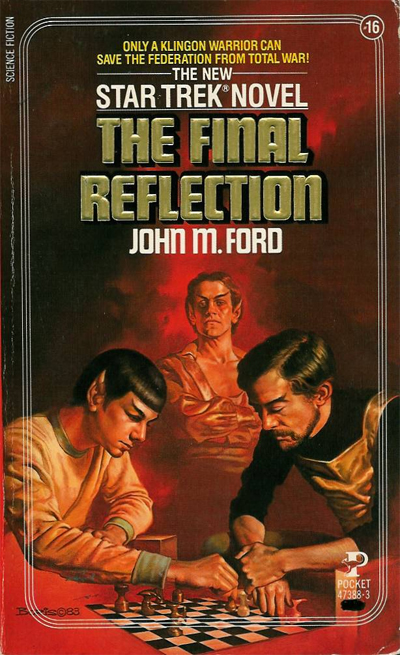
Perhaps because the Star Trek novels had not quite turned into a massive franchising opportunity, and they weren’t under the same level of publicity or scrutiny that they would be in the years to come, writer John M. Ford was able to do something quietly revolutionary with his first Star Trek novel, The Final Reflection. He was able to venture away from our core cast of iconic characters and instead develop the Klingon Empire.

More than that, though, he was able to paint the Klingons as the good guys.

tos-thefinalreflection5

Continue reading

Star Trek: Early Voyages #12-15 – Futures, Parts I, II, III & IV (Review)

To celebrate the release of Star Trek: Into Darkness this month, we’ll be running through the first season of the classic Star Trek all this month. Check back daily to get ready to boldly go. It’s only logical.

We’ll be supplementing our coverage of the episodes with some additional materials – mainly novels and comics and films. This is one such entry.

As we discussed before, Star Trek: Early Voyages is about as close to a series starring Christopher Pike as we are ever likely see. A monthly comic book running for about a year-and-a-half, told by Dan Abnett and Ian Edginton, the book followed the adventures of Christopher Pike’s Enterprise, a prelude to the classic Star Trek television show, filling some gaps left by The Cage and The Menagerie. However, the comic had the benefit of being told after a lot of Star Trek had aired.

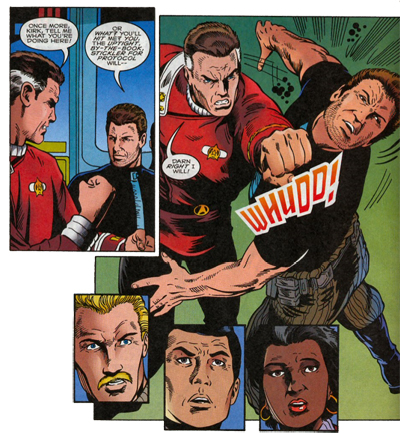
First published in 1997, it hit stands after the big-screen adventures of the Kirk era had officially wrapped up in Star Trek: Generations, and long after Star Trek: The Next Generation had gone off the air. Even Star Trek: Deep Space Nine was more than half way through its run. This puts Early Voyages in an interesting place. It is set in the past, but knows how the future plays out. The epic four-part Futures storyline plays with this concept, offering us a glimpse of an imperfect future where Captain Kirk is a rogue running a cargo ship, the Klingons have annexed considerable portions of the Federation and are on the verge of war…

Oh, and Christopher Pike is happy. That’s how you know it’s a flawed universe.

"And THAT is for stealing my show!"

“And THAT is for stealing my show!”

Continue reading

Star Trek 103: The Best of Deep Space Nine

To celebrate the release of Star Trek: Into Darkness, we’re holding a month full of Star Trek related fun. We’re reviewing every episode of the show’s first season, from The Cage through to Operation — Annihilate!, one-per-day for all of May. We’re also looking at some of the various spin-offs, tie-ins and pop culture intersections, so there’s always something going on to do with Star Trek. Anyway, with the release of the new film, we thought it might be interesting to make some recommendations for fans of the new films who wanted to “dip their toes in the water” so to speak. Today, we’re making recommendations from the second of the 24th century spin-offs, and the first to broadcast concurrently with another Star Trek project, Star Trek: Deep Space Nine.

ds9-emissary2

Continue reading

Star Trek – Dagger of the Mind (Review)

To celebrate the release of Star Trek: Into Darkness this month, we’ll be running through the first season of the classic Star Trek all this month. Check back daily to get ready to boldly go. It’s only logical.

I knew we were due a nice Shakespearean title soon. And The Conscience of a King is just around the corner, to boot. Seriously though, I have to admit a massive fondness for these wonderfully lofty and high-minded episode titles. It’s something that links the original Star Trek and Star Trek: Deep Space Nine quite firmly, and was sadly never enthusiastically taken up by any of the other spin-offs. It’s a shame, because – regardless of the quality of the episodes in question – there’s something undeniably endearing about forty-five minutes of television given a pretentious name like For the World is Hollow and I Have Touched the Sky, The City on the Edge of Forever or Wrongs Darker Than Death or Night.

A scream...

A scream…

Continue reading

Star Trek – Errand of Vengeance: The Edge of the Sword by Kevin Ryan (Review)

To celebrate the release of Star Trek: Into Darkness this month, we’ll be running through the first season of the classic Star Trek all this month. Check back daily to get ready to boldly go. It’s only logical.

We’ll be supplementing our coverage of the episodes with some additional materials – mainly novels and comics and films. This is one such entry.

When you think about it, Star Trek finished its first season with its mythology reasonably well established. There were the Romulans, the Klingons and the Federation. (Oh, my!) We knew that Kirk had a brother on the colonies, who died in the season finalé. Vulcan was a hot desert planet. The Prime Directive existed, and we even got a taste of how Starfleet operated. However, these things all developed gradually over the course of the year, and early episodes couldn’t even seem to agree who exactly Kirk was working for.

The Federation was first mentioned in Arena and only fully named in A Taste of Armageddon. The Klingons were introduced in Errand of Mercy, with a cold war between the two galactic powers finally turning hot. Of course, it’s hard to write “finally” when they had only been introduced in this particular episode. So where were the Klingons during the show’s first year? How come we didn’t pick up any of the tension that must have been simmering?

Kevin Ryan’s Errand of Vengeance trilogy attempts to offer some context, suggesting that the Klingon threat had been brewing during the entire first season. It follows Jon Anderson, a new recruit to the ship’s security department, arriving just before the events of What Are Little Girls Made Of? Oh, and he’s a Klingon infiltrator.

tos-errandofvengeance1

Continue reading