• Following Us

  • Categories

  • Check out the Archives


  • Awards & Nominations

Star Trek: Deep Space Nine – Distant Voices (Review)

This September and October, we’re taking a look at the jam-packed 1994 to 1995 season of Star Trek, including Star Trek: Deep Space Nine and Star Trek: Voyager. Check back daily for the latest review.

Poor Julian Bashir. Even at two-and-a-half seasons in Star Trek: Deep Space Nine, the character is still a blank slate. Distant Voices is a story that takes us inside the character’s head, but it winds up feeling very generic. It turns out that Bashir is afraid of getting old, as awkwardly pointed out in the opening scene. He also might have some self-esteem issues. For an episode that journeys into Bashir’s brain, Distant Voices is really pretty bland. There’s really not too much going on there.

Indeed, the most interesting thing about this glimpse inside Bashir’s mind is that it is so generic that it manages to avoid conflicting at all with the character-shattering revelation that Ronald D. Moore proposes in Doctor Bashir, I Presume. While it’s a nice piece of trivia, it’s hardly a compelling hook.

"So this is what a 100,000th episode party looks like..."

“So this is what a 100,000th episode party looks like…”

Continue reading

Star Trek: The Next Generation – The Icarus Factor (Review)

This January and February, we’ll be finishing up our look at the second season of Star Trek: The Next Generation and moving on to the third year of the show, both recently and lovingly remastered for high definition. Check back daily for the latest review.

The Icarus Factor is a character-driven story. At least, it wants to be a character-driven story. The problem is that Star Trek: The Next Generation hasn’t reached the point where it can really do character-driven storytelling with a measure of consistence. (The fact that Picard confronting his future failures in Time Squared worked was more down to Patrick Stewart than the episode’s script.)

The Icarus Factor is a story focusing on Riker as a character, and it suffers from the fact that Riker hasn’t really been well-defined to date. We’re repeatedly told that he’s ambitious and career-driven, but most his on-screen characterisation has fluctuated between reckless, jerkish and horny. So The Icarus Factor tries to compensate by giving Riker the most generic back story possible for a lead male character on a television show.

This is the story of Riker’s daddy issues.

Somehow, this image just sums up Riker as a character...

Somehow, this image just sums up Riker as a character…

Continue reading

Star Trek: Deep Space Nine – Dramatis Personae (Review)

Star Trek: Deep Space Nine is twenty years old this year. To celebrate, I’m taking a look at the first season. Check back daily for the latest review or retrospective.

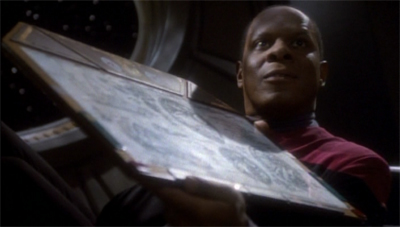
Dramatis Personae tends to get lost in the shuffle at the end of Star Trek: Deep Space Nine‘s first season. Sitting between two of the season’s most generic Star Trek stories (If Wishes Were Horses… and The Forsaken) and two distinctly Deep Space Nine classics (Duet and In the Hands of the Prophets), it’s easy to see why Joe Menosky’s tale of repeated history tends to get overlooked. It manages to sit quite neatly in both camps, as a generic Star Trek tale and as something more specific to Deep Space Nine.

After all, possession stories are scattered throughout the Star Trek mythos. Star Trek: The Next Generation was quite fond of have various members of the crew impersonated or doubled or controlled by a variety of alien influences. Dramatis Personae also feels like a very Joe Menosky script, linked by various thematic connections to the writer’s work on both The Next Generation and later on Star Trek: Voyager.

And yet, despite all those links, Dramatis Personae feels quite anchored to Deep Space Nine. It’s hard to imagine the dynamic working with any other Star Trek cast, even Voyager‘s Maquis and Starfleet ensemble. There’s also the sense that the episode’s pattern of repeated history feels more in keeping with Deep Space Nine‘s perception of history than any other Star Trek show’s.

The man with the plan...

The man with the plan…

Continue reading