












In a very real way, the Rick Berman era of Star Trek ends with Future’s End, Part I and Future’s End, Part II.
Future’s End, Part I and Future’s End, Part II marks the point at which Star Trek: Voyager stops moving forward. It is the point at which the show decides that it has accomplished just about everything that it could ever want to accomplish, and that it has crystalised into its final form. There are some changes still to come, with the introduction of Jeri Ryan in Scorpion, Part II and the departure of Jeri Taylor following Hope and Fear, but (by and large) the show has pretty much figured out the kinds of stories that it wants to tell and the ways in which it wants to tell those stories.

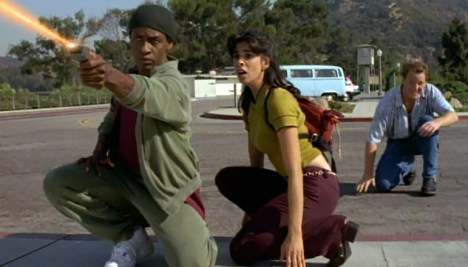
More like a hole-o deck character…
Future’s End, Part I and Future’s End, Part II feels like an appropriate place at which to draw that line in the sand. It is the two-parter that really introduces the concept of big blockbuster storytelling to Voyager, and which restructures the series as a mechanism through which generic Star Trek stories might be told. The template for the remaining three-and-a-half seasons can be found in this episode, from the “everything is back to normal” ending through to the idea of giving Janeway a a singular action-movie antagonist against which she might define herself.
The two-parter seems to freeze Voyager in amber, and set its storytelling sensibilities in stone. There will be no more experimentation, no more evolution. This is how things are to be from this point onwards. Appropriately enough, Future’s End, Part I and Future’s End, Part II mark the future’s end.

Tom and Tuvok’s Bogus Journey…
Filed under: Voyager | Tagged: Brannon Braga, future's end, henry starling, star trek, star trek: voyager, Temporal Cold War, time travel, voyager | 19 Comments »



 the m0vie blog