• Following Us

  • Categories

  • Check out the Archives


  • Awards & Nominations

Star Trek: Enterprise – Vanishing Point (Review)

Next year, Star Trek is fifty years old. We have some special stuff planned for that, but – in the meantime – we’re reviewing all of Star Trek: Enterprise this year as something of a prequel to that anniversary. This April, we’re doing the second season. Check back daily for the latest review.

Vanishing Point continues the “remix” formula that we’ve come to expect from the second season of Star Trek: Enterprise. In particular, Vanishing Point is a rather heady Star Trek: The Next Generation cocktail. It has shades of Remember Me, Realm of Fear, The Next Phase and even The Inner Light – with a healthy dose of Brannon Braga’s questions about the nature of reality. All of these elements blend together to form Vanishing Point, an episode that feels overly familiar and rote despite an intriguing set-up.

It is a shame that it doesn’t work better. Vanishing Point brings us back to the idea that Archer and his crew are pioneers in space exploration. The teaser reminds us that the crew of the Enterprise still don’t take the transporter for granted – that it is still something of a mystery to them, despite the audience’s familiarity with the device. Vanishing Point feels like the first time that Enterprise has emphasised this sense of novelty and inexperience since the first season.

Reflections...

Reflections…

However, the episode feels like something of a disappointment. The entire story turns out to be a gimmick and a twist. There is nothing wrong with this sort of storytelling. After all, the franchise has played these sorts of games before. Indeed, some of Braga’s best scripts – Frame of Mind and Projections come to mind – touch on similar ideas with similar twists. The problem with Vanishing Point is that these twists seem a bit too loose or too disconnected to properly resonate.

Vanishing Point feels like the rough sketch of a good episode doodled quickly on the back of a napkin, a collection of connective clauses all designed to keep the story ticking for forty-five minutes before ending on a fairly stock twist. There is a great deal of potential here, but Vanishing Point never quite delivers on it.
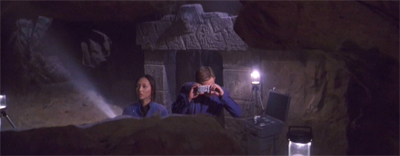
Trip Tucker: Space Tourist...

Trip Tucker: Space Tourist…

Continue reading

The X-Files – Pusher (Review)

This November (and a little of December), we’re taking a trip back in time to review the third season of The X-Files and the first (and only) season of Space: Above and Beyond.

Pusher is perhaps one of the most effective stand-alone “monster of the week” stories that the show ever did.

It is no wonder that the episode is frequently cited among the best episodes of The X-Files ever produced, but it is telling that it was identified by Slate as the perfect “gateway” episode of the show. If you want to give someone a taste of The X-Files without burdening them with continuity or back story, this is a good choice. It may not be the best episode that Vince Gilligan ever wrote, and it may not even be the best episode of the third season, but it is one the strongest demonstrations of what the show does on a weekly basis.

Mano a mano...

Mano a mano…

Pusher is the first episode that Vince Gilligan wrote after joining The X-Files writing staff. It is the only episode credited to Gilligan in the show’s third season. He had been offered a position on staff after turning in Soft Light at the end of the second season, but had hesitated before accepting the job. When he did accept the job, he came down with a dose of infectious mononucleosis. As a result, Gilligan only wrote one script for the third season, despite becoming one of the show’s most prolific writers.

Pusher is a pulpy delight, a spectacularly constructed standalone that perhaps points the way to Gilligan’s later work.

Gift of the gab...

Gift of the gab…

Continue reading

The X-Files – F. Emasculata (Review)

This August (and a little of September), we’re taking a trip back in time to review the second season of The X-Files. In November, we’ll be looking at the third season. And maybe more.

The wonderful thing about the second season of The X-Files is the spirit of experimentation. There’s a sense that the show is consciously pushing itself to try new things, to figure out what works. Watching the second season of the show, you can see the series’ outline beginning to take shape, even if it’s not full developed yet. The third season of The X-Files would seem a lot stronger and more cohesive, but it was building off the lessons learned during the second season.

Sometimes those experiments worked well. For example, the first stretch of the season demonstrated that the show could do an arc spanning multiple episodes. Colony and End Game established the foundations of the larger “colonisation” mythology even beyond “the government knows about aliens and they sometimes abduct people.” Episodes like Die Hand Die Verletzt and Humbug demonstrated that the show could do comedy stories and step outside its comfort zones.

Has everybody caught the Ebola bug?

Has everybody caught the Ebola bug?

Of course, there were a few narrative dead-ends as well, a few experiments that did not work as well as they might. Most notably, the tail end of the season leans rather heavily on science-fiction high-concepts. The elements introduced in Colony and End Game work well enough, but shows like Soft Light and Død Kälm feel almost like episodes of some other science-fiction anthology show. Still, there’s a sense that the show is trying to figure out what exactly it wants to be.

F. Emasculata is a wonderful example of that spirit of experimentation, effectively tapping into nineties health scares within the framework of a conspiracy thriller.

Everything burns...

Everything burns…

Continue reading

Star Trek – Music of the Spheres by Margaret Wander Bonanno (Review)

This August, to celebrate the upcoming release of Star Trek: Into Darkness on DVD and blu ray, we’re taking a look at the Star Trek movies featuring the original cast. Movie reviews are every Tuesday and Thursday.

We’ll be supplementing our coverage of the movies with tie-ins around (and related to) the films. We’ll be doing one of these every week day. This is one such article.

Music of the Spheres is something of a legend in Star Trek circles. It’s not quite a ghost story, spoken of in hushed whispers. Indeed, author Margaret Wander Bonanno has made the manuscript available to interested fans via her website, and has used it to raise money for a variety of worth causes. She’s documented the difficult story of how her original novel warped in Probe in a wonderfully wry and insightful essay, offering a glimpse at the inner workings of Pocket Book and Paramount towards the end of the eighties.

It’s a rare peek behind the curtain, with Music of the Spheres serving as a compelling vehicle to explore just what was going on inside Star Trek licensing in the late eighties and early nineties.

startrek-voyagehome8

Continue reading