• Following Us

  • Categories

  • Check out the Archives


  • Awards & Nominations

Star Trek: Voyager – Emanations (Review)

This September and October, we’re taking a look at the jam-packed 1994 to 1995 season of Star Trek, including Star Trek: Deep Space Nine and Star Trek: Voyager. Check back daily for the latest review.

Emanations has a pretty effective set-up and solid premise. It is very clearly one of Star Trek: Voyager‘s “planet of the week” stories – like the show directly before it and the show directly following it – but it’s build around some vaguely interesting ideas. It’s very clearly an episode designed to function as social commentary in the grand Star Trek tradition, hitting on big ideas and bold concepts.

Unfortunately, it’s not the type of script that Brannon Braga is best suited to handle. It doesn’t feel so much an exploration of an important issue as a social treatise. It’s simplistic and heavy-handed while dealing with ideas that require a bit of nuance and sophistication. It feels under-developed, contrived and a little shallow. Despite an attempt at ambiguity in its closing scene, it feels like an episode driven primarily by an agenda rather than a strong story.

Emanations is a misfire, another example of the weird tendency in the first season of Voyager to assign the wrong writers to the wrong scripts.
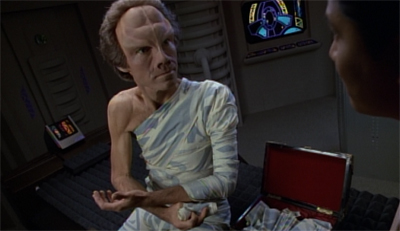
Harry really got wrapped up in local culture...

Harry really got wrapped up in local culture…

Continue reading

Star Trek: Voyager – The Cloud (Review)

This September and October, we’re taking a look at the jam-packed 1994 to 1995 season of Star Trek, including Star Trek: Deep Space Nine and Star Trek: Voyager. Check back daily for the latest review.

The Cloud feels more like a first season episode than Time and Again and Phage did. Star Trek: Voyager has ploughed fairly effectively into its first season, primarily by treating it as the eighth season of Star Trek: The Next Generation. However, the first season has been falling into a regular pattern so fast that pausing for forty-five minutes to do some awkward and ill-defined character work doesn’t feel like a bad idea.

The Cloud is an awkwardly constructed piece of television that feels like it’s interested in building up this ensemble. As such, the pacing suffers, and the episode makes a number of awkward mistakes along the way, but it still feels like it is at least trying to do something worthwhile.

Shaking things up around here...

Shaking things up around here…

Continue reading

Star Trek: Voyager – Parallax (Review)

This September and October, we’re taking a look at the jam-packed 1994 to 1995 season of Star Trek, including Star Trek: Deep Space Nine and Star Trek: Voyager. Check back daily for the latest review.

Parallax feels like a seventh season episode of Star Trek: The Next Generation nested inside a first season episode of Star Trek: Voyager. It’s Brannon Braga’s first script for the show, having opted to join Star Trek: Voyager rather than moving over to Star Trek: Deep Space Nine. Braga would go on to become one of the longest-serving creative forces on televised Star Trek, becoming an executive producer on Star Trek: Voyager and creating (and producing) Star Trek: Enterprise.

Braga is a fantastic high-concept science-fiction writer. His scripts for The Next Generation count among the best the show ever produced – Cause and Effect, Parallels, Frame of Mind. The team of Brannon Braga and Ronald D. Moore ranks as one of the most consistently great collaborations in the history of Star Trek. On his own, Braga writes fascinating sci-fi concepts. His scripts for the various shows support that.

The problem is that Braga isn’t the franchise’s strongest character writer. Indeed, among the staff writers working on the first season of Voyager, Braga seems like the worst candid to draft in to write the big “establishing character dynamics” episode directly following the pilot. The problem with Parallax is that it’s a nice premise featuring a bunch of characters we don’t care about yet, and the script is more interested in the anomaly of the week than it is in getting us to care about those characters.

"It's like looking into the future..."

“It’s like looking into the future…”

Continue reading

Star Trek: The Next Generation – The Enemy (Review)

This January and February, we’ll be finishing up our look at the second season of Star Trek: The Next Generation and moving on to the third year of the show, both recently and lovingly remastered for high definition. Check back daily for the latest review.

The Enemy is just a fantastic piece of television. The third season of Star Trek: The Next Generation has maintained an impressive consistency up to this point, despite all the difficulties bubbling away behind the scenes. However, The Enemy is the point where everything seems to have finally settled down and the show is truly comfortable churning out episodes of this sort of quality.

It’s a very typical Star Trek plot, with one of our leads trapped on the planet surface and forced to team up with an enemy soldier in order to survive. It’s a very standard morality tale about how the enemy is not as different as we might like to think; it’s an exploration – in a very Star Trek style – of how two people can overcome their differences in order to survive  a suitably desperate situation.

The Enemy is a demonstration of just how well-oiled The Next Generation had become at this point in time, and how even the most standard of plots could be executed with considerable skill.

The show's quality is climbing...

The show’s quality is climbing…

Continue reading

Star Trek: Deep Space Nine – Season 2 (Review)

Star Trek: Deep Space Nine is twenty years old this year. To celebrate, I’m taking a look at the first and second seasons. Check back daily for the latest review or retrospective.

Well, that’s more like it. The second season of Star Trek: Deep Space Nine might not rank with the very best of the franchise, but it doesn’t have to. Deep Space Nine is still a young show, and Star Trek spin-offs have a long history of taking their time to find their feet. The second season of Deep Space Nine contains its fair share of classic or memorable episodes, but it’s defined by a sense that the producers are still trying to figure out what works and what doesn’t.

While the first season occasionally felt like the series was stumbling back towards safety, trying to become a lighter version of Star Trek: The Next Generation as faith in its premise wavered, the second season is a lot more confident in itself. It’s willing to play around a bit to figure out how to be the show that it wants to be. And there’s a sense, as the season winds to a close, that we’re almost there.

By the time we hit the second half of the season, it seems the show has learned to churn out inoffensive episodes that feel unique and distinctively Deep Space Nine – episodes like Playing God or Shadowplay. However, it’s in the final third that the show seems to figure out how make truly great episodes of Deep Space Nine.

ds9-playinggod22

Continue reading