• Following Us

  • Categories

  • Check out the Archives


  • Awards & Nominations

Star Trek – Shore Leave (Review)

To celebrate the release of Star Trek: Into Darkness this month, we’ll be running through the first season of the classic Star Trek all this month. Check back daily to get ready to boldly go. It’s only logical.

When I talk about the surreal sixties energy that really holds quite a bit of Star Trek together, it’s quite possible that it sounds like a back-handed compliment, a cheap and easy gig at a cult television show. However, I mean that sincerely. When I argue that the illogical and somewhat scattershot dynamism of the last act of Court Martial can barely hold the patchwork script together, it’s quite possible that I sound like I’m being sarcastic. However, my affection for the mad-cap mayhem particular to the first iteration of Star Trek is entirely genuine. Although it makes no sense, the climax to Court Martial isn’t the problem. Everything leading up to it is.

I think Shore Leave is pretty much the perfect iteration of this concept. It is, from start to finish, absolutely insane nonsense that threatens to fall apart if one concentrates too hard on any particular detail. However, it’s executed with enough energy and drive that it becomes a compelling and surreal piece of television, and one of the best illustrations of the kind of weirdness that the classic Star Trek could pull off almost effortlessly.

No bunny business...

No bunny business…

Continue reading

Star Trek – The Menagerie, Part II (Review)

To celebrate the release of Star Trek: Into Darkness this month, we’ll be running through the first season of the classic Star Trek all this month. Check back daily to get ready to boldly go. It’s only logical.

I will admit that I am sceptical of Gene Roddenberry as a writer. There’s no denying that Roddenberry was a fantastic ideas man. After all, his concepts and characters have stood the test of time. Without Roddenberry, there would be none of the Star Trek that we all love so dearly. As such, I feel a little guilty when I criticise his writing, or when I argue that his influence on the early years of Star Trek: The Next Generation held the show back from greatness. (I’d suggest that it was only when Roddenberry’s involvement was minimised, and the writers were allowed to add shading to his futuristic utopia that The Next Generation truly came into its own.)

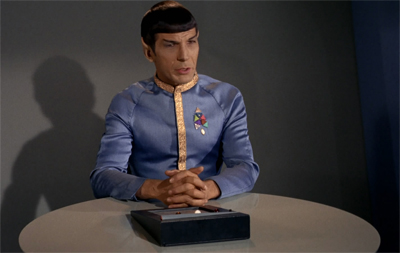
Still, Roddenberry was always an excellent salesman, and his script for The Menagerie brings out that quality in abundance. The Menagerie is effectively an excuse for why the show ran out of original scripts half-way through its first year, and Roddenberry might not make the most convincing argument, but he still makes it compelling.

Watching Star Trek on Star Trek...

Watching Star Trek on Star Trek…

Continue reading

Star Trek – The Menagerie, Part I (Review)

To celebrate the release of Star Trek: Into Darkness this month, we’ll be running through the first season of the classic Star Trek all this month. Check back daily to get ready to boldly go. It’s only logical.

Ah, clip shows. The bane of modern television. Okay, I’m being a bit harsh. After all, home media is a relatively recent invention. Up until the past couple of decades, it seemed that most people would only catch their television shows on… well, television. The audience was generally thought to be somewhat transient, the realities of scheduling and life making it highly unlikely that everybody would see everything. Indeed, most fans of old television shows found themselves at the mercy of fickle network schedules. Particularly for long-running shows, it was reasonable to assume that a significant portion of your audience might not be intimately familiar with the show.

Of course, the emergence of DVD box sets and on-line streaming have radically changed the way that television operates. Most obviously, there has been a massive a swing towards serialisation in the past few years, overlapping with the expansion of home media. While it’s tough to imagine a show like The Wire or Game of Thrones working in the early nineties, the fact that people can record and download and own their television shows means that producers can get away with assuming that everybody has seen everything.

What I’m getting at here  is that there was a time when clip shows were an understandable, maybe even desirable, part of the network television landscape. They could bring new viewers up to speed, or allow old viewers to celebrate the favourite parts of the show that they would otherwise never see again. Indeed, The Menagerie, the only two-part episode of the classic Star Trek, has a better excuse than most. The clip sections of this adventure are taken from the 1964 pilot, The Cage. Not only was this footage two years old when The Menagerie was broadcast, it had also never been aired.

Spock the difference...

Spock the difference…

Continue reading

Star Trek: Early Voyages #12-15 – Futures, Parts I, II, III & IV (Review)

To celebrate the release of Star Trek: Into Darkness this month, we’ll be running through the first season of the classic Star Trek all this month. Check back daily to get ready to boldly go. It’s only logical.

We’ll be supplementing our coverage of the episodes with some additional materials – mainly novels and comics and films. This is one such entry.

As we discussed before, Star Trek: Early Voyages is about as close to a series starring Christopher Pike as we are ever likely see. A monthly comic book running for about a year-and-a-half, told by Dan Abnett and Ian Edginton, the book followed the adventures of Christopher Pike’s Enterprise, a prelude to the classic Star Trek television show, filling some gaps left by The Cage and The Menagerie. However, the comic had the benefit of being told after a lot of Star Trek had aired.

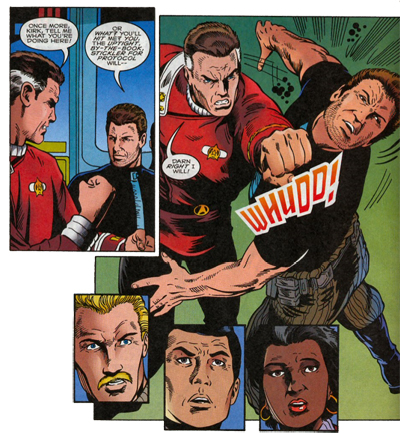
First published in 1997, it hit stands after the big-screen adventures of the Kirk era had officially wrapped up in Star Trek: Generations, and long after Star Trek: The Next Generation had gone off the air. Even Star Trek: Deep Space Nine was more than half way through its run. This puts Early Voyages in an interesting place. It is set in the past, but knows how the future plays out. The epic four-part Futures storyline plays with this concept, offering us a glimpse of an imperfect future where Captain Kirk is a rogue running a cargo ship, the Klingons have annexed considerable portions of the Federation and are on the verge of war…

Oh, and Christopher Pike is happy. That’s how you know it’s a flawed universe.

"And THAT is for stealing my show!"

“And THAT is for stealing my show!”

Continue reading

Star Trek – Court Martial (Review)

To celebrate the release of Star Trek: Into Darkness this month, we’ll be running through the first season of the classic Star Trek all this month. Check back daily to get ready to boldly go. It’s only logical.

It’s hard not to be impressed by the sheer versatility of Star Trek as a format. For a show about exploring the universe, the creators have really managed to incorporate just about any and all genres of television story. Over the franchise’s 700-episode history, there’s been a wealth of quirky episodes that explore types of stories that one might consider quite surreal for a show about a ship travelling to the stars. A court room episode might not be the most radical of these shifts, but Court Martial is still fascinating as an evolution of Star Trek as a concept, broadening the kind of stories that could be told within a Star Trek framework. After all, the fact that there’s a whole subgenre of Star Trek involving court room drama is probably rooted in this first-season adventure.

While its influence is absolutely massive, Court Martial is still a problematic episode. Despite demonstrating what writers could really do within the context of the show, Court Martial suffers because it’s really not that good.

Running rings around the prosecution...

Running rings around the prosecution…

Continue reading

Star Trek – Dagger of the Mind (Review)

To celebrate the release of Star Trek: Into Darkness this month, we’ll be running through the first season of the classic Star Trek all this month. Check back daily to get ready to boldly go. It’s only logical.

I knew we were due a nice Shakespearean title soon. And The Conscience of a King is just around the corner, to boot. Seriously though, I have to admit a massive fondness for these wonderfully lofty and high-minded episode titles. It’s something that links the original Star Trek and Star Trek: Deep Space Nine quite firmly, and was sadly never enthusiastically taken up by any of the other spin-offs. It’s a shame, because – regardless of the quality of the episodes in question – there’s something undeniably endearing about forty-five minutes of television given a pretentious name like For the World is Hollow and I Have Touched the Sky, The City on the Edge of Forever or Wrongs Darker Than Death or Night.

A scream...

A scream…

Continue reading

Non-Review Review: Star Trek – Into Darkness

Note: This is a spoiler-heavy review. If you want a spoiler-lite recommendation, click here. If not, continue at your own risk.

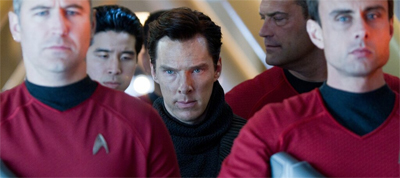
Towards the climax of Star Trek: Into Darkness, Kirk and the Enterprise flee an aggressor by entering warp. At that speed, several factors the speed of light itself, they surmise that they must be safe from their pursuer. Of course, they prove to be wrong – brutally so. Everything in Into Darkness moves fast, so fast that the Enterprise’s top speed seems more like a casual jog than a breakneck acceleration. The plot rockets along with incredible speed, from plot point to plot point, counting on the momentum to sustain the film and carry it across the line.

There is enough material here to produce a trilogy of films. Indeed, cynics might suggest that a lot of the movie’s iconography and plot points are indeed recycled from the central “trilogy” of the original Star Trek films, running from the homages to Star Trek II: The Wrath of Khan right down a climactic visual reference to Star Trek IV: The Voyage Home. Abrams and his team of writer continue their work from 2009’s breakout blockbuster Star Trek by putting the franchise’s most compelling images and cues into a high-speed blender.

Into Darkness just substantially increases the concentration.

Seeing red...

Seeing red…

Continue reading

Star Trek – What Are Little Girls Made Of? (Review)

To celebrate the release of Star Trek: Into Darkness this month, we’ll be running through the first season of the classic Star Trek all this month. Check back daily to get ready to boldly go. It’s only logical.

What Are Little Girls Made Of? is the first episode from a script written by Robert Bloch, perhaps best known as the author of Psycho. Interestingly, it wasn’t the first script Bloch wrote for the show. Apparently Bloch contributed Catspaw first, when the show asked him for a Halloween special, even though it wouldn’t be produced until the series’ second year. And, to be fair, you can sense that What Are Little Girls Made Of? is a bit more comfortable with the Star Trek conventions than Bloch’s other two episodes. An uncredited re-write from Gene Roddenberry probably helped.

With Bloch’s third script, Wolf in the Fold, serving as a loose adaptation of (or spiritual successor to) his celebrated short story Yours Truly, Jack the RipperWhat Are Little Girls Made Of? stands out among Bloch’s contributions to the show. It’s an iconic episode, one that has undoubtedly influenced the way that we remember Star Trek, serving as the source for all manner of Star Trek memes like Kirk overwhelming a hot android with his sexual charisma, and defeating a less physically attractive robot with a logic puzzle. It features some of the most iconic costuming of the original Star Trek show, and also serves as the root of the whole “what constitutes life?” philosophical strand that would find itself embodied by Data on Star Trek: The Next Generation.

It helps that, like so much of this first season of Star Trek, it is just good pulpy fun.

A cold reception...

A cold reception…

Continue reading

Non-Review Review: Star Trek – Into Darkness

Note: This is a spoiler-lite review. If you want a spoiler-heavy in-depth look at the film, click here.

Towards the climax of Star Trek: Into Darkness, Kirk and the Enterprise flee an aggressor by entering warp. At that speed, several factors the speed of light itself, they surmise that they must be safe from their pursuer. Of course, they prove to be wrong – brutally so. Everything in Into Darkness moves fast, so fast that the Enterprise’s top speed seems more like a casual jog than a breakneck acceleration. The plot rockets along with incredible speed, from plot point to plot point, counting on the momentum to sustain the film and carry it across the line.

There is enough material here to produce a trilogy of films. Indeed, cynics might suggest that a lot of the movie’s iconography and plot points are indeed recycled from the central “trilogy” of the original Star Trek films, running from the homages to Star Trek II: The Wrath of Khan right down a climactic visual reference to Star Trek IV: The Voyage Home. Abrams and his team of writer continue their work from 2009’s breakout blockbuster Star Trek by putting the franchise’s most compelling images and cues into a high-speed blender.

Into Darkness just substantially increases the concentration.

Seeing red...

Seeing red…

Continue reading

Star Trek – The Man Trap (Review)

To celebrate the release of Star Trek: Into Darkness this month, we’ll be running through the first season of the classic Star Trek all this month. Check back daily to get ready to boldly go. It’s only logical.

It really is amazing how busy the Star Trek universe is. Or, well, how busy it was at one point. Although there are plenty of alien civilisations scattered across the vast gulf space, numerous empires vying for power and glory, the first season of Star Trek seems fixated on the notion that the universe is packed with the relics and ruins of long-dead civilisations. The Man Trap is just one example, as Kirk and his crew investigate an archaeological dig on the planet M-113, decorated with “the ruins of an ancient and long-dead civilisation.” Of course, the civilisation isn’t quite dead, but there’s a definite funereal atmosphere about The Man Trap.

That somewhat grim atmosphere makes the show’s fixation on long-dead worlds somewhat fascinating, given how the series is primarily about mankind’s optimistic future. However, it creates a sense – palpable throughout the first year of Star Trek – that the human race is a relatively new arrival on the scene, but emerging following the collapse and decay of countless ancient civilisations. It’s an old universe, but it’s a new dawn.

Suckers!

Suckers!

Continue reading