• Following Us

  • Categories

  • Check out the Archives


  • Awards & Nominations

The X-Files: Season 10 (IDW) #8 – Being for the Benefit of Mr. X (Review)

This June, we’re going to be taking a look at the current run of The X-Files, beginning with the IDW comic book revival and perhaps taking some detours along the way. Check back daily for the latest review.

Being for the Benefit of Mr. X is effectively another origin story, following on from Hosts.

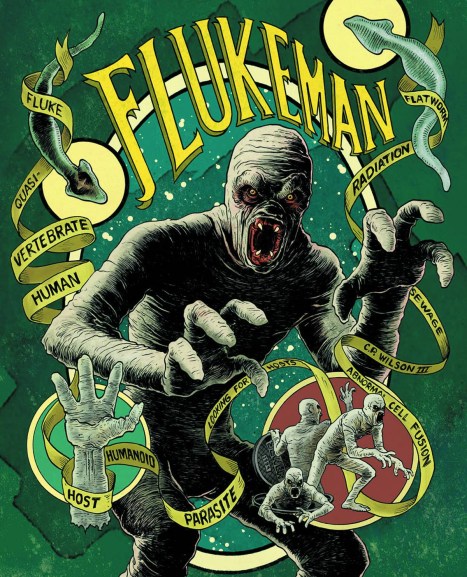
While Hosts explained exactly how the Fluke Man came to be, and even gave the character tangible motivation, Being for the Benefit of Mr. X is largely driven by flashbacks that proceed to explain and elaborate upon Mulder’s second informant. Mister X has long been one of the franchise’s most interesting and underdeveloped character, in part owing to the fact that the show fleshed out very little about him and in part due to Steven Williams’ performance. While the show revealed a lot about Deep Throat or the Cigarette-Smoking Man, Mister X remains a mystery.

Marking the spot.

Marking the spot.

The question, of course, is what this actually adds to the story being told. It is fun to revisit the origin of Mister X, but he is very much an outdated concern at this point in the show’s life. In fact, the character’s last appearance was in flashback in Unusual Suspects at the start of the fifth season, following his death in Herrenvolk at the start of the fourth season. Unlike the Cigarette-Smoking Man, Mister X was never literally resurrected. Unlike Deep Throat, he never turned up to haunt Mulder in episodes like The Blessing Way or The Sixth Extinction II: Amor Fati.

It is not as if writer Joe Harris has constructed a particularly compelling origin story for Mister X. The story told in Being for the Benefit of Mr. X is solid and sturdy, integrating quite smoothly with the continuity of the show and the character as we understand it. However, there are no real surprises or tangents, no twists or surprises. Being for the Benefit of Mr. X is a solid “done in one” story. It just feels a tad unnecessary.
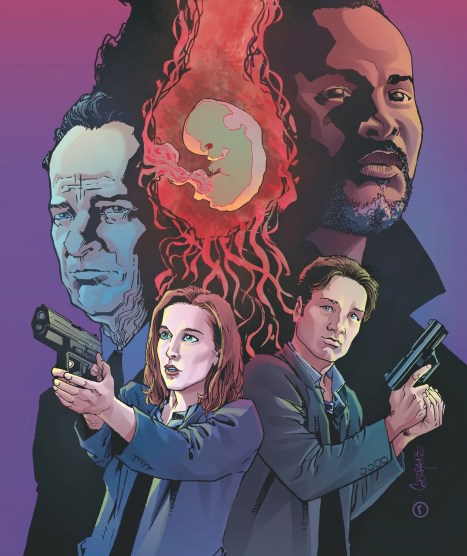
In too Deep (Throat)...

In too Deep (Throat)…

Continue reading

The X-Files: Season 10 (IDW) #6-7 – Hosts (Review)

This June, we’re going to be taking a look at the current run of The X-Files, beginning with the IDW comic book revival and perhaps taking some detours along the way. Check back daily for the latest review.

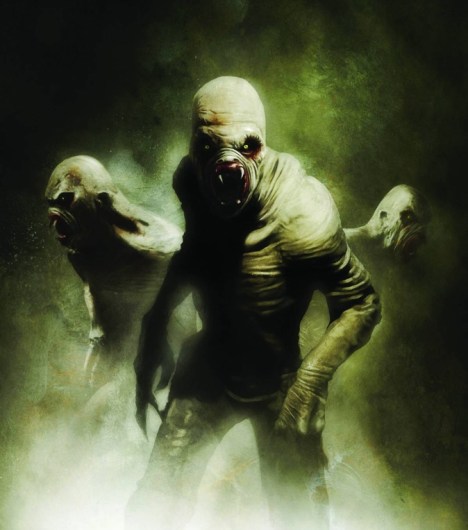
Balance was always going to be an issue for The X-Files: Season 10, even in a purely logistical sense.

At its peak, The X-Files was churning out twenty-six episodes in a season. Of those, maybe a third would be mythology episodes and the rest would be standalone monster of the week stories. As a result, the show could find the time to balance earth-shaking mythology episodes like Paper Clip, Nisei, 731 and Talitha Cumi with brilliant episodic television like Clyde Bruckman’s Final ReposeOublietteGrotesquePusher and Jose Chung’s “From Outer Space.” Part of the appeal of The X-Files was always striking that balance.

No Fluke.

No Fluke.

That is not really possible with a conventional comic book release schedule. Comic books are released once a month, limiting the creative team to twelve issues in a given year. They might also get an annual, if the comic is popular. Given modern comic book narrative conventions and the lower page counts of modern comics, “done-in-one” standalone stories are increasingly uncommon. At best, it seems like a creative team might get away with seven stories in a year, six two-parters and an annual.

This causes issues in structuring a comic book season of The X-Files. Quite cleverly, The X-Files: Season 10 runs for twenty-five issues, evoking the length of a classic television season. However, it tells far fewer stories, with the run dominated by epic sprawling mythology stories like the five-part Believers, the five-part Pilgrims and the five-part Elders. That is three-fifths of the “season” given over to three mythology stories. It is no wonder that the rest of the run feels so compressed.

Worming his way back to you...

Worming his way back to you…

Continue reading

Scott Snyder & Greg Capullo’s Run on Batman – Endgame (Review)

This March sees the release of Batman vs. Superman. To celebrate, we’ll be looking at some iconic and modern Batman and Superman stories over the course of the month.

Scott Snyder and Greg Capullo’s Batman has been lodged in a constant state of apocalypse.

The duo have framed Batman as a blockbuster comic book, to the point that it seems like Batman stares down the end of all things more often than the rest of the superheroes in Geoff Johns’ Justice League. All of Snyder and Capullo major stories have placed Gotham City on the edge of the abyss, teetering (and even falling) into darkness. It is a sharp contrast to the lower key threats of Snyder’s work on The Black Mirror, very consciously a stylish affectation to reflect the fact that Batman is very much one of the comic book industry’s blockbuster title.

Bringing back the laughs...

Bringing back the laughs…

In The Court of Owls, Gotham finds itself subjected to a long night of terror by an army of undead assassins. In Death of the Family, the Joker carves his way across the city. In Zero Year, the origin of Batman is tied to a disaster on the scale of No Man’s Land. Even outside of his work on the main title, Snyder’s role as “executive producer” of Batman Eternal saw yet another apocalypse visited upon Gotham in a relatively short space of time. It becomes exhausting after a while.

To be fair, it is reasonable to ask whether this is just part of a larger cultural context. Pop culture has always been fascinated with the end of the world, but it seems increasingly fixated on the concept in recent years. The popularity of the zombie genre is just one example, but any list of critically and commercially successful art in the twenty-first century will confront the reader with multiple ends of all things. The Walking Dead, The Road, Mad Max: Fury Road, Jericho, Revolution, Book of Eli, and so on and so forth.

"Hm. Maybe we should consider counselling...?"

“Hm. Maybe we should consider counselling…?”

However, popular culture is not just fascinated with post-apocalyptic horror. Increasingly, media engages with the question of what the end of the world will look like, rather than the question of how we might survive it. Fear the Walking Dead depicts the end of the world that led to its sister series. Chris Carter revived The X-Files so that the final episode could depict the end of the world as foreshadowed across the original nine-season run. With advances in CGI, blockbusters like The Avengers and Man of Steel can render destruction on an impossible scale.

As such, Scott Snyder and Greg Capullo’s recurring fascination with the end of all things exists as part of a broader cultural context. Still, the writer and artist seem to position Endgame as the ultimate apocalypse for its two central characters.

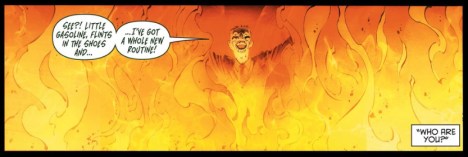
Burning down the house...

Burning down the house…

Continue reading

Batman – Knightfall (Review/Retrospective)

This March sees the release of Batman vs. Superman. To celebrate, we’ll be looking at some iconic and modern Batman and Superman stories over the course of the month.

Knightfall is one of the definitive Batman stories.

That is, to be clear, not the same as saying it is one of the best. Knightfall is far too chaotic and disorganised to rank among the best Batman stories ever told. This becomes particularly obvious when the story enters its second and third act, as everything falls to pieces and the saga sort of sputters out rather than coming to a clear end. Indeed, this problem can be seen even in the nineteen-issues-and-change introductory arc; the creative teams start with a strong focus and clear direction, but this quickly descends into anarchy as the story builds a forward momentum.

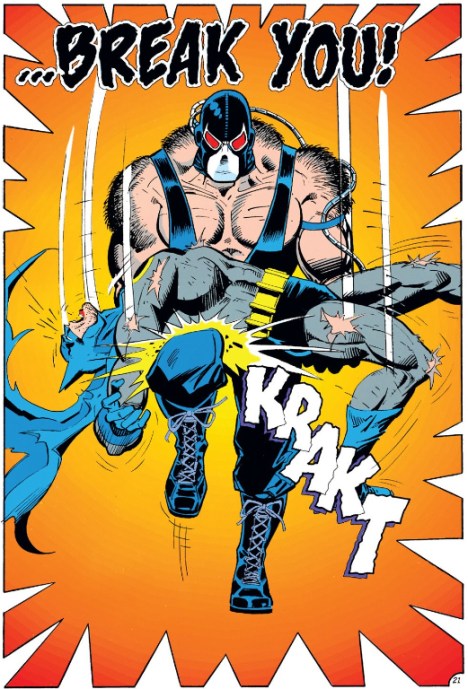
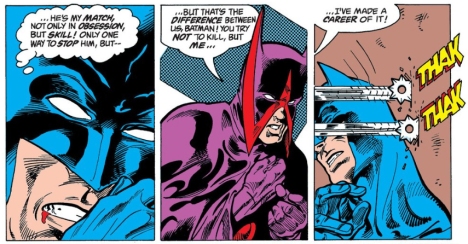
Batman just snapped...

Batman just snapped…

At the same time, there is something striking and ambitious about Knightfall. It is no surprise that Denny O’Neil considers it one of his crowning accomplishments as editor of the line. Asked to name his favourite Batman arc, O’Neil replies, “I guess it would be Knightfall because it involved me so deeply–I worked on it as a comic series, a novel, and a radio show. It was a very steep mountain to climb, but we climbed it and that was satisfying.” There is no denying the influence and success of the arc.

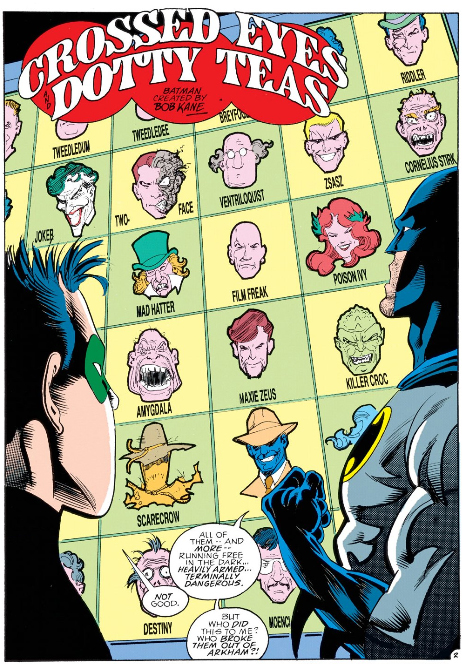
In some respects, Knightfall is an astonishingly cynical piece of work. It is quite blatantly designed as a crossover with a high-profile guest cast and killer high concept. Indeed, Knightfall could be seen as a headline-grabber in the style of The Death and Return of Superman, but with the added hook of Batman’s iconic rogues gallery. After all, it was the nineties, the era of sensationalist headline-grabbing sales stunts. It could be argued that comics (and mass culture) have always been stuck in this cycle, but it was particularly evident in nineties comic books.

All of Batman's greatest adversaries... ... and Maxie Zeus.

All of Batman’s greatest adversaries…
… and Moench.

However, Knightfall has two core virtues that go a long way towards excusing the confusion and excess at the heart of the story. The first is that there is a sense that the writers seemed to have a (very) rough idea where they would like to end up, even if the journey was not mapped in advance. While the plot resolves with a convenient and contrived twist, at least it does not hinge on Bruce magically waking up from a coma. More than that, though, there is a sense that Knightfall is actually trying to say something about its central character.

For all the noise and static along the way, Knightfall is essentially a story about Batman means in the context of the nineties.

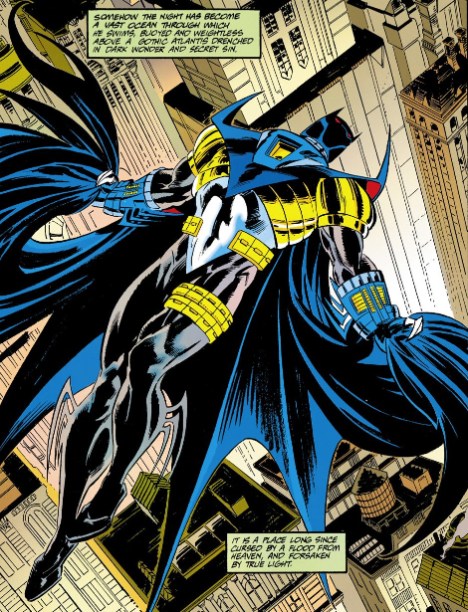
Armoured and dangerous...

Armoured and dangerous…

Continue reading

Scott Snyder and Jim Lee’s Superman Unchained (Review)

This March sees the release of Batman vs. Superman. To celebrate, we’ll be looking at some iconic and modern Batman and Superman stories over the course of the month.

Superman Unchained is a big deal.

It arrives in the character’s seventy-fifth anniversary year. It is designed to tie into the release of Man of Steel, launching two months after Zack Snyder’s cinematic adaptation. It is also the flagship Superman title, launching three months after Grant Morrison finished up on Action Comics and existing free of the line-wide crossovers haunting the Superman line. It slots comfortably into the niche between the end of Grant Morrison’s Action Comics run in May 2013 and the new direction for Superman dictated by the “DC You” re-branding in June 2015.

Let's get ready to rumble...

Let’s get ready to rumble…

Superman Unchained is also the work of an a-list creative team, written by superstar writer Scott Snyder and illustrated by DC co-publisher Jim Lee. The only higher profile team that DC comics could have assembled would have been to team Jim Lee with Geoff Johns, as they did launching Justice League back in September 2011. In fact, Geoff Johns would do his part to help revitalise the Superman line when he teamed up with John Romita Jr. on the Superman title, marking the artist’s first work non-crossover work at DC.

So Superman Unchained is very much a big deal for the character, and represents a conscious effort by DC to bring Superman to the fore. However, what is most striking about Superman Unchained is how old-fashioned and narratively conservative it seems, particularly when juxtaposed with Grant Morrison and Greg Pak’s work on Action Comics. In a way, this fits with the anniversary branding and the mass market push; this is very much your grandfather’s Superman.

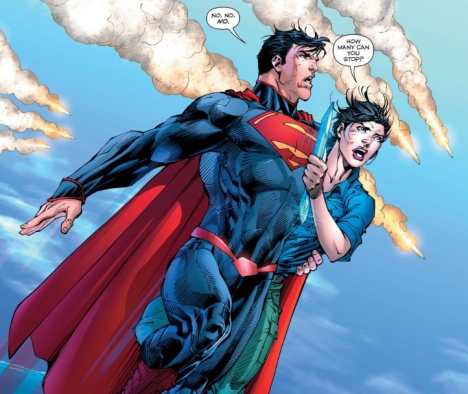
Up in the sky!

Up in the sky!

Continue reading

Batman Special #1 (1984) – The Player on the Other Side (Review)

This March sees the release of Batman vs. Superman. To celebrate, we’ll be looking at some iconic and modern Batman and Superman stories over the course of the month.

Mike W. Barr is one of the great Bronze Age Batman writers, a writer with a clear vision of what he expects Batman to be and with a body of work that seems build around that principle.

One of the interesting aspects of Batman is the character’s flexibility and ubiquity. Batman can be virtually anything that a writer needs him to be, and it does little to dilute the brand because there are so many other writers working on the character – often at the same instant. Even when a particular writer is working on the character, they cannot claim exclusivity. Grant Morrison’s version of the Dark Knight is distinct from Scott Snyder’s take on the Caped Crusader, for example.

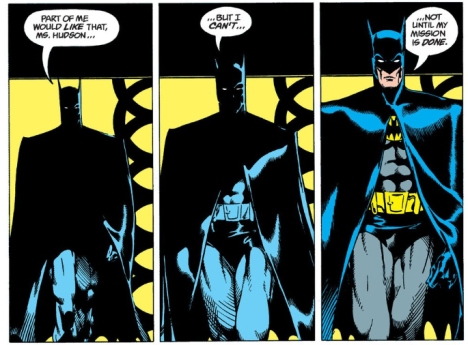
Long Dark Knight of the soul...

Long Dark Knight of the soul…

Perhaps, as a result of this, there is more freedom for writers to craft their own unique take on Batman. Mike Barr wrote Batman across a variety of different titles over a considerable stretch of time. Barr had written random stories in Detective Comics dating back to the seventies, and had provided occasional scripts to Batman since the start of the eighties. He would continue to work sporadically on the character into the nineties and the new millennium, contributing scripts to stories like In Darkest Knight into the nineties and beyond.

However, Barr’s longest sustained work on the character came in the eighties. He wrote Batman as the headline character of Batman and the Outsiders for the first thirty-two issues of the title, collaborating with artists Jim Aparo and Alan Davis. He enjoyed a sustained run on Detective Comics with artist Alan Davis that overlapped with Frank Miller and David Mazzucchelli’s iconic Batman: Year One run. The run culminated in Batman: Year Two. He and Davis also collaborated on Full Circle. He wrote Son of the Demon and Bride of the Demon.

"Face my Wrath!"

“Face my Wrath!”

Barr had considerable influence on the evolution of the character Batman. Grant Morrison’s creation of Damian Wayne, for example, was heavily influenced by Barr’s work on Son of the Demon. In a larger sense, Barr’s willingness to reintroduce classic Silver Age concepts into continuity following Crisis on Infinite Earths paved the way for more flexible interpretations of the Dark Knight. Barr is frequently overlooked in discussions of the character’s history, which is entirely understandable given that his most high-profile work overlapped with one of the greatest Batman stories ever told.

Still, as influential as Barr was on future depictions of the Dark Knight, it is clear that the writer had an internally consistent vision of the Caped Crusader, with a number of themes and ideas that he would visit time and time again in his work featuring the Dark Knight. Although The Player on the Other Side comes before Barr’s most extended and high-profile solo work on the character, those themes are most definitely present.

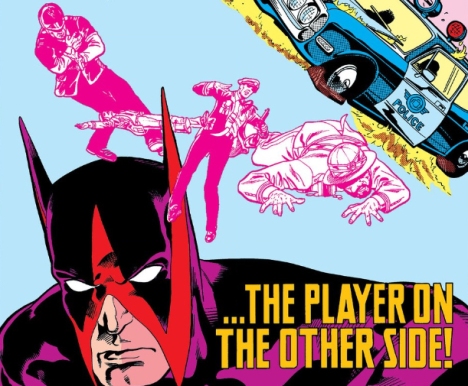
Batman Special I: The Wrath of Wraith.

Batman Special I: The Wrath of Wrath.

Continue reading

Grant Morrison’s Run on Action Comics (Review/Retrospective)

This March sees the release of Batman vs. Superman. To celebrate, we’ll be looking at some iconic and modern Batman and Superman stories over the course of the month.

On paper, Grant Morrison and Rag Morales’ Action Comics should have been a slam dunk.

The title was announced as part of DC’s “new 52” relaunch, a resetting of the comic book giant’s continuity beginning in September 2011. Designed to revitalise the line, shoring up sales numbers and providing a clear point of entry, the “new 52” was clearly intended as a “jumping on” point for new and lapsed comic fans. It was bold and radical, an even greater departure for the company than their reboot following Crisis on Infinite Earths back in 1986. The comic book publisher gave themselves a blank slate.

Wow, he IS more powerful than a locomotive...!

Wow, he IS more powerful than a locomotive…!

In theory, this was a great idea; anything was possible and everything was on the table. In practice, the execution was more muddled; the massive experiment curtailed by a very conservative aesthetic. In many respects, the “new 52” felt like more of the same; familiar mid-tier talent working on familiar mid-tier ideas. The most interesting books were those that dared to do things differently; Scott Snyder inverting Alan Moore’s brilliant twist on Swamp Thing made for iconoclastic reading, as did Brian Azzarello’s ground-up reimagining of Wonder Woman.

In contrast, a lot of the line felt like hedging. Hellblazer was cancelled so that John Constantine could be dragged under the corporate umbrella in Justice League Dark, all in the name of coporate synergy. The Wildstorm characters were ported over into mainstream continuity, in spite of the fact that they were largely redundant or incompatible. Instead of courting either exciting new talent or industry veterans, the company had difficulty drawing top-tier talent. Scott Lobdell and Rob Liefeld were among the relaunch’s heavy hitters.

... And what was that about speeding bullets?

… And what was that about speeding bullets?

To be fair, there were bright spots. But the ideas and concepts that were interesting were frequently hobbled by the demands of the publisher. All-Star Western was diminished by having to tie to Gotham City continuity, while attempts at genre diversity in books like Demon Knights or I, Vampire were under-promoted. Emphasis was placed squarely on monthly print sales numbers, with little patience for books to grow their audiences whether online or through collected editions.

In spite of all the confusion and chaos of the relaunch, Grant Morrison writing Action Comics was the cause of considerable excitement. Morrison was one of few comic book writers who could legitimately be described as a superstar, arguably with a higher profile outside mainstream comics than executives Jim Lee and Geoff Johns. Having Morrison on a monthly book was a big deal, particularly a monthly book as important to the company’s legacy as Action Comics. (Then again, the relaunch also chose to put Tony Daniel on Detective Comics, so there’s that.)

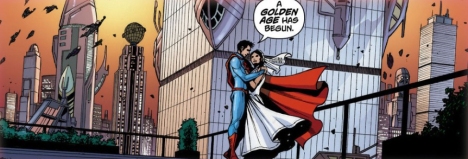
Happily never after...

Happily never after…

More than that, the book represented something of a homecoming for Morrison. Although the character of Superman had struggled with issues of relevance in the twenty-first century, Morrison had been the architect of one of the character’s most beloved stories. All-Star Superman is widely regarded as one of the best Superman stories ever published. Having its author writing a monthly book as part of the relaunch was a big deal. Following high-profile misfires like New Krypton or Grounded, it seemed like the perfect opportunity to put Superman back on the right course.

In many respects, Grant Morrison’s run on Action Comics typifies the sort of push-and-pull at the publisher as part of the relaunch. The great ideas smothered by corporate mandates, the tension between familiarity and novelty, the burden of expectation even while trying to chart a new course. For better or worse, Action Comics could be seen as the flagship of DC’s “new 52” initiative. This seems entirely appropriate, given the title’s historical significance to DC comics.

Running jump...

Running jump…

Continue reading

Batman – Vengeance of Bane #1 (Review/Retrospective)

This March sees the release of Batman vs. Superman. To celebrate, we’ll be looking at some iconic and modern Batman and Superman stories over the course of the month.

Bane is a fascinating creation, arguably the most important addition to Batman’s rogues gallery since Denny O’Neil and Neal Adams created Ra’s Al Ghul in the early seventies.

There have been important villains added since. Jeph Loeb and Jim Lee created Hush, a character who has subsequently been developed and expanded by Paul Dini and Dustin Nguyen; Hush has popped up with surprising frequency in various Batman media, even being incorporated into the weekly series Batman Eternal in a major way. It will be interesting to see how Lincoln March and the Court of Owls endure after Scott Snyder and Greg Capullo finish their run on Batman. Still, Bane towers above all of those.

"When Gotham is ashes..."

“When Gotham is ashes…”

Continue reading

Batman: Sword of Azrael (Review)

This March sees the release of Batman vs. Superman. To celebrate, we’ll be looking at some iconic and modern Batman and Superman stories over the course of the month.

Given how messy Knightfall ended up, readers would be forgiven for assuming that the Batman editorial staff had been making it up on the fly.

To a certain extent, the editors and writers were effectively making it up as they went along. According to writer Greg Rucka, the big Batman events of the nineties were not so much mapped out as loosely plotted. The creative talent had some vague idea of where they wanted to go and what they wanted to accomplish, but not necessarily the particulars of how they would get there or how they would accomplish it. After all, Rucka’s novelised adaptation of No Man’s Land had a different ending to the comic book because the novel had to be finished ahead of time.

All fired up...

All fired up…

Reading Knightfall, it quickly becomes clear that the writers had no real idea about how they wanted the story to unfold. The event has a fairly solid first act, but its second act is cluttered and much of the resolution is messy and unsatisfying. At the same time, it is clear that the writers had some idea of what they were doing and where they were going; at least in the beginning. As much as the sprawling nineties even might bungle the pay-off, it benefits from a very careful and meticulous set-up.

A lot of the key elements of the Knightfall saga were set up and signposted ahead of time. The months leading up to the start of Knightfall in April 1993 were quite busy at the Batman offices. Shondra Kinsolving was introduced in November 1992. Bane was introduced in a special one-shot in January 1993, The Vengeance of Bane, that provided the back story of the new antagonist. Bridging these two milestones was the miniseries Batman: Sword of Azrael, introducing the character who would step into the vacancy left by the broken bat.

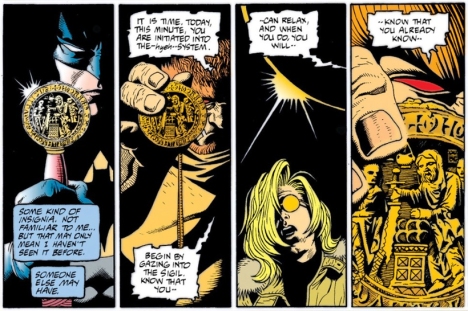
Medallion man.

Medallion man.

Continue reading

The Adventures of Superman – The Sound of One Hand Clapping (Review)

This March sees the release of Batman vs. Superman. To celebrate, we’ll be looking at some iconic and modern Batman and Superman stories over the course of the month.

Max Landis has a relatively unique path to writing for Superman.

Landis is one of the most striking young writers to emerge from Hollywood in quite some time, making a strong impression through his collaboration with Josh Trank in the low-budget found-footage superhero film Chronicle. Landis has diversified somewhat since that original screenplay; a filmography that includes films like Mr. Right, American Ultra and Victor Frankenstein suggests that Landis’ interests lie more in unconventional pairings than in the superhero genre itself.

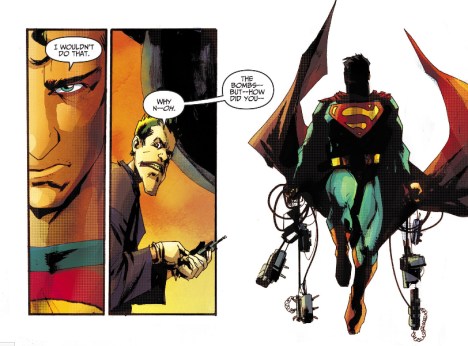
The Joker's gags really bombed...

The Joker’s gags really bombed…

Nevertheless, Landis is a writer who does seem fascinated with the mechanics and underlying logic of superhero storytelling. A year before the release of Chronicle, Landis put together a short film that served as an extended discussion of The Death and Return of Superman featuring a variety of top tier talent like Mandy Moore, Elijah Wood, Ron Howard and Simon Pegg. At once reveling in the absurdity of the massive nineties comic book crossover and interrogating its central character’s identity crisis, it was a potent piece of pop culture criticism.

In the years following his initial success, Landis has remained relatively connected with the Man of Steel. He drafted an eight-page origin for the Atomic Skull for the first annual of DC comics’ relaunched Action Comics run, and would get a change to craft his own origin story for Clark Kent in American Alien. However, he also wrote a short two-issue story as part of DC’s digital-first The Adventures of Superman comic, scripting Superman’s first encounter with the Clown Prince of Crime.

Last laugh...

Last laugh…

Continue reading