












Choose Your Pain is perhaps the most traditional episode of Star Trek: Discovery to date, at least in terms of basic structure.
One of the central tensions of Discovery has been trying to figure out exactly how much to modernise the standard Star Trek storytelling template, the basic model of storytelling that has been in play through Star Trek: The Next Generation, Star Trek: Deep Space Nine, Star Trek: Voyager and Star Trek: Enterprise. These shows were produced over an eighteen-year period running from the second half of the eighties through to the turn of the millennium. However, a lot has happened in the twelve years since These Are the Voyages…
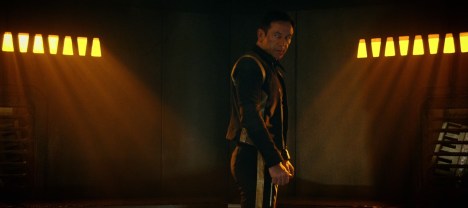
Avenging angel Gabriel.
There is a sense that times are changing, and that Discovery is attempting to provide an early twenty-first century update to a thirty-year-old template. After all, no other Star Trek series opened its first season with a two-episode prologue before introducing its core setting and premise. No other Star Trek series feature as many extended sequences with characters speaking subtitled Klingon. No other Star Trek series has featured swear words like “piss”, “sh!t” or “f$@k.” These are all new frontiers for televised Star Trek.

An echo chamber.
For all the noise being made in certain quarters of the internet that Discovery is not really a Star Trek series, Choose Your Pain is the most conservative and old-fashioned episode of the series to date. Choose Your Pain is an episode that could easily have worked as part of Deep Space Nine or Enterprise, preserving the structure and rhythm with only a few minor tweaks along the way. Ironically, the episode’s biggest issue is that it feels just a little bit too much like classic Star Trek.
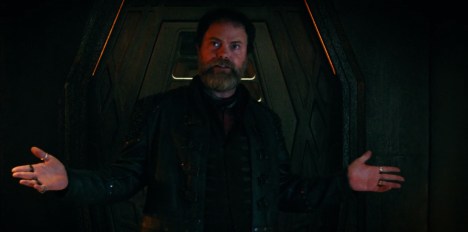
Here’s Mudd in your eye.
One of the most distinct aspects of Discovery is the fact that its viewpoint character is not the commanding officer on the central starship. Kirk was the protagonist of Star Trek, even if William Shatner was anxious about Leonard Nimoy’s fan mail. Patrick Stewart was credited as “starring” in The Next Generation. Benjamin Sisko was not promoted to captain until The Adversary, but Avery Brooks was the series lead. The writers struggled to characterise Kathryn Janeway, but Kate Mulgrew anchored Voyager. Jonathan Archer was the central character on Enterprise.
With that in mind, it is something of a surprise that the commanding officers on Discovery exist on the sidelines. Michelle Yeoh was credited as “Special Guest Star” in The Vulcan Hello and Battle at the Binary Stars. Jason Isaacs is a lot more central to the story, but he is shunted off to the end of the credits with an “… and.” That is the sort of credit reserved for actors like Whoopi Goldberg on The Next Generation, important performers that are not at the centre of a given episode.

Lorca is not the centre of the universe.
To be fair, there is precedent. Lower Decks was a late episode of The Next Generation that dared to imagine what the series might look like from a perspective outside the senior staff. The ensemble on Deep Space Nine was so large that it was possible to build entire episodes around guest characters, with Sisko frequently at the periphery of stories. On Deep Space Nine, episodes like The Visitor, Valiant and Treachery, Faith and the Great River felt at a remove from the regular chain of command.
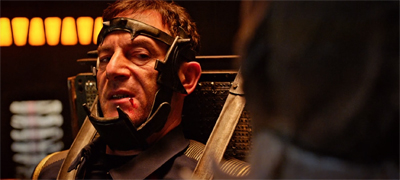
“Shouldn’t we agree safe words first?”
In contrast, Michael Burnham was introduced as the central protagonist in The Vulcan Hello and Battle at the Binary Stars. The audience was invited to follow Burnham as she investigates the mysterious Klingon beacon, occasionally flashing back to her childhood and even meeting her surrogate father figure. The audience witnessed a large portion of the battle from the brig, alongside Burnham. In Context is For Kings, the audience was introduced to the Discovery alongside Burnham; meeting Lorca, sneaking into the engine room, experience the power of the spores.

We have lift-off.
“The story that is fascinating for me is we’ve seen six series now from captains’ points of view,” Fuller said. “To see a character from a different perspective on a starship who has a different dynamic relationship with the captain, with subordinates, felt like it would give us richer context to have different types of stories. It is ensemble, but we do have that main female protagonist.”
To a greater or lesser extent, it worked. In terms of pure plotting, Context is for Kings and The Butcher’s Knife Cares Not for the Lamb’s Cry were boilerplate Star Trek. However, they felt relatively interesting because they were constructed from a new and distinct perspective.

Self sacrifice.
One of the more intriguing aspects of Discovery has been the care that the production team have taken in structuring the individual episodes. Every episode of Discovery has been its own story with a clear beginning, middle and end; character beats and plot threads carry over, but each episode is about watching the characters react to a specific event. The only real exception is the two-part season premiere, The Vulcan Hello and Battle at the Binary Stars, which is its own almost-self-contained narrative.
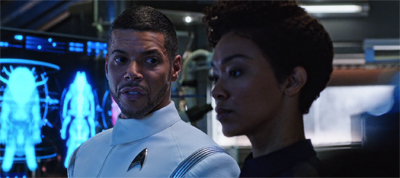
“You know, you’d think these white dress uniforms would be impractical for surgeons during wartime, but…”
A lot of other prestige and streaming dramas would allow these plot points to linger, would take advantage of the opportunities of serialised storytelling to let these developments breath. Even in the context of nineties television, Worf and Garak spend more time in Dominion custody in In Purgatory’s Shadow and By Inferno’s Light than Lorca spends as a Klingon prisoner of war in Choose Your Pain. The abduction of the commander of a key military asset in the middle of a galactic war should be a huge event. There is a sense Discovery would be justified allocating a few episodes to it.
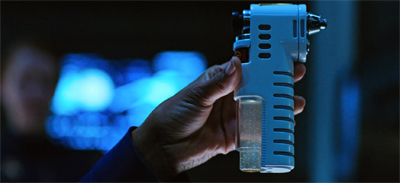
Say it, don’t hypo spray it.
When the material is interesting enough, and there’s enough story to comfortably stretch out over however many episodes and hours, this isn’t an issue. … But when the story’s not quite there, then those formless blobs intended as episodes become a real drag: necessary viewing to understand the overall plot, but not interesting viewing in the meantime, even as part of a day-long binge.
This isn’t a phenomenon limited to Netflix, Amazon, and Hulu shows, though. More and more – particularly on cable, but now even on many broadcast shows – dramas are being structured for marathon viewing, rather than the weekly schedule in which they originally air. Serialization was once a dirty word in network television, where researchers used to claim that even a show’s most devoted fans watched one out of every four episodes on average, and where the president of entertainment at FOX had to lie to her bosses that “24” would have self-contained episodes in order to get a greenlight. Now that DVRs are commonplace, almost nobody airs reruns anymore, and the big aftermarket isn’t in syndicated repeats but selling shows to the streaming outlets, serialization is not only accepted, but in many cases preferred.
As such, in terms of episode structure and pacing, Discovery is much more conservative than other high-profile prestige series like The Handmaid’s Tale or Fargo. For better and for worse, the production team have not forgotten the art of structuring an episode that was honed in the era of Michael Piller.

Back in black alert.
As such, Choose Your Pain is the first episode of Discovery that feels like the classic ensemble drama that defined The Next Generation, Deep Space Nine, Voyager and Enterprise. The episode marks the first time that the series really steps outside Michael Burnham to look at life on the ship from other perspectives. It is telling that Choose Your Pain is the episode that ends with the revelation of the relationship between Stamets and Culbur, despite the fact that the production team had been teasing their dynamic months before the premiere.
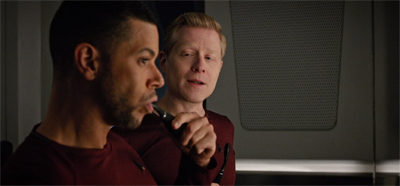
Brushing it off.
This is a Star Trek staple, for better and for worse. In In the Cards, the primary plot follows Nog and Jake through a chain of deals while the secondary plot focuses on the tense negotiations between the Dominion and Bajor. In Life Support, a harrowing and heartbreaking story about the death of a recurring character is juxtaposed with a tale about an awkward double date. The example closest to Choose Your Pain is probably The Chain of Command, Part I and The Chain of Command, Part II, in which Picard is captured and tortured while the Enterprise adjusts to life without him.
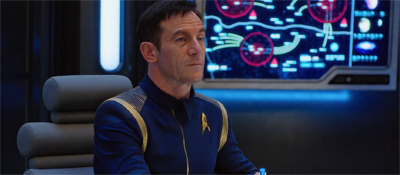
“Trust me, compared to the meeting that opens the episode, Klingon torture is practically relaxing.”
In fact, part of what is so endearing about the narrative flow of Discovery is the relative speed at which these major plot points develop. The plot involving the Shenzhou was dealt with over the course of The Vulcan Hello and Battle at the Binary Stars. Even smaller character beats are established and delivered upon in rapid succession. Burnham received Georgiou’s telescope at the start of The Butcher’s Knife Cares Not for the Lamb’s Cry, and decided to pass it along to Saru at the end of Choose Your Pain.
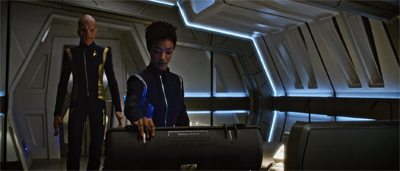
Scoping him out.
Even five episodes into the first season, there is a sense that Discovery is not going to let its wheels spin, that it is not going to try the audience’s patience by teasing mysteries and riddles that it refuses to answer. Given that Discovery is the first Star Trek show to broadcast in the age of serialised television, this approach is commendable. The writing staff seem to understand that long-form storytelling is a balancing act, and that it is unfair to string the audience along forever. This is a welcome rejection of the modern model of television that tends to treat a show’s first season as the pilot.
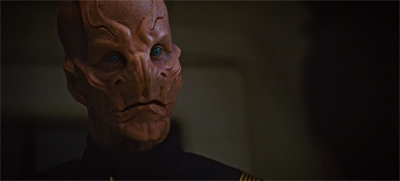
It turns out that Saru’s abilities also help him identify serial killers; that is, things that kill serial drama.
There’s the great line from Joss Whedon (chief architect of some of the best 22-episode dramatic plotting ever) where he says, “Play your cards early. It forces you to come up with new cards.” And he’s spot on. So many seasons of Buffy had an endgame in mind, but there were so many twists, turns, and misdirections before you ever understood what that endgame was. Now, we give all the info up front and then just… wait. The cut-throat truth is that if you dragged plots like that in the earlier days people would tune out. But now there are so many ways to work around it in the binge model, whether it’s the visceral appeal of the show itself or the reliance on teasing things out, that we have people willing to sit through complete dramatic stagnation just because.
Discovery feels like it belongs in that particular wheelhouse, carefully balancing the demands of long-form narratives with a surprisingly traditional episodic structure.
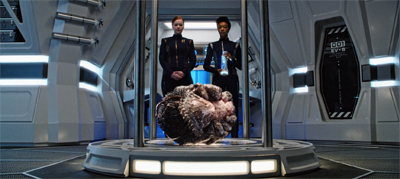
“You… you couldn’t find any bagpipe music, then?”
The plot thread focusing on Stamets is probably the most satisfying, on a number of levels. Most superficially, it affirms that Stamets is very much an archetypal Star Trek protagonist, in that he ultimately decides that he cannot abide the suffering of a potentially sentient creature, and so takes a massive risk to protect it. Stamets jokingly suggests that he only did it because Culbur cared about the creature. “I also knew you’d leave me if I let anything else endanger that creature,” he quips. However, there is a sense that Stamets is capable of compassion, despite his stand-off-ish-ness.

“Those were some good mushrooms.”
However, the other subplots in Choose Your Pain are less satisfying. A lot of this is down to clunky writing. There are several points at which it feels like Choose Your Pain is still stuck (stylistically) in the mid-nineties, reflexively importing a lot of the clumsy storytelling conventions of classic Star Trek without any examination or reflection. There is an awkwardness to the scripting that is unforgivable in this age of prestige television, when television drama is understood as an art form rather than a disposable diversion.
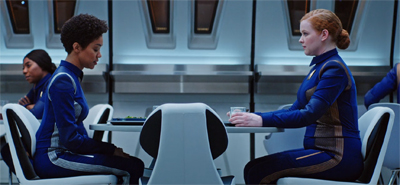
“So… light week, then?”
The issue is not so much that Discovery chooses to tell rather than show. The issue is that Discovery chooses to tell in the most clumsy manner possible. In plot terms, this is most obvious during the early briefing scenes between Lorca and Cornwell. The Klingon War has been raging for six months at this point, but Discovery has never quite managed to convey a sense of how the conflict is going and how it has affected Starfleet. Is Starfleet losing the war? Are the Klingons pressing an advantage? Are both sides at a stalemate?
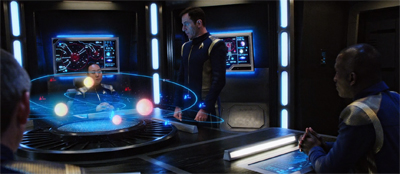
“The other ships in the fleet will take up the slack?”
“There are other ships?”
Even when the Dominion arrived in the Alpha Quadrant in By Inferno’s Light, the series spent a full half a season escalating towards all-out war. There was a sense that the Dominion was pushing for an armed conflict in episodes like Soldiers of the Empire and Blaze of Glory, that it was trying to isolate the Federation in In the Cards. By the time that war was formally declared in Call to Arms, it was clear that the Federation had been backed into a corner and that there was simply no other choice.

“Well, I hate to point ears, but this is kinda your fault.”
Even when Deep Space Nine wasn’t essential to the war effort, the series still made sure to provide the audience with a sense of how the war was going. Following the taking of Deep Space Nine, episodes like Statistical Probabilities and Far Beyond the Stars suggested that it was a war of attrition. When the Romulans entered the war in In the Pale Moonlight, episodes like The Reckoning and Tears of the Prophets suggested that the tide was turning. The Breen entering the conflict in The Changing Face of Evil represented another change.
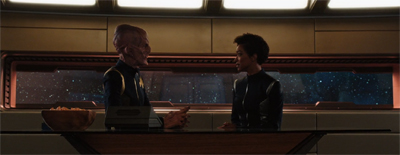
“So, I was thinking. I really miss the Captain’s Log.”
Choose Your Pain opens with a really awkward exposition scene, in which Lorca attends a briefing of senior Starfleet officials and seems to tell them information that they should already know in a rather blunt manner. “In less than three weeks, the Discovery has prevented the destruction of the dilithium mines at Corvan II, broken the Klingon supply line at Benzar, and routed an attack through the Ophiucus system,” he boasts. These are somehow all events that took place off-screen and involving a single ship rather than the larger fleet.

Exposition is part of the franchise’s DNA.
More than that, the exposition-driven briefing room sequences in The Next Generation and Deep Space Nine also made a point to provide a larger context for the episode-specific plot points. When Sisko reveals the Romulan-Dominion non-aggression pact to the senior staff in Call to Arms, his subordinates put this in the context of the Dominion’s diplomatic “in-roads” into the Alpha Quadrant. When the Dominion take Betazed in In the Pale Moonlight, the staff run through a list of other systems that are within striking distance of the enemy.
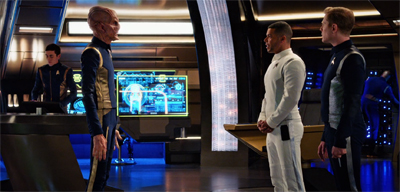
“I’m feeling pretty sick about this.”
It does not help that Cornwell is a transparent vehicle for exposition, stating things that the audience already knows in the bluntest possible manner. “There is concern at the highest levels of leadership about taxing our prime asset,” she advises Lorca. “We believe the enemy may have identified Discovery as our secret weapon. You are hereby ordered to rein in your use of the spore drive unless authorized by Starfleet. With respect to the war effort, the fleet will pick up the slack caused by your absence.”
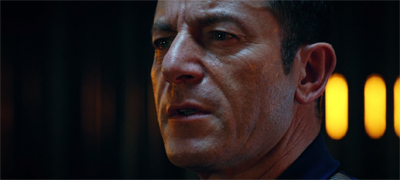
Don’t Lorca any further.
To be fair, part of the problem is Cornwell herself. The character seems like the stock “Admiral of the Week” from the Berman era shows, lacking the personality that made Alynna Nechayev or Bill Ross stand out on The Next Generation or Deep Space Nine. In terms of Bryan Fuller’s oeuvre, Cornwell seems the character most likely to be played by Caroline Dhavernas. There are shades of Alana Bloom from Hannibal to Cornwell, particularly in the reveal that she is a doctor and her interest in Lorca’s psychological well-being. But she is still hazily defined.

Eye, eye, captain.
In particular, Commander Saru’s crisis of confidence is a potentially interesting character beat that is ruined in the execution through clumsy exposition. When Saru finds himself thrown into command during a crisis, he retreats to the ready room to plot a course of action. Through a conversation with the computer, Saru outlines his own insecurities and tries to figure out how best to assert himself. It is a familiar character beat, one that worked for Geordi in Arsenal of Freedom and for Data in Redemption, Part II. However, it falls flat in Choose Your Pain.
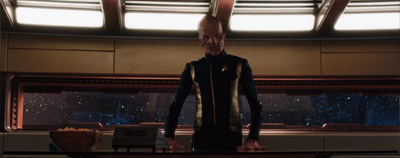
“So, casual pose or serious pose?”
More than that, the lack of any other characters in Saru’s plot thread means that the character is left bouncing off the computer. It is a little cute, but it also undercuts the arc. After all, the computer is hardly an engaging scene partner or a compelling screen presence. This means that Doug Jones and Saru have to do the heavy lifting in the scene itself, which doesn’t really work. In order to properly verbalise his insecurities and inner conflicts, Saru has to talk at length to the computer as if addressing his therapist.
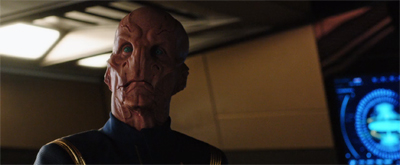
The road to (Sa)ruin.
This cumbersome exposition carries over to Saru’s final scene with Burnham towards the end of the episode. Confronting Burnham in her quarters, Saru finally unburdens himself of years of resentment. “Are you really afraid of me?” Burnham challenges Saru early in the conversation. This seems like a fair question, given how anxiously his “threat ganglia” have reacted to her presence. However, what follows is not so much a conversation as an extended monologue that feels like something adapted directly from the writers’ bible for Discovery.
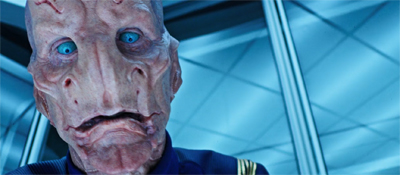
Prey for Stamets.
To be fair, there are moments in Choose Your Pain were the very traditional and old-school Star Trek mechanics work quite well. Part of this is the character of Harry Mudd himself. Of course, Mudd is a rather transparent bit of fan service, like Sarek’s involvement in The Vulcan Hello and Battle at the Binary Stars. It is a character who shares the name and some characteristics with a recurring character from the original Star Trek series, who has seemingly been inserted into the narrative because fans will recognise the character from Mudd’s Women, I, Mudd and Mudd’s Passion.
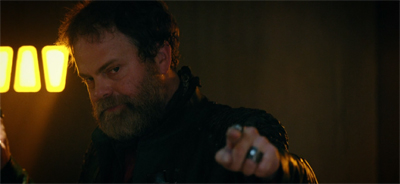
Staying on point.
The cargo ship captain is an old reprobate named Harry Mudd who has a colourful reputation in space for fly-by-night schemes, grandiose promotions, and suspected smuggling. And yet it is impossible not to like Mudd.
More than that, Mudd embodies a very unique character archetype within the Star Trek canon. Gene Roddenberry famously prohibited pulpy science-fiction stories built around space opera elements like “space pirates”, wanting Star Trek to be a more intellectual form of science-fiction. However, Mudd seems like a relic from those pulpy science-fiction tales (a “space smuggler”) who managed to sneak in under the radar.
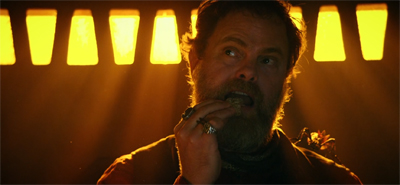
Mudd has gone completely crackers.
Of course, as with a lot of Discovery, it is very hard to square this iteration of the character with his earlier counterpart. Harry Mudd was always something of a cartoon character, even before his appearance in Mudd’s Passion. As such, there is a strange dissonance to introducing the character as a prisoner in a Klingon brig who cynically passes torture on to his cellmates and waxes lyrical about the flaws of the Federation. The character is interesting and compelling, and very much in keeping with the style and tone of Discovery, but it is hard to believe that it is the same Harry Mudd.
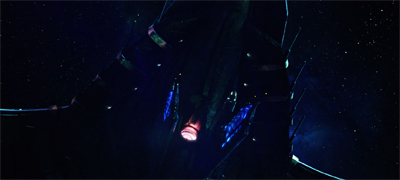
Then again, this isn’t really the same D7, I suppose.
There is a sense that Discovery needs to find a happy medium between this blatant fanservice and the sort of continuity blackout that defined the early years of The Next Generation, when the writing staff had to fight to get the word “Spock” into Sarek. It might have been better to go with the classic “two you know, one we made up” convention that defines Star Trek list-making. In fact, The Butcher’s Knife Cares Not for the Lamb’s Cry had a good example of that format with Lorca’s reference to “the Wright Brothers, Elon Musk, Zefram Cochrane.”
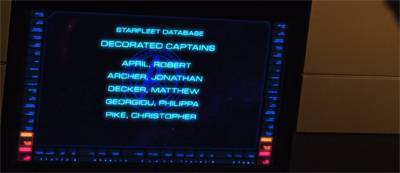
Alternative list:
Decker, Matt
Edison, Balthazar
Izar, Garth of
Merik, R.M.
Tracey, Ronald
I inherited a character that had been previously portrayed by another brilliant actor. I stole a lot of things that I loved from his performance, and then added a lot more of my own. It’s a testament to Roger C. Carmel, to what an interesting actor he was. You can’t take your eyes off him when he’s in an episode. So full of light. The new writers have added that he’s mischievous and deadly at the same time, and that’s a fun balance to watch.
It is a credit to Wilson that it is almost possible to imagine Carmel delivering cynical rebukes of the Federation, making Wilson’s performance feeling more like an elaboration than mere imitation.
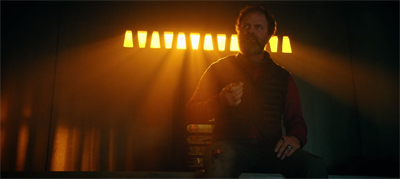
The light at the end of the torture chamber.
A lot of this is down to the script’s floral language. With the possible exceptions of Saru and (maybe) Stamets, the primary cast on Discovery tend to speak in a more naturalistic manner than most Star Trek regulars. Even though he is played by a British character actor, Lorca seems markedly less likely to spontaneously quote Shakespeare than any of his counterparts. In contrast, Harry Mudd speaks in monologues and metaphors. Wilson treats the character as something theatrical, relishing each syllable. The effect is something that feels like classic Star Trek.

“Wade into the quiet of the slipstream.”
“Oh, it’s amazing,” he said. “It’s amazing. It’s part Shakespeare. He has heightened language. It’s very much in the Star Trek universe. Also, to get to play a civilian is rare in Star Trek; there’s very few civilian roles. I really think they’re the most fun. Just think about it. There’s this whole universe in the Federation space that they’re buying things, and selling things, and trading things, and having cities, and falling in love. We need to see some of those characters sometimes.”
Indeed, the most compelling thing about Harry Mudd is that he suggests the existence of life outside of Starfleet or the Klingon Empire, which is important.
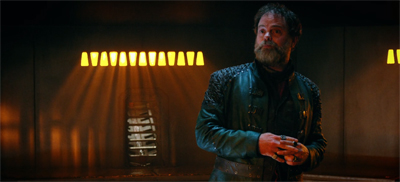
Harrying favour with the Klingons.
Indeed, this emphasis on life outside of Starfleet is particularly important for Deep Space Nine and Discovery, because these are both Star Trek series about war. It is important for war stories to provide a sense of context beyond the military experience, to explore the consequences of conflict and combat for those who have not devoted their lives to military service. Harry Mudd provides an potentially interesting window on the conflict between the Federation and the Klingons, as a civilian essentially caught in the crossfire.
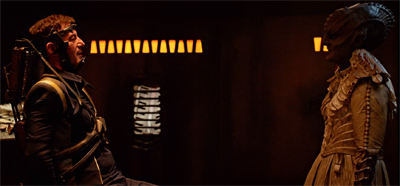
“So… if Tilly and Stamets get to say f!$k, do I get to make a Klingon dick joke?”
Mudd is not convinced. “Of course you did,” he states. “The moment you decided to boldly go where no one had gone before. What do you think would happen when you bump into someone who didn’t want you in their front yard?” In many ways, Mudd is articulating what was largely left as subtext with the Dominion War. The Dominion War was a result of Federation expansionism, of the Alpha Quadrant powers reaching into the Gamma Quadrant and trying to stake a claim; building colonies and infrastructure, looking for natural resources and negotiating alliances.

Muddying the waters.
It should be noted, of course, that Discovery has not endorsed this isolationist rhetoric. Although T’Kuvma and Mudd are allowed to make their cases, Discovery makes it very clear that these are not good people and that their isolationist rhetoric is self-serving nonsense. T’Kuvma sparks a war in order to unite the Klingon Empire. Mudd rationalises passing beatings on to innocent people for his own comfort. Both T’Kuvma and Mudd are horrible people who do not care about the harm that they inflict upon other people.
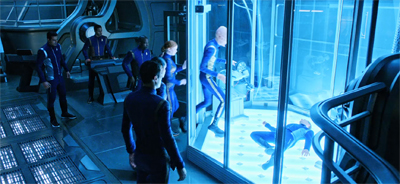
“I have been, and always shall be, your work colleague.”
Indeed, the characterisation of Harry Mudd in Choose Your Pain feels very pointedly political. The production team working on Discovery have conceded that the series is quite explicitly rooted in contemporary American politics, in the push and pull between neo-liberalism and ethno-nationalism. With that in mind, it probably makes a great deal of sense that humanity’s primary proponent of isolationism and opponent of galactic globalisation should be a failed business man and con artist. (It helps that I, Mudd suggests that Harry Mudd has a misogynist streak.)
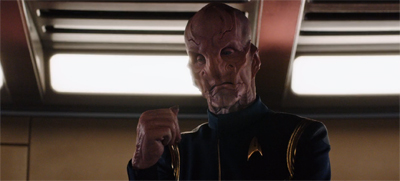
“Nothing naughty or inappropriate happens in my subplot.”
Harry Mudd and the Klingons are established as diametrically opposed to the selfless Starfleet ideal. The Federation is about bringing people together, while the Klingon Empire is about keeping them apart. Even their prisons are designed to emphasise competition over cooperation. “They may look stupid, our Klingon hosts,” Mudd muses. “They’re anything but. They regularly give us the choice to choose our pain. We can accept the beating ourselves, or pass it on to our cellmates. It’s our captors’ way of keeping us from bonding.”

Burn(ham) her bridges.
Indeed, the Federation is largely an extrapolation of the geopolitical order since the end of the Second World War, an order that increasingly finds itself subject to skepticism and attack. There is a sense that even the Star Trek franchise itself is no longer certain that its utopian future is even possible. Even beyond the nostalgic appeal of the familiar iconography, this uncertainty seems to suggest the pull of the prequel or the reboot to the Star Trek franchise. There are compelling questions to be asked about how mankind built their utopian future.
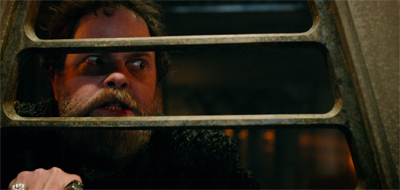
In like Mudd.
Even the JJ Abrams reboots seem genuinely uncertain about the sustainability of the franchise’s utopia. Star Trek Into Darkness wondered how the franchise might respond to the War on Terror. Star Trek Beyond questioned what happened to the soldiers that helped to build the Federation. Twenty-first century Star Trek has often struggled with the question of how the Federation could possibly exist, no longer able to take its existence for granted in the way that the original Star Trek or even The Next Generation had.

Still navigating by stars.
To be fair, Mudd is not the only person in the cell who falls short of that ideal. “Don’t judge,” Mudd admonishes Lorca. “You’re gonna wanna stick with me. I’m a survivor. Just like you.” Mudd reveals that Lorca effectively murdered his own crew, to protect them from Klingon torture. At the end of the episode, Lorca consigns Mudd to the same fate. It is a brutal and shocking choice. Even after Kruge murdered his son in Star Trek III: The Search for Spock, Kirk made a token effort to safe the Klingon. After Nero attacked Earth in Star Trek, Kirk made a similar gesture.

“To be fair, that dick joke was totally worth it.”
Even the teaser makes it clear that Lorca is far from the ideal Starfleet officer. Cornwell seems to be genuinely worried about Lorca’s psychology. For his part, Lorca cannot resist the urge to raise even more red flags. “Are you uncomfortable with the power I’ve been given, Admiral?” Lorca taunts. Lorca very clearly has more in common with characters like Ronald Tracey or Garth of Izar than he does with Christopher Pike or James Tiberius Kirk. And that is an approach to a Star Trek captain, while also explaining why Jason Isaacs is not the series lead.
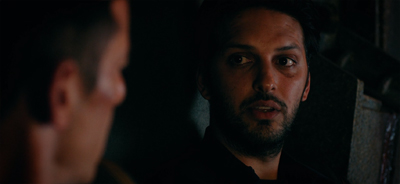
“One of these fellas ain’t who he says he is.”
Choose Your Pain quite heavily hints at the possibility that Ash Tyler might actually be Voq. After all, Voq was last seen at the end of The Butcher’s Knife Cares Not for the Lamb’s Cry rescued by L’Rell from the remains of the Shenzhou. He had been buried in “the grave of [his] enemy”, surrounded by nothing but Federation archives and resources. His final scene in The Butcher’s Knife Cares Not for the Lamb’s Cry found Voq reading the crew manifest of the Shenzhou. It seems likely he had access to similar databases on other ships.

On the other hand, L’Rell will probably be able to find a good plastic surgeon.
Given Voq’s battle cry of “remain Klingon!”, there would be something beautifully ironic about the character going undercover as a human. In The Butcher’s Knife Cares Not for the Lamb’s Cry, L’Rell pointed out that Voq had already compromised himself by consuming human flesh and trying to salvage Federation technology from the debris field. It seems like disguising himself as a human prisoner of war to infiltrate Discovery would be the perfect continuation of that character arc.
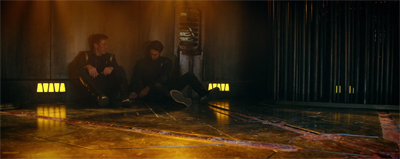
Giving it the hard cell.
Once again, it feels like Discovery is brushing up against the conventions of prestige television, of the changes in television storytelling since the end of Enterprise. These days, most high-profile television shows are expected to incorporate major twists and reversals. Much like sudden character deaths, these twists and reversals serve to hold the audience’s interest and keep them off-guard. They centre social media conversation around the show, and generate buzz. Discovery is at least hinting in that direction with this particular set-up.
This is very different from the way that Star Trek has traditionally approached big narrative twists. On Deep Space Nine, the writers would often make up their story as they were going rather than plot the arc in advance. The writers did not decide that Martok would be the changeling in Apocalypse Rising until they started writing the episode. Ronald D. Moore did not decided to kill off the character of Gowron in Tacking Into the Wind until Michael Piller gave him a note on his first draft. Alexander Siddig repeatedly complained about being blindsided by twists centred on Bashir.
As such, Discovery is attempting a very different kind of storytelling. These twists are a staple of twenty-first century genre television, dating back to Lost. Series like The Good Place and Westworld have popularised the idea of television puzzle boxes, suggesting that their narratives are riddles to be solved. However, this approach has its own risks and rewards. Most obviously, twists and reveals like this set up a competition between the audience and the series. However, the writing staff on Discovery is effectively competing against the entire internet.
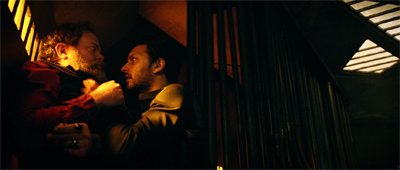
“Shut the f$!k up Ash Tyler, with your made up name.”
Westworld is part of an elite yet troubled class. They’ve captured the increasingly elusive zeitgeist, every Peak TV–era executive’s dream, and yet they’ve found it to be a mixed blessing. Often genre, always story-centric, shows like Mr. Robot, Game of Thrones, Westworld, and their shared ancestor Lost face enormous pressure, partially self-inflicted, to deliver jaw-dropping twists and stay one step ahead of an ever-savvier audience in order to pull them off. As Westworld’s shown, they can’t always. We’re currently living in a paradoxical TV moment: “Spoilers” are considered sacrosanct, and yet we do our damnedest to figure out what they are. We rush to do the Wikipedia Test — and then to check Reddit, and the recap, and the podcast. Preserving a pop culture property’s sanctity and plumbing its depths are just two different ways of showing how much you care.
So how are shows shouldering the burden of that scrutiny, provided they’re lucky enough to earn it? Is rabid sleuthing an entertaining appendix to a show, or a distraction from it? Are we loving our TV to death?
It is certainly debatable whether these twists help or hinder television storytelling. That has to be determined on a case-by-case basis.

Starbaseless speculation.
In contrast, traditional television is structured in such a way as to afford viewers a whole week of theorising and speculating and collating. There are one hundred and sixty seven hours between every episode of Discovery. There are also a lot of fans devoting lots of those hours to turning each episode over in their head. The internet is basically a gigantic supercomputer with incredible processing power that seems perfectly designed to solve twists buried in random Star Trek episodes. In some ways, the twist would work better if Discovery were a traditional streaming series.
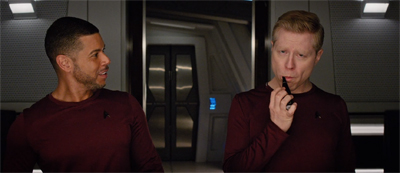
The tooth is out there.
It wasn’t like there were surprises that we’re trying to keep from the audience consciously; we were trying to lead a path of breadcrumbs. We anticipated that a small group of the audience might discover it, that that will be part of the game that we were playing with these die-hard fans. What we didn’t anticipate was that they would go to social media and talk about it and they would get circulated so that it hit a wider base of people who have an online presence and pick that up.
This is something that would not have happened at the peak of The Next Generation or Deep Space Nine, but is part of the media landscape in which Discovery exists.
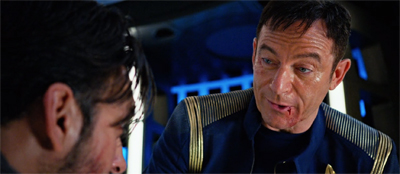
“You know, I’ve recently had an opening on my senior staff for somebody unscrupulous and angry?”
After all, a twist is not merely the twist. A big narrative reveal is nice, but that reveal can only work in the context of the story being told. There is a difference in the way that Christopher Nolan bakes the twists into movies like Memento and The Prestige as compared to the work of M. Night Shyamalan on movies like The Sixth Sense or The Village. Audiences will forgive awkward reveals and clumsy twists if they work in service of a broader narrative.

Here comes the science.
In some ways, this is a logical extension of Burnham’s plot in The Butcher’s Knife Cares Not for the Lamb’s Cry. In that episode, Burnham worked with Saru, Stamets and Tilly to figure out the mystery of the tardigrade. However, each of these characters worked in isolation with Burnham, sharing a scene or two in which they employed their special abilities or their special access. Choose Your Pain finds multiple combinations of the cast sharing the same physical space to solve crucial pseudo-scientific problems.
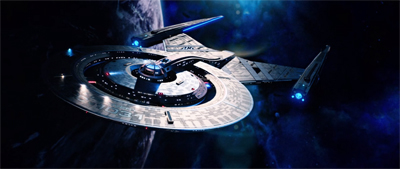
Warped priorities.
Of course, the pseudo-science is all nonsense. The sequence is filled to the brim with nonsensical technobabble, exposition that is pretty much meaningless. The characters work through a science-fiction problem to its logical conclusion, with each member of the team offering some insight or advice. This pure Star Trek, in the same way that the clunky banter on the Shenzhou bridge in The Vulcan Hello was pure Star Trek. Unlike the awkward exposition in the Lorca or Saru subplots, this exposition feels like it belongs.
Indeed, Cadet Tilly is so excited at this quintessential Star Trek moment that she blurts out, “You guys, this is so f$!king cool.” This is notable as the first time that the f-word has been employed in the Star Trek franchise. It goes without saying that this has been somewhat divisive. After all, the Star Trek fandom is nothing if not conservative. This sort of swearing is divisive. Much like the deaths of Georgiou and Landry, or even the two-part disconnected pilot, Tilly’s use of the swear word is seen as an example of Discovery awkwardly trying to emulate the conventions of prestige television.
To be entirely fair, swearing has a long history within the Star Trek franchise. Kirk famously used the word “hell” at the end of The City on the Edge of Forever, which was strong language for prime-time television in the sixties. While Star Trek IV: The Voyage Home built jokes around the crew’s inability to swear, in large part as their status as refugees from television, the movie featured the franchise’s first use of the word “sh!t.” Data would use it again in Star Trek: Generations. Picard would occasionally exclaim “merde” in episodes like The Last Outpost or Elementary, Dear Data.
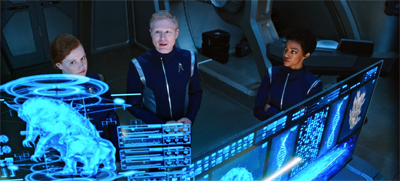
Swear trek.
Indeed, Tilly immediately apologises for her language, realising that it is inappropriate. Stamets turns to her and hesitates a beat. After all, Stamets has been fairly effectively established to this point as something of a wet blanket. Instead of berating Tilly, Stamets smiles. “No, cadet. It is f$!king cool.” It is a beautiful little moment. Indeed, ironically enough given the controversy over the moment, it represents the first time that this ensemble truly feels like a Star Trek ensemble, doing weird pseudo-science together with gleeful joy. It’s a moment that could work with Data and Geordi.
Anthony Rapp acknowledged as much in his discussion of the scene:
“We were aware of it, and we embraced it, and we had a blast with it,” he said. “These people just put their brains to work in a really tough way and they had a breakthrough. And I imagine there’s scientists in their labs who might do that any time. We didn’t drop the f-bomb in Star Trek by telling something to go f$!k themselves. It’s like we did it by saying ‘this is f$!king cool.’”
While the f-word might be a trapping of prestige television, it is employed in a very Star Trek way.
Indeed, that short scene might be Discovery‘s most successful integration of the trappings of prestige television with more traditional Star Trek storytelling. Of course, despite the controversy prompted by the f-word or by Lorca’s decision to leave Mudd behind, Choose Your Pain is the most traditional episode of the first season to date. It is an episode that is built around the narrative template established by Michael Piller in the third season of The Next Generation and carried across the next fifteen years through Deep Space Nine, Voyager and Enterprise.
Discovery is still in the process of figuring out what Star Trek should look like in 2017, but the answer seems to be “a lot like Star Trek.”
Filed under: Star Trek | Tagged: choose your pain, Harry Mudd, language, Michael Piller, mystery, shazad latif, star trek, star trek: discovery, structure, swearing, twists, voq |



 the m0vie blog
Hey! Really enjoying your Discovery reviews – do you know when you’ll be getting back to them? Or are you waiting until the end of the season?
Thanks! I’ll probably get back to them eventually. I just happened to get caught up in some other stuff.
It’ll likely be quite a while after the show ends; maybe even August/September-ish. (Sorry!)